
TL;DR:
- Signage on film sets influences narrative clarity, safety, and coordination, requiring early, strategic management. Properly designed and positioned signs enhance scene authenticity and operational safety, especially in digital and AI-assisted workflows. Integrating signage planning from pre-production prevents technical issues and enriches storytelling effects.
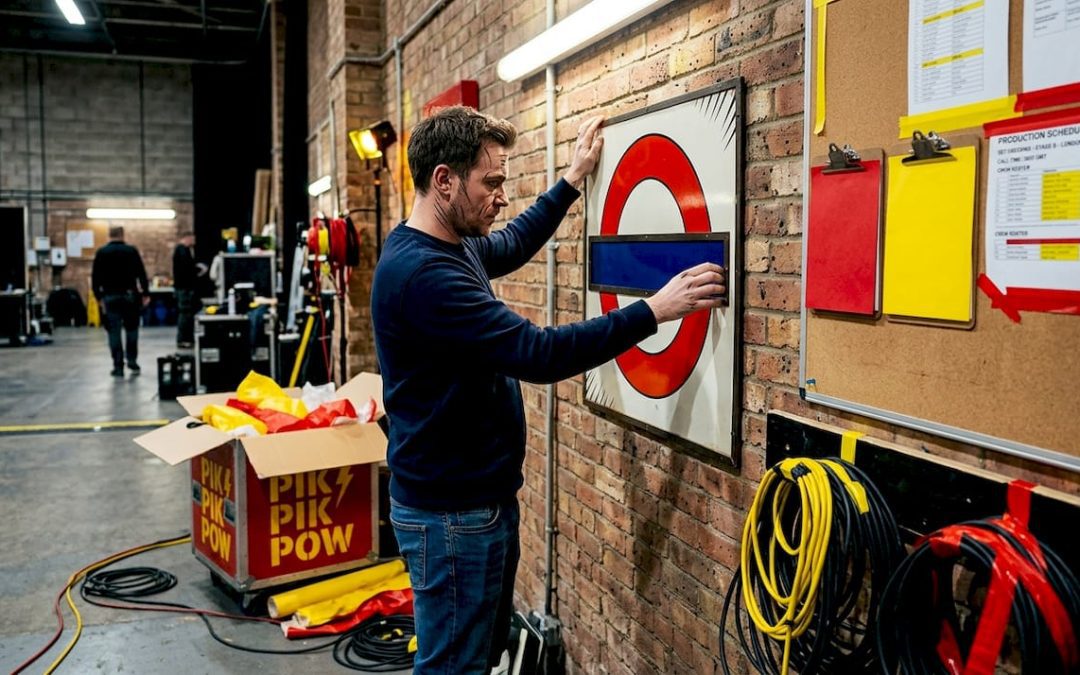
A single street sign in the background of a scene can tell an audience exactly where and when they are. A poorly placed safety notice can block a camera sightline or, worse, go unnoticed by crew working in a hazardous area. Signage on a film set is rarely treated with the same strategic attention as costume or lighting, yet it influences narrative clarity, on-set safety, and departmental coordination in equal measure. This guide is written for UK production professionals and set designers who want practical, evidence-based guidance on managing signage from pre-production through to the final shoot.
Table of Contents
- What is signage in film production?
- How signage shapes narrative and audience experience
- Practical functions: safety, workflow, and on-set coordination
- Designing and specifying effective signage for UK film sets
- A fresh perspective on signage: what most productions get wrong
- Enhance your film set with bespoke signage solutions
- Frequently asked questions
Key Takeaways
| Point | Details |
|---|---|
| Signage shapes stories | Thoughtful signage adds narrative depth, authenticity, and vital context for viewers. |
| Safety and workflow | Proper signage improves safety and efficiency across busy UK film sets. |
| Plan signage early | Specifying and briefing signage in pre-production avoids costly design and safety errors on set. |
| Collaborative approach | Coordinate signage across departments—art, camera, and safety for optimal results. |
What is signage in film production?
Signage in a film production context covers every piece of text, symbol, or graphic that appears on set, whether it is visible to camera or not. That scope is broader than most people assume at the planning stage, and getting clarity on it early saves considerable time and budget later.
There are two distinct categories you need to distinguish from the outset.
Diegetic signage exists within the world of the film. It is the shop front your character walks past, the hospital ward sign above a door, the political poster on a wall, or a fictional brand name on a product. Audiences read these signs as part of the story world.
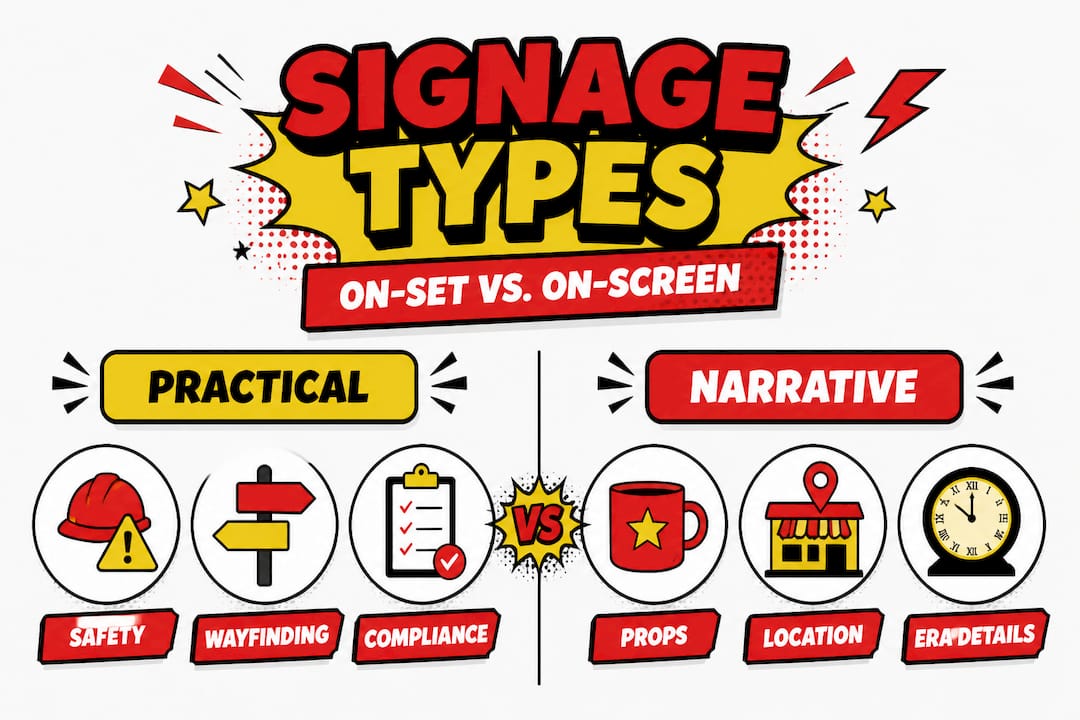
Non-diegetic or functional signage exists for the crew. It includes health and safety notices, fire exit markings, construction zone warnings, directional arrows for departments, and production-specific wayfinding for large lots or location shoots.
Common types you will encounter across both categories include:
- Health and safety notices (mandatory under UK law on working sets)
- Fire exit and evacuation route signage
- Wayfinding signs for departments, unit bases, and catering
- Narrative props: shop fronts, street signs, institutional signage
- Period-specific signs (dating a scene to a particular era)
- Construction zone and structural warning signs
- Brand and logo reproductions for fictional or licensed businesses
- Temporary banners and directional signage for exterior location shoots
Research in film studies supports the idea that these objects carry significant communicative weight. Object-signs in film can be studied using methodologies that combine quantitative frequency with qualitative contextual interpretation, meaning the more often a particular sign appears on screen, the more meaning an audience assigns to it. Getting signage specification timing right is therefore a narrative decision as much as a logistical one.
If you want a clearer picture of which categories apply to your specific production, reviewing types of production signage is a useful starting point for briefing your art and construction departments.
How signage shapes narrative and audience experience
A sign does not just label a location. On screen, it functions as part of the visual grammar of a scene. The font, condition, colour, language, and placement of a sign all communicate something to an audience, often without them being consciously aware of it.
Consider a detective drama set in 1970s London. A background sign using a contemporary sans-serif typeface immediately breaks period authenticity, even for viewers who could not name the typeface. The anachronism registers subconsciously. Conversely, a well-researched, era-accurate sign on a shop front adds to immersion without requiring a single line of dialogue.
Research in film analysis confirms this: narrative/communicative roles of text-bearing objects on screen can be studied systematically, and their frequency of appearance correlates with their narrative significance. A sign that appears in three scenes is not incidental. It is doing storytelling work.
“Fine-grained text and signage visible on screen are not merely decorative. They carry meaning that shapes how both human audiences and automated systems interpret a scene.”
There is also a technically important dimension to this that many productions overlook. In an era of AI-assisted post-production, content delivery systems, and accessibility tools, scene-text reasoning is increasingly mediated via OCR (optical character recognition) rather than purely visual retrieval. This means that small text cues on screen, such as a partially visible street sign or a background poster, can materially affect how a scene is indexed, categorised, or described by automated systems. Productions making content for international or digital-first audiences need to factor this in.
Here is a practical framework for analysing the narrative function of signage in a scene before it goes into production:
- Identify every sign visible in frame. Include background elements. Do not assume a sign is too small to register.
- Assign a narrative role to each one. Is it establishing location? Indicating era? Introducing a brand or institution relevant to plot? Or is it neutral fill?
- Check for unintended meaning. Does any signage imply something contradictory to the scene’s tone or narrative intent?
- Verify period and location accuracy. Cross-reference typography, materials, and language conventions with the production’s historical or geographical setting.
- Flag any signs that appear in multiple scenes. Repeated exposure increases audience interpretation. Make sure repeated signs say what you intend them to say.
Incorporating set signage for health and safety into this review process ensures you are not treating the two categories of signage as entirely separate problems. Functional signage that accidentally falls into camera frame is a common and avoidable issue.
Practical functions: safety, workflow, and on-set coordination
Away from the lens, signage carries a different kind of responsibility. On a UK film set, certain categories of signage are not optional. Health and safety law requires clear marking of hazards, emergency exits, and restricted areas. On a large studio build or a complex location shoot, the absence of proper safety signage is both a legal risk and a practical danger.
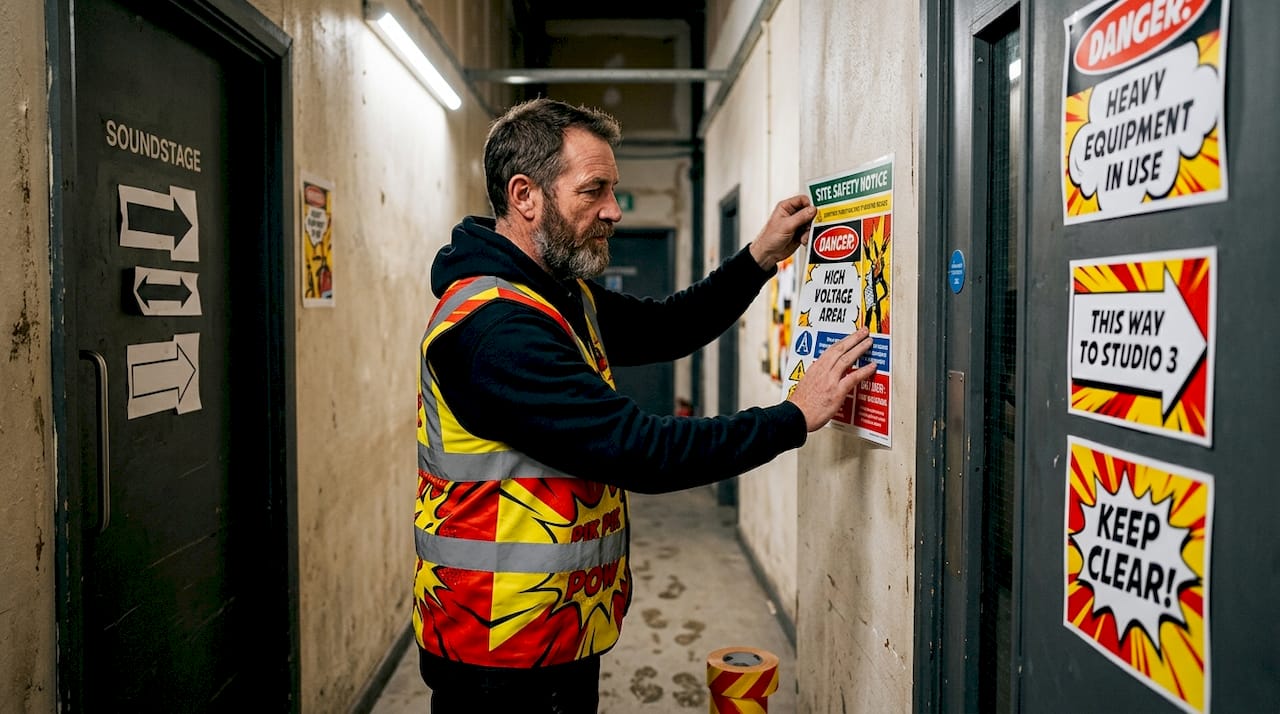
The challenge is that signage can become a sightline problem rather than just a decoration issue. UK set workflows should treat signage placement as part of overall safety and access planning, coordinating it with lighting and camera requirements. A safety notice fixed at the wrong height can obscure a camera’s field of view. A highly reflective sign surface near a lighting rig can introduce unwanted lens flare. Neither outcome is acceptable.
The table below outlines common signage challenges on UK-based film sets and practical solutions for each.
| Challenge | Impact on production | Practical solution |
|---|---|---|
| Reflective sign surface near lights | Lens flare, lighting continuity issues | Specify matte finishes for all set-adjacent functional signage |
| Oversized safety notice in background | Breaks scene continuity or draws focus | Use proportionate sizing; position outside established shot lines |
| Poor wayfinding for large unit base | Delays, crew arriving late to set | Install clear directional signage at all junctions before shoot day |
| Temporary signs falling or shifting | Safety hazard and continuity errors | Use appropriate fixings; mark positions with tape for reset accuracy |
| Period-inaccurate background signage | Breaks authenticity; reshoots required | Involve art department in functional sign design from pre-production |
Pro Tip: Before the tech scout, share proposed sign locations with both your camera operator and your gaffer. A sign that looks correctly placed on a floor plan can sit directly in a key lighting path or occupy frame space that the director has already allocated to another visual element. Catching this at the tech scout costs nothing. Catching it on shoot day costs a great deal.
Consistent workflow signage, such as UK set safety signage and clear departmental wayfinding, also reduces the cognitive load on crew. On a busy production, crew members should not have to ask which direction leads to the make-up truck or where the nearest first aid point is. Good signage answers those questions automatically, freeing up assistant directors and runners for higher-value tasks.
If you are working on a build phase prior to principal photography, construction signage compliance is an area worth reviewing to ensure your set build meets the same standards applied to permanent construction sites in the UK.
Designing and specifying effective signage for UK film sets
The most effective signage on a film set is the result of decisions made early, not last-minute fixes. This section walks through the key steps for specifying, designing, and sourcing signage that serves both your narrative and your operational needs.
Comparison: temporary vs. permanent signage for film production
| Factor | Temporary signage | Permanent or semi-permanent signage |
|---|---|---|
| Typical use case | Location shoots, short-run sets | Long-running productions, studio builds |
| Cost | Lower upfront; may need replacement | Higher upfront; better value over time |
| Durability | Variable; depends on substrate choice | High; suited to repeated use |
| Customisation | High; digital print options are quick | High; more material and finish options |
| Period accuracy | Achievable with correct print spec | Achievable with correct materials |
| Compliance | Must still meet UK safety standards | Must still meet UK safety standards |
When briefing your art and construction departments on signage, the following steps will help ensure nothing is missed:
- Define the full inventory of required signs at the location scout or pre-production design review
- Separate narrative signs (camera-visible) from functional signs (crew-facing) and manage them on separate trackers
- Specify materials based on camera distance: signs seen in close-up need higher resolution and more precise finish than background fill
- Confirm signage material choices with your set decorator or art director before going to print, as material finish affects both durability and on-camera appearance
- Submit all narrative signs for director and DoP approval before fabrication
- Arrange delivery of safety and wayfinding signs before the construction crew begins work on set
One area that remains underappreciated is the on-screen legibility of fine-grained scene text. As content is increasingly processed by automated tools for captioning, accessibility, and content delivery, the accuracy and clarity of text visible on screen carries more practical significance than it did in earlier production pipelines. Investing in well-designed, clearly printed signage pays dividends beyond the shoot itself.
For productions that need coordinated signage across multiple sets or locations, working with a supplier experienced in bespoke signage systems gives you consistent quality and faster turnaround than managing multiple print vendors separately. The signage design for branding principles that apply to commercial projects translate directly to the demands of a film set, particularly when you need fictional brand identities to look convincing at close range.
Pro Tip: Build a signage review into your pre-light session. Once the lights are in place, walk through the set with your art department lead and check every sign for reflections, correct positioning, and period accuracy. This is the last practical opportunity to make adjustments before camera rolls.
A fresh perspective on signage: what most productions get wrong
In our experience working with UK productions, signage is almost always deprioritised. It lands near the bottom of the pre-production list, treated as an afterthought once the bigger budget lines have been confirmed. The result is predictable: signs arrive late, they are not reviewed by the camera team, and they either cause technical problems or fail to do the narrative work they were supposed to do.
The most common mistake is treating functional and narrative signage as two entirely separate problems managed by two separate departments with no shared briefing. The art department designs the in-world signs. The production manager orders safety notices from a generic supplier. Neither group talks to the lighting team until it is too late.
What seasoned production designers do differently is treat signage as a unified design asset from the start. Every sign on set, whether it faces the camera or not, has a specification: size, material, typeface, fixing method, and review checkpoint. This approach catches the problems outlined in this article before they become expensive.
There is also a creative argument for giving signage more attention. A well-designed, high-impact production sign can anchor a scene’s visual identity in a way that saves coverage. When the environment speaks clearly, the camera does not have to work as hard to establish context.
The productions that get signage right share one habit: they involve their signage supplier in pre-production conversations, not just fabrication. That early dialogue is where the best results come from.
Enhance your film set with bespoke signage solutions
If the guidance in this article has prompted you to reconsider how signage is being managed on your next project, Pik Pik POW! can help you get it right from the start. We work with UK film and TV productions to design, fabricate, and deliver signage that meets both narrative and operational requirements, from period-accurate props to compliant safety notices.
Our film signage systems are built for the demands of a working set, with fast turnaround, material options suited to camera use, and design expertise that bridges the gap between art department vision and practical production constraints. We also supply wayfinding signage for unit bases and large location shoots, and our team can advise on architectural signage for studio builds where durability and scale matter. Get in touch with us early in your pre-production timeline to make the most of what bespoke signage can do for your production.
Frequently asked questions
How does signage influence story clarity in film?
Strategically placed signage provides critical narrative context, reinforcing location, era, and plot details for viewers. Research confirms that text-bearing objects on screen carry communicative roles that directly affect audience interpretation.
What type of signage is required for health and safety on UK sets?
UK sets require clearly visible, legible signage indicating hazards, emergency exits, restricted zones, and safety equipment locations, all of which must comply with current UK health and safety regulations applicable to working locations and studio environments.
Can digital signage be used in period films?
Digital signage offers flexibility for non-camera-facing functional uses, but for anything visible on screen in a period production, physical signage styled accurately for the depicted era is the correct approach and maintains audience immersion.
What is ‘scene-text reasoning’ and why does it matter?
Scene-text reasoning involves interpreting on-screen text and signage, and small text cues can materially affect how scenes are understood by both human audiences and automated systems used in post-production, accessibility, and content delivery pipelines.