

Every retail manager in the United Kingdom knows that signage is more than decoration. It is a strategic tool for communicating your brand’s message and guiding customers throughout your store. Strong site signage begins with understanding your audience, mapping site needs, and reflecting your brand identity—all factors highlighted in research on effective signage design. This guide walks you through each step, offering insight into how thoughtful planning, clear objectives, and smart material choices can amplify brand visibility across your sites.
Table of Contents
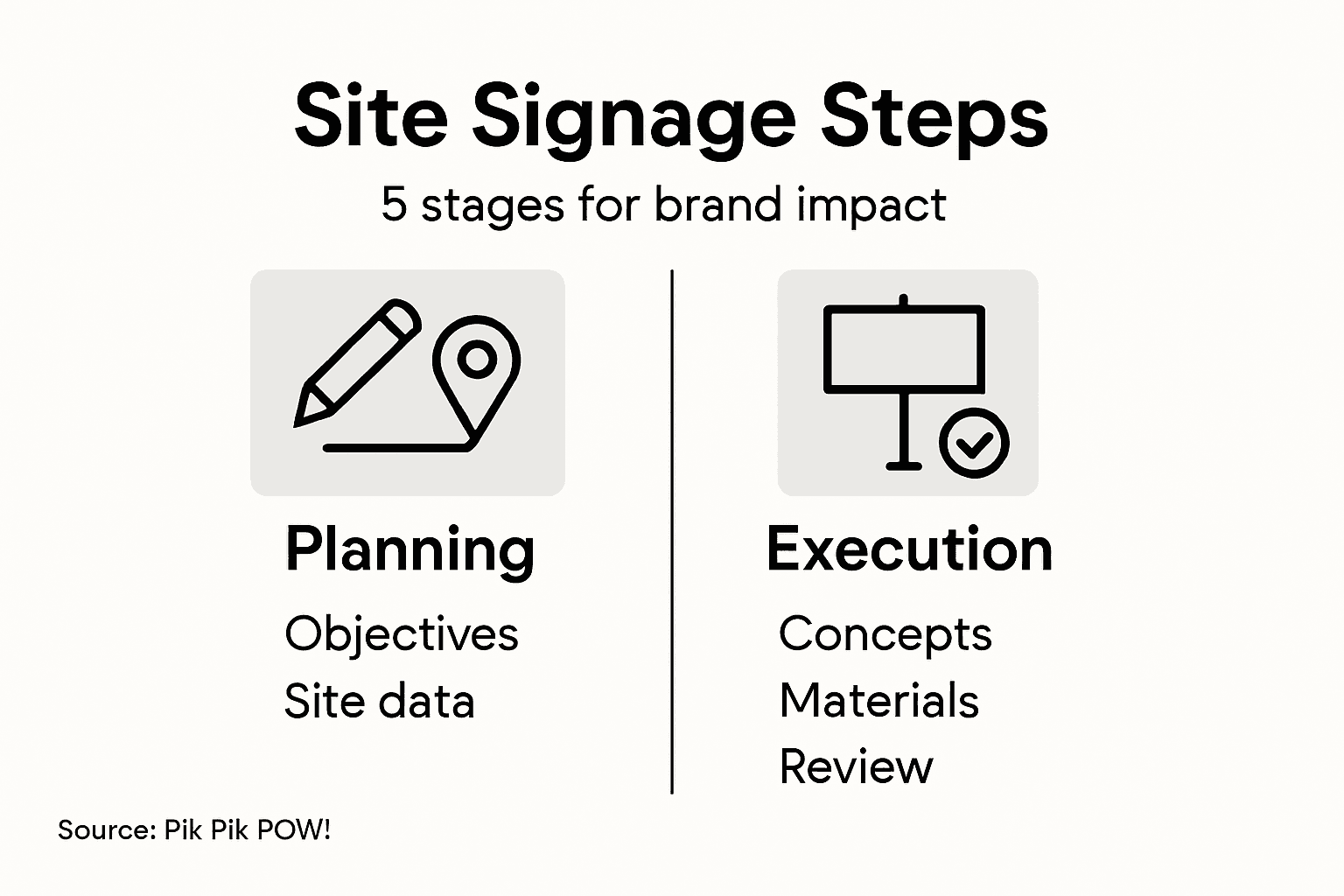
- Step 1: Define Your Signage Objectives And Site Needs
- Step 2: Gather Site Data And Brand Guidelines
- Step 3: Develop Creative Concepts And Layouts
- Step 4: Select Materials And Manufacturing Methods
- Step 5: Review, Test And Approve Final Designs
Quick Summary
| Key Point | Explanation |
|---|---|
| 1. Define clear signage objectives | Establish what your signage must achieve to enhance navigation, visibility, or information delivery specific to your brand and location. |
| 2. Gather detailed site and brand data | Collect essential information on measurements, lighting, traffic flow, and brand guidelines to ensure cohesive and effective signage design. |
| 3. Develop compelling design concepts | Create several variations of your signage to explore different layouts and visual hierarchies that best convey your core message. |
| 4. Choose appropriate materials | Select signage materials based on their durability and visual appeal, ensuring they align with both aesthetic goals and practical application needs. |
| 5. Conduct thorough design reviews | Implement a structured review process involving key stakeholders to confirm technical accuracy, brand compliance, and overall visual effectiveness before production. |
Step 1: Define your signage objectives and site needs
Successful site signage begins with crystal-clear objectives that communicate your brand’s core message effectively. Your first task is understanding precisely what you want your signage to achieve across different spaces and contexts.
To develop robust signage objectives, you must systematically evaluate several critical dimensions. Effective signage design requires a comprehensive approach that considers multiple strategic factors:
- Target audience demographics and expectations
- Location-specific communication requirements
- Brand identity visual guidelines
- Operational functionality of proposed signage solutions
- Environmental constraints like lighting and architectural features
The process involves mapping out your specific site needs by conducting a thorough visual audit. This means walking through your physical space and critically assessing where signage can create maximum impact. Consider viewing your space from multiple perspectives: customer entry points, wayfinding challenges, brand storytelling opportunities, and functional communication zones.
Your signage objectives should articulate clear, measurable goals. Are you aiming to improve navigation, enhance brand visibility, provide critical information, or create a memorable visual experience? Each objective will influence design choices, from typography and colour palette to size and placement.
Signage is more than decoration – it’s strategic communication that bridges your brand’s identity with your audience’s immediate environment.
Pro tip: Sketch preliminary site maps and mark potential signage locations before finalising design specifications to ensure comprehensive coverage and strategic placement.
Step 2: Gather site data and brand guidelines
Before designing your signage, you’ll need to collect comprehensive information about your physical space and brand visual identity. This crucial step ensures your signage design aligns perfectly with both spatial requirements and corporate communication standards.
Wayfinding sign design requires meticulous attention to detail and strategic information gathering. Start by compiling essential site data through a structured approach:
- Architectural measurements of potential signage locations
- Lighting conditions across different site areas
- Traffic flow and visitor movement patterns
- Existing visual elements that might interact with new signage
- Accessibility requirements for diverse user groups
Parallel to site mapping, you must thoroughly review your brand’s visual guidelines. These documents typically outline critical design parameters such as:
- Approved colour palettes
- Typography specifications
- Logo usage rules
- Preferred iconography
- Minimum design clearance zones
Your goal is creating signage that feels like an organic extension of your brand’s visual language. This means understanding not just the technical specifications, but the emotional and strategic intent behind your brand’s visual identity.
Effective signage communicates more than information – it tells your brand’s story through every visual element.
Pro tip: Bring your brand guidelines and site measurement documents to a single planning session, enabling direct cross-referencing and holistic design strategy.
Step 3: Develop creative concepts and layouts
Transforming your brand’s strategic objectives into compelling visual design requires a thoughtful approach to signage conceptualisation. This step is where your creative vision meets practical communication needs, translating brand identity into tangible visual experiences.
Effective signage design demands understanding fundamental layout principles that guide viewer perception. Your design process should incorporate several key strategic elements:
- Visual hierarchy that directs viewer attention
- Colour contrast for maximum readability
- Typography that reflects brand personality
- Spatial composition that enhances message clarity
- Negative space to prevent visual overload
Begin by sketching multiple concept variations, exploring different approaches to presenting your core message. Consider how natural reading patterns might influence your layout – most viewers scan information using ‘F’ or ‘Z’ pattern sequences, which can strategically guide your design choices.
Digital and physical signage require nuanced design considerations. While digital platforms offer dynamic display options, physical signs must balance aesthetic appeal with functional communication. Your concepts should feel cohesive across different mediums, maintaining consistent brand language and visual identity.
Creative signage is more than decoration – it’s strategic communication that transforms spaces and connects with audiences.
Pro tip: Create a design mood board combining your brand guidelines, site measurements, and initial concept sketches to maintain visual coherence throughout the development process.
Step 4: Select materials and manufacturing methods
Choosing the right materials and manufacturing techniques is critical for creating signage that looks exceptional and withstands real-world conditions. Your selection will directly impact the durability, visual appeal, and long-term performance of your signage project.
Signage material selection involves carefully evaluating multiple substrate options and fabrication approaches. Consider these primary material categories:
- Acrylic for lightweight, transparent applications
- Aluminium for robust outdoor signage
- Polycarbonate for impact-resistant solutions
- Vinyl films for flexible graphic applications
- Composite materials for specialised design requirements
Each material brings unique properties to your signage design. Aluminium offers exceptional weather resistance and longevity, while acrylic provides crystal-clear visual transparency. Your choice should balance aesthetic goals with practical performance requirements such as installation environment, maintenance expectations, and budget constraints.

To clarify material selection for signage, here is a comparison of popular signage substrates and their typical uses:
| Material | Ideal Usage | Durability | Visual Impact |
|---|---|---|---|
| Acrylic | Indoor display, illuminated | Moderate, UV sensitive | High clarity, sleek |
| Aluminium | Outdoor main signs | Excellent, weatherproof | Modern, premium look |
| Polycarbonate | Safety, high-traffic areas | High, impact resistant | Clear, robust finish |
| Vinyl Films | Short-term graphics, wraps | Low to moderate | Vibrant, flexible |
| Composite | Custom, challenging designs | Good, adaptable | Versatile appearance |
Modern manufacturing techniques like digital printing, CNC machining, and thermoforming enable sophisticated design execution. Collaborate closely with experienced fabricators who can recommend optimal materials and production methods tailored to your specific project needs.
The right material doesn’t just carry your message – it amplifies your brand’s visual language and durability.
Pro tip: Request material samples and conduct durability testing before final production to ensure your chosen materials meet performance expectations.
Step 5: Review, test and approve final designs
The final stage of your signage design journey involves meticulous review and validation to ensure your visual communication meets all strategic objectives. This critical phase transforms your creative concepts into production-ready assets that represent your brand with precision and impact.
Proofing workflow strategies are essential for maintaining design integrity and avoiding costly production errors. Your review process should encompass multiple comprehensive assessment layers:
- Technical specification verification
- Brand compliance cross-checking
- Dimensional accuracy measurements
- Material compatibility evaluation
- Visual clarity and legibility assessment
Begin by creating a structured review checklist that covers every potential design aspect. Involve stakeholders from multiple departments – marketing, brand management, and operations – to gather diverse perspectives. Pay particular attention to how your signage design performs under different lighting conditions, viewing distances, and environmental contexts.
Digital proofing tools can streamline your review process, allowing collaborative feedback and version tracking. Use high-resolution mock-ups and physical prototypes to validate design choices, ensuring your final signage meets both aesthetic and functional requirements.
For efficient signage review, the following table highlights stakeholders and their roles in the approval process:
| Reviewer | Focus Area | Contribution |
|---|---|---|
| Marketing Team | Brand identity, messaging | Ensures brand consistency |
| Operations | Installation, functionality | Validates site practicality |
| Design Manager | Visual quality, execution | Checks layout and clarity |
| External Fabricator | Material integrity, feasibility | Confirms manufacturing constraints |
Design approval is not just about perfection – it’s about creating a visual communication tool that speaks your brand’s language.
Pro tip: Create a standardised design review template with clear evaluation criteria to maintain consistent quality across all signage projects.
Elevate Your Brand with Expert Site Signage Solutions
Designing site signage that delivers maximum brand impact involves tackling challenges like strategic placement, material selection and maintaining brand consistency—just like the critical steps covered in our guide. If you want signage that not only stands out visually but also meets your exact site needs and brand guidelines, professional expertise is essential. From ensuring perfect material durability to flawless design approval, every detail matters to create signage that truly communicates your brand story.
Pik Pik POW! specialises in bespoke indoor and outdoor signage tailored to your business goals. We combine creative design with precision manufacturing to craft high-quality shopfronts, architectural signage and vehicle graphics that boost visibility and enhance customer experience. Trust us to handle everything from concept development to material selection and installation, so your signage performs perfectly in every environment.
Looking to bring your signage vision to life confidently and effectively? Discover how our signage solutions can transform your space today.
Get in touch now to create powerful, durable signs that link strategy with stunning design. Visit Pik Pik POW! and start your brand’s signage journey with proven UK expertise.
Frequently Asked Questions
What are the key objectives for site signage?
Effective site signage should communicate your brand’s core message clearly while achieving specific goals such as improving navigation, enhancing visibility, and providing critical information. Identify and define what you want your signage to accomplish to guide your design choices.
How can I evaluate the needs of my signage locations?
Conduct a thorough visual audit of your space by walking through it and assessing potential signage locations. Take note of customer entry points, wayfinding challenges, and areas where brand storytelling can make a strong impact, aiming for comprehensive coverage and strategic placement.
What factors should I consider when selecting materials for signage?
Choose materials based on their durability, visual appeal, and how well they suit your environment. For instance, use Aluminium for outdoor signs and Acrylic for areas requiring transparency, ensuring that the materials align with your brand’s visual language and practical requirements.
How can I ensure my signage design aligns with my brand guidelines?
Thoroughly review your brand’s visual guidelines, including colour palettes, typography, and logo usage rules, before finalising your signage designs. Creating a design mood board that integrates these elements can help maintain visual coherence and brand identity throughout the project.
What steps should I take during the signage review process?
Create a structured checklist that includes technical specifications, brand compliance, and visual clarity assessments. Involve diverse stakeholders in the review to gather valuable feedback, helping to ensure your signage meets both aesthetic and functional objectives before manufacturing.