Construction sites are among the most hazardous working environments in the UK, and inadequate signage is a significant contributing factor. With 79,000 ill health cases and 35 fatalities linked to poor signage in UK construction, the stakes could not be higher. For project managers and safety officers, getting signage right is not just a legal obligation; it is a direct investment in the wellbeing of every person on site. This guide covers the key regulations, best placement practices, material choices, and practical strategies to help you build a safer, more compliant site from the ground up.
Table of Contents
- Understand UK regulations and sign types
- Optimal placement and visibility for maximum safety
- Selecting durable and compliant materials
- Catering for multilingual workforces and site changes
- Avoiding common pitfalls and legal liabilities
- Our perspective: Beyond compliance, building a proactive signage culture
- Find signage solutions tailored for your site
- Frequently asked questions
Key Takeaways
| Point | Details |
|---|---|
| Follow UK signage rules | Always use the correct signage types, colours, and placements as outlined by UK regulations. |
| Prioritise visibility and clarity | Signs must be easy to see, unobstructed, and regularly maintained for safety. |
| Choose durable materials | Weather-resistant, reflective materials ensure your signage lasts and remains effective. |
| Adapt to workforce needs | Implement bilingual signs and pictograms where needed, and update for site changes. |
| Regular audits prevent penalties | Routine checks and updates of site signage help avoid fines and improve accident prevention. |
Understand UK regulations and sign types
Knowing the rules is the first step. UK construction site signage is governed by the Health and Safety (Safety Signs and Signals) Regulations 1996, which set out clear requirements for when signs must be used, what they must look like, and who is responsible for maintaining them. If a risk cannot be eliminated or adequately controlled by other means, it must be communicated through compliant signage.
Understanding safety sign terminology is essential for anyone managing a site. The four main categories are:
- Prohibition signs (red circle with a diagonal bar): indicate actions that must not be taken, such as no unauthorised entry
- Warning signs (yellow triangle): alert workers to hazards such as overhead loads or uneven ground
- Mandatory signs (blue circle): specify required actions, such as wearing hard hats or high-visibility jackets
- Safe condition signs (green rectangle): mark emergency exits, first aid points, and assembly areas
All signs must conform to BS EN ISO 7010, the international standard for safety symbols. This means using prescribed pictograms, colours, and shapes rather than custom designs, which ensures instant recognition regardless of language background.
As a site manager, your legal responsibility under signage regulations extends beyond simply putting signs up. You must ensure they remain visible, undamaged, and relevant throughout the project lifecycle. The HSE signage regulations also require that workers receive adequate instruction and training on what each sign means, particularly when new operatives join the site.
Key fact: The 1996 Regulations apply to all workplaces, including temporary construction sites, and cover acoustic and luminous signals as well as physical signs.
Regular checks and documented reviews of your signage inventory are not optional extras; they are part of your legal duty of care.
Optimal placement and visibility for maximum safety
Once you understand the required sign types, placement becomes the next critical factor. A sign that cannot be seen, or is positioned where workers are unlikely to notice it, offers no real protection. Sign types including prohibition, warning, mandatory, and safe condition signs should be placed at entry points, near specific hazards, and at eye level, kept unobstructed and well maintained at all times.
Here is a practical breakdown of where each category should be located:
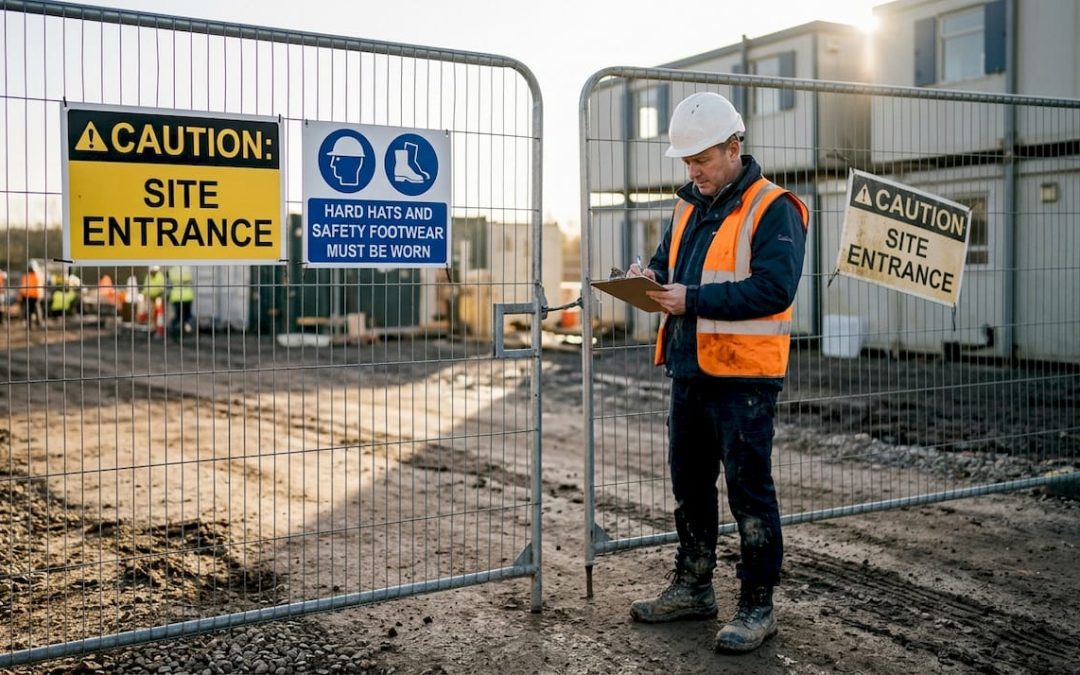
- Entry points: Display mandatory PPE (personal protective equipment) requirements and site rules at every access gate before workers step foot on site
- Hazard zones: Position warning signs within direct line of sight of the hazard, not behind equipment or obscured by materials
- Emergency routes: Safe condition signs must be clearly visible along all evacuation routes, including stairwells and corridors on multi-level builds
- Restricted areas: Prohibition signs should be mounted at the boundary of restricted zones, not just at a single entry point
Mounting height matters more than many managers realise. Signs should generally be fixed at eye level, between 1.5 and 1.8 metres from the ground, to ensure they fall naturally within a worker’s field of vision. For overhead hazards, additional signage at a higher level is appropriate, but do not rely solely on elevated signs.
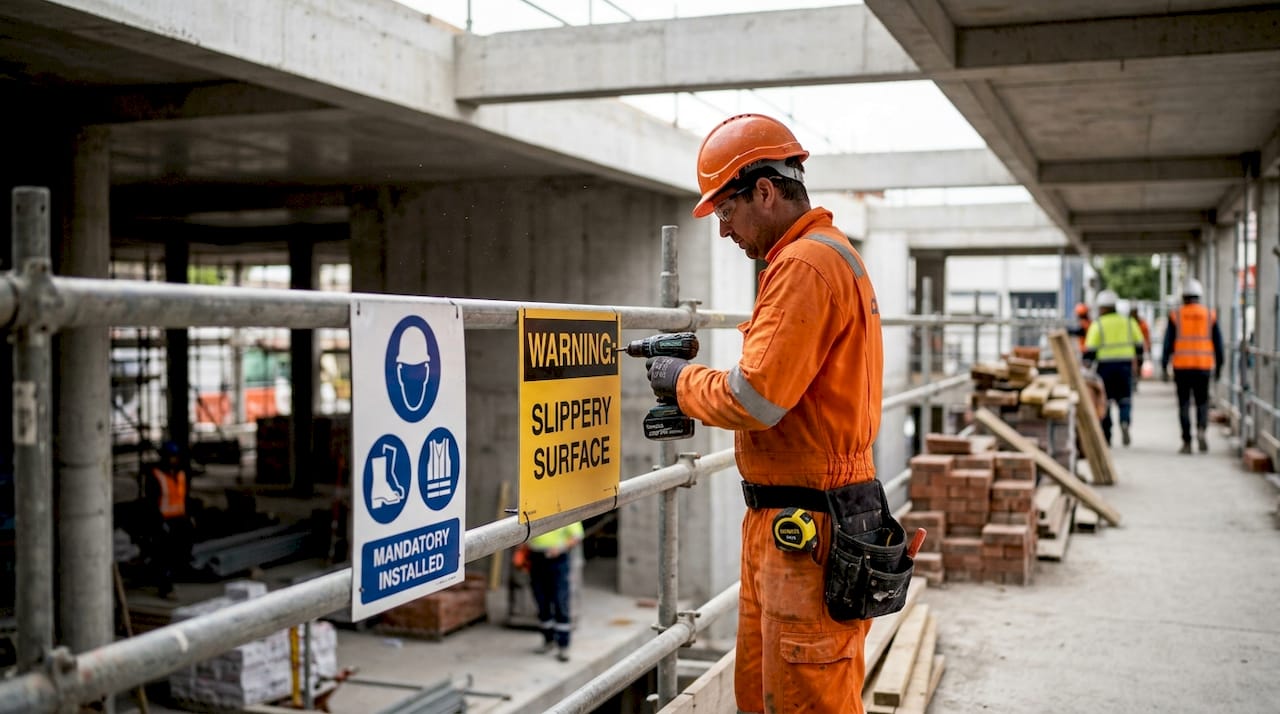
Pro Tip: On complex or multi-level sites, repeat essential signs on every floor and at every stairwell entry. Workers moving between levels should never have to guess what the rules are in a new area.
For guidance on structuring a logical signage layout across a large site, a wayfinding signage guide can help you map out sign positions systematically. The HSE placement guide also provides detailed recommendations for specific scenarios. Illuminated or photoluminescent signs are essential wherever natural light is limited, such as basements, tunnels, or early morning and evening shifts.
Selecting durable and compliant materials
With placement sorted, material selection is where many sites fall short. Construction environments are tough: rain, wind, UV exposure, impact from machinery, and temperature fluctuations all degrade signage faster than in a standard workplace. Materials should be durable, weather-resistant, reflective for low light, and high-contrast for visibility to remain effective throughout a project.
Here is a comparison of the most commonly used sign materials on UK construction sites:
| Material | Best use | Durability | Cost |
|---|---|---|---|
| Aluminium | Permanent or long-term signs | Excellent | Medium to high |
| Correx (corrugated plastic) | Temporary or short-term signs | Moderate | Low |
| Foamex (PVC foam board) | Indoor or sheltered areas | Good | Low to medium |
| Steel | High-impact or security areas | Excellent | High |
Aluminium is the preferred choice for most outdoor construction signage because it resists corrosion, holds print quality well, and withstands physical knocks. Correx is cost-effective for temporary hazard notices that will be replaced as the site evolves, but it degrades quickly in prolonged UV exposure.
Pro Tip: Specify Class 1 reflective vinyl on signs in areas where work continues after dark or in poor weather. Reflective materials dramatically improve visibility for vehicle drivers and pedestrians moving around the site at low light.
Font size and contrast are equally important. Use bold, sans-serif typefaces with strong colour contrast between text and background. Avoid decorative fonts entirely. For a full breakdown of options, our signage material guide covers specifications in detail, and durable signage benefits explains why investing in quality materials pays off over time.
Catering for multilingual workforces and site changes
Adaptable signage is vital as construction sites evolve and diverse teams bring new communication challenges. The UK construction workforce is highly multicultural, and assuming all workers read English fluently is a compliance risk you cannot afford to take. HSE encourages bilingual signs or pictograms for multilingual sites, and recommends updating signage as hazards change throughout the project.
Practical approaches for multilingual sites include:
- Use universally recognised pictograms as the primary communication method, with text as a secondary layer
- Where text is essential, include the most relevant second language alongside English based on your workforce composition
- Keep language simple and direct; avoid jargon or long sentences on signs
- Brief all workers during induction on the meaning of each sign type used on your specific site
Site changes are just as important to manage. As construction progresses, hazards shift: floors open up, scaffolding moves, new plant arrives. Signage that was accurate in month one may be misleading or irrelevant by month three.
| Trigger for sign update | Action required |
|---|---|
| New hazard identified | Install appropriate warning or prohibition sign immediately |
| Hazard removed or controlled | Remove or replace sign to avoid confusion |
| Layout change (new routes, barriers) | Update wayfinding and safe condition signs |
| Regulatory update | Review all signs against new requirements |
One risk that is often overlooked is sign overload. Placing too many signs in one area causes workers to stop reading them altogether. Prioritise the most critical messages and use signage systems that allow for modular updates rather than replacing entire boards each time conditions change.
Avoiding common pitfalls and legal liabilities
Even well-intentioned signage programmes can fail if common mistakes are not addressed proactively. The consequences are serious. Poor signage resulted in a £60,000 fine after a worker fell through an unprotected floor opening, a case that illustrates exactly how costly an oversight can be. Beyond fines, inadequate signage can result in prosecution, reputational damage, and most importantly, preventable injury or death.
The most common pitfalls to avoid are:
- Outdated signs: Leaving hazard signs in place after the hazard has been resolved creates confusion and erodes trust in all signage on site
- Obscured signs: Signs blocked by stored materials, plant, or temporary structures are effectively invisible and offer no legal protection
- Damaged or faded signs: A sign that cannot be read clearly is non-compliant; replace it immediately
- Inconsistent sign standards: Mixing non-standard custom signs with compliant ISO signs undermines the visual language workers rely on
- No worker training: Signs alone are insufficient; workers must understand what each sign means and what action to take
“Conduct site-specific risk assessments and train workers on sign meanings to ensure signage is effective and legally defensible.”
Regular audits are your best defence. Schedule formal signage inspections at least weekly, and assign a named individual responsibility for sign maintenance. For guidance on keeping your signage programme in good shape, our signage maintenance tips offer practical checklists. The HSE guidance for site transport also covers specific requirements for vehicle and pedestrian separation zones.
Our perspective: Beyond compliance, building a proactive signage culture
Most sites treat signage as a box-ticking exercise. Put up the required signs, pass the inspection, move on. We think that approach leaves significant value on the table, both in terms of safety outcomes and long-term cost.
A proactive signage culture means your team actively notices when a sign is faded, obscured, or no longer relevant, and reports it without waiting to be asked. It means workers understand the reasoning behind each sign, not just the rule it communicates. That level of engagement reduces misinterpretation, speeds up inductions for new starters, and builds a site environment where safety is genuinely shared rather than imposed.
The financial case is straightforward too. One avoided incident, one avoided HSE investigation, one avoided fine easily justifies the cost of a thorough, well-maintained signage programme. Investing in quality materials and clear signage terminology insights from the outset is far cheaper than reactive replacement or legal defence.
Compliance sets the floor. Culture determines how far above it you operate.
Find signage solutions tailored for your site
Understanding best practice is one thing; having the right supplier to deliver it is another. At Pik Pik POW!, we work with construction project managers and safety officers across the UK to produce signage that meets regulatory requirements and stands up to the demands of live construction environments.
From durable aluminium safety signs to modular signage systems that adapt as your site evolves, we offer solutions built for compliance, clarity, and longevity. We also provide digital signage options for sites where real-time updates and dynamic messaging add real safety value. Get in touch with our team for a site-specific consultation and find out how we can support your next project from groundworks to handover.
Frequently asked questions
What is the minimum legal requirement for construction site signs in the UK?
All significant risks that cannot be eliminated by other means must be clearly signed using standard symbols and colours, as set out in the Health and Safety (Safety Signs and Signals) Regulations 1996. This applies to all construction sites, including temporary ones.
How often should construction site signage be checked and updated?
Site signage should be inspected at least weekly, and more frequently when site conditions change, to ensure all signs remain visible, undamaged, and relevant to current hazards.
How do I ensure signage is understood by all workers, including those who don’t speak English?
Use pictograms as the primary communication method and supplement with bilingual text where needed, as recommended by the HSE for multilingual sites. Worker induction training on sign meanings is also essential.
What happens if my construction site signage is inadequate?
Inadequate signage can lead to HSE enforcement action, substantial fines, and serious injury. A recent case saw a £60,000 fine issued after a worker fell through an unprotected floor opening where warning signage was absent.