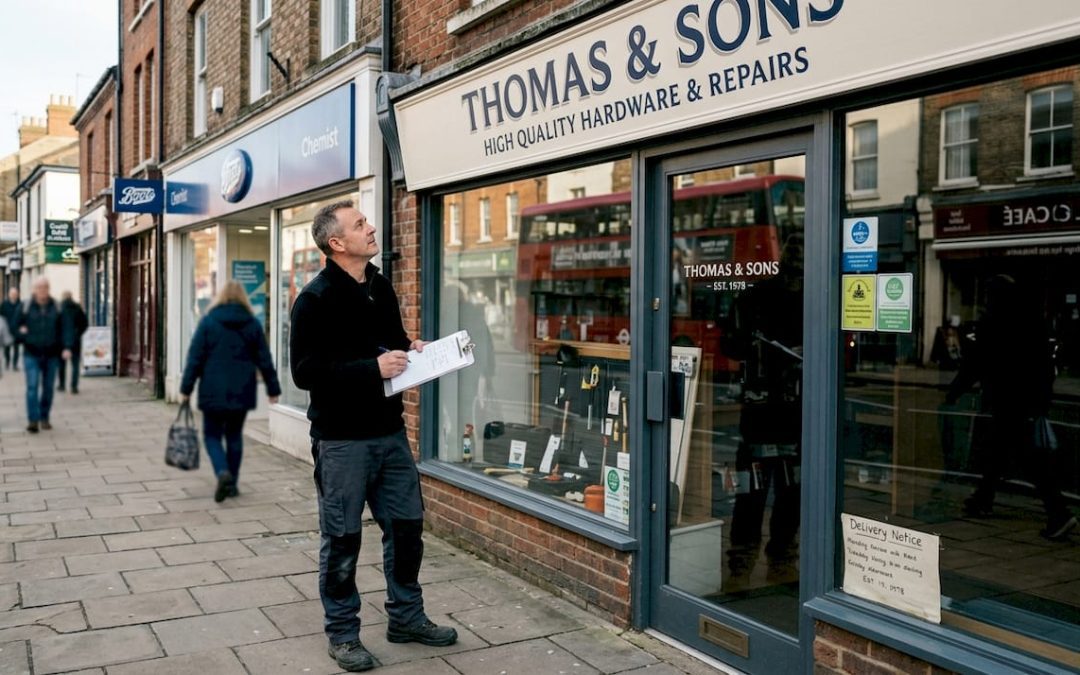
Getting your business signage wrong can cost you far more than a redesign. UK businesses have faced fines exceeding £2,500 per offence for non-compliant signs, along with enforcement notices and compulsory removal orders. Yet many business owners assume that putting up a sign is straightforward, a matter of design and budget rather than regulation. The reality is that UK signage law is layered, specific, and actively enforced. This guide cuts through the confusion, explaining exactly what the rules require, which signs need permission, and how to protect your business from costly mistakes.
Table of Contents
- What is signage compliance in the UK?
- Sign types and consent: Which signs need permission?
- Key conditions every business sign must meet
- The application process: Securing consent for your signs
- Non-compliance and enforcement: Risks, penalties, and real cases
- Construction and commercial signage: Safety rules and sector standards
- Edge cases and expert insights: Digital, projecting, and conservation areas
- How Pik Pik POW! helps you get signage right first time
- Frequently asked questions
Key Takeaways
| Point | Details |
|---|---|
| Consent is often required | Most business signs over 0.3 sqm or illuminated need council approval in the UK. |
| Universal five rules | All signs must be kept clean, safe, authorised, unobtrusive, and removable if requested. |
| Non-compliance is costly | Fines can exceed £2,500, with enforcement orders and forced removal for breaches. |
| Sector-specific standards | Construction and commercial sites have strict safety and information signage requirements. |
| Heritage and digital extra scrutiny | Conservation areas and digital signs are subject to harsher rules and aesthetic reviews. |
What is signage compliance in the UK?
Signage compliance means following all national and local rules that govern the content, size, placement, and illumination of business signs. It is not simply about aesthetics. It is a legal obligation. Many business owners are surprised to learn that even a small fascia sign above a shopfront can trigger a formal consent process if it meets certain criteria.
The primary legislation governing external business signage is the Town and Country Planning (Control of Advertisements) Regulations 2007, which sets out when advertisement consent is required and what conditions all signs must meet. Local planning authorities enforce these rules, and they have real powers to act.
For any external sign, the baseline obligations apply regardless of size or type:
- The sign must be kept clean and tidy at all times
- It must be structurally safe and not pose a hazard
- You must have permission from the landowner
- It must not obscure or interfere with official road or traffic signs
- It must be removable if the local authority orders it
“Advertisement consent is required for most business signs that are illuminated, project from a building, or exceed 0.3 sqm in area.”
If you are unsure whether your sign needs formal consent, our guide to shop sign planning permission is a useful starting point. For those operating on building sites, construction signage compliance carries its own set of requirements covered later in this article.
Sign types and consent: Which signs need permission?
Understanding the regulations sets the stage. Now, let us pinpoint which kinds of signage require extra permissions and which are automatically allowed.
UK planning rules divide signs into two categories: those with deemed consent and those requiring express consent from your local authority.
Deemed consent applies to certain small signs, but illuminated, freestanding, or projecting signs usually need express consent from the local planning authority.
| Sign type | Consent needed? | Notes |
|---|---|---|
| Small flat fascia sign (under 0.3 sqm, not illuminated) | Usually no | Must still meet standard conditions |
| Illuminated fascia or box sign | Yes, express consent | Brightness and hours of illumination reviewed |
| Projecting sign (hanging blade sign) | Yes, express consent | Projection limits and height apply |
| Freestanding totem or A-board | Depends on size and location | A-boards often require consent in busy areas |
| Signs in conservation areas | Yes, express consent | Stricter aesthetic controls apply |
| Signs on listed buildings | Yes, express consent | Listed building consent may also be needed |
To check whether your sign needs permission, follow these steps:
- Measure the total display area of your proposed sign
- Confirm whether it will be illuminated in any way
- Check whether your premises are in a conservation area or on a listed building
- Contact your local planning authority or use the Planning Portal to verify requirements
- If in doubt, submit a pre-application enquiry before committing to manufacture
Pro Tip: Always get written confirmation from your local authority if they advise that your sign has deemed consent. Verbal assurances are not enforceable, and enforcement officers may take a different view later.
For businesses considering lit signage, our page on illuminated signage rules explains what councils typically assess during the consent process.
Key conditions every business sign must meet
With signage types and consent clarified, the next step is to cover the baseline rules that apply to every sign, no matter the business.
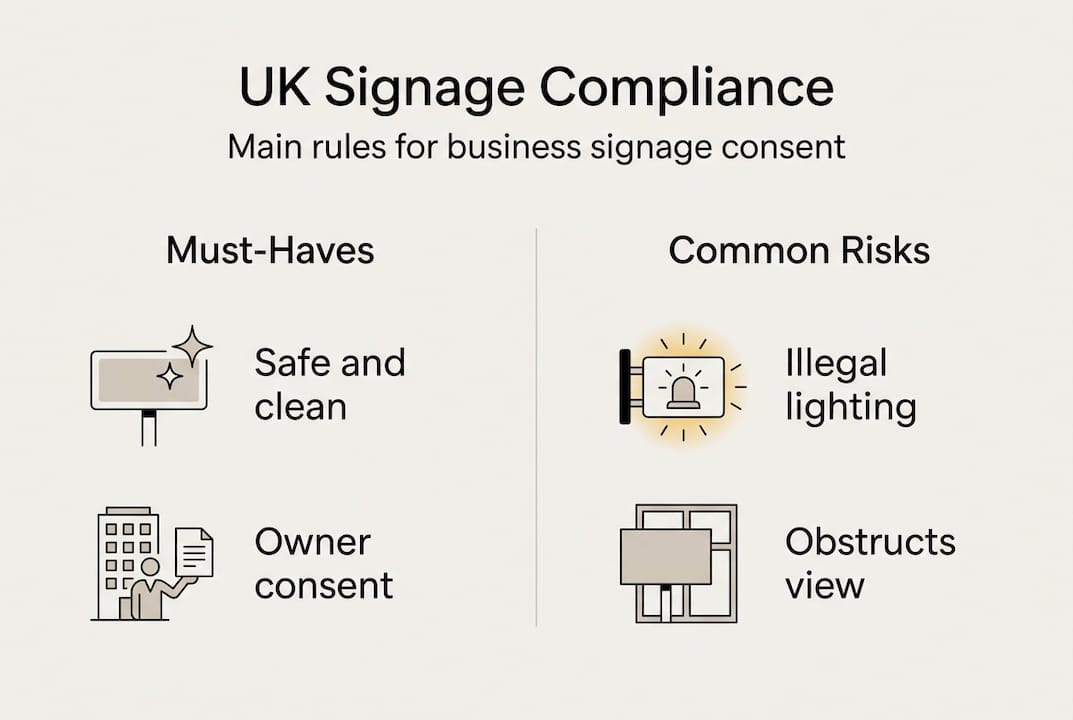
All outdoor advertisements must meet five standard conditions: kept clean and tidy, structurally safe, supported by landowner or highway authority permission, not obscuring official signage, and removable when ordered by the authority.
These conditions sound straightforward, but businesses regularly fall short on a few of them:
- Highway permission: If your sign is on or over a public highway, you need separate consent from the highways authority, not just the planning authority. Many businesses miss this entirely.
- Landowner permission: If you lease your premises, your landlord must formally agree to the sign. A lease clause permitting “alterations” does not automatically cover external signage.
- Removal obligation: If you receive an enforcement notice requiring removal, you must act within the stated timeframe. Ignoring it escalates the matter to court proceedings.
- Ongoing maintenance: A sign that was compliant when installed can become non-compliant if it deteriorates. Faded lettering, broken illumination, or structural damage can all trigger enforcement action.
Pro Tip: Keep a simple compliance log for each sign on your premises. Record the consent reference, installation date, last inspection date, and any maintenance carried out. This protects you if an enforcement officer visits.
For practical guidance on getting the design right from the start, our resources on designing compliant signage and shop signage design tips cover both the creative and regulatory considerations.
The application process: Securing consent for your signs
If your signage does need permission, here is what to expect from the application process itself.
Applying for advertisement consent involves submitting plans and supporting details to your local planning authority. The standard decision timeline is around eight weeks, and fees are typically around £120 per application. In London, scrutiny tends to be stricter, particularly in areas with strong heritage or conservation designations.
| Step | What is required | Typical timeframe |
|---|---|---|
| Pre-application check | Confirm consent type needed | 1 to 2 weeks |
| Prepare drawings | Scaled plans, elevations, material specs | 1 to 3 weeks |
| Submit application | Online via Planning Portal or local authority | Day of submission |
| Validation | Authority confirms application is complete | Up to 1 week |
| Decision period | Authority reviews and consults | Up to 8 weeks |
| Consent issued | Conditions attached, consent period stated | After decision |
Conservation areas and listed buildings add complexity. Councils in these locations may request additional heritage impact statements or require materials to match the existing building fabric. Submitting a thorough, well-prepared application reduces the risk of delays or refusal.
Our overview of the signage consent process provides further detail on what a well-prepared submission looks like.
Non-compliance and enforcement: Risks, penalties, and real cases
Having planned your application, it is vital to recognise the tangible risks and consequences of failing to comply.
Fines for non-compliant signage can reach and exceed £2,500 per offence, and enforcement actions have included removal orders and court proceedings against well-known retailers and small businesses alike.
Recent UK enforcement cases illustrate the real-world impact:
- A flyposting campaign resulted in a fine of £2,875
- A projecting sign installed without consent led to a £1,315 penalty
- A combined shutter and sign installation cost one business £2,437
- B&M Bargains received a formal removal order for signage deemed incompatible with a heritage area
“Local authorities prioritise public safety and the visual character of an area. Your branding preferences are secondary to those considerations in any enforcement decision.”
Enforcement is not just about fines. Removal orders require you to dismantle and dispose of signage at your own cost, which can easily exceed the original fine. Repeated non-compliance can also affect future planning applications for your premises.
Stay informed about enforcement trends through our UK signage enforcement news, and if you manage commercial interiors as well as external signage, our guide to commercial interiors compliance is worth reviewing.
Construction and commercial signage: Safety rules and sector standards
Non-compliance is risky everywhere, but construction and commercial sites have extra layers of signage regulation that go beyond planning law.
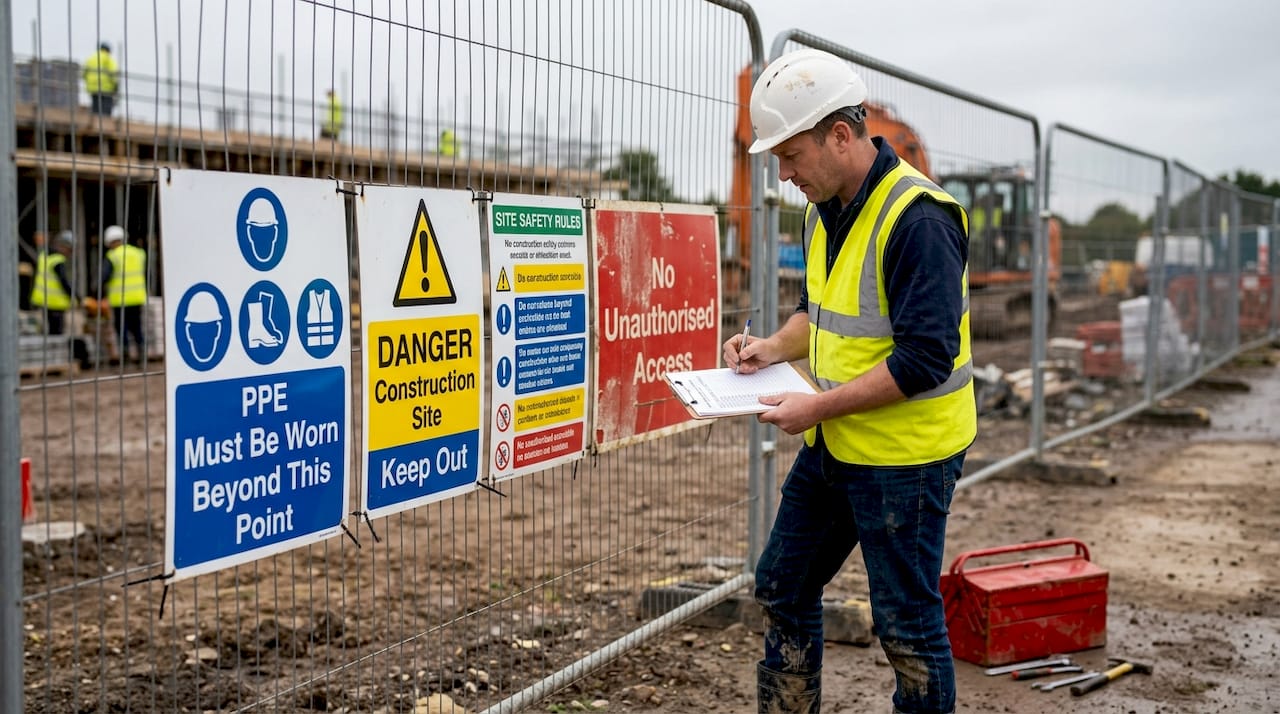
HSE requires warning, mandatory, and prohibition signs wherever risks remain present on site, and CDM 2015 regulations require project boards displaying main contractor details at the site entrance.
Key requirements for construction and commercial signage include:
- ISO 7010 compliance: All safety sign symbols must conform to this international standard, ensuring they are universally understood regardless of language
- Warning signs: Required wherever hazards such as overhead loads, moving vehicles, or excavations are present
- Mandatory signs: Indicate required actions such as wearing PPE in specific zones
- Prohibition signs: Mark areas or actions that are strictly forbidden
- CDM project boards: Must display the principal contractor’s name, contact details, and HSE notification reference where applicable
Pro Tip: Walk every traffic route and high-risk zone on your site and check for signage gaps. Missing a single mandatory sign in a vehicle and pedestrian conflict zone is one of the most common HSE compliance failures.
For detailed guidance, our pages on HSE signage rules and safety sign terms cover the full range of requirements for construction and commercial environments.
Edge cases and expert insights: Digital, projecting, and conservation areas
Some signage types and locations bring unique challenges and council scrutiny. Here is how to manage the toughest cases.
Digital and bright signs receive extra scrutiny, and conservation area signage can be refused purely on aesthetic grounds, even when the business case for the sign is strong.
Here is what to be aware of in each scenario:
- Digital and LED signs: Councils assess brightness levels, hours of operation, and whether the sign could distract drivers or harm the local character. Many authorities impose conditions limiting brightness after 10pm.
- Projecting signs: Safe projection limits are typically 1 metre from the building face, and the sign must maintain a minimum clearance above pavement level. Express consent is almost always required.
- Conservation areas: The appearance of your sign must be sympathetic to the architectural character of the area. Plastic fascias, bright colours, and modern fonts are frequently refused in favour of painted timber or brushed metal finishes.
- Listed buildings: Any fixing into the fabric of a listed building requires listed building consent in addition to advertisement consent. Even reversible fixings can be subject to scrutiny.
“Councils may refuse signage that is technically within size limits if it is judged to harm the character or appearance of a conservation area.”
For advice on navigating these situations, our pages on digital signage advice and architectural signs in conservation areas offer practical, sector-specific guidance.
How Pik Pik POW! helps you get signage right first time
At Pik Pik POW!, we work with retail, construction, and commercial businesses across the UK to design and produce signage that is both impactful and fully compliant. We understand the planning requirements, the consent process, and the sector-specific rules that apply to your business, so you do not have to navigate them alone.
From shopfront fascias and illuminated signs to construction site boards and commercial interior graphics, we handle the full process from initial design through to installation. Our team can advise on consent requirements before you commit to a design, helping you avoid costly revisions or enforcement issues down the line. If you are ready to invest in signage that works for your brand and meets every regulatory requirement, get in touch with our team to discuss your project.
Frequently asked questions
What is the penalty for illegal signage in the UK?
Businesses risk fines up to £2,500 per offence for non-compliant signs, and enforcement orders can require removal at the business owner’s expense.
Do I need planning permission for a shop front sign?
Most shop signs over 0.3 sqm or those that are illuminated require advertisement consent from your local planning authority before installation.
What are the five rules all business signs must follow?
All outdoor advertisements must be kept clean and safe, have landowner and highway permission where relevant, not obscure official signs, and be removable when ordered by the authority.
Are there extra rules for construction site signage?
Yes. HSE and CDM 2015 require mandatory safety signs, warning signs, and contractor information boards to be displayed correctly on all active construction sites.
Recommended
- Construction Signage Terminology – Ensuring Safety and Compliance
- Role of Design in Signage Solutions – Impact on UK Retail
- News and Updates: Get the Latest Updates and Information – Pik Pik Pow
- Role of Signage in Commercial Interiors: UK Impact
- What is compliance monitoring: a guide for UK security professionals|SJB