
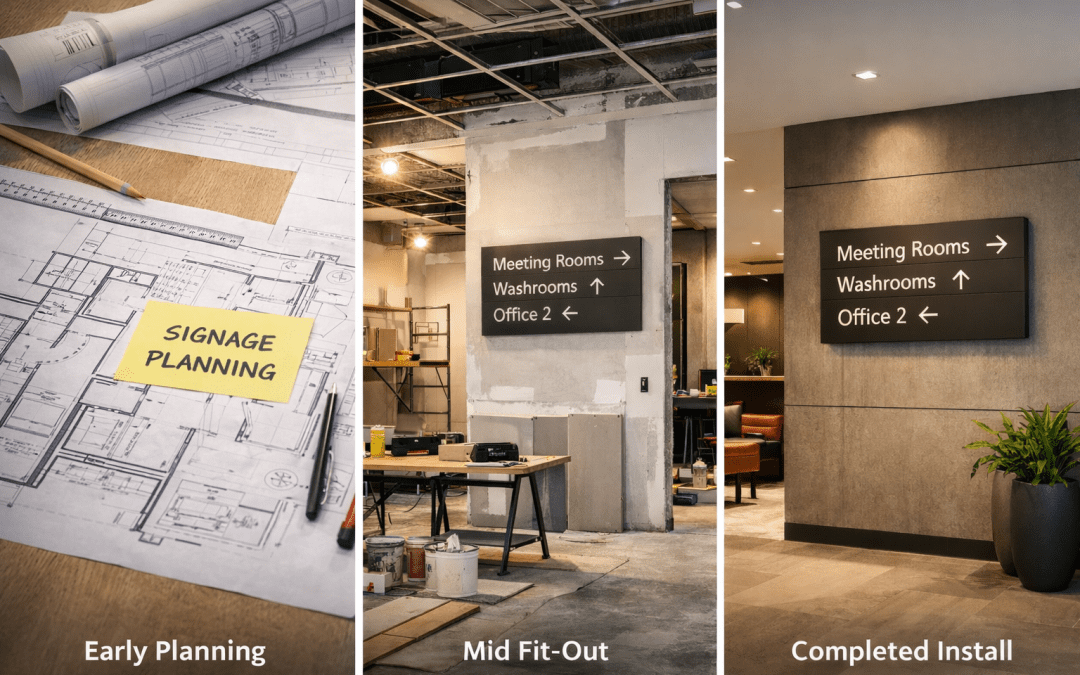
Why Signage Should Be Specified Early in Any Commercial Project
In many commercial projects, signage is still treated as a finishing touch. Something to think about once the walls are up, the flooring is down, and the furniture is in place. By that stage, however, the most important decisions have already been made.
Specifying signage early in the design and build process is one of the most effective ways to reduce cost, avoid delays, protect brand integrity, and deliver a more coherent finished environment. Whether the project is a new office fit-out, retail space, gym, hospitality venue, or multi-site rollout, early signage planning consistently leads to better outcomes.
This article explains why signage should be considered from the outset, and what typically goes wrong when it is left too late.
Signage Is Part of the Built Environment, Not an Add-On
Signage is often grouped with graphics or décor, but in reality it sits much closer to architecture and interior design. Wayfinding, statutory signs, brand elements, and environmental graphics all interact with walls, ceilings, lighting, circulation routes, and sightlines.
When signage is specified early, it becomes part of the spatial logic of the building. Locations are considered alongside layouts. Fixings are coordinated with wall constructions. Power supplies and lighting allowances are planned rather than improvised.
When signage is specified late, it is forced to work around decisions that were never made with it in mind.
The difference between these two approaches is immediately visible in the finished space.
Early Signage Planning Reduces Cost and Rework
One of the most common misconceptions is that early signage involvement increases cost. In practice, the opposite is almost always true.
Late signage decisions often lead to:
Walls being opened up to add fixings or power
Finished surfaces being damaged or patched
Signage solutions being compromised to suit what is already built
Last-minute fabrication and rushed installations
All of this adds cost, both directly and indirectly.
When signage is planned early:
Fixing methods are aligned with wall types
Cable routes and power points are included in the build
Materials are chosen with longevity and maintenance in mind
Installation is scheduled efficiently alongside other trades
The result is fewer variations, fewer surprises, and better cost control overall.
Signage Plays a Critical Role in User Experience
In commercial environments, signage is not simply informational. It shapes how people move, orientate themselves, and feel within a space.
Poorly planned signage often results in:
Confusing navigation
Cluttered or over-signed environments
Inconsistent messaging
A sense that the space does not quite work as intended
When signage is considered early, it supports:
Clear circulation and wayfinding
Logical hierarchy of information
Calm, legible environments
Better first impressions for visitors and staff
This is particularly important in environments such as offices, healthcare settings, gyms, and retail spaces, where user experience directly affects perception, efficiency, and dwell time.
Brand Consistency Depends on Early Decisions
Brand expression through signage is not just about logos. It includes typography, colour, materials, proportions, lighting, and placement. These elements need to sit comfortably within the architecture and interior design.
When signage is introduced late:
Brand elements are often applied superficially
Opportunities for integrated solutions are missed
Visual consistency suffers across different areas
Long-term scalability becomes difficult
Early signage specification allows brand expression to be embedded rather than applied. This is especially valuable for organisations planning future growth, additional sites, or phased rollouts.
A signage system designed early can be replicated, adapted, and scaled without reinventing the approach each time.
Compliance Is Easier When Planned from the Start
Statutory and safety signage is a requirement in most commercial environments. When considered late, it can feel intrusive or visually disruptive, leading to compromises between compliance and design.
Early planning allows compliance requirements to be:
Integrated discreetly
Designed in line with brand guidelines
Positioned logically within the space
Future-proofed as layouts evolve
This avoids the common scenario where compliant signage is added hastily at the end of a project, undermining the visual quality of the space.
Signage Touches Multiple Disciplines
Signage sits at the intersection of several disciplines:
Architecture
Interior design
Branding
Facilities management
Health and safety
When signage is introduced late, it often falls between responsibilities. No one fully owns it, and decisions are made reactively.
Early involvement allows signage to be coordinated with:
Architects and designers
Fit-out and construction teams
Brand and marketing stakeholders
Facilities and operations teams
This coordination reduces friction and ensures signage supports both the immediate project and long-term operational needs.
The Difference Between a Supplier and a Partner
One of the key reasons signage is specified late is that it is still viewed as a product to be purchased rather than a system to be designed.
A transactional approach focuses on:
Unit costs
Individual signs
Short-term solutions
A consultative approach focuses on:
Strategy and sequencing
Systems and scalability
Integration with the wider environment
When signage specialists are involved early, they can advise not just on what to install, but on when, where, and why. This shifts the conversation from procurement to planning, and ultimately leads to better results.
When Should Signage Be Considered?
Ideally, signage should be discussed:
During early design stages
Alongside spatial planning and layouts
Before wall constructions and finishes are finalised
Before electrical and lighting designs are locked in
This does not mean every detail needs to be resolved immediately. It means that signage has a seat at the table early enough to influence decisions, rather than being constrained by them.
A More Considered Way to Build
Commercial projects are complex. Every late decision increases risk, cost, and compromise. Signage is no exception.
When specified early, signage:
Costs less over the life of the project
Integrates more cleanly with the space
Supports brand and user experience
Reduces stress and last-minute changes
Treating signage as an integral part of the built environment, rather than an afterthought, is one of the simplest ways to improve project outcomes.
Planning a Project?
If you are in the early stages of a commercial project, or planning a refurbishment or rollout, considering signage early can save time, money, and frustration later.
A consultative approach allows signage to be designed as part of the whole environment, not bolted on at the end.