
TL;DR:
- Poor signage in sports venues risks safety, confusion, and miscommunication during emergencies. Properly designed, placed, and maintained signage enhances safety, crowd flow, branding, and legal compliance; flexible solutions support multi-event requirements. Regular review and strategic planning elevate signage from a cost to a valuable, ongoing asset that boosts safety, branding, and visitor experience.
Signage is often treated as a finishing touch in sports facilities, something to sort once the main build or renovation is complete. That approach carries real risk. Poor signage compromises crowd safety, creates confusion during emergencies, and sends visitors the wrong message about your venue. Done well, it supports legal compliance, guides thousands of people efficiently, and reinforces your brand at every turn. This guide covers every dimension of sports venue signage, from your legal obligations under UK law to practical placement, configurable event solutions, and building a long-term strategy that works for operations and marketing alike.
Table of Contents
- Understanding the role of signage: from safety to branding
- Legal standards and compliance: what every sports venue must know
- Placement, visibility, and maintenance: practical best practice
- Configurable signage: balancing event requirements and branding
- Developing a signage strategy: risk control to visitor experience
- The overlooked opportunity: signage as an ongoing asset, not a tick-box
- Find the right signage solutions for your sports facility
- Frequently asked questions
Key Takeaways
| Point | Details |
|---|---|
| Legal compliance is essential | Safety signage must align with current UK law to avoid penalties and protect all users. |
| Signage supports safety and flow | Well-placed, visible signs reduce accidents and help visitors find their way efficiently. |
| Branding and adaptability matter | Signage also creates a venue’s identity and must be flexible for event-driven changes. |
| Strategy is critical | Effective signage involves risk mapping, regular review, and cooperation across teams. |
Understanding the role of signage: from safety to branding
Signage in a sports facility does far more than tell people where the toilets are. It serves three distinct functions, each with its own objectives, legal context, and day-to-day impact on how your venue operates.
Safety signage is a legal requirement. Safety signs must be designed and placed to communicate hazards, warnings, and required behaviours clearly and consistently. In a sports facility, this means fire exit signs, hazard warnings near machinery or playing surfaces, and mandatory instructions in restricted areas. Get this wrong and you are not just creating confusion; you are breaching your duty of care.
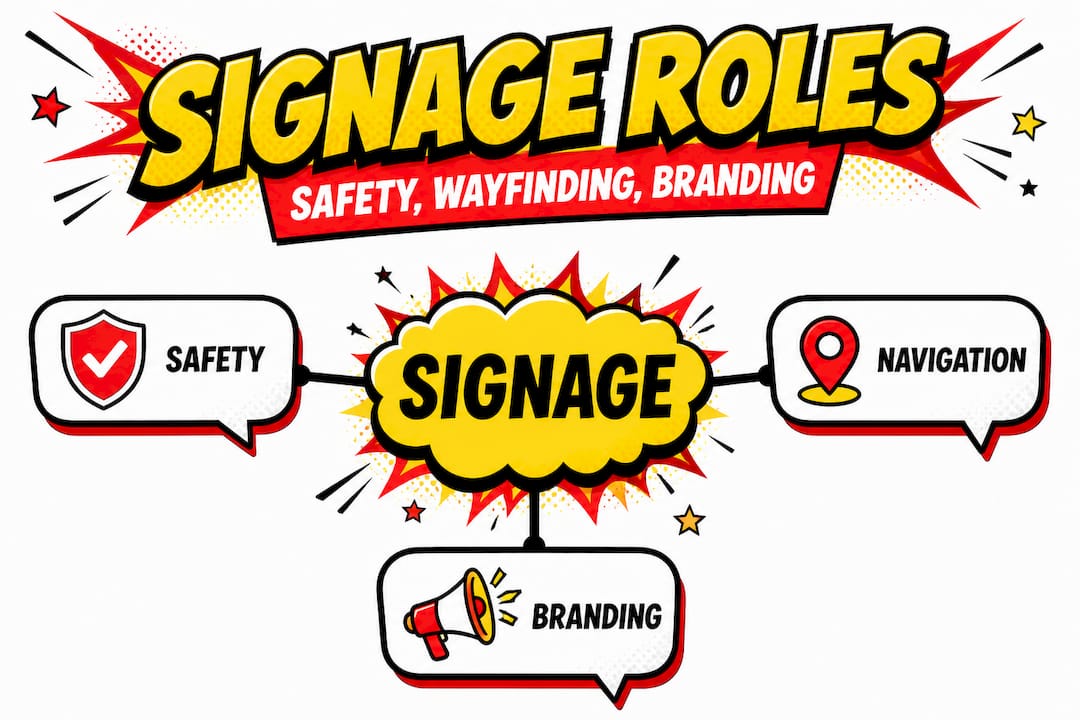
Navigation signage, often called wayfinding, manages the flow of large crowds safely and efficiently. In a stadium holding several thousand spectators, poorly positioned directional signs can cause dangerous bottlenecks at exits, confusion over evacuation routes, or simply a frustrating visitor experience that damages your reputation.
Branding signage covers everything from your venue’s name and identity through to sponsor boards, digital displays, and event-specific dressing. It creates commercial value and shapes how fans, sponsors, and media perceive your facility.
| Category | Key objective | Typical impact | Legal context |
|---|---|---|---|
| Safety | Communicate hazards and required actions | Prevents injury, supports emergency response | HSE 1996 Regulations |
| Navigation | Guide visitors through the facility | Controls crowd flow, reduces confusion | Venue licensing conditions |
| Branding | Reinforce identity and commercial value | Fan engagement, sponsorship revenue | Sponsor/broadcast contracts |
Common signage types across these categories include:
- Safety: Prohibitory signs (no entry, no smoking), warning signs (slippery surface, high voltage), mandatory signs (wear hi-vis, fire door keep shut), emergency signs (fire exits, first aid)
- Navigation: Directional arrows, zone identifiers, seating block signs, accessible route signs
- Branding: Fascia signs, LED display boards, sponsor banners, event overlay panels, vinyl graphics
If you manage a facility that also involves construction or refurbishment phases, it is worth reviewing types of construction signage to ensure you have separate, clear systems for each stage.
Legal standards and compliance: what every sports venue must know
UK sports venues are bound by the Health and Safety (Safety Signs and Signals) Regulations 1996, which require consistent use of standardised safety signs. This is not optional. Failure to comply can result in enforcement action from the Health and Safety Executive (HSE), and in the event of an incident, non-compliant signage will be scrutinised closely.
The four main sign types defined under these regulations are:
- Prohibitory signs: Red circle with a diagonal bar on a white background. Used to forbid specific actions, for example no unauthorised entry, no smoking.
- Warning signs: Yellow triangle with a black border. Used to alert people to a hazard, such as wet floors, low headroom, or high-voltage equipment.
- Mandatory signs: Blue circle with a white symbol. Used to require a specific action or behaviour, for example wearing safety footwear or operating fire doors correctly.
- Emergency escape or fire equipment signs: Green rectangle or square, with white symbols or text. Used to indicate exit routes, first aid, and fire-fighting equipment.
| Sign type | Colour | Shape | Typical use in sports venues |
|---|---|---|---|
| Prohibitory | Red and white | Circle with bar | No entry, no unauthorised access |
| Warning | Yellow and black | Triangle | Slippery surfaces, electrical hazards |
| Mandatory | Blue and white | Circle | PPE requirements, door operation |
| Emergency | Green and white | Rectangle | Fire exits, evacuation routes, first aid |
HSE guidance is clear that signage must be designed, placed, and maintained so that people notice and act on them in time. That means considering sight lines, lighting conditions, and the height at which signs are fixed.
A basic compliance audit for your venue should follow these steps:
- Walk every public and staff area and list all existing signage.
- Cross-reference each sign against the correct type, colour, and shape standards.
- Check that all mandatory locations (fire exits, hazard zones, restricted areas) have appropriate coverage.
- Confirm that signs are visible at the distances and angles from which they will be approached.
- Document any gaps and create a prioritised replacement or installation schedule.
- Set a regular review cycle (at least annually, or after any structural change).
For a thorough reference on your obligations, the full detail of UK signage compliance rules is worth reviewing before any audit or renovation project. Familiarising yourself with signage terminology also helps when briefing contractors or sign manufacturers.
Pro Tip: If you are planning a facility build or renovation, map your signage requirements during the design phase rather than retrofitting them later. This saves significant cost and avoids compliance gaps that are expensive to fix once construction is complete.
Placement, visibility, and maintenance: practical best practice
Knowing which signs you need is only part of the task. Where you place them, how well they are lit, and how consistently you maintain them determines whether they actually work.
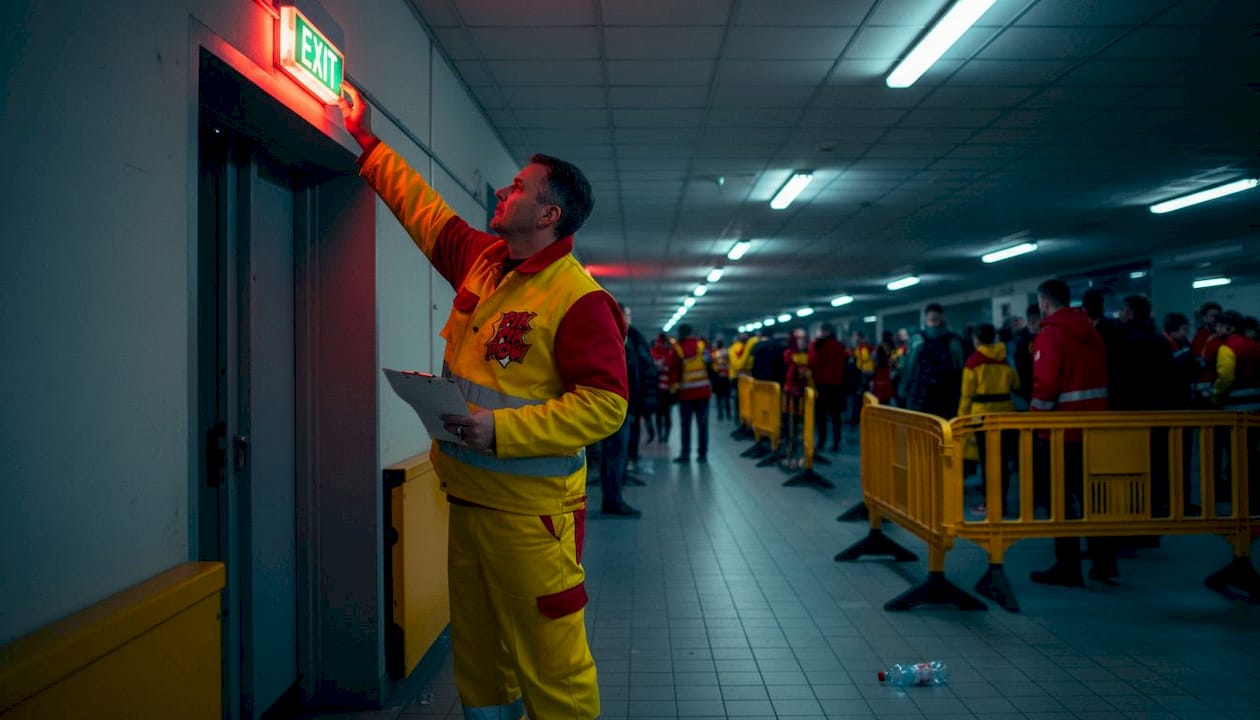
Signs should be placed, lit, and maintained so people can notice, read, and act on them in time. In practice, that means fixing signs at eye level where possible, ensuring they are not obscured by fixtures, advertising boards, or other signs, and using illuminated or reflective versions in areas with variable or low lighting.
High-priority signage locations in a sports venue include:
- All public entrances and exits
- Stairways, ramps, and escalators
- Emergency evacuation routes and assembly points
- Changing rooms and accessible facilities
- High-risk zones (plant rooms, electrical installations, kitchens)
- Event-specific areas such as media zones, VIP access, or field-of-play perimeters
- Car parks and external approach routes
The most common pitfalls facility managers encounter are signage clutter (too many signs grouped together so that none is read properly), ambiguous messaging (signs that are technically correct but unclear in context), and poor maintenance. A faded, dirty, or damaged sign is not just ineffective; it may actively mislead and creates a liability if an incident occurs in that area.
For car parks and outdoor routes, roadway marking guidance provides useful additional context on how surface markings and vertical signs work together for vehicle and pedestrian management.
Use this practical maintenance checklist:
- Inspect all signs at a set frequency, monthly as a minimum in high-traffic areas.
- Clean signs as part of the inspection, removing dirt, dust, and graffiti.
- Replace any sign that is faded, cracked, or illegibly damaged immediately.
- Test illuminated signs to confirm lighting is functioning correctly.
- Check that no new fixtures, displays, or equipment have obstructed existing signs since the last inspection.
Pro Tip: Assign responsibility for sign maintenance to a named member of the facilities team. Shared responsibility often means no one acts. A named owner with a documented schedule produces far better results.
For a structured approach to your internal spaces, an indoor signage checklist covering visibility and compliance standards is a practical tool to have on hand.
Configurable signage: balancing event requirements and branding
Multi-use venues face a specific challenge that single-sport or single-purpose facilities do not. When your stadium or sports centre hosts events across different sports, different promoters, and different broadcasters, your signage needs to adapt quickly without compromising safety or compliance.
One significant factor is the clean-site principle, a requirement found in major-event hosting arrangements that restricts visible sponsorship and naming-rights signage for the duration of the event. This is common when international governing bodies or broadcast partners require a controlled visual environment. It means permanent sponsor signage must be covered, removed, or made invisible for the event period, then reinstated afterwards.
Planning for this from the outset saves significant operational cost and stress. The key is choosing signage systems that support flexibility.
| Signage type | Advantages | Disadvantages |
|---|---|---|
| Permanent | Durable, cost-effective long term, consistent branding | Inflexible, requires physical alteration for events |
| Temporary/removable | Highly adaptable, quick to install and remove | Higher recurring cost, requires storage |
| Digital | Fully programmable, instant updates, multi-event ready | Higher upfront cost, requires power and maintenance |
Practical solutions for configurable signage include:
- Removable panel systems: Magnetic or clip-fixed panels that sit over permanent branding and can be swapped for event-specific graphics within hours.
- Overlay banners: Lightweight PVC or fabric banners that cover sponsor boards without permanent fixing.
- Programmable digital signs: LED boards or digital displays that can switch between safety information, wayfinding, event branding, and sponsor content at the touch of a button.
- Modular wayfinding systems: Sign frames that accept interchangeable inserts, allowing directional content to be updated for different event layouts.
HSE guidance also notes that management systems should decide where warning and instruction signs are needed and confirm their adequacy for emergency responses. This is especially relevant in multi-event venues where the physical layout, crowd size, and access routes may change between events.
Explore digital signage solutions as a starting point for versatile event signage, and look at removable signage systems for venues that need rapid changeover capability. For facilities that also manage outdoor sports courts, sports court installation guidance may inform surface-level marking decisions alongside vertical signage planning.
Developing a signage strategy: risk control to visitor experience
Once you understand the legal requirements, placement principles, and flexibility options, the final step is pulling it all together into a structured strategy. A venue signage strategy is not a one-off document. It is an ongoing management tool.
Signage should be treated as part of the facility’s risk controls and wayfinding system, starting with hazard mapping and ensuring alignment with legal standards. The following steps will help you build a strategy that covers both compliance and visitor experience:
- Carry out a hazard and space mapping exercise. Walk the entire facility and identify every area where a hazard exists, where crowds congregate or move through, and where decision points occur for visitors navigating the space.
- Identify stakeholder requirements. Consult your safety officer, operations team, marketing department, and any event promoters or governing bodies who use the venue regularly.
- Run a compliance check against current HSE standards. Cross-reference your planned signage against the four sign types and their required formats, colours, and placement rules.
- Assess event-specific needs. Identify which areas need configurable signage for events and what your plan is for clean-site compliance or event rebranding.
- Create a maintenance and review schedule. Set inspection frequencies, assign responsibilities, and build in a review cycle that includes any change in layout, tenancy, or event calendar.
- Integrate branding from the start. Work with your marketing team to ensure that brand signage, sponsor boards, and visitor-facing graphics are designed with the same rigour as safety and wayfinding signs.
For venues with complex development or ongoing capital projects, understanding signage impacts for developers is directly relevant and can inform how signage is specified during the project lifecycle. Facilities that also manage external roadways and vehicle access should consider roadway markings as part of the overall strategy.
Pro Tip: Involve both operational and marketing staff in your signage strategy from the beginning. Operations brings safety rigour; marketing brings brand consistency. Venues that plan signage in silos end up with compliant but visually inconsistent spaces, or visually impressive venues that fail safety checks.
The overlooked opportunity: signage as an ongoing asset, not a tick-box
Here is an uncomfortable truth for many sports venue managers: most signage programmes are treated as a one-off capital expense, installed during a build or refurbishment and then left untouched until something breaks or an audit flags a problem. That approach works as a minimum, but it misses a significant opportunity.
Facilities that review and update their signage regularly, not just for compliance reasons but with genuine thought about fan experience, technology, and commercial value, consistently outperform those that do not. Digital signage in particular has shifted from a premium option to a practical tool for mid-sized venues. The ability to display real-time safety information, live event updates, wayfinding adjustments for different crowd flows, and dynamic sponsor content from a single system is genuinely transformative.
Consider what happens when your signage strategy evolves with your venue. Fans notice when a space feels current and well-managed. Sponsors pay more attention to digital inventory than static boards. Safety teams have more confidence when signs are regularly verified rather than assumed to be adequate. The venues that treat signage as a living part of their facility management, reviewing it as part of each event cycle and each year’s capital plan, are the ones that avoid costly emergency replacements and build a stronger commercial and safety record simultaneously.
This is not about spending more money. It is about treating signage with the same professional rigour you apply to pitch maintenance, staffing, or security. The indoor signage best practice framework is a practical starting point for building that habit into your regular operations.
Find the right signage solutions for your sports facility
If this guide has prompted you to review or improve your venue’s signage, the next step is getting hands-on support from a specialist who understands both the compliance requirements and the practical realities of managing a busy sports facility.
At Pik Pik Pow!, we work with facility managers and venue operators across the UK to design, manufacture, and install signage that meets HSE standards, adapts to event requirements, and strengthens your venue’s identity. Whether you need a full audit and strategy review or specific solutions for a particular challenge, we can help. Explore our custom signage systems for adaptable venue solutions, speak to our wayfinding signage specialists for complex navigation projects, or find out how our digital signage experts can give your venue flexible, future-ready display capability.
Frequently asked questions
What are the four types of safety signs required in UK sports venues?
Prohibitory, warning, mandatory, and emergency signs are the four legally defined categories under the Health and Safety (Safety Signs and Signals) Regulations 1996, and all must follow the prescribed colour, shape, and format standards.
How often should signage be inspected in sports facilities?
Regular inspection is essential; signs must remain clean, visible, and properly lit or reflective at all times, so a monthly check in high-traffic areas and a formal annual audit is considered good practice.
What is a ‘clean-site’ requirement for event signage?
A clean-site rule restricts visible sponsorship and naming-rights signage for the duration of a major event, typically as a condition of hosting agreements with international governing bodies or broadcast partners.
Where should safety signage be placed for maximum effectiveness?
Place signs at key decision points including entrances, exits, evacuation routes, and high-risk zones so they are clearly visible and understood before people need to act on them.
Why involve both operations and marketing teams when planning signage?
Operations staff ensure that safety and compliance requirements are fully met, while marketing teams maintain brand consistency, and collaboration between both produces signage that is legally sound, commercially effective, and coherent for visitors.