
TL;DR:
- A signage checklist ensures compliance, safety, and brand consistency across facilities.
- Regular audits and updates prevent signage from becoming outdated or damaged.
- Expert support can help design, install, and maintain effective indoor signage systems.
Balancing compliance, safety, and brand identity across a busy facility is no small task. Miss a single required sign and you risk a safety incident, a failed inspection, or a confused visitor who cannot find the exit. For facility managers in retail, commercial interiors, and the TV and film industry, indoor signage is one of those areas that looks simple on the surface but carries serious consequences when it goes wrong. This guide walks you through a practical indoor signage checklist covering mandatory requirements, design best practice, and audit processes, so you can manage your spaces with confidence.
Table of Contents
- Why every facility needs an indoor signage checklist
- Mandatory signage: what you must include
- Branding, legibility, and location: making your signage work harder
- Maintaining and auditing your indoor signage
- What most checklists miss: the danger of ‘set and forget’ signage
- Get expert help with your indoor signage solutions
- Frequently asked questions
Key Takeaways
| Point | Details |
|---|---|
| Compliance is critical | Missing mandatory signs can result in penalties—review legal requirements regularly. |
| Visibility boosts safety | Clear, well-placed signs help prevent accidents and enhance navigation for all visitors. |
| Brand integration matters | Smart signage can reinforce your unique brand while guiding and protecting visitors. |
| Regular audits save time | Scheduled inspections catch out-of-date or damaged signs before they become an issue. |
Why every facility needs an indoor signage checklist
A checklist is not just a convenience. It is a structured approach to making sure nothing critical is overlooked. When you manage a large retail unit, a film studio, or a multi-floor commercial interior, the sheer number of signs in play makes informal oversight unreliable. A checklist gives you a repeatable process.
Understanding what is indoor signage is the first step. Indoor signage covers everything from fire exit notices and hazard warnings to branded wayfinding panels and room identification plates. Each category serves a different purpose, but all of them need to be present, legible, and accurate.
Here is why a formal checklist matters for your facility:
- Legal compliance: UK law requires specific safety signs to be displayed in workplaces and public buildings. Missing these exposes you to enforcement action and liability.
- Staff and visitor safety: Clear signage guides people to exits, first aid points, and safe routes, especially critical during an emergency.
- Brand consistency: In retail and commercial interiors, signage is part of the customer experience. Inconsistent or damaged signs undermine your brand.
- Operational accuracy: Layouts change. A checklist ensures signs are updated when rooms are repurposed, routes are altered, or hazards shift.
- Audit readiness: A documented checklist means you can demonstrate compliance to inspectors or insurers at any time.
The office FM checklist confirms that signage for fire exits, hazards, and first aid points must be included in any facilities management routine, with regular inspections required to maintain accuracy and compliance.
A signage checklist is not a one-time document. It is a living tool that should be reviewed every time your facility changes, not just once a year.
Maintaining signage compliance in the UK requires you to stay current with regulations and to inspect signs regularly. The checklist is the mechanism that makes this achievable in practice.
Now that you know the stakes, let us explore which signs must be included.
Mandatory signage: what you must include
Some signs are not optional. UK legislation and health and safety regulations set out specific requirements for what must be displayed in workplaces and public-facing spaces. Getting this right is the foundation of any effective indoor signage checklist.
Here are the core mandatory sign categories you need to account for:
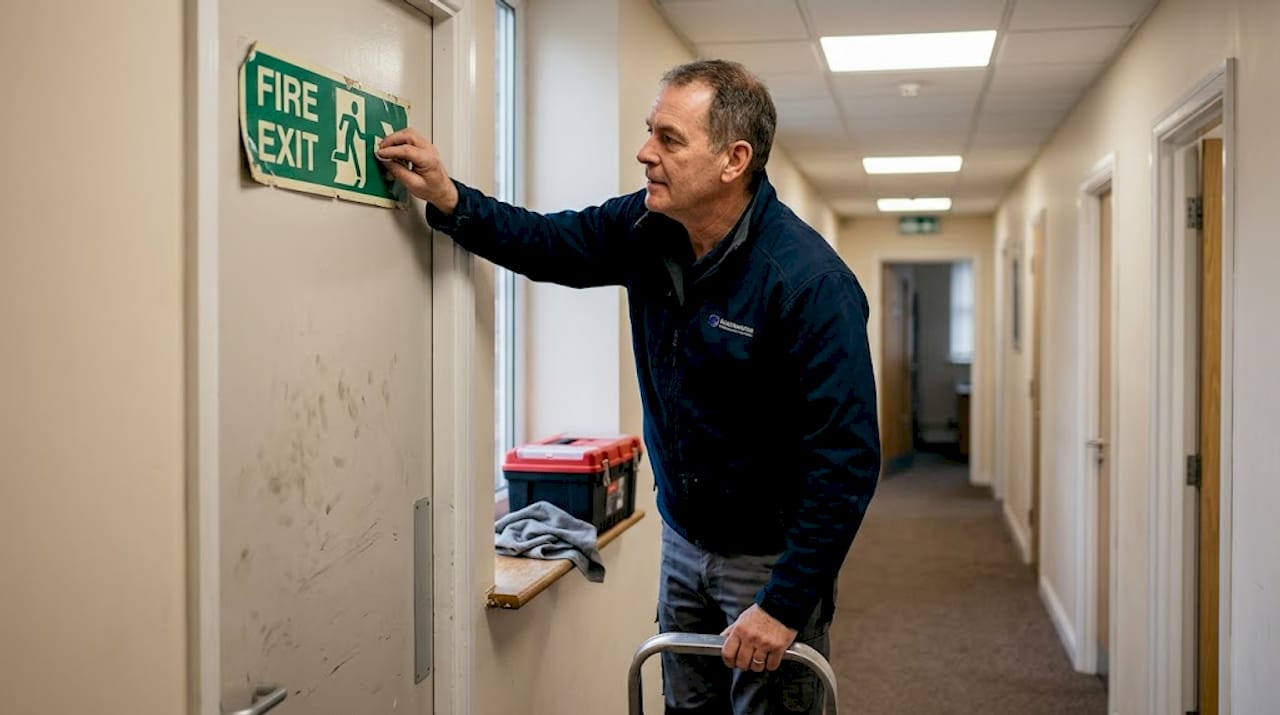
- Fire exit and emergency route signs: Every building must display illuminated or photoluminescent fire exit signs on all escape routes. These must conform to BS 5499 standards and be visible from any point along the route.
- Hazard warning signs: Areas containing electrical equipment, chemical storage, or physical risks require clearly posted hazard signs. These follow specific colour and symbol conventions under the Health and Safety (Safety Signs and Signals) Regulations 1996.
- First aid signs: The location of first aid kits, defibrillators, and first aid rooms must be clearly signed. Green and white signs are the standard for safe condition and first aid information.
- Prohibition and mandatory signs: No smoking, no entry, and PPE requirement signs fall into this category. Prohibition signs are red and white; mandatory signs are blue and white.
- Custom hazard signs: Some facilities have unique risks, such as a film studio with high-voltage lighting rigs or a retail unit with a loading bay. These require bespoke signs that communicate the specific hazard clearly.
For navigation and branding signage to work alongside mandatory signs, you need a coherent system where safety information is never obscured or confused with decorative elements.
Pro Tip: Walk your facility as a first-time visitor before conducting your audit. You will quickly spot missing or confusing signs that your team has stopped noticing because they are familiar with the space.
The legal signage regulations confirm that signage is a legal requirement for fire exits, hazards, and first aid. Understanding the full range of types of signage available helps you match the right format to each requirement.
With legal and essential signs covered, it is time to think about how to select and upgrade your signage for maximum impact.
Branding, legibility, and location: making your signage work harder
Compliance gets you to the minimum standard. Good design and placement get you to a space that works well for everyone in it. The most effective indoor signage does both at once.
Legibility is the starting point. A sign that cannot be read quickly is a sign that is not doing its job. Key factors that affect readability include:
- Font size and typeface: Sans-serif fonts at appropriate sizes for the viewing distance are the standard. A sign at the end of a 10-metre corridor needs larger text than one mounted beside a door.
- Colour contrast: High contrast between text and background improves visibility in all lighting conditions. Dark text on a light background, or light text on a dark background, both work well.
- Lighting: Signs in poorly lit areas may need to be internally illuminated or made from photoluminescent material to remain visible.
- Mounting height: Eye-level mounting works for most wayfinding signs. Overhead mounting suits directional signs in busy corridors where sightlines at ground level are blocked.
The table below compares placement and design choices by their impact on effectiveness:
| Design or placement factor | Lower effectiveness | Higher effectiveness |
|---|---|---|
| Font choice | Decorative or serif fonts | Clean sans-serif fonts |
| Colour contrast | Low contrast (e.g. grey on white) | High contrast (e.g. black on white) |
| Mounting position | Behind obstacles or too low | Eye level, unobstructed |
| Lighting | Unlit in dim areas | Illuminated or photoluminescent |
| Brand integration | Generic, no brand identity | Consistent with brand colours and style |
Durable signage for safer spaces also matters here. Signs that fade, warp, or peel quickly lose their effectiveness and reflect poorly on your facility. Choosing the right substrate and finish for the environment, whether that is a high-traffic retail floor or a temperature-controlled studio, extends the life of your investment.
Pro Tip: Align your wayfinding sign colours and typography with your brand guidelines wherever possible. This creates a cohesive environment without compromising the clarity required for safety signs.
Boosting navigation with signage is most effective when you treat wayfinding as a system rather than a collection of individual signs. Each sign should connect logically to the next, guiding visitors through your space without confusion. Signage maintenance tips confirm that regular inspections ensure signage maintains both effectiveness and compliance over time.
Having explored design and placement, let us see how to keep your checklist and facility up to date.
Maintaining and auditing your indoor signage
Installing the right signs is only half the work. Keeping them accurate, legible, and compliant over time requires a structured audit process. Without one, signs get damaged, become outdated, or simply go unnoticed until something goes wrong.
Here is a practical approach to setting up your audit schedule:
- Monthly visual checks: Walk the facility and look for damaged, faded, obscured, or missing signs. Note any that need repair or replacement.
- Quarterly full audits: Cross-reference every sign against your master checklist. Confirm that all mandatory signs are present, correctly positioned, and compliant.
- Post-renovation or layout change audits: Any time a space is repurposed, a wall is moved, or a route changes, conduct an immediate signage review. This is when gaps most commonly appear.
- Annual compliance review: Review your signage against current regulations. Standards and requirements do change, and an annual review ensures you stay current.
The table below shows a sample audit checklist for a typical commercial facility:
| Sign type | Location | Compliant (Y/N) | Condition | Last updated |
|---|---|---|---|---|
| Fire exit sign | Main corridor | Y | Good | Jan 2026 |
| Hazard warning | Electrical cupboard | Y | Fair | Oct 2025 |
| First aid point | Reception | Y | Good | Jan 2026 |
| No smoking sign | Entrance lobby | Y | Good | Jan 2026 |
| Wayfinding panel | Level 2 stairwell | N | Damaged | Needs update |
Documenting your audit findings is as important as conducting them. A written record shows inspectors and insurers that you have a proactive approach to signage terminology and compliance. It also makes it easy to delegate maintenance tasks and track which signs have been updated.
Facilities signage audit guidance confirms that regular inspections are necessary for both compliance and accuracy. Following best practices for signage gives you a framework that works across all types of indoor environments.
Pro Tip: Create a shared digital document or spreadsheet for your signage audit records. This makes it easy for multiple team members to contribute updates and ensures nothing is lost if a key person leaves the organisation.
Armed with a full understanding of compliance, design, and maintenance, it is worth reflecting on a hidden pitfall many teams miss.
What most checklists miss: the danger of ‘set and forget’ signage
Most facilities get the initial installation right. The real problem comes six months later, when a partition wall goes up, a team moves floors, or a new hazard is introduced and nobody thinks to update the signs.
We see this regularly. A facility that passed its last inspection now has wayfinding panels pointing to a room that no longer exists, or a hazard sign that refers to equipment that has been moved. These are not just aesthetic problems. They create genuine confusion and, in an emergency, genuine danger.
The mistake is treating signage as a project with a start and end date. It is not. It is an ongoing responsibility that needs to be embedded into every operational change process. When you plan a refurbishment, signage review should be on the project checklist from day one, not added as an afterthought at the end.
Staying current with the latest updates on signage practice and regulation is part of this. The facilities that manage signage best are the ones that have made it a habit, not a reaction.
Get expert help with your indoor signage solutions
Putting a checklist together is a strong start. Turning it into a fully compliant, well-branded signage system is where specialist support makes a real difference.
At Pik Pik Pow, we work with facility managers, retail chains, and production teams across the UK to design, manufacture, and install indoor signage that meets both legal requirements and brand standards. From initial surveys and compliance checks to bespoke design and precision installation, we handle the full process. Our signage systems cover every category on your checklist, and our internal and wayfinding signage solutions are built to perform in demanding commercial environments. Get in touch to discuss your requirements and let us help you build a signage setup that works.
Frequently asked questions
What are the legal requirements for indoor signage in the UK?
UK law requires facilities to display signs for fire exits, hazards, and first aid points, in line with the Health and Safety (Safety Signs and Signals) Regulations 1996. Non-compliance can result in enforcement action and increased liability in the event of an incident.
How often should indoor signage be inspected?
You should carry out visual checks monthly and full audits quarterly, with additional reviews after any layout changes or renovations. Regular inspections are necessary to maintain both compliance and accuracy across your facility.
What are the best materials for indoor signage?
Durable, easily cleaned, and fire-retardant materials are the best choice for indoor signage, as they maintain legibility and safety performance over time. The right substrate depends on the specific environment, whether that is a high-traffic retail floor, a studio set, or a corporate office.
Can indoor signage help with branding as well as compliance?
Yes. Well-designed signage integrates your brand colours, typography, and style into wayfinding and informational panels, reinforcing your identity while meeting legal requirements. The key is to keep safety signs clearly distinct from branded elements so there is no confusion between the two.