

TL;DR:
- Consistent signage enhances brand recognition, customer trust, and safety compliance across multiple locations.
- Digital and innovative signage solutions enable real-time updates and targeted messaging for greater engagement.
- Proper planning and standardized standards are essential to avoid operational, legal, and reputational risks.
Signage is often treated as a finishing touch, something you sort once and forget. But for businesses operating across multiple locations, that mindset creates real problems. Inconsistent or poorly planned signage affects how customers perceive your brand, how safely they navigate your sites, and whether they return. The truth is, signage does far more than display your logo. It shapes first impressions, guides behaviour, supports compliance, and reinforces trust at every single touchpoint. This article walks you through the strategic value of multi-site signage, the benefits you may be missing, and the practical steps to get it right across your entire estate.
Table of Contents
- The strategic role of signage in multi-site businesses
- Key benefits: Beyond the logo – what signage delivers
- Ensuring consistency and compliance: Best practices for multi-site signage
- Innovation and digital trends shaping signage for multi-site brands
- Our perspective: The hidden costs of poor signage and the real ROI
- Elevate your multi-site signage strategy with Pik Pik Pow
- Frequently asked questions
Key Takeaways
| Point | Details |
|---|---|
| Signage builds brand trust | Consistent, branded signage at every location boosts recognition and customer confidence. |
| Uniform signage streamlines operations | Well-managed signage prevents confusion and improves staff and customer experience. |
| Compliance protects your business | Following legal standards for signage across all sites avoids costly penalties and reputational risk. |
| Innovation drives engagement | Adopting digital signage and sustainable materials helps future-proof growing multi-site businesses. |
The strategic role of signage in multi-site businesses
When we talk about signage in a multi-site context, we mean the full range of visual communication tools across your locations. That includes exterior fascia signs, illuminated shopfronts, interior wayfinding systems, digital display screens, window graphics, and branded vehicle wraps. Each of these plays a distinct role, and together they form the visual identity of your business in the physical world.
Signage is, in effect, a silent brand ambassador. It works around the clock, communicating your brand values without a word being spoken. At every site you operate, it either reinforces or undermines the experience you want customers to have. That is a significant responsibility for something many businesses treat as a procurement afterthought.
“Consistent branded signage enhances recognition and trust across locations.” Getting this right at scale is what separates brands that feel coherent from those that feel fragmented.
For multi-site businesses, the stakes are higher than for a single outlet. A customer who visits your Manchester branch and then your Birmingham branch expects the same experience. If the signage is mismatched in colour, font, or quality, that inconsistency registers, even if the customer cannot articulate why. It creates doubt. And doubt erodes loyalty.
The core functions that well-executed signage delivers across multiple sites include:
- Brand recognition: Uniform visual identity across all locations builds familiarity and recall.
- Customer confidence: Clear, professional signage signals that your business is organised and trustworthy.
- Wayfinding and safety: Directional and safety signage reduces confusion and supports regulatory compliance.
- Promotional alignment: Consistent messaging across sites ensures campaigns land with equal impact everywhere.
- Operational efficiency: Staff and visitors can navigate and operate within your sites more effectively.
Investing in durable signage and branding also protects your long-term spend. Signs that fade, warp, or deteriorate quickly cost more to replace and damage your brand image in the interim.
Key benefits: Beyond the logo – what signage delivers
Understanding the role of signage, we now break down the direct and practical benefits you can expect when you approach it strategically across your sites.
Well-designed signage increases footfall and improves customer experience, and that holds true whether you are running a retail chain, a corporate campus, or a hospitality group. The benefits are tangible and measurable.
Here is a breakdown of what effective multi-site signage actually delivers:
- Attract new customers: Exterior signage is often the first point of contact. A clear, well-lit fascia sign on a high street or retail park draws attention and communicates what you offer before anyone steps inside.
- Reduce in-store friction: Interior wayfinding and departmental signage help customers find what they need without staff assistance, improving satisfaction and freeing up your team.
- Reinforce promotions consistently: When a campaign rolls out across 20 or 50 locations, consistent point-of-sale and window graphics ensure every site delivers the same message at the same time.
- Support safety and compliance: Mandatory health and safety signage, fire exit markers, and accessibility information are non-negotiable in regulated environments.
Pro Tip: When planning a signage rollout, brief your designer on designing impactful site signage from the outset. Getting the design right before production saves significant cost and time across multiple sites.
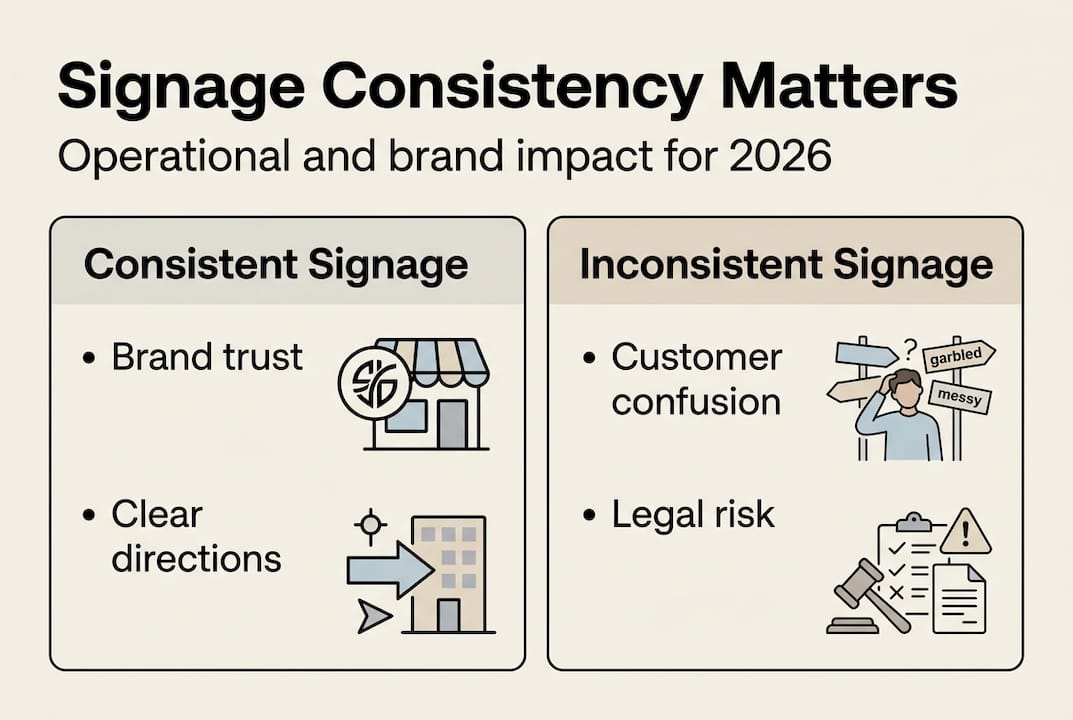
The contrast between uniform and inconsistent signage is stark when you put it side by side:
| Metric | Uniform signage | Inconsistent signage |
|---|---|---|
| Brand recognition | High across all sites | Variable, weakens recall |
| Customer satisfaction | Consistent, positive | Patchy, can frustrate |
| Safety compliance | Standardised, auditable | Gaps and risks |
| Promotional impact | Aligned, campaign-ready | Diluted, off-message |
| Staff confidence | Clear operational guidance | Confusion and errors |
The table makes it clear: inconsistency is not just an aesthetic issue. It has operational and legal consequences that compound across a large estate.
Ensuring consistency and compliance: Best practices for multi-site signage
Knowing the benefits, the next step is mastering multi-site signage implementation and legal compliance. This is where many businesses struggle, particularly when sites have been acquired at different times or managed by different regional teams.
Misaligned signage can confuse both staff and customers, impacting safety and operations. That risk increases with every additional site you add to your estate.
The foundation of consistent multi-site signage is a clear set of brand standards. These should define:
- Colour specifications: Pantone or RAL references for all brand colours, not just hex codes.
- Typography: Approved fonts, sizes, and hierarchy for different sign types.
- Iconography and symbols: Standardised icons for wayfinding, safety, and accessibility.
- Material and finish specifications: So that signs look identical whether produced in London or Leeds.
- Regulatory requirements: Mandatory text, sizing, and placement for compliance signage.
Centralised control over signage procurement is generally the most effective approach for large estates. It ensures consistency, allows bulk production savings, and makes audits straightforward. However, some local adaptation is sometimes necessary, for example where planning permissions vary by location or where a site serves a specific demographic. The key is to define clearly what is fixed and what is flexible.
Pro Tip: Review your signage compliance rules before any major rollout. UK planning regulations, the Health and Safety (Safety Signs and Signals) Regulations 1996, and accessibility standards under the Equality Act 2010 all apply to business signage.
For a practical rollout, follow these steps:
- Audit existing signage across all sites and identify gaps or non-compliant elements.
- Produce a master sign schedule listing every sign type, location, and specification.
- Work with a single supplier to ensure consistency in materials, colour matching, and finish.
- Stagger installation to manage disruption, prioritising customer-facing and safety-critical signs first.
- Schedule regular reviews, at least annually, to catch deterioration or compliance changes.
For regulated sectors such as construction, healthcare, or food retail, signage tips for safety are especially important. Non-compliance can result in enforcement action, fines, or worse.
Innovation and digital trends shaping signage for multi-site brands
With best practices in mind, let us explore what innovation and technology bring to signage strategy for businesses managing multiple sites.
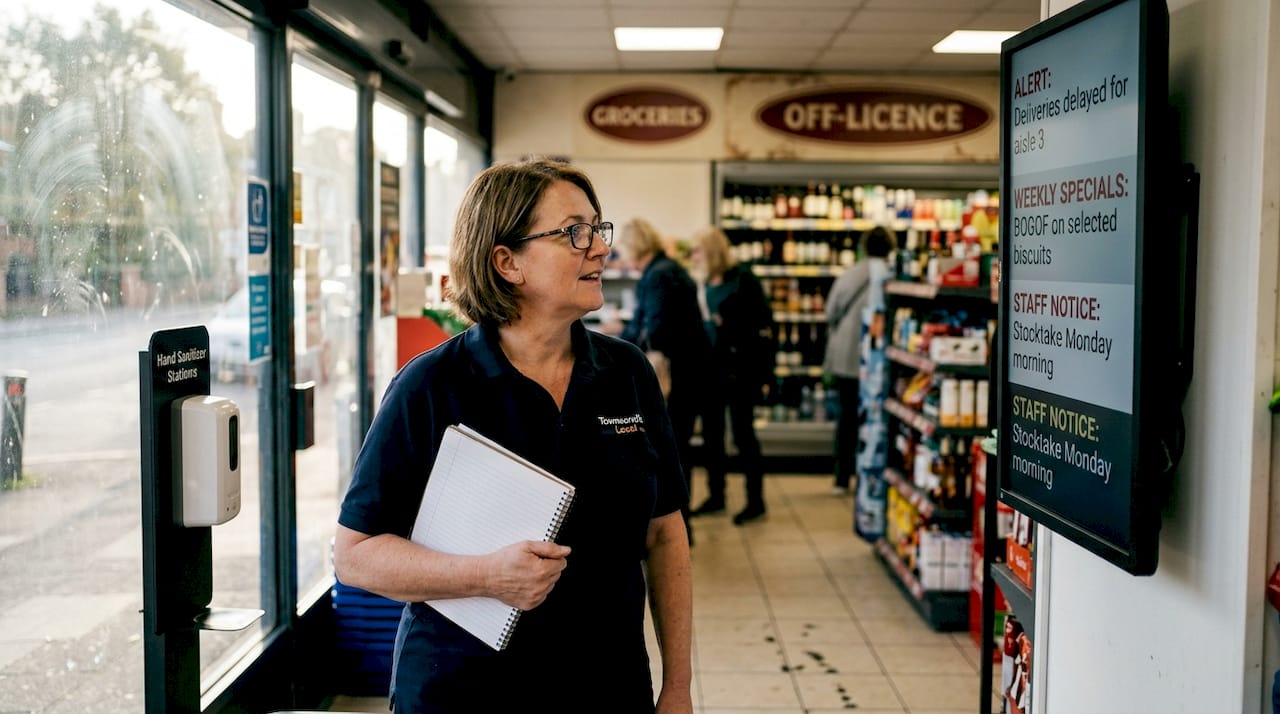
Digital signage offers real-time content updates and analytics for enhanced engagement, making it one of the most powerful tools available to multi-site operators today. The ability to change messaging instantly across every location, without printing or logistics, is a significant operational advantage.
The key capabilities digital signage delivers include:
- Dynamic content: Promotions, menus, or announcements can be updated centrally and pushed to all screens simultaneously.
- Audience targeting: Content can be scheduled by time of day, location, or audience profile.
- Analytics integration: Screen engagement data helps you understand what messaging works and where.
- Emergency communications: Critical safety or operational messages can be broadcast instantly across all sites.
Sustainability is also reshaping how businesses approach signage. Eco-responsible printing using recycled substrates, water-based inks, and energy-efficient LED illumination reduces your environmental footprint without compromising quality. For businesses with ESG commitments, this matters both internally and to customers.
Looking ahead, the trends worth watching include AI-driven content personalisation, where screens adapt messaging based on real-time data such as weather or footfall, mobile integration that connects physical signage to customer smartphones, and centralised management software that gives operations teams full visibility and control over every sign across every site from a single dashboard.
Key stat: The global digital signage market is projected to grow significantly through the late 2020s, reflecting how seriously businesses are investing in this channel as a core part of their customer experience strategy.
For multi-site brands, the combination of physical and digital signage, managed centrally but deployed locally, represents the most adaptable and future-ready approach available.
Our perspective: The hidden costs of poor signage and the real ROI
Here is something most signage articles will not tell you: the biggest cost of poor signage is not the replacement bill. It is the slow, invisible erosion of customer trust and operational confidence that happens in the background.
We see it regularly. A business cuts its signage budget during a cost review, opts for cheaper materials or skips a rollout update, and then wonders why footfall is down or why a site feels tired. The connection is rarely made explicitly, but it is real.
The ROI of good signage is not just aesthetic. It shows up in faster customer journeys, fewer staff queries about directions or procedures, fewer compliance incidents, and stronger brand recall that drives repeat visits. These are measurable outcomes, even if they are rarely attributed directly to signage spend.
Treating signage as an investment rather than a cost changes how you plan and procure it. It means specifying materials that last five to ten years rather than two. It means working with a partner who understands shop sign design essentials and can advise on what will perform across different site environments. The businesses that get multi-site signage right are the ones that plan it properly from the start.
Elevate your multi-site signage strategy with Pik Pik Pow
If this article has prompted you to look more critically at your current signage estate, that is a good starting point. The next step is getting expert input on what you have, what you need, and how to close the gap efficiently.
At Pik Pik Pow, we work with multi-site retail and corporate businesses to design, produce, and install signage that performs consistently across every location. From signage systems and digital signage to wayfinding solutions, we offer the full range of solutions your estate needs. Get in touch to arrange a site-wide signage audit or consultation, and let us help you build a signage strategy that works as hard as your business does.
Frequently asked questions
What types of signage do multi-site businesses need most?
Different signage types serve distinct purposes, but multi-site businesses benefit most from a combination of exterior fascia signs, interior wayfinding, digital displays, window graphics, and branded vehicle wraps to cover every customer touchpoint.
How does inconsistent signage impact customer experience?
Misaligned signage leads to confusion and reduced customer satisfaction, and across multiple sites it actively weakens brand trust and reduces the likelihood of repeat visits.
What are the benefits of digital signage for multi-site brands?
Digital signage enables real-time content updates, targeted messaging by location or time of day, and improved engagement across all sites without the cost and delay of reprinting physical materials.
Is there a UK legal requirement for certain business signs?
Yes. UK signage regulations require businesses to display specific health, safety, and accessibility signage at all sites, with non-compliance carrying legal and financial consequences.