TL;DR:
- Consistent signage reinforces brand recognition and trust across multiple locations.
- Addressing site-specific constraints ensures cohesive branding despite physical and regulatory obstacles.
- Ongoing governance and system management prevent brand drift and maintain signage quality.
Even a single inconsistent sign can plant doubt in a customer’s mind before they’ve set foot through your door. Customers use visible brand cues to judge professionalism and trust, and any mismatch across your locations can delay or derail purchasing decisions. Signage is not decoration. It is a frontline brand communicator that either reinforces your credibility or quietly undermines it. This article explains why consistent signage matters so much, how to overcome the real-world obstacles that make it difficult, and what operational systems you need to maintain it effectively across multiple sites.
Table of Contents
- The power of consistent signage for business impact
- Common challenges: physical constraints and regulatory issues
- Governance and systems: maintaining consistency at scale
- Wayfinding and user experience: signage clarity in action
- Why treating consistency as a living system sets leaders apart
- Expert signage solutions for brand consistency
- Frequently asked questions
Key Takeaways
| Point | Details |
|---|---|
| Brand trust begins with signage | Consistent signage signals professionalism and reliability to customers at every location. |
| Overcome site challenges smartly | Adapt signage for local constraints while always maintaining brand coherence and clear intent. |
| Governance keeps programmes on track | True consistency relies on operational systems, centralised standards, and ongoing audits—not just good design. |
| Wayfinding benefits from clarity | Unified signage and terminology make navigating spaces easier and more accessible for everyone. |
The power of consistent signage for business impact
Having established the risks of inconsistency, let us examine the business case for cohesive signage.
When a customer visits one of your retail outlets and then walks into a second branch two weeks later, they should feel an immediate sense of familiarity. The colours, typography, materials, and overall visual tone should speak the same language. This is not a cosmetic concern. It directly affects how much confidence that customer places in your brand. Consistent signage reinforces brand identity and delivers a familiar customer experience across locations in a scalable and repeatable way.
The business case for this kind of consistency is well-established. Think about major retail chains or construction site hoarding programmes that maintain identical visual standards across hundreds of locations. The result is instant recognisability. Customers know what to expect, and that predictability is reassuring. On the other hand, businesses that allow signage to drift, whether through poor procurement decisions, local ad hoc modifications, or neglected replacements, signal a lack of care and attention.
“Brand recognition built through consistent visual cues is one of the most cost-effective investments a business can make. Every sign is a silent salesperson working around the clock.”
Here is a direct comparison of what consistent versus inconsistent signage typically produces for a multi-site business:
| Factor | Consistent signage | Inconsistent signage |
|---|---|---|
| Customer trust | Strengthened at every touchpoint | Eroded by visible mismatches |
| Brand recognition | Immediate and reliable | Patchy and unreliable |
| Operational costs | Lower over time through standardised production | Higher due to one-off replacements |
| Scalability | Simple to replicate across new sites | Complicated by differing local interpretations |
| Staff and visitor experience | Clear, navigable, professional | Confusing and potentially off-putting |
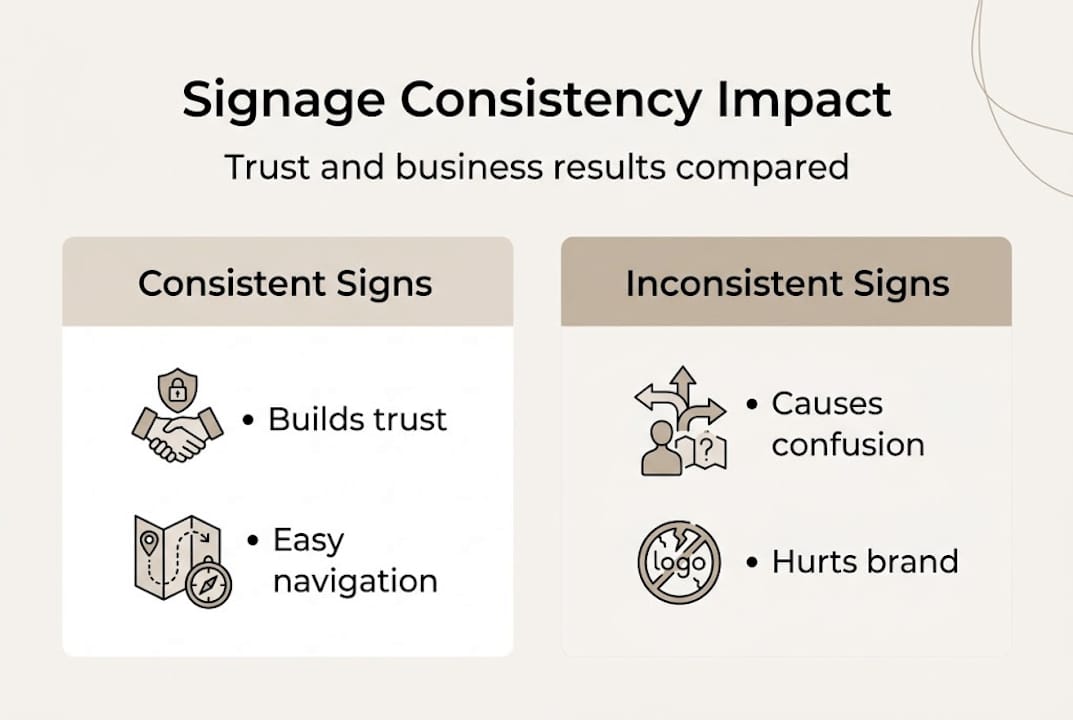
Understanding signage importance for professionalism early in your planning process gives you the foundation to build a consistent programme from the outset rather than retrofitting standards later.
The key benefits of consistent signage for your business include:
- Immediate recognition across all customer-facing locations
- Stronger perceived professionalism, which directly influences purchasing decisions
- Reduced production costs through standardised specifications and bulk ordering
- Simpler onboarding of new locations or construction sites into your brand programme
- Better compliance with brand guidelines, reducing the risk of unauthorised variations
Pro Tip: When designing effective shop signs, build a specification document that covers approved colours (with RAL or Pantone references), fonts, materials, and fixing methods. Share this with every supplier and contractor involved in your signage programme. It becomes the single source of truth.
Businesses that invest in consistent signage at the start of a fit-out or development programme consistently report a smoother rollout and fewer costly corrections down the line. Treating signage as a strategic asset rather than a procurement afterthought is one of the clearest differentiators between brands that scale successfully and those that struggle to maintain their identity as they grow.
Common challenges: physical constraints and regulatory issues
But achieving cohesion is not just a matter of making every sign the same. Real-world environments introduce complications that must be addressed thoughtfully.
Every site is different. A narrow Victorian shopfront in a town centre conservation area presents entirely different challenges to a wide industrial unit on a retail park. Fascia dimensions, wall substrates, planning restrictions, and illumination rules all vary. Compliance and local code constraints can require deviations in execution while still preserving the intended brand outcomes, but navigating this takes careful planning.
The most common physical and regulatory obstacles businesses encounter include:
- Frontage width restrictions, which affect sign proportions and letter sizing
- Listed building or conservation area controls, which may prohibit certain materials, illumination types, or fixing methods
- Landlord consent requirements, which can delay or limit sign installation
- Substrate limitations, such as brick, render, or cladding that require different fixing approaches
- Illumination restrictions, including rules around brightness, colour temperature, and operating hours in residential-adjacent areas
- Planning permission requirements, which differ between local authorities and can vary significantly even within a single city
Here is how these constraints typically present across different site types:
| Site type | Common constraint | Adaptation required |
|---|---|---|
| Conservation area shopfront | No illuminated signage permitted | Unlit painted or applied vinyl lettering |
| Narrow urban frontage | Limited fascia height | Scaled-down typography with simplified logo |
| Industrial unit | Large, open facade | Larger format signage with extended colour field |
| Multi-tenanted building | Landlord design code | Restricted palette and positioning zones |
The important principle here is that consistency is not synonymous with identical signs. The goal is a cohesive brand impression that adapts intelligently to site constraints, not a rigid template that becomes impossible to implement.
Think of it this way: if your brand uses a specific shade of deep blue and a particular typeface, those elements must appear on every sign. But whether the sign is illuminated or non-illuminated, whether it uses aluminium composite or painted timber, is a secondary consideration. What matters is that the visual outcome feels consistent to the customer standing outside.
Signage compliance in construction environments adds further layers of complexity, including safety-critical requirements that must be balanced with brand standards. Understanding types of construction signage in advance helps you plan for these variables before they become expensive problems.
Pro Tip: When briefing a signage supplier for a new site, always share your brand guidelines and the site-specific constraints upfront. A good supplier will tell you what is achievable within both sets of parameters before any design work begins, saving you time and revision costs.
Governance and systems: maintaining consistency at scale
Once physical and code-based constraints are addressed, maintaining consistency becomes an organisational practice.
Brand guidelines are a starting point. They are not a solution on their own. Many businesses invest considerable time and money producing a comprehensive brand manual, only to find that three years later, their signage programme looks entirely different from what was specified. This is known as brand drift, and it is more common than most organisations realise.
Preventing brand drift at scale requires systems for governance, centralised standards, and ongoing maintenance and audits, not just design documentation. The distinction matters enormously. A well-designed sign programme that is not actively managed will degrade over time through localised decisions, aging materials, and inconsistent replacements.
Here is a practical framework for maintaining signage consistency across multiple locations:
- Establish a single point of authority. Designate one person or team responsible for approving all signage decisions. Without this, local managers will make independent choices that accumulate into visible inconsistency.
- Create a pre-approved supplier list. Work with a small number of trusted signage partners who understand your brand standards and can produce to specification without extensive rebranding.
- Set a regular audit schedule. Conduct physical or photographic audits of all signage at least annually, using a standardised scoring framework.
- Define a maintenance and refresh programme. Specify when signs should be cleaned, repaired, or replaced based on material lifespan and visible wear criteria.
- Document every deviation. When a site requires a non-standard solution, record it formally and note why the deviation was necessary. This prevents it becoming a precedent applied elsewhere without justification.
“Treating your brand guidelines as a living document, rather than a printed document filed away, is the single most important operational shift most multi-site businesses can make.”
The risks of neglecting programme-led consistency are significant. A customer who visits your flagship location and then visits a poorly maintained branch with faded, misaligned, or replaced signs with the wrong typeface is receiving contradictory brand signals. That creates a subtle but real erosion of trust.
Signage maintenance and compliance are closely linked, particularly in commercial and construction environments where safety signage forms part of the overall programme. Alongside brand consistency, internal signage systems need the same level of governance to ensure that interior environments support the same consistent experience as the exterior.
Pro Tip: Build your signage audit into your wider facilities management calendar. If it sits separately, it gets deprioritised. Treat it the same way you would treat an annual safety inspection, with formal records and clear action-ownership for any issues identified.
Wayfinding and user experience: signage clarity in action
Finally, let us look at the direct user benefits of signage consistency, especially for navigation and wayfinding.
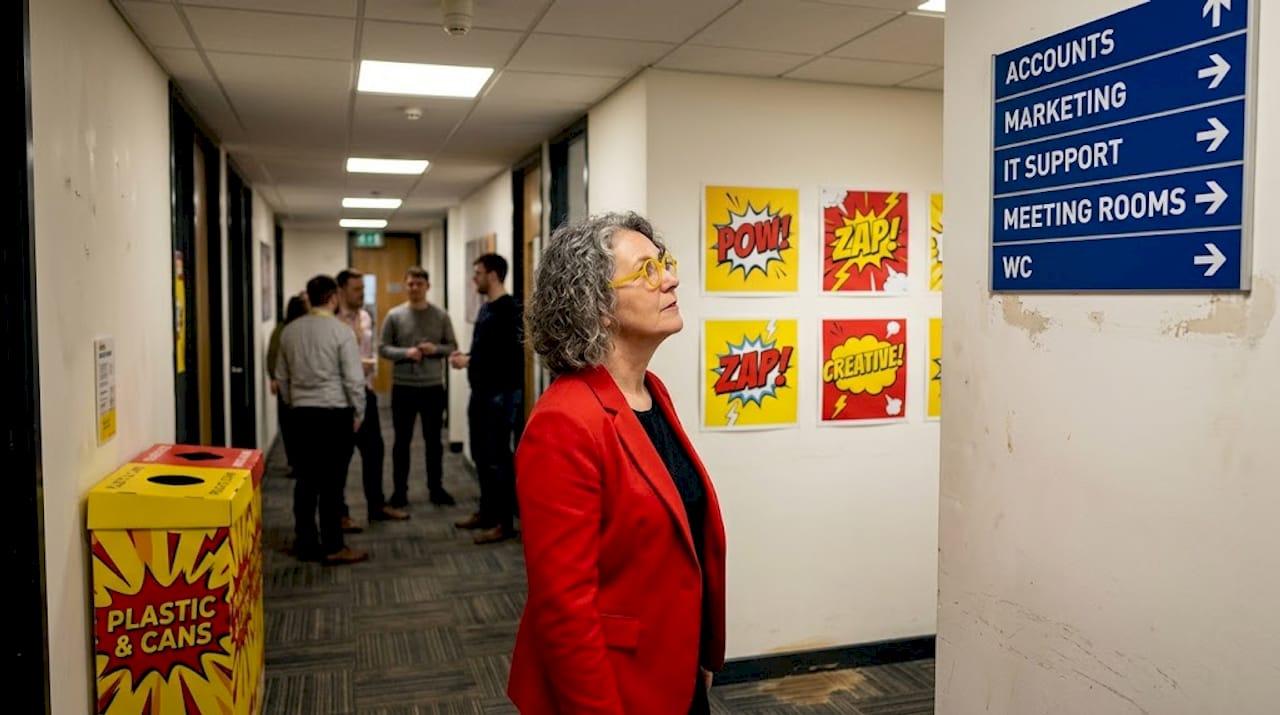
Wayfinding is one of the most practical and immediate expressions of signage consistency. When a visitor enters a large retail environment, a commercial building, or a construction campus, their ability to move through that space confidently depends entirely on the clarity and coherence of the signs around them. Wayfinding works best when naming conventions, design systems, and governance are consistent across every touchpoint.
The core principles of effective wayfinding signage include:
- Standardised iconography, so that symbols mean the same thing in every location and context
- Consistent colour coding, allowing users to understand zone or route logic at a glance
- Unified typography, ensuring that all directional text is immediately legible and visually familiar
- Logical and predictable naming, using the same terminology across floor plans, digital directories, and physical signs
- Accessible design, including appropriate contrast ratios, Braille provisions, and positioning at eye level
Signage systems improve both perception and behaviour, specifically trust and recognition on the perceptual side, and legibility and navigation on the behavioural side. Consistency reduces ambiguity and actively supports accessibility for users with visual impairments or cognitive differences.
Here is how effective wayfinding compares with a poorly managed signage environment:
| Element | Effective wayfinding | Poor wayfinding |
|---|---|---|
| Signage terminology | Unified across all touchpoints | Mixed naming conventions cause confusion |
| Colour and iconography | Standardised and intuitive | Inconsistent and difficult to interpret |
| Positioning | Predictable and at key decision points | Random or absent at critical junctions |
| Accessibility | Inclusive design throughout | Patchy provision, excluding some users |
| Maintenance | Regularly checked and updated | Outdated, damaged, or missing signs |
Deploying effective wayfinding signage across a commercial space or multi-site environment requires thoughtful planning. Review cohesive signage systems that integrate directional, informational, and brand signage within a single coherent design framework. Understanding signage terminology for navigation also helps ensure that your brief to designers and manufacturers is precise and unambiguous from the outset.
The user experience payoff is measurable. Visitors who navigate your space with ease have a more positive interaction with your brand overall. They feel less stressed, ask fewer questions of your staff, and leave with a more favourable impression. In a retail context, that translates directly into dwell time and conversion. In a commercial or construction environment, it supports productivity and safety.
Why treating consistency as a living system sets leaders apart
Most conversations about signage consistency focus on design. Colours, fonts, materials. These are important, but they are not where most businesses actually fail. The real failure mode is organisational, not aesthetic.
A common failure mode is treating guidelines as static artwork rather than an operational programme. Drift accumulates slowly and often invisibly. A replacement sign ordered in a hurry with a slightly different typeface. A new branch where the local contractor used a different shade of the brand colour. An interior sign that was never replaced after a department rename. Individually, each of these is minor. Collectively, they undermine the trust that consistent signage is supposed to build.
The leaders in this space treat signage consistency as a living operational system. They assign ownership, set review cycles, and empower their signage partners to flag deviations before they are installed rather than after. They also understand that adaptation and flexibility are not enemies of consistency. They are part of a mature programme. A brand that can maintain its visual identity coherently across a listed building in Edinburgh and a new-build retail park in Bristol is demonstrating genuine operational excellence.
Design for brand impact is not a one-time project. It is an ongoing discipline that requires the same attention as any other operational standard in your business.
Expert signage solutions for brand consistency
If you want to take control of your brand consistency, this is where specialised support makes a real difference.
At Pik Pik POW!, we work with businesses across retail, construction, and commercial interiors to standardise, adapt, and maintain signage programmes that genuinely hold up across multiple sites. From signage systems that unify interior and exterior environments to bespoke architectural signage solutions designed for complex site constraints, we combine design expertise with precision manufacturing to deliver results that are consistent, durable, and on-brand. We also specialise in wayfinding signage that improves user experience in large or multi-tenanted spaces. Get in touch with us to discuss your requirements and explore how we can help you build a signage programme that scales.
Frequently asked questions
What is signage consistency and why does it matter?
Signage consistency means keeping all signs visually and functionally aligned to your brand standards, helping customers recognise your business and trust its professionalism. Customers use visible brand cues to judge trustworthiness, so any mismatch across sites can undermine confidence and delay purchasing decisions.
Can signage be consistent if locations have different layouts or codes?
Yes, effective consistency relies on maintaining a unified impression and brand intent, even when physical signs must adapt to local site constraints or regulatory codes. Consistency is not synonymous with identical signs, and adapting guidelines intelligently for site-specific needs is a sign of a well-managed programme, not a failure.
How can companies maintain signage consistency across many sites?
Implement centralised standards, regular audits, approved supplier lists, and ongoing maintenance schedules to prevent brand drift. Governance, centralised standards, and ongoing audits are the operational foundations of any successful multi-site signage programme.
Does signage consistency improve wayfinding for users?
Yes, cohesive wayfinding designs with standardised terminology, iconography, and colour coding help visitors navigate spaces smoothly and reduce confusion. Wayfinding works best when naming conventions and design systems are consistent across every touchpoint within a space.