
TL;DR:
- Accessibility in signage benefits all users by enhancing clarity, safety, and inclusivity across various sectors. It helps businesses comply with legal standards, reduces liability, and improves brand reputation through thoughtful design. Implementing accessible signage from the outset ensures program access and creates welcoming environments for everyone.
Many business owners assume that accessibility in signage is a niche concern, relevant only to specialist facilities or regulated healthcare environments. This assumption is costly. Accessible signage affects every customer who walks through your door, every contractor on your site, and every visitor to your corporate premises. It shapes how people perceive your brand before they even speak to a member of staff. Across retail, construction, and corporate sectors, the businesses that treat accessibility as a core design principle rather than an afterthought are the ones that build stronger reputations, reduce legal exposure, and serve a wider customer base more effectively.
Table of Contents
- Understanding accessibility in signage
- Legal requirements and compliance standards
- Impact on business reputation and customer experience
- Practical steps for implementing accessible signage
- Why most accessibility signage plans fall short
- Accessible signage solutions from Pik Pik Pow
- Frequently asked questions
Key Takeaways
| Point | Details |
|---|---|
| Inclusivity builds loyalty | Accessible signage helps all customers feel welcome, supporting brand loyalty and broader customer engagement. |
| Legal compliance prevents risk | Meeting accessibility standards protects against legal issues and reduces liability for your business. |
| Reputation boost | Businesses with accessible signage are seen as more professional and caring, improving their public image. |
| Practical steps can be simple | Auditing and updating signage for accessibility regularly ensures ongoing compliance and customer satisfaction. |
| Sector-specific benefit | Retail, construction, and corporate environments all gain from accessible signage with tailored solutions. |
Understanding accessibility in signage
Accessibility in signage means designing and installing signs so that they can be understood and used by the widest possible range of people. This includes individuals with visual impairments, hearing loss, cognitive disabilities, and mobility restrictions, as well as older customers and people who may be unfamiliar with a building’s layout. It is not limited to Braille. It encompasses contrast ratios, font size, tactile lettering, mounting height, pictogram use, and the logical sequencing of wayfinding information.
The common misconception is that accessible signage serves only a small minority of users. In reality, clarity and legibility benefit everyone. A sign with strong colour contrast and a clean typeface is easier for all visitors to read, not just those with visual impairments. Directional signage that follows a logical sequence reduces confusion for every customer, not just those with cognitive differences. Inclusive design, by its nature, improves the overall user experience.
For business owners, the benefits extend well beyond good intentions. Accessibility signage fosters inclusivity, enhances your professional image, and reduces both liability and insurance risks by prioritising programme access and equal facility use. Thinking about accessibility in construction signage from the outset of a project, rather than retrofitting it at the end, delivers better outcomes at lower cost.
Key benefits of accessible signage for business owners include:
- Reaching a broader customer base, including the estimated 16 million disabled people in the UK
- Reducing the risk of discrimination claims under the Equality Act 2010
- Strengthening brand reputation as a responsible, professional organisation
- Improving the overall experience for all visitors, not just those with disabilities
- Lowering the likelihood of accidents or incidents caused by unclear safety or directional signage
Accessible signage is not merely a compliance exercise. It is a visible commitment to treating every visitor with equal respect, and it lowers your liability exposure at the same time.
Legal requirements and compliance standards
Understanding the legal framework around accessible signage is essential for any business operating in the UK or internationally. In the United Kingdom, the primary legislation is the Equality Act 2010, which places a duty on service providers and employers to make reasonable adjustments for disabled people. This includes the physical environment and the signage within it. Failure to comply can result in legal challenges, financial penalties, and significant reputational damage.
For businesses with international reach or those working on projects with global standards, the Americans with Disabilities Act (ADA) provides a detailed technical framework that is widely referenced even outside the United States. It specifies requirements for character height, stroke width, finish and contrast, Braille placement, and mounting height for accessible signs. Importantly, not all signs need Braille: only permanent room and facility identifiers require tactile characters and Braille, while directional and informational signs follow different rules. Mounting signs on doors is considered invalid under these standards, and some jurisdictions, such as California, apply stricter requirements than the federal baseline.
For construction signage compliance in the UK, additional Health and Safety regulations apply, including requirements under the Health and Safety (Safety Signs and Signals) Regulations 1996. Understanding signage safety terminology is a practical first step for site managers and developers.
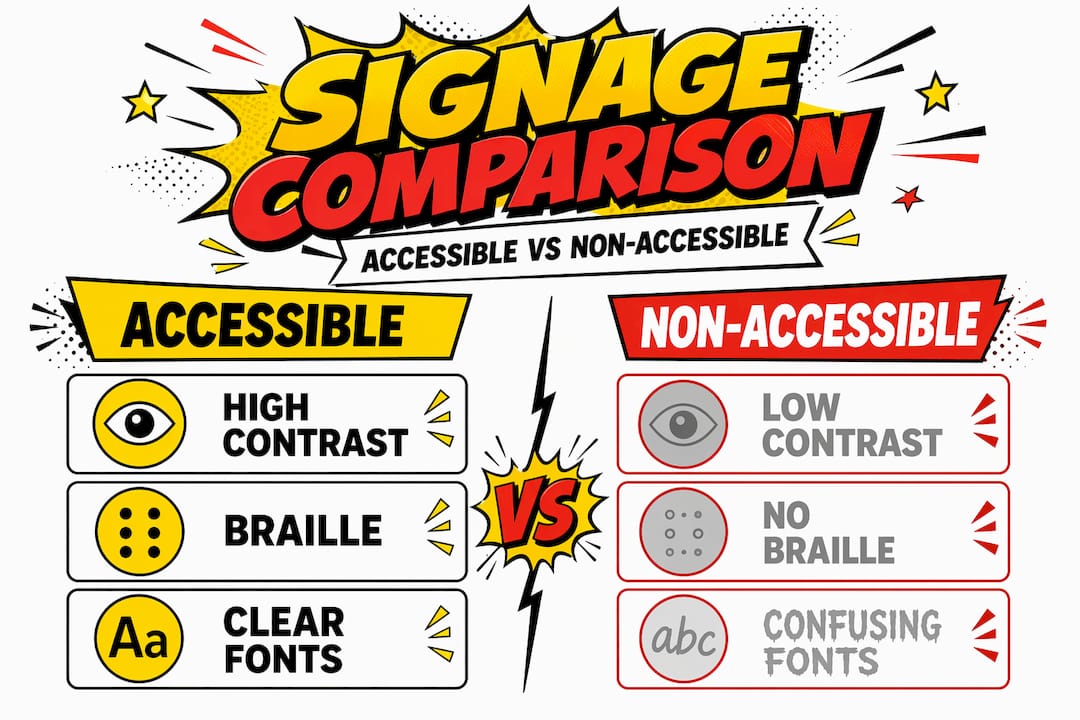
Comparison: accessible vs. non-accessible signage
| Feature | Accessible signage | Non-accessible signage |
|---|---|---|
| Contrast ratio | Minimum 70% light reflectance difference | Variable, often insufficient |
| Tactile characters | Present on permanent identifiers | Absent |
| Braille | Grade 2 Braille on room/facility signs | Not included |
| Mounting height | 1,500 mm centreline from floor | Inconsistent |
| Font choice | Sans serif, upper and lower case | Decorative or all caps |
| Compliance status | Meets Equality Act and ADA standards | At risk of non-compliance |
| Liability exposure | Reduced | Elevated |
How to check your signage for compliance
- Audit all permanent identifiers such as room names, toilet facilities, and office numbers. Check whether they include tactile characters and Braille.
- Measure mounting heights to confirm signs are positioned at the correct centreline height, typically between 1,400 mm and 1,600 mm from the finished floor level.
- Check contrast levels between sign backgrounds and character colours using a light reflectance value (LRV) calculator.
- Review font choices across all signage to ensure they use a legible sans serif typeface in mixed case rather than all capitals.
- Map your wayfinding sequence from the main entrance to key destinations, identifying any gaps where visitors could become disoriented.
- Confirm that directional signs point to accessible entrances where the main entrance is not fully accessible.
Pro Tip: The most frequently overlooked compliance failures are signs mounted on the pull side of doors, missing tactile elements on permanent identifiers, and wayfinding that directs to inaccessible routes. Address these three areas first and you will resolve the majority of common audit failures.
Impact on business reputation and customer experience
Legal compliance is vital, but the real opportunity comes from elevating your brand and improving the customer journey through accessible signage. Customers notice when a business has invested in clear, inclusive communication. They also notice when it has not.

Accessible signage fosters inclusivity, enhances your brand image, and directly reduces liability and insurance risk. These are not abstract benefits. A retail environment with poor wayfinding frustrates shoppers and shortens dwell time. A construction site with unclear safety signage increases the risk of incidents. A corporate office with inadequate directional signage creates a poor first impression for visitors and clients.
The following table shows how accessible signage features apply across the three key sectors:
Accessible signage features by sector
| Feature | Retail | Construction | Corporate |
|---|---|---|---|
| Wayfinding | Aisle and department signs, exits | Safe routing, hazard zones | Floor directories, meeting rooms |
| Tactile signage | Changing room, accessible toilet signs | Safety warnings | Permanent room identifiers |
| Contrast and legibility | Product category headers | High-visibility safety signs | Lobby and reception signs |
| Braille | Accessible facility identifiers | N/A (temporary signage) | Permanent room signs |
| Pictograms | Department and exit signs | Mandatory safety symbols | Directional and amenity signs |
For safer construction site signage, accessible features are not just about disability inclusion. They are about ensuring that every worker and visitor can understand and act on safety information quickly. In a retail context, strong shop signage design that incorporates accessibility principles creates a more welcoming environment that encourages longer visits and return custom.
Key improvements in customer experience from accessible signage include:
- Faster navigation to products, services, or facilities, reducing frustration
- Greater confidence for visitors with disabilities who know they are catered for
- Positive word of mouth from customers who experience inclusive environments
- Reduced staff time spent directing confused visitors
- Fewer accidents or near-misses caused by unclear safety or directional information
Research consistently shows that a significant majority of consumers actively prefer to spend money with businesses that demonstrate a commitment to inclusion. When accessibility is built into your signage rather than added as an afterthought, it communicates professionalism at every touchpoint.
Practical steps for implementing accessible signage
Having understood the broader impact, let us look at actionable steps every business can take for accessible signage.
- Commission a full signage audit before making any changes. Document every sign on your premises, noting its type, location, condition, and current compliance status.
- Prioritise permanent identifiers first. Room names, toilet facilities, fire exits, and lift lobbies are the highest-priority locations for tactile and Braille signage.
- Review your entrance and approach signage. As signage directs to accessible entrances when the main entrance is unavailable, you need clear, consistent directional signs leading to the accessible route from the public footpath or car park.
- Update your wayfinding sequence. Work with a wayfinding signage guide to map the logical journey from arrival to destination for a visitor with reduced mobility or visual impairment.
- Specify materials and finishes that meet contrast requirements. Matt finishes reduce glare for visually impaired users. High-contrast colour combinations ensure legibility in varying light conditions.
- Plan for future changes. Review your signage whenever you undertake a refurbishment, change room uses, or alter circulation routes.
- Consider the full range of types of site signage relevant to your sector, including mandatory safety signs, informational signs, and directional wayfinding.
Pro Tip: After any refurbishment or building upgrade, accessibility signage is frequently overlooked because it is treated as a finishing detail rather than a specification item. Include signage requirements in your project brief from day one, and allocate a review stage before practical completion to confirm that all accessibility elements are in place and correctly installed.
Why most accessibility signage plans fall short
In our experience working with businesses across retail, construction, and corporate environments, the most common failure is not a lack of good intentions. It is the tendency to treat accessibility as a checklist rather than a design principle.
Many businesses commission an accessible signage scheme, tick the compliance boxes, and consider the matter closed. What they miss is the adaptive dimension. Signage needs to work for real users in real conditions, not just satisfy an auditor reviewing a specification sheet. A Braille sign mounted at the correct height on a fixed wall is compliant. But if it is positioned behind a door swing, or in a poorly lit corridor, it is functionally useless for the people it is meant to serve.
The concept of programme access is widely undervalued. It is not enough to have an accessible toilet if the signage leading to it is confusing or absent. It is not enough to label a ramp entrance if the directional signage from the car park does not acknowledge it exists. True programme access means a disabled visitor can navigate your entire facility with the same confidence as any other customer.
Accessible signage that has not been reviewed by actual users, or tested against real navigation scenarios, is little more than a paperwork exercise. The businesses that get this right treat accessibility as an ongoing commitment, not a one-time installation.
The most effective signage programmes we see are planned early in the project lifecycle. Specifying signage early allows accessibility requirements to be integrated into the architectural and interior design process, rather than retrofitted around constraints created by other decisions. They are also reviewed regularly. Building uses change, layouts evolve, and what was compliant and functional three years ago may no longer serve its purpose today.
Accessible signage solutions from Pik Pik Pow
At Pik Pik Pow!, we work with businesses across retail, construction, and corporate sectors to design and deliver signage that is both visually impactful and genuinely inclusive. Accessibility is not a separate service we offer as an add-on. It is a built-in consideration across every signage project we undertake.
Whether you need a full wayfinding system for a commercial building, compliant safety signage for a construction site, or an accessible shopfront scheme, our team can guide you from specification to installation. We also offer signage system solutions designed to meet both aesthetic and compliance requirements, as well as digital signage solutions that offer dynamic, adaptable accessibility features including adjustable text size and contrast. Contact us to discuss your project and find out how we can help you build a signage environment that works for everyone.
Frequently asked questions
Can all signs be made accessible, or are only certain types required?
Only permanent room and facility identifiers typically require Braille and tactile features, while directional signage must indicate accessible entrances when the main route is unavailable. Not every sign on your premises requires tactile elements.
What common mistakes do businesses make with accessibility signage?
Mounting signs on doors, omitting tactile requirements on permanent identifiers, and failing to update signage after renovations are the most frequent errors businesses encounter during compliance audits.
How does accessible signage reduce liability and insurance risks?
Accessible signage demonstrates compliance and programme access, reducing exposure to discrimination claims under the Equality Act 2010 and improving your risk profile with insurers and regulators alike.
Does accessibility signage improve business reputation?
Yes. It shows a clear commitment to inclusivity and professionalism, creating positive first impressions with customers, clients, and business partners who value responsible, well-managed environments.
What sectors benefit the most from accessible signage?
Retail, construction, and corporate spaces benefit most, as inclusive signage improves the customer and visitor experience while helping businesses meet sector-specific compliance regulations and reduce the risk of incidents or claims.