
TL;DR:
- UK signage laws require specific permissions based on sign size, illumination, and location.
- Proper site assessment, material choice, and secure installation are essential for compliance and safety.
- Ongoing maintenance and prompt response to enforcement notices protect your signage investment.
Poor signage costs businesses more than they realise. A sign installed without the correct permissions can result in council enforcement notices, fines, or forced removal. Equally, a poorly positioned or badly fixed sign simply fails to attract the customers you need. UK regulations strictly control signage size, illumination, height, safety, and permissions, meaning the stakes are high if you get it wrong. This guide walks you through every stage of the process, from understanding planning rules and choosing the right sign type, to preparing your site, installing safely, and maintaining compliance over time.
Table of Contents
- Understanding UK signage regulations and permissions
- Choosing the right signage for your property
- Preparation: Tools, materials, and site assessment
- Step-by-step signage installation process
- Troubleshooting and maintenance tips
- Why most businesses underestimate signage installation
- Take your property signage to the next level with expert help
- Frequently asked questions
Key Takeaways
| Point | Details |
|---|---|
| Know the rules | Understanding UK signage law saves you time, money, and prevents legal headaches. |
| Match signage to brand | Selecting the right sign type and materials strengthens visibility and durability. |
| Prepare thoroughly | A careful site assessment and preparation prevent installation setbacks and risks. |
| Install safely | Following best practice steps ensures your signage is secure and compliant. |
| Maintain compliance | Regular checks and cleaning keep your signs safe, visible, and within the law. |
Understanding UK signage regulations and permissions
Before you order a single panel or drill a single hole, you need to understand the legal framework governing business signage in the UK. The primary legislation is the Town and Country Planning (Control of Advertisements) Regulations 2007, which sets out when you can display a sign and under what conditions.
The regulations operate on two levels. The first is deemed consent, which allows certain signs to be displayed without a formal application. This typically covers small, non-illuminated signs on your own premises. The second is express consent, which requires a formal application to your local planning authority. Deemed consent covers small signs, but most illuminated signs, signs above 4.6 metres, or any signage in a conservation area will need express consent.
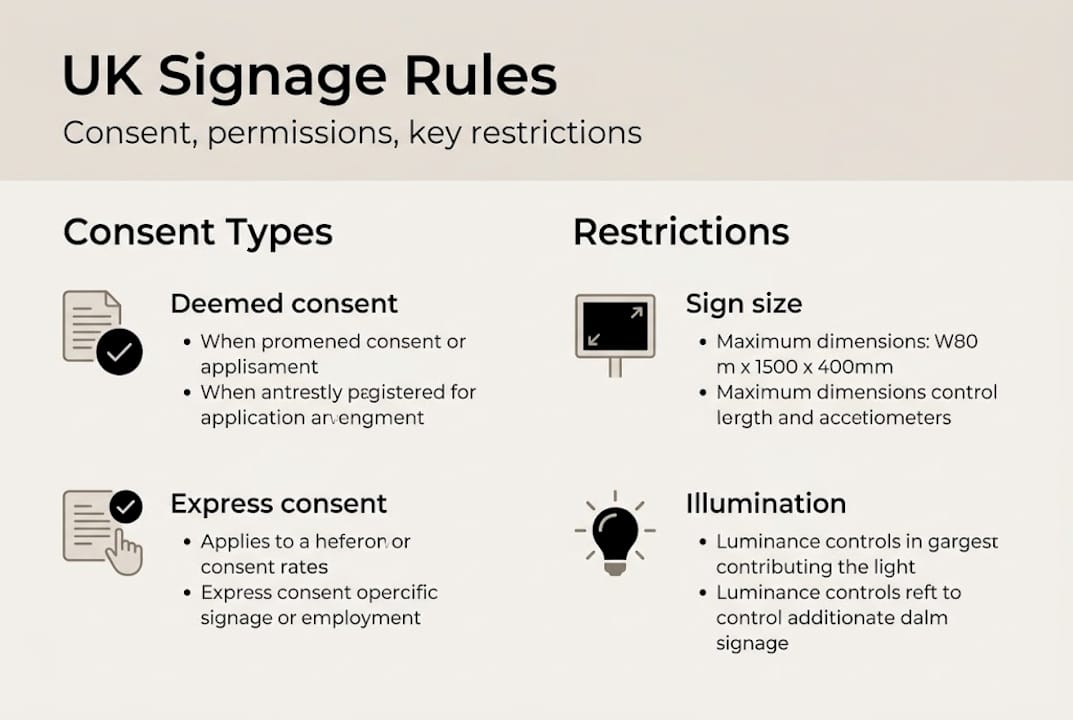
Here is a summary of the key requirements:
| Sign type | Permission required | Key restrictions |
|---|---|---|
| Small fascia sign (non-illuminated) | Deemed consent | Max 0.3m² in some zones |
| Illuminated fascia sign | Express consent | Brightness and hours limits |
| Projecting sign | Express consent | Max height and projection limits |
| Conservation area signage | Express consent | Strict design and material controls |
| Temporary banners | Deemed consent (limited) | Max 14 days in many cases |
Beyond planning, you must also meet safety and maintenance standards. Your sign must not overhang a public highway in a way that creates danger, and it must be kept clean and in good repair. You also need landowner permission if you do not own the building, which is particularly relevant for tenants in commercial properties.
For a thorough breakdown of what applies to your specific situation, review the signage compliance guidelines and the detailed rules around planning permission for shop signs.
Key point: Always confirm your consent category with your local council before installation. Assumptions about deemed consent are one of the most common and costly mistakes businesses make.
Key obligations to keep in mind:
- Obtain landowner written permission before installation
- Confirm whether your site falls within a conservation area or listed building zone
- Check illumination restrictions, including colour and brightness
- Ensure the sign does not obstruct traffic sightlines or pedestrian routes
- Retain all consent documentation on file
Choosing the right signage for your property
With permissions clarified, it is time to decide what type of signage will best serve your property and business goals. The right choice depends on your brand objectives, the physical characteristics of your building, and the local planning rules that apply to your site.
The right signage type must balance brand impact with compliance requirements around size, illumination, and location. Getting this balance right from the start saves you from costly redesigns later.
Here is a comparison of common sign types and their best applications:
| Sign type | Best use | Material options | Compliance note |
|---|---|---|---|
| External fascia sign | Shopfronts and offices | Aluminium, acrylic, foam PVC | Check size limits |
| Illuminated sign | High-footfall retail | LED-lit acrylic, lightbox | Express consent likely |
| Wayfinding sign | Large sites, car parks | Aluminium composite, vinyl | Generally low risk |
| Internal signage | Reception, corridors | Acrylic, wood, vinyl | No planning needed |
| Banners and flags | Temporary promotions | PVC, fabric | Time and size limits apply |
For the UK climate specifically, material selection matters enormously. Rain, wind, and UV exposure will degrade cheaper materials quickly. Powder-coated aluminium and UV-stabilised acrylic both perform well outdoors. Avoid untreated wood or standard foam PVC for exposed external positions, as they absorb moisture and warp over time.
You can explore a wider range of signage types for UK businesses and get practical advice on designing signage for impact before finalising your choice.
Use this checklist before confirming your sign specification:
- Does the design align with your brand colours, fonts, and tone?
- Is the sign visible from the key approach directions?
- Does the size comply with deemed or express consent limits?
- Is the material suited to the installation environment?
- Have you reviewed all available shop signage options for your property type?
Pro Tip: Design your sign with future updates in mind. Using a modular system or replaceable face panels means you can refresh your branding without replacing the entire structure, saving significant cost over time.
Preparation: Tools, materials, and site assessment
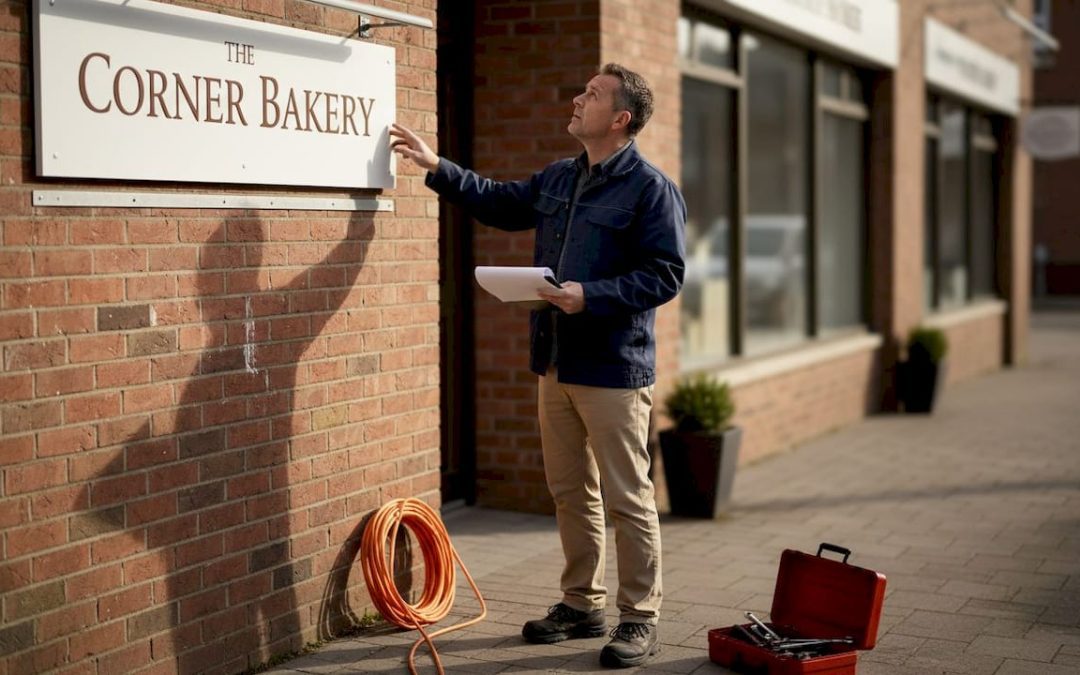
Now you know which signage to install, let us prepare the site and materials to keep your project compliant and on schedule. Skipping this stage is where many installations go wrong, resulting in misaligned signs, structural failures, or safety incidents.

Start with a thorough site survey. All signs must be safe, clean, and securely fixed, so understanding your wall substrate, fixing points, and visibility lines before you begin is essential. Check whether the wall is brick, render, timber, or cladding, as each requires different fixings and load considerations.
Health and safety preparation is non-negotiable. If installation requires working at height, you must comply with the Work at Height Regulations 2005. A written risk assessment should cover:
- Identification of hazards (height, electrical, structural)
- Assessment of risk level for each hazard
- Control measures to be implemented
- Named responsible person for site safety
- Emergency procedures if something goes wrong
Essential tools and materials for most external sign installations include:
- Spirit level and laser level for accurate alignment
- Appropriate drill bits for the wall substrate (masonry, metal, or wood)
- Stainless steel fixings to prevent corrosion
- Sealant for weatherproofing around fixing points
- Personal protective equipment including gloves and eye protection
- Scaffolding or a stable access platform if working above 2 metres
For guidance on safe working practices, the safer installation tips resource covers common risks in detail. You should also familiarise yourself with installation terms explained if any technical specifications are unclear. For external projects, reviewing outdoor signage practices will help you avoid common positioning errors.
Pro Tip: On installation day, photograph the wall before drilling. This gives you a reference point if any disputes arise about pre-existing damage and supports your documentation for planning consent records.
Confirm all landowner and local authority approvals are in writing before any physical work begins.
Step-by-step signage installation process
You are ready to get started. Follow these steps to install your signage safely and professionally.
- Mark your fixing positions using a template or paper pattern. Use a spirit level to confirm horizontal alignment before marking any drill points.
- Drill pilot holes at the marked positions. Use the correct drill bit for your substrate and keep the drill perpendicular to the wall surface.
- Insert wall plugs appropriate for the substrate and the load the sign will place on the fixings.
- Offer up the sign to check alignment before final fixing. Have a second person hold the sign in position while you verify level and position.
- Secure the fixings using stainless steel bolts or screws. Do not overtighten, as this can crack acrylic or distort aluminium faces.
- Apply sealant around all fixing points and any gaps between the sign and the wall to prevent water ingress.
- Carry out a post-installation check, including a pull test on fixings, a visual alignment check from street level, and confirmation that no cables or surfaces have been damaged.
It is your responsibility to ensure the sign is securely fixed and poses no danger to the public. This is a legal obligation, not just best practice.
Safety warning: Never install signage that overhangs a public footpath or road without confirming structural load capacity and obtaining any required highway authority approval. Failure to do so creates serious public liability risk.
Common mistakes to avoid:
- Relying on adhesive alone for external signs without mechanical fixings
- Using non-stainless fixings that corrode and weaken over time
- Failing to check for concealed cables or pipes before drilling
- Skipping the post-install documentation
For further detail on safe practices, the safe installation guide and an overview of signage systems are useful references.
Troubleshooting and maintenance tips
Once installed, your work is not over. Keeping your signage effective and within the law requires ongoing attention.
Signs must be kept clean and safe, otherwise local authorities may require removal. A neglected sign is not just a branding problem; it is a compliance risk.
If you receive a council complaint or enforcement notice, respond promptly in writing. Request clarification on the specific issue, and if the sign was installed under deemed consent, provide your evidence. Do not ignore notices, as this can escalate to formal enforcement action and removal costs.
Routine maintenance checklist:
- Monthly: Visual inspection for damage, loose fixings, or graffiti
- Quarterly: Clean sign face with appropriate non-abrasive cleaner
- Bi-annually: Check all fixings for corrosion or movement
- Annually: Full structural inspection, especially after severe weather
- As needed: Replace faded vinyl, repair cracked acrylic, or repaint metalwork
Spotting compliance issues early is far cheaper than dealing with enforcement. Look out for signs that have shifted position, fixings that have worked loose, or illumination that has developed faults. Any of these can trigger a council inspection.
For the latest guidance and updates on signage regulations, the signage updates resource is worth bookmarking.
Pro Tip: Set a recurring calendar reminder every six months for a signage condition review. Include a brief photographic record each time so you can track deterioration and demonstrate due diligence if a compliance query arises.
Why most businesses underestimate signage installation
Most businesses spend considerable time on sign design and very little on installation planning. That is a mistake we see repeatedly. The assumption is that once the artwork is approved, the hard work is done. In reality, a beautifully designed sign installed without the correct permissions, or fixed inadequately to a wall, can cost far more to resolve than the original installation.
The financial consequences are real. Council enforcement can result in removal costs, retrospective application fees, and reputational damage if scaffolding appears outside your premises for the wrong reasons. Beyond fines, there is the missed opportunity cost of a sign that fails to perform because it was positioned incorrectly or deteriorated prematurely.
Treating signage installation as a strategic investment changes how you approach every decision in this guide. The value of branded signage extends well beyond aesthetics; it is a long-term asset that supports footfall, brand recognition, and customer trust. Protect that investment with the same rigour you would apply to any other business-critical asset.
Take your property signage to the next level with expert help
Navigating permissions, selecting materials, and installing signage correctly takes time and specialist knowledge. At Pik Pik POW!, we work with commercial property managers and business owners across the UK to make this process straightforward from the first consultation to the final fixing.
Our range of signage systems covers everything from architectural fascia signs to modular wayfinding solutions, all designed and manufactured to meet UK compliance requirements. If you are considering a more dynamic approach, our digital signage solutions offer flexible, high-impact options for retail and commercial interiors. Get in touch today for a tailored site assessment or a no-obligation quote, and let us help you install signage that works as hard as your business does.
Frequently asked questions
Do I need planning permission for my shop sign in the UK?
Most shop signs require planning permission, particularly if illuminated, over 0.6m², or located in a conservation area. Express permission is needed for illuminated or large signs in most UK cases, so always confirm with your local council before proceeding.
What are the safety rules for business signage installation?
All signs must be safe, clean, securely fixed, and must not obstruct traffic or pedestrian sightlines. You hold legal responsibility for any public safety risk your sign creates.
How do I maintain compliance after my sign is installed?
Regular inspections, prompt repairs, and keeping the sign clean are your core obligations. Signs must be kept clean and safe at all times, or your local authority may require removal at your expense.
What should I consider when choosing sign materials for the UK climate?
Prioritise materials resistant to rain, wind, and UV exposure, such as powder-coated aluminium and UV-stabilised acrylic, to ensure long-term durability and avoid premature deterioration that could trigger a compliance issue.