
TL;DR:
- Signage on a film or TV set is essential for access control, safety, and continuity, yet it is often overlooked during planning. Properly designed signage prevents set disruptions, safety incidents, and costly re-dressing, ensuring smooth operations from the first day. Integrating signage strategies early, with durable materials and clear hierarchy, enhances efficiency, professionalism, and safety throughout production.
Signage on a film or TV production set is rarely the first thing discussed in pre-production meetings, yet it consistently proves to be one of the most operationally important elements on any shoot. Many production managers and location scouts treat it as an afterthought, assuming a few printed sheets and hand-written notices will do the job. In reality, poorly planned signage causes set disruptions, safety incidents, and continuity errors that cost far more to fix than they would have cost to prevent. This article explains what effective signage actually does on set, the different types you need, and how to build a strategy that protects your production from day one.
Table of Contents
- The critical roles signage plays on production sets
- Types of signage: from operational to prop realism
- Challenges of signage in live and multi-day shoots
- Signage strategy: enhancing efficiency and brand visibility
- A production designer’s perspective: why signage is more than a box-ticking exercise
- Upgrade your production with professional signage solutions
- Frequently asked questions
Key Takeaways
| Point | Details |
|---|---|
| Signage prevents disruptions | Well-placed signage stops accidental set changes and keeps filming on schedule. |
| Operational and prop signage differ | Operational signage delivers critical information while prop signage maintains set realism. |
| Continuity saves money | Proper signage avoids costly rebuilding and ensures scene consistency. |
| Planning enhances branding | Strategic signage boosts both efficiency and crew experience, reinforcing your production’s brand. |
The critical roles signage plays on production sets
With misconceptions dispelled, let’s clarify the essential roles that signage plays on production sets. Signage on a production set serves several distinct and critical functions simultaneously. It is not decorative. It is operational infrastructure.
The most immediate function is access control. Production sets contain expensive equipment, dressed props, and carefully arranged scenes that cannot be disturbed. Clear, bold signage at entry and exit points tells crew, visitors, and support staff exactly where they can and cannot go. This is particularly true for restricted zones, equipment storage areas, and actively dressed sets awaiting filming.
Safety is the second major function. Film and TV sets present genuine physical hazards: heavy rigging, electrical cabling, pyrotechnics, elevated platforms, and high-powered lighting rigs. Health and safety signage is not optional. It is a legal requirement under UK health and safety legislation, and it must be legible, correctly positioned, and regularly checked. Alongside this, site safety essentials such as PPE reminders and hazard warnings need to be clearly communicated throughout the set.
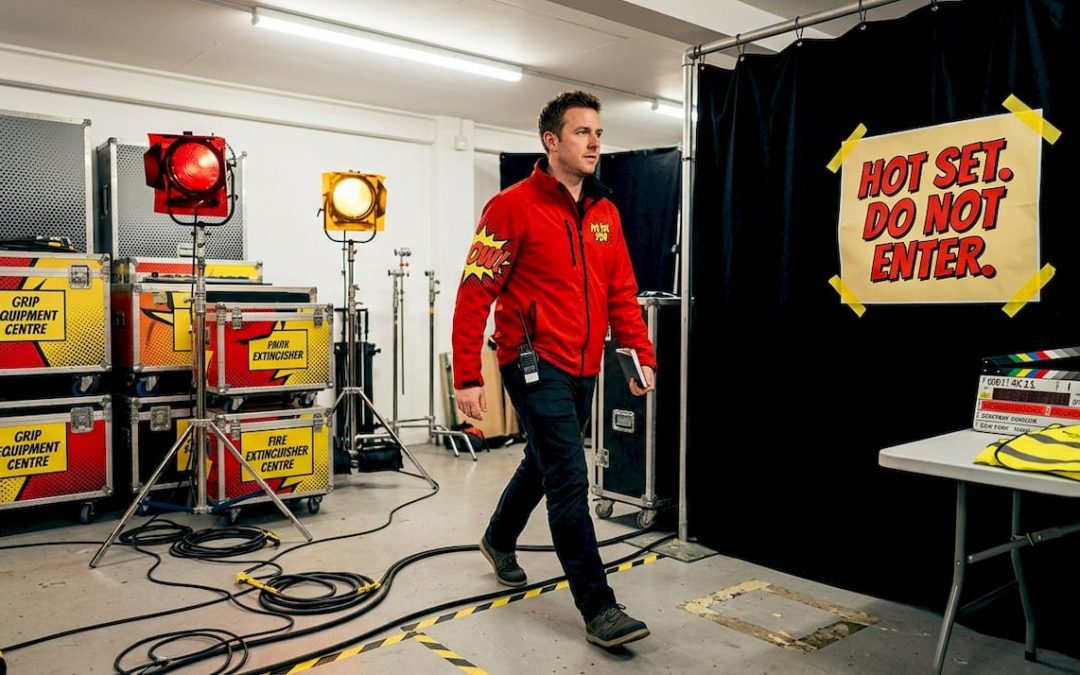
The third function is continuity protection. One of the most critical uses of signage on any set is the “hot set” sign. As industry resources confirm, hot set signage prevents unauthorised entry and maintains continuity on film sets. A hot set is a dressed environment that must remain exactly as it is between takes and shooting days. Any disturbance can require expensive redressing and delays.
Effective signage on a production set typically covers:
- Access control: Restricting entry to dressed sets, equipment stores, and live recording areas
- Hot set protection: Clearly marking environments that must not be altered or entered without authorisation
- Safety compliance: Hazard warnings, emergency exit routes, fire safety notices, and PPE requirements
- Wayfinding: Directing crew, talent, and visitors to green rooms, holding areas, production offices, and toilets
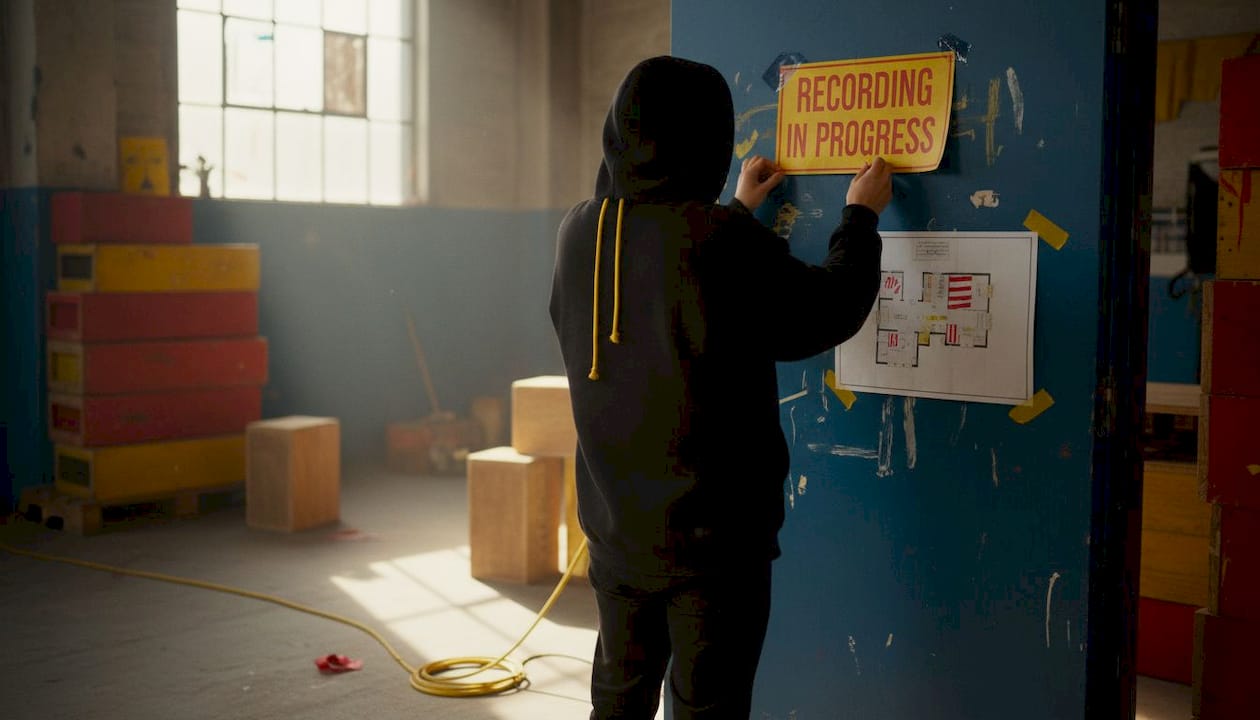
- Operational communication: Quiet signs, “recording in progress” notices, and department identification boards
The types of construction signage used in managed site environments translate directly to production set requirements. Both environments demand clear hierarchies of information, durable materials, and consistent placement logic.
“Hot set signage prevents unauthorised entry and maintains continuity on film sets. It signals to all crew that the set must remain undisturbed until filming resumes.” — Set Hero, Film Set Terminology Guide
Types of signage: from operational to prop realism
Having established the vital roles of signage, it’s helpful to distinguish the main types and their specific purposes on set. Production signage broadly falls into four categories, each with different design requirements, materials, and placement logic.
Operational signage includes hot set notices, restricted area warnings, recording in progress signs, and any notice that directs crew behaviour. This type of signage must be immediately visible and legible even in low-light or busy environments. Bold typefaces, high-contrast colours, and standardised layouts are essential. As research confirms, operational signage prioritises bold red warnings for immediacy, whereas prop signage emphasises subtle realism and camera legibility over raw visibility.
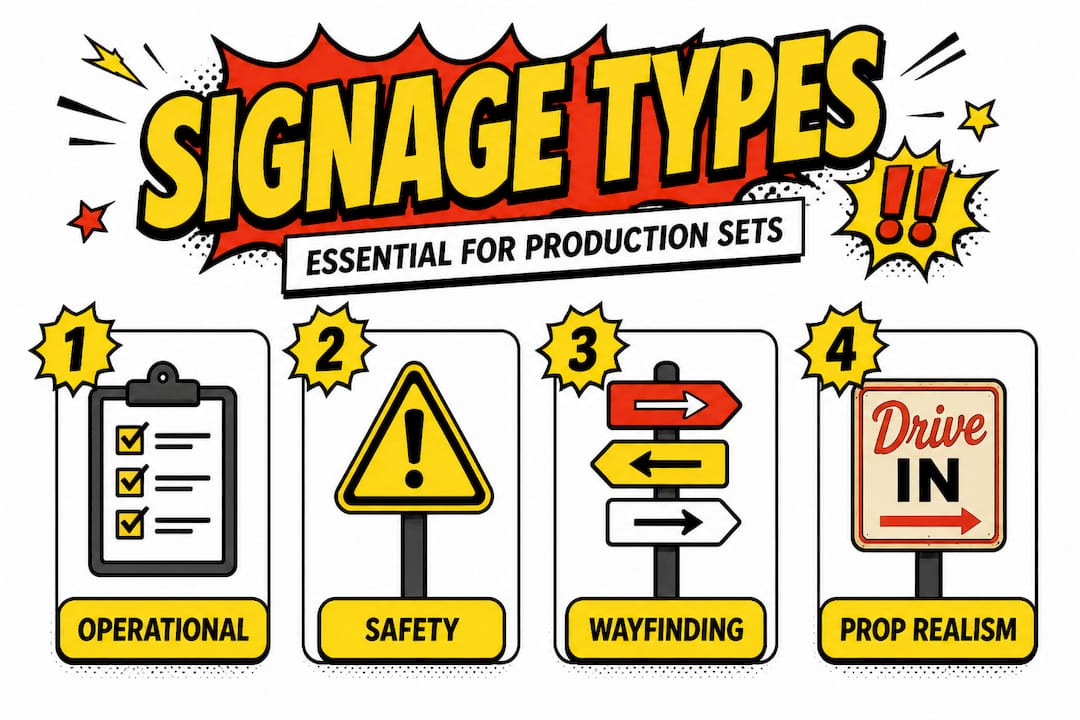
Health and safety signage sits within operational signage but deserves its own category because it carries legal weight. Under the Health and Safety (Safety Signs and Signals) Regulations 1996, certain signs must conform to specific colour and symbol standards. You cannot simply print these on a home printer and call it compliant. Understanding signage types and compliance requirements is essential before your crew arrives on set.
Wayfinding signage is often overlooked entirely on smaller productions. On larger sets or multi-location shoots, wayfinding directly affects how efficiently crew move between departments. A disorganised set without clear wayfinding wastes time at every call time, tea break, and shift changeover.
Prop signage is a specialist category. This is signage that appears in frame, designed to support the visual narrative of the production. A period drama needs shop fronts, street signs, and office directories that look authentic for the era. A contemporary thriller might need corporate lobby signage, hospital wayfinding, or road signs. Reviewing indoor signage best practices can help you understand how legibility, font size, and material choice affect what reads well on camera versus what works in person.
| Signage type | Primary purpose | Design priority | Typical material |
|---|---|---|---|
| Operational (hot set) | Access control and continuity | Visibility and immediate legibility | Rigid foam board, PVC, correx |
| Health and safety | Legal compliance and hazard communication | Standardised colour codes and symbols | Foamex, aluminium, self-adhesive vinyl |
| Wayfinding | Crew and visitor navigation | Clarity and logical layout | Lightweight board, banner, or fabric |
| Prop signage | On-camera realism and narrative support | Period accuracy and camera legibility | Wide-format print, vinyl wrap, rigid substrate |
Key considerations when specifying your signage mix:
- Visibility distance: Operational signs need to be readable from at least 5 to 10 metres in a busy set environment
- Lighting conditions: Sets with low ambient light need signs with reflective or illuminated elements
- Durability: Multi-day shoots require materials that won’t warp, fade, or peel under studio lighting heat
- Removal and repositioning: Temporary shoots need signage that can be relocated without leaving residue or damage
Pro Tip: Before ordering signage for a new production, hold a joint briefing between the art department, locations team, and health and safety coordinator. The art department controls prop signage and set dressing, while the locations or operations team handles operational and safety signs. Without coordination, you end up with conflicting visual styles, duplicated effort, and gaps in coverage that create real risks.
Challenges of signage in live and multi-day shoots
Understanding signage types highlights the complexity, especially in live or multi-day shoots, where continuity is at risk. Managing signage across an extended shoot is significantly more demanding than setting it up once and walking away.
The core problem is set geography. Over multiple shooting days, the physical layout of a set changes. New set pieces are introduced, old ones are struck, and departments move their equipment around. Signage installed at the start of a shoot can quickly become irrelevant, misleading, or physically obstructed.
Hot set management becomes particularly critical during overnight breaks and between shooting blocks. Industry best practice confirms that multi-day shoots require photographing sets or deploying security to preserve hot set integrity, because rebuilding a dressed set is costly and time-consuming. If a set is accidentally disturbed because signage was unclear or in the wrong position, continuity errors follow, and those errors often only appear in the edit.
The steps required to maintain reliable signage on a multi-day shoot are:
- Conduct a full signage audit before each shooting block. Walk the set with a checklist and confirm every sign is in place, undamaged, and still accurately reflects the current set layout.
- Photograph the complete set geography at the end of each shooting day. This creates a reference point if anything is moved overnight and gives the signage team a clear reset target.
- Brief all heads of department on signage protocols. Every department lead must understand that hot set signs are non-negotiable and that moving or removing signage without authorisation is not acceptable.
- Assign a designated signage lead. This person is responsible for maintaining, updating, and replacing signage throughout the shoot. On large productions, this sits within the locations or production management team.
- Keep a signage inventory and a stock of replacements. Signs get damaged, obscured, and occasionally removed. Having spares means you can replace them immediately rather than waiting for reprints.
Tools such as visualising set layouts digitally before the shoot begins can help identify signage placement gaps before they become problems on the day.
| Risk | Cause | Consequence | Prevention |
|---|---|---|---|
| Set continuity error | Hot set disturbed overnight | Costly redressing and reshoots | Clear hot set signage and photography |
| Safety incident | Hazard sign removed or obscured | Crew injury and potential legal liability | Daily signage audit and replacements |
| Filming delay | Wayfinding failure causing misdirected crew | Lost shooting time | Consistent wayfinding from base camp to set |
| Access breach | Poorly positioned restricted area signs | Unauthorised entry and set disruption | Boundary signage reviewed after each shift |
Pro Tip: After any significant crew movement, such as a lunch break, a location changeover, or a night shoot shift change, do a quick walk of all hot set and restricted area signage. Crew moving equipment through a set often inadvertently reposition or cover signs. A five-minute check saves hours of disruption.
Signage strategy: enhancing efficiency and brand visibility
With logistical challenges in mind, a strong signage strategy is the real solution for set efficiency and branding. A good signage strategy does more than cover the basics. It makes your production run more smoothly, presents a professional image to talent and visitors, and reduces the number of questions your production team has to answer every day.
The starting point is balancing three priorities: practicality, compliance, and aesthetics. Practical signage is well positioned and immediately usable. Compliant signage meets the legal requirements for health and safety communication. Aesthetic signage reflects the production’s brand identity and contributes positively to the set environment. All three are achievable simultaneously with proper planning.
A practical checklist for signage placement and visibility on a production set:
- Entry and gate signage: Production name, access rules, visitor check-in instructions, and emergency contact numbers
- Set boundary signage: Clearly marking the perimeter of active shooting areas, dressed sets, and restricted zones
- Department identification boards: Large, clearly legible boards at each department’s base area so crew can orient themselves immediately on arrival
- Emergency information boards: Fire evacuation routes, first aid locations, and emergency services contact numbers, placed at regular intervals throughout the set
- Hot set notices: Positioned at every access point to a dressed set, at eye level, and reviewed at least once per shift
Production branding on signage serves a secondary but valuable purpose. Consistent use of production logos, colour palettes, and typography across wayfinding, department boards, and noticeboards builds a sense of identity and professionalism on set. It also improves crew morale. A well-presented production environment signals to your team that they are working on something that is taken seriously. This matters, particularly on long shoots.
As data consistently shows, hot set signage prevents unauthorised entry and maintains continuity on film sets. Embedding this principle into your broader signage strategy means treating every sign as a functional tool rather than an administrative formality.
Reviewing outdoor signage best practices is also worthwhile for location-based shoots, particularly where you are working on public or semi-public sites where production activity interacts with members of the public. Good external signage manages expectations, reduces disruption, and communicates authority. Alongside this, resources on preventing workplace injuries are directly relevant when designing safety signage systems for active set environments.
Pro Tip: Involve all department heads in the signage planning stage, not just the art and locations departments. Camera, electrical, and sound departments all have specific operational needs that affect where signage can and cannot be placed. Consulting them early prevents conflicts and oversights that would otherwise surface on the first shooting day.
A production designer’s perspective: why signage is more than a box-ticking exercise
In our experience working across construction, commercial interiors, and the film and TV industry, the productions that treat signage as a strategic asset consistently run more efficiently than those that treat it as an administrative requirement. The difference is not subtle.
Productions that under-invest in signage do not just create compliance risks. They create daily friction. Crew spend time asking for directions that good wayfinding would have answered instantly. Department leads field questions about what is and is not a hot set because the signage is ambiguous or absent. Visitors are escorted around sets because access boundaries are not clearly marked. None of this is dramatic. All of it is costly.
What we consistently recommend is treating signage as part of art direction from the very first production meeting. When the impact of signage on projects is considered early, it integrates naturally with the visual identity of the production and the operational needs of the set. When it is added at the last moment, it is reactive, inconsistent, and invariably incomplete.
The productions that do this well treat their signage supplier as a collaborator, not just a vendor. They share set plans, discuss material durability requirements, and plan for signage updates across shooting days. The result is a set that communicates clearly, operates efficiently, and presents a professional front to everyone who walks through the gate.
Upgrade your production with professional signage solutions
Effective production signage requires the right materials, the right design approach, and a supplier who understands the operational demands of film and TV environments.
At Pik Pik Pow!, we work directly with production managers and location scouts to deliver bespoke signage solutions that cover every requirement: from hot set notices and health and safety boards to branded wayfinding systems and prop signage printed to camera-ready specifications. Our signage systems are built for durability and fast deployment, suitable for both studio and location shoots. We also offer digital signage solutions for productions that need updateable, high-impact display options across larger set environments. Get in touch with our team to discuss your specific production requirements and receive a tailored signage plan.
Frequently asked questions
What is a hot set and why is hot set signage important?
A hot set is a filming location that must remain completely unchanged between takes or shooting days to preserve continuity, and hot set signage prevents accidental disturbance by clearly marking the set as off-limits without authorisation. Without it, even well-intentioned crew members can inadvertently alter dressed props or set pieces.
How does poor signage affect production costs?
Inadequate signage leads directly to set disruptions, continuity errors, and safety incidents, all of which require time and money to correct. As industry evidence confirms, rebuilding a disturbed set is costly, making prevention through clear signage far more economical than any remedial action.
What’s the difference between operational and prop signage?
Operational signage is designed for crew communication, safety compliance, and access control, prioritising immediate legibility and standardised formatting. Prop signage is created for on-camera use, where camera legibility over visibility is the guiding principle, and authenticity and period accuracy matter far more than conforming to safety sign conventions.
Who is responsible for signage on a production set?
Responsibility is typically split: the art department manages all prop and set-dressing signage, while the locations or production operations team owns operational, wayfinding, and health and safety signage. Clear ownership of each category from the start of pre-production prevents gaps and conflicting approaches on the shooting day.