
TL;DR:
- Clear objectives and real-world testing are essential for effective signage design and placement.
- Compliance with UK regulations and proper installation practices prevent legal issues and signage failure.
- Regular maintenance and expert support ensure signage remains functional, compliant, and visually appealing.
Selecting the right corporate signage is one of those decisions that looks straightforward until you realise how many things can go wrong. Choose the wrong size and your sign becomes invisible from the street. Pick the wrong material and it fades or warps within a year. Ignore planning rules and you face enforcement notices before you even open your doors. Small signs fail businesses more often than most business owners realise, and the consequences go well beyond aesthetics. This checklist covers everything you need to get your corporate signage right the first time, from setting clear objectives to planning long-term maintenance.
Table of Contents
- Determine your signage objectives
- Check compliance and legal requirements
- Evaluate sign design, materials and placement
- Organise installation and regular maintenance
- Corporate signage checklist: at-a-glance
- Why most signage checklists miss the mark
- Create your ideal signage solution with expert support
- Frequently asked questions
Key Takeaways
| Point | Details |
|---|---|
| Define objectives first | Start your project by clarifying exactly what you need your signage to achieve for your business. |
| Prioritise legal compliance | Ensure all signage meets size, accessibility and safety regulations to avoid costly errors. |
| Test and review designs | Always test sign mock-ups onsite at intended distances before making your final order. |
| Maintain signage regularly | Plan for ongoing inspections and updates so signage stays effective and on-brand. |
Determine your signage objectives
With the importance of signage clear, let us start by clarifying exactly what you want your signage to achieve. This is the step most businesses skip, and it is the reason so many end up with signs that look fine in isolation but fail in practice.
Before you speak to a signage supplier or request a quote, you need to define the specific functions your signage must perform. These typically fall into several categories:
- Brand visibility: Attracting attention from pedestrians or passing vehicles, reinforcing your business identity, and making a strong first impression
- Wayfinding: Guiding visitors through your premises, from the car park to reception and between departments or floors
- Compliance and safety: Communicating fire exit routes, hazard warnings, restricted access zones, and mandatory health and safety information
- Operational clarity: Labelling storage areas, meeting rooms, entrances and exits, and service points to support day-to-day efficiency
You also need to consider whether your signage needs are indoor, outdoor, or both. An office complex in a business park has very different requirements from a retail shopfront or a construction site. Similarly, some projects call for temporary signage, such as event banners or construction hoardings, while others require permanent installations designed to last a decade or more.
Take time to identify the specific areas in your facility where signage will add the most value. Reception areas, stairwells, loading bays, and public-facing entrances are often the highest priority. Poorly sized signs frequently result from unclear objectives at this stage, leading to low visibility and wasted spend. If you want to design impactful signage that works across every area of your facility, you need to start with a clear brief that documents each purpose and location.
Pro Tip: Involve end-users early. Ask the people who work in and move through your space what they find confusing or unclear. Their feedback often surfaces requirements that management would never have considered, and it prevents costly revisions after installation.
Check compliance and legal requirements
Once you have outlined your objectives, you need to ensure every option on your checklist meets legal obligations. This is non-negotiable. Signage that fails to comply with UK regulations can result in enforcement action, fines, and significant reputational damage.
Here are the key compliance areas you must work through:
Letter size and viewing distance: UK guidance specifies that letter height should correspond to viewing distance. As a practical rule, use approximately 10mm of letter height for every 3 metres of viewing distance. A sign intended to be read from 30 metres away, for instance, needs letters at least 100mm tall. Letter sizes must suit the intended viewing distance, and failing to apply this standard is one of the most common and costly mistakes in corporate signage.
Planning permission: Exterior signage, particularly fascia signs, projecting signs, and illuminated displays, may require advertisement consent from your local planning authority. This applies even if you are replacing an existing sign with a new design. Always check before you commission production. Review our signage compliance guide for a detailed breakdown of when consent is required.
Accessibility standards: Signage in public-facing premises must be accessible to all users. This includes using clear, legible fonts (avoid overly decorative typefaces), maintaining high contrast between text and background, and providing tactile or braille signage in certain locations, particularly in buildings covered by the Equality Act 2010.
Health and safety signage: Fire exit signs, first aid points, hazard warnings, and mandatory instruction signs must comply with the Health and Safety (Safety Signs and Signals) Regulations 1996. These specify exact colours, symbols, and formats. Review the requirements for health and safety signage carefully, as non-compliance carries serious legal risk.
Construction and site signage: If your business operates a construction or development site, additional regulations apply. Familiarise yourself with signage terminology and compliance specific to the construction sector to avoid gaps.
Pro Tip: Do not rely solely on desk-based checks. Test sign visibility on site before committing to final production. Print a scaled mock-up, position it at the intended location, and view it from the typical approach distance under different lighting conditions.
Evaluate sign design, materials and placement
You can only design effective signage once you have confirmed your compliance requirements. Now let us focus on crafting signs that work visually and physically over the long term.
Material selection is one of the most consequential decisions in any signage project. Each material has distinct performance characteristics:
- Acrylic: Highly versatile, available in a wide range of colours and finishes, and suitable for both indoor and outdoor use. Acrylic can be laser-cut, printed, and illuminated from behind for a clean, professional finish. It is a strong choice for reception signage, brand displays, and retail fascias.
- Aluminium: Extremely durable, lightweight, and weather-resistant. Aluminium is widely used for outdoor signage, including site hoardings, directional signs, and building identification panels. It resists corrosion and holds its appearance in the UK climate far better than many alternatives.
- Vinyl: Cost-effective and flexible, vinyl is ideal for window graphics, vehicle wraps, temporary signage, and surface-applied branding. High-quality cast vinyl can last five to seven years outdoors, making it a practical choice for medium-term applications.
- Digital screens: LED and LCD displays offer dynamic content capability, which is particularly valuable for reception areas, retail environments, and wayfinding in large facilities. The upfront cost is higher, but the ability to update content without reprinting provides long-term flexibility.
For outdoor signage, weatherproofing and vandal resistance must be factored into your material choice. UV-stable inks, powder-coated finishes, and anti-graffiti laminates all extend the working life of exterior signs significantly. Choosing durable materials for signage is not just about longevity; it is also about maintaining a professional appearance that reflects well on your brand throughout the year.
“Sign mock-ups should always be tested onsite to confirm readability at intended distances. Desk-based design alone is rarely sufficient to guarantee effective real-world performance.”
Colour and brand consistency matter enormously. Your signage should align precisely with your brand guidelines, using correct Pantone or RAL references for colours and approved typefaces. Inconsistent branding across a facility signals poor attention to detail and can undermine customer confidence.
Placement should be driven by traffic patterns, not guesswork. Position primary signage at natural decision points where visitors choose between routes. For outdoor signs, consider sightlines from the road and whether any obstructions such as parked vehicles, trees, or other structures will reduce visibility at certain times of day. Good branding and safety signage accounts for both the visual and functional needs of the space.
| Material | Best use | Durability | Approximate lifespan |
|---|---|---|---|
| Acrylic | Indoor displays, fascias | Moderate to high | 7 to 10 years |
| Aluminium | Outdoor panels, site signs | High | 10 to 15 years |
| Vinyl | Window graphics, temporary | Moderate | 3 to 7 years |
| Digital screens | Dynamic content, wayfinding | High (with maintenance) | 5 to 10 years |
Organise installation and regular maintenance
Once you have the signage produced, a thorough installation and ongoing maintenance plan avoids costly issues and keeps your facility compliant and looking sharp.
Poor installation is one of the most avoidable causes of signage failure. A well-designed, well-manufactured sign that is poorly fitted can look unprofessional, create safety hazards, or simply fall down. Follow these steps to keep the process on track:
Plan your installation schedule carefully. Avoid disrupting high-traffic areas during business hours. Reception installations, for example, are often best completed before opening or at weekends. For construction sites or retail environments, coordinate with your site manager or store manager to minimise disruption to operations.
Use qualified installers. Electrical connections for illuminated signs must be completed by a qualified electrician. Large exterior fixings may require specialist access equipment and structural assessments. Review the signage installation process to understand what a professional installation involves from start to finish.
Document everything at the point of installation. Record the date, location, installer details, and any fixing specifications for every sign. This information is invaluable when scheduling future maintenance or making warranty claims.
Schedule routine inspections. Routine checks and maintenance are essential to keep signage clearly legible and compliant over time. Fading, structural damage, loose fixings, and failed illumination can all develop gradually and go unnoticed without a regular inspection regime.
Build in a review cycle for regulatory and branding updates. Regulations change. Brands evolve. Your signage needs to keep pace. Set a formal review point at least every two to three years to assess whether your signage remains accurate, compliant, and consistent with your current brand.
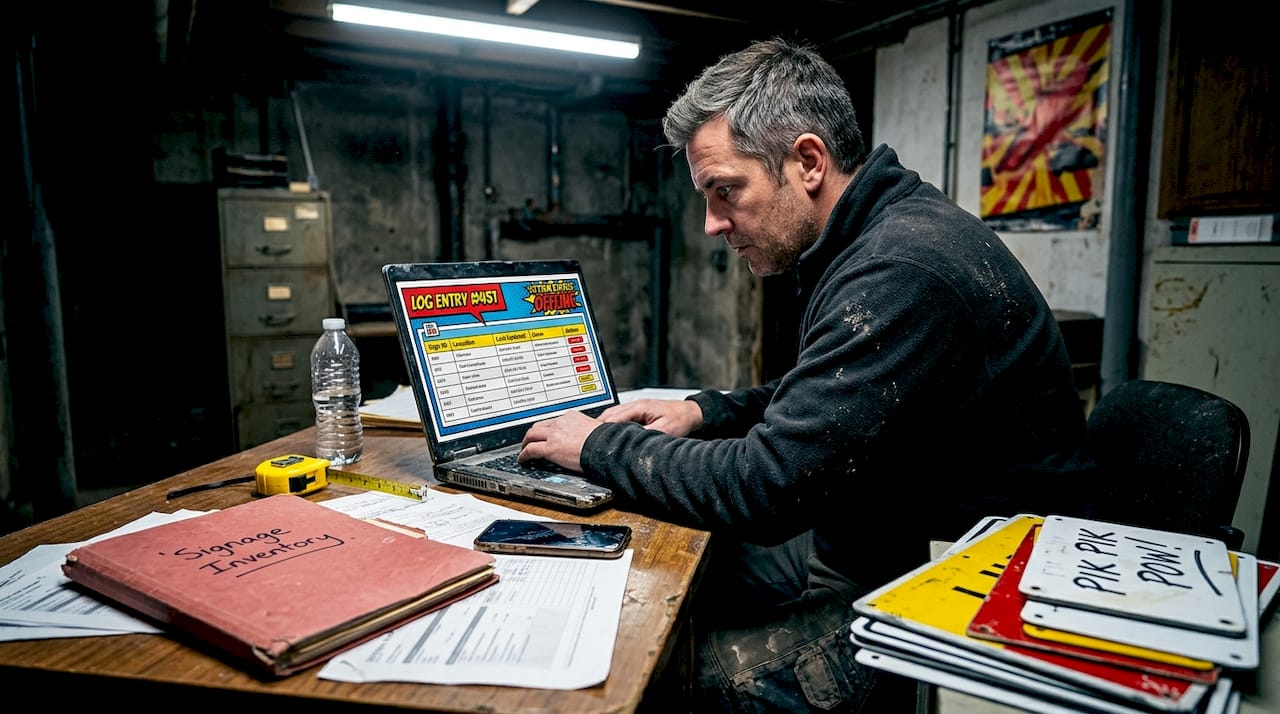
Pro Tip: Keep a digital log of every sign in your facility, including installation date, location, material, and scheduled maintenance dates. A simple spreadsheet works well for smaller estates. Larger facilities may benefit from a property management system with a signage asset register.
Corporate signage checklist: at-a-glance
To keep everything on track, here is a ready-to-use checklist you can work through for every new signage project.
| Checklist area | Key actions | Status |
|---|---|---|
| Objectives | Define purposes (brand, wayfinding, compliance, operational); identify indoor/outdoor needs; confirm temporary or permanent | To do / Complete |
| Compliance | Check letter height and viewing distance ratios; confirm planning permission requirements; apply accessibility standards; verify health and safety sign specifications | To do / Complete |
| Design and materials | Select materials suited to environment and lifespan; confirm brand colour and typeface accuracy; assess placement against traffic patterns; produce and test onsite mock-ups | To do / Complete |
| Installation | Schedule installation to minimise disruption; use qualified installers; document all fixing and electrical details | To do / Complete |
| Maintenance | Set inspection schedule; create a digital asset log; build in a branding and compliance review cycle | To do / Complete |
Use this table as a project management tool. Assign a responsible person to each area, set deadlines, and tick off actions as they are completed. It keeps the process accountable and prevents anything from slipping through.
Why most signage checklists miss the mark
With the core checklist covered, let us take a candid look at what most lists miss and how to truly future-proof your signage decisions.
The signage industry produces plenty of guidance. But most of it treats signage as a static, one-off decision: design it, install it, move on. What those lists consistently overlook is the behavioural reality of how people actually interact with signs in the real world.
Here is the uncomfortable truth: the majority of signage failures we see are not caused by bad design or poor materials. They are caused by signs that were never properly tested with real people in real conditions before they were permanently installed. Real-world testing of mock-ups is critical, and desk-based design alone is rarely enough to identify the problems that only appear when a visitor stands at the actual decision point and tries to navigate.
We have seen organisations invest significantly in beautifully designed wayfinding systems, only to find that visitors still cannot locate the entrance because the primary sign is obscured by a parked delivery vehicle for six hours a day. We have seen health and safety signs installed at the correct height per the regulations, but positioned on a wall that is never in the line of sight of workers at the point of risk.
The solution is not a better checklist. It is a better process. Combine your checklist with at least one structured walk-through before final installation, ideally with a mix of staff and genuine first-time visitors. Their experience will surface issues that no amount of desk-based planning will reveal. If you want to learn about durable signage choices that hold up over time, the same principle applies: test your choices against real conditions, not just specifications on paper.
Pro Tip: Conduct at least one formal walk-through with staff and, where possible, customers or visitors before signing off on final installation. Brief them only minimally so their responses reflect genuine first-time experience.
Create your ideal signage solution with expert support
If you are ready to turn your checklist into a live signage project, working with an experienced signage partner makes every stage more straightforward.
At Pik Pik POW!, we work with business owners and facility managers across the UK to design, produce, and install corporate signage that meets both brand and compliance requirements. Whether you need architectural and wayfinding signage for a commercial development, shopfront and fascia signs for a retail environment, or a full suite of health, safety, and directional signage for a facility, we handle the process from initial brief to final installation. Our team combines design expertise with precision manufacturing to deliver results that stand up to real-world use. Get in touch to discuss your project and receive tailored advice.
Frequently asked questions
What is the recommended letter height for corporate signage in the UK?
Use at least 10mm of letter height for every 3 metres of viewing distance, so a sign read from 15 metres away needs letters at least 50mm tall. Always test mock-ups onsite to confirm clarity before committing to final production.
How often should business signage be checked or maintained?
Inspect all signage at least once a year and immediately after significant weather events or changes to your facility layout. Routine checks keep signage legible, structurally sound, and up to date with any regulatory or branding changes.
Can corporate signage require planning permission in the UK?
Yes, exterior and illuminated signs often require advertisement consent from your local planning authority, regardless of whether you are installing a new sign or replacing an existing one. Always confirm requirements before production begins.
What are the most durable materials for exterior business signage?
Aluminium, acrylic, and weatherproof vinyl are the strongest performers for exterior signage in the UK climate, each offering a working lifespan of between five and fifteen years depending on the application and finish.