TL;DR:
- Proper signage is a legal requirement and critical for ensuring safety on UK construction sites.
- Different sign types have standardized colors and shapes to communicate hazards effectively.
- Regularly reviewing and maintaining signage prevents accidents and ensures ongoing site safety compliance.
A construction company was fined £60,000 after a worker fell through an unprotected floor opening. The absence of adequate warning signage was a key factor. For construction project managers and site supervisors, this is not an isolated case. Getting your signage right is not just about ticking boxes. It is a legal obligation and a direct line of defence for every person on your site. This guide breaks down the main types of construction signage required under UK law, explains where and how to use them, and covers the special cases that catch many sites out.
Table of Contents
- Understanding UK construction signage regulations
- Key types of construction signage and their meanings
- Where and how to use construction signage effectively
- Special cases: site entrance boards, traffic, and public protection signage
- A fresh perspective: the true role of signage in site safety
- Need expert signage for your next project?
- Frequently asked questions
Key Takeaways
| Point | Details |
|---|---|
| Comprehensive signage is mandatory | UK law requires a full range of signage types to reduce risk on every construction site. |
| Placement and clarity are critical | Effective signage must be visible, well-maintained, and understandable by all workers. |
| Special rules for notifiable projects | Larger or longer-term sites must display detailed entrance boards and extra signage. |
| Signage supports—not replaces—risk management | Signs must be paired with active site controls and regular hazard reviews. |
Understanding UK construction signage regulations
The primary legislation you need to know is the Health and Safety (Safety Signs and Signals) Regulations 1996. These regulations require employers to provide safety signs wherever a significant risk to health and safety remains after all other control measures have been applied. In plain terms, if you cannot fully eliminate a hazard, you must sign it.
Alongside this, the BS EN ISO 7010 standard sets out the symbols used on safety signs across Europe. Using standardised icons means that workers who speak different languages can still understand the message quickly and clearly. This is particularly relevant on UK construction sites, where teams are often made up of people from a wide range of backgrounds.
The CDM 2015 requirements add another layer of responsibility. Under the Construction (Design and Management) Regulations 2015, principal contractors must ensure that health and safety information is communicated clearly across the site, which includes appropriate signage at entrances and throughout the working area.
You should also be aware of the UK signage regulations that apply more broadly, as these interact with site-specific requirements and can affect how you specify and procure signs.
Key obligations under the 1996 regulations include:
- Providing signs where risks cannot be controlled by other means
- Ensuring signs conform to recognised symbols and colour codes
- Maintaining signs so they remain legible and visible at all times
- Training workers to understand the meaning of signs used on site
- Reviewing signage whenever site conditions or risks change
Statistic: Fines for signage-related safety failures on construction sites have ranged from £24,000 to £60,000 in recent HSE prosecutions. Non-compliance is not a minor administrative issue. It carries serious financial and legal consequences.
For a broader overview of signage tips for construction safety, it is worth reviewing best practice guidance alongside the legal framework to ensure your approach covers both compliance and practical effectiveness.
Key types of construction signage and their meanings
Not all construction signs are the same. Each type has a specific purpose, a defined colour scheme, and a standardised format under BS EN ISO 7010. Understanding the differences helps you select the right sign for every situation on site.
Here is a quick-reference comparison of the five main sign types:
| Sign type | Colour | Shape | Example use |
|---|---|---|---|
| Prohibition | Red circle, white background | Circle with diagonal bar | No unauthorised entry |
| Warning | Yellow background | Triangle | Overhead load, uneven surface |
| Mandatory | Blue circle | Circle | Wear hard hat, high-visibility vest |
| Safe condition | Green rectangle | Rectangle or square | First aid point, emergency exit |
| Fire | Red background | Rectangle or square | Fire extinguisher location |
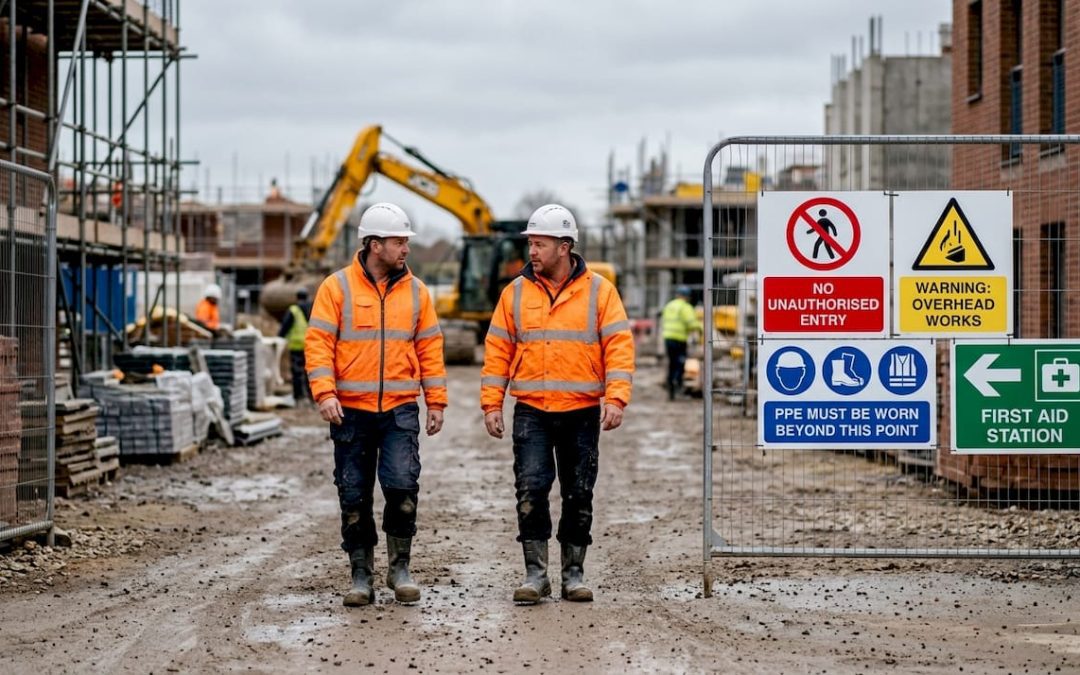
Prohibition signs tell people what they must not do. The red circle with a diagonal bar is universally recognised. Common examples include no-entry signs for restricted zones and no-smoking signs near flammable materials.
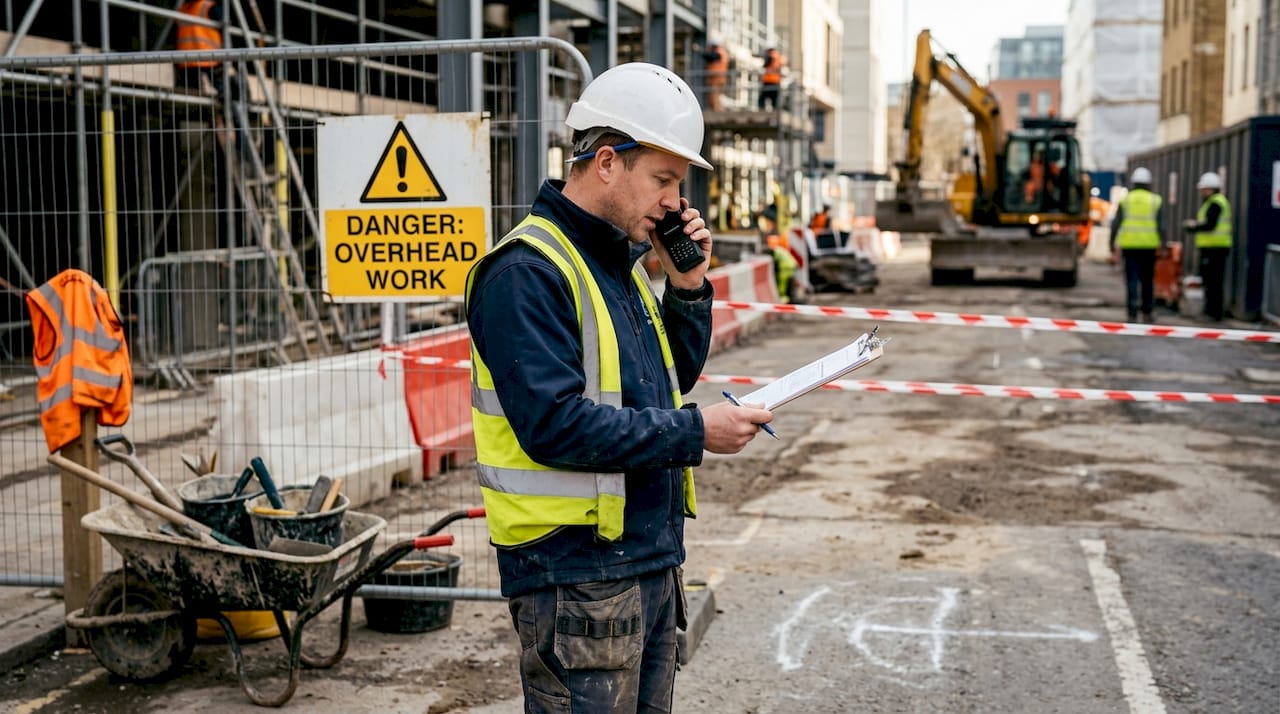
Warning signs alert workers to a specific hazard nearby. The yellow triangle is the key identifier. You will see these used for overhead loads, deep excavations, and areas with moving plant.
Mandatory signs instruct workers to take a specific action. The blue circle format is used for all PPE (personal protective equipment) requirements, such as wearing safety boots, helmets, or eye protection. These are among the most frequently used signs on any active construction site.
Safe condition signs direct people to safety facilities or safe routes. Green rectangles are used for first aid stations, emergency exits, and assembly points.
Fire signs identify fire-fighting equipment and alarm points. These use a red background and must be clearly visible at all times.
Pro Tip: Do not rely solely on text-based signs. Symbol-based signs conforming to BS EN ISO 7010 are far more effective for multilingual teams and in low-light or high-noise environments where reading is difficult.
“Signage clarity is not a design preference. It is a safety-critical requirement. A sign that is misread or ignored is no sign at all.”
For a full breakdown of construction signage terminology used across UK sites, and to keep up with signage safety updates as regulations evolve, it is worth bookmarking reliable resources you can return to regularly.
Where and how to use construction signage effectively
Having the right signs is only part of the job. Where you place them and how you maintain them is equally important. HSE guidance is clear: signs must be visible, unobstructed, positioned at eye-level, and located before the hazard rather than at it or beyond it.
Core placement principles to follow:
- Position signs at the point of decision, not after a worker has already passed the risk
- Ensure nothing blocks the sign, including temporary structures, equipment, or other notices
- Use appropriate fixings for outdoor and high-traffic environments where signs can be knocked or shifted
- Check that lighting conditions allow signs to be read at all times, including early mornings and overcast days
- Replace faded, damaged, or obscured signs immediately
Multilingual signage is increasingly important on UK construction sites. HSE recommends using symbol-based signs as the primary format, supplemented by text in the languages spoken by your workforce where necessary. This is not just good practice. It is a practical way to reduce misunderstandings that lead to incidents.
Site-specific risk assessments should drive your signage plan. A generic set of signs bought off the shelf may not cover every hazard on your particular site. Regular audits, ideally weekly on active sites, help you catch signs that have faded, been moved, or become irrelevant as work progresses.
Here is a quick reference for placement by sign type:
| Sign type | Recommended location |
|---|---|
| Prohibition | Site entrances, restricted zone boundaries |
| Warning | Immediately before the identified hazard |
| Mandatory | Entry points to areas where PPE is required |
| Safe condition | Along evacuation routes, near first aid points |
| Fire | Adjacent to fire equipment, at regular intervals |
Pro Tip: Walk the site as if you were a new starter on their first day. If you cannot find a sign or understand its message within a few seconds, it needs to be repositioned or replaced. This simple exercise often reveals gaps that routine checks miss.
For guidance on site signage design that balances compliance with clarity and visual impact, working with an experienced signage supplier can make a real difference to the quality of your output.
Special cases: site entrance boards, traffic, and public protection signage
Beyond standard safety signs, certain projects carry additional signage obligations. These are often the areas where sites fall short, particularly when it comes to public-facing and traffic-related requirements.
Under CDM 2015, notifiable projects must display a site entrance board. Your project is notifiable if it meets any of the following criteria:
- The construction phase will last longer than 30 working days with more than 20 workers simultaneously on site
- The project will exceed 500 person-days of construction work
- The site involves demolition or dismantling of a structure
A compliant site entrance board must include the project name and address, the names and contact details of the principal designer and principal contractor, the HSE project notification reference number, details of key hazards, and PPE requirements for anyone entering the site.
Traffic management signage is another area that requires careful attention. Highway Code standards apply to any signs that interact with public roads, including temporary traffic lights, road closure notices, and pedestrian diversion routes. Banksman signals, used to guide vehicles safely within the site boundary, must also be clearly communicated and understood by all plant operators.
Public protection signage includes:
- Hoarding and fencing with clear warnings for pedestrians
- Overhead protection notices where work takes place above public footpaths
- Signage directing the public away from active work zones
- Emergency contact information visible from outside the site boundary
Fencing and hoarding are not just physical barriers. They are a communication tool. Clear, well-maintained signage on your hoarding tells the public that your site is professionally managed and safety-conscious.
For a complete range of health and safety signage that covers both standard and site-specific requirements, working with a supplier who understands the full scope of CDM obligations is a practical advantage.
A fresh perspective: the true role of signage in site safety
Signage is essential. But it is not a substitute for active site management. A recent HSE prosecution involving a sign-fitting company resulted in significant fines after a fatal fall from scaffolding. Falls remain the leading cause of construction fatalities in the UK, and poor or absent signage consistently features in enforcement cases.
The uncomfortable truth is that many sites treat signage as a one-time task. Signs go up at the start of a project and are rarely reviewed until something goes wrong. This is where complacency becomes dangerous.
Signage must be part of a living safety system. It should be reviewed when risks change, updated when new hazards are introduced, and removed when it is no longer relevant. An out-of-date sign can be as harmful as no sign at all, because it trains workers to ignore what they see.
Regular toolbox talks that reference specific signs on your site reinforce their meaning and keep safety front of mind. The site signage best practices that make the biggest difference are not the most expensive ones. They are the ones that are consistently applied and actively managed.
Need expert signage for your next project?
At Pik Pik POW!, we work with construction project managers and site supervisors across the UK to deliver signage that is compliant, clear, and built to last on active sites.

From health & safety signage covering all five sign types to fully bespoke site entrance boards and public-facing hoarding, we handle the full range. Our construction signage systems are designed to meet CDM 2015 and BS EN ISO 7010 requirements, so you can be confident your site is covered. Get in touch with our team for site-specific advice and a quote tailored to your project’s exact needs.
Frequently asked questions
What types of construction signage are legally required in the UK?
The law requires prohibition, warning, mandatory, safe condition, and fire signage wherever residual risks exist on site. Each type has a defined colour and symbol format under BS EN ISO 7010.
Who needs to comply with construction signage regulations?
Every employer and contractor on UK construction sites must provide compliant signage under the Safety Signs and Signals Regulations 1996. This applies regardless of project size or duration.
Where should construction safety signs be placed for maximum effect?
Signs must be visible, unobstructed, at eye-level, and positioned before the hazard rather than at or beyond it. Regular checks ensure they remain effective as site conditions change.
What information is required on a site entrance board under CDM 2015?
Site entrance boards on notifiable projects must display the project name, key contacts, HSE notification reference, site hazards, and PPE requirements for all who enter.