
TL;DR:
- Sustainable signage focuses on durability, reusability, and responsible disposal rather than just materials.
- Implementing sustainable signage reduces costs, waste, and enhances brand perception.
- Strategies include audits, modular systems, early specification, and choosing long-lasting, recyclable materials.
Many retail and commercial managers assume that switching to recycled or biodegradable materials is the defining step towards sustainable signage. It is not. The real picture is more layered, and the businesses that get it right are seeing measurable results: reduced banner production by 26% and cost savings of 34% in documented retail programmes. This article cuts through the noise to help you understand what sustainable signage genuinely means, how it translates into business value, and how to implement it in your retail or commercial environment without sacrificing brand quality or operational efficiency.
Table of Contents
- Defining sustainable signage: more than just materials
- Business impact: how sustainable signage delivers value
- Materials, manufacturing, and the supply chain: what really matters
- Applying sustainable signage in your business: practical steps
- The uncomfortable truth: what brands get wrong about sustainable signage
- Find the right sustainable signage partner
- Frequently asked questions
Key Takeaways
| Point | Details |
|---|---|
| Durability over labels | Choosing longer-lasting signage yields bigger sustainability gains than simply opting for ‘eco’ branded materials. |
| Proven business value | Sustainable signage can cut both costs and waste while enhancing customer perception and brand loyalty. |
| Go beyond materials | Consider the full lifecycle, including supply chain and end-of-life, to achieve real sustainability. |
| Plan and measure impact | A strategic, stakeholder-focussed approach ensures sustainable signage delivers lasting results. |
Defining sustainable signage: more than just materials
Before diving into practical comparisons and applications, we need clear definitions. Sustainable signage is not a product category. It is a design philosophy applied across the full lifecycle of every sign you commission, install, and eventually retire.
At its core, sustainable signage is designed, produced, and managed to minimise environmental impact at every stage. That includes how it is manufactured, how long it lasts, whether it can be reused or updated, and how it is disposed of at end of life. Material choice is just one factor within that system.
The foundational principles are:
- Durability: Signage that lasts longer eliminates the environmental and financial cost of frequent replacement.
- Reusability: Systems that allow graphic inserts or modular updates reduce total waste considerably.
- Waste minimisation: Planning for lower production volumes from the outset avoids unnecessary resource use.
- Responsible disposal: Specifying materials that can be recycled or composted closes the loop properly.
A key insight that reshapes how most teams approach this is that reducing replacement frequency matters as much as, or more than, specifying a material with an eco label. A sign made from a recycled substrate that is replaced every three months is far less sustainable than a conventional sign that lasts five years.
The waste hierarchy is a useful framework here. It places avoidance first, then reuse, then recycling, and finally disposal. Most eco signage conversations skip straight to recycling and miss the bigger wins higher up the chain. Modular signage systems that allow graphic swaps without replacing the full unit sit firmly at the top of that hierarchy.
Prioritise durability and reusability over eco labels alone. Frequent replacement negates the environmental benefit of the materials themselves, regardless of their green credentials.
One common pitfall is chasing certifications and labels rather than proven performance. A product may carry an environmental logo but require disposal after a single campaign. That is not sustainable by any reasonable definition. Look for verified long-life options and digital signage solutions that eliminate print waste at scale.
Business impact: how sustainable signage delivers value
With the foundations set, let’s examine the business case for sustainability in signage. It is more than environmental tick-boxing.
Sustainable signage creates direct, measurable business benefits when implemented strategically. The most immediate gains are cost reduction and waste elimination, but the longer-term advantages include stronger brand equity and improved stakeholder perception.

Consider these benchmarks from documented retail programmes:
| Metric | Short-term approach | Sustainable approach |
|---|---|---|
| Banner production volume | High, replaced seasonally | Reduced by up to 26% |
| Annual signage cost | Variable, frequently over budget | Reduced by up to 34% |
| Waste generated | Significant, landfill-bound | Reduced by up to 40% via frame-insert systems |
| Brand perception | Neutral | Positively correlated with green store design |
34% cost reduction is the figure that tends to get operations managers’ attention. That is the saving achieved when banner production was reduced from 25,000 to 6,700 units annually in a documented retail case. The environmental benefit and the commercial benefit aligned directly.
The business case extends beyond cost. Research shows a strong correlation between visible green store design and both customer perception and brand loyalty. Sustainable choices, when executed visibly and consistently, build trust with your customers and your internal stakeholders.
Key business outcomes supported by sustainable signage include:
- Lower procurement and print spend over a rolling 12-month period
- Reduced storage requirements for seasonal signage volumes
- Improved ESG reporting metrics and supply chain transparency
- Stronger alignment with customer values, particularly among younger demographics
- Reduced pressure on marketing budgets through reusable system investment
Bespoke branding signage that is designed for longevity from the outset avoids the compounding cost of repeated reprints. The short-term saving of a cheap, single-use solution almost always costs more over a two-year period than a durable alternative.
Materials, manufacturing, and the supply chain: what really matters
The value is clear, but the path to truly sustainable choices means going beyond price tags and green logos.
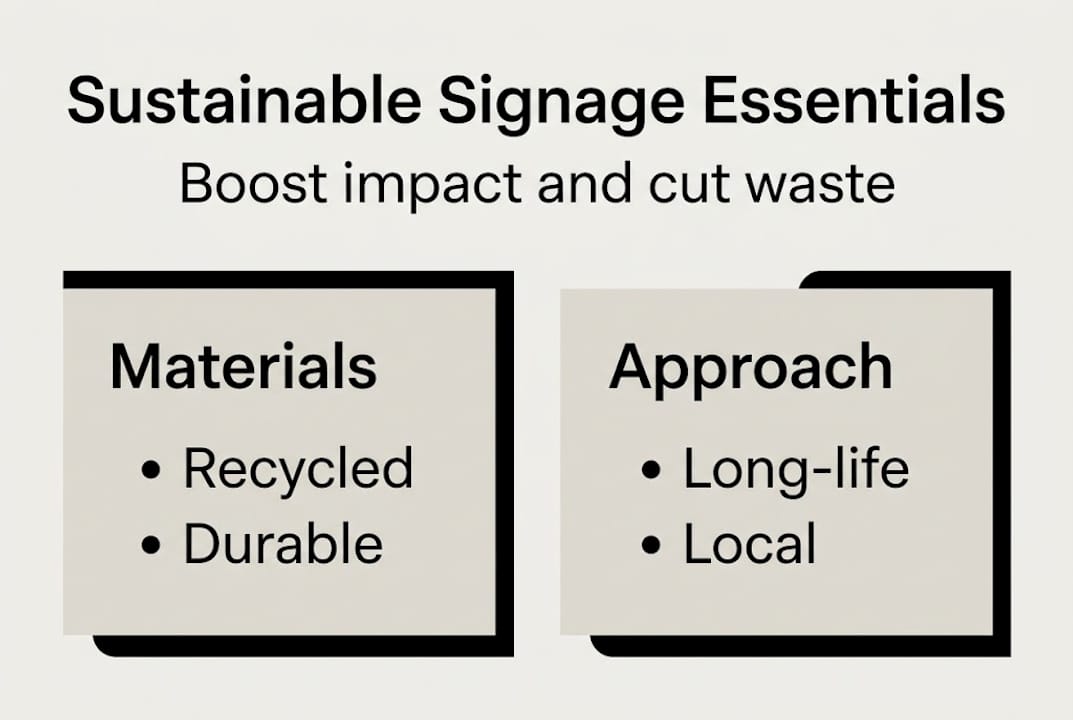
Material selection is where most conversations start, but it is rarely where the most impactful decisions lie. The honest reality is that recycled content quality can match virgin materials in most signage applications, but logistics, transport, and supply chain resource use often add costs and challenges that offset the environmental gain.
Here is a practical framework for evaluating materials:
| Factor | Questions to ask |
|---|---|
| Lifecycle length | How long will this sign last in its intended environment? |
| Recyclability | Can it be recycled at end of life, and is that infrastructure available? |
| Supply chain distance | Where is it manufactured, and what does transport add to its footprint? |
| Reuse potential | Can graphics or components be replaced without scrapping the whole unit? |
| Composite risk | Does it combine materials that make recycling harder? |
One concept worth understanding is ‘glocal’ production: balancing local manufacturing for reduced transport emissions with globally sourced specialist materials where quality or cost demands it. This approach optimises your carbon footprint without compromising specification.
Pro Tip: When specifying signage materials, ask your supplier for the full material data sheet, not just an eco label. Confirm whether the item is mono-material (easier to recycle) or a composite (often harder). Durable signage that outlasts three replacement cycles of a cheaper alternative is nearly always the more sustainable choice.
Here are the most common material pitfalls to avoid:
- Specifying foam-backed composites that cannot be separated for recycling
- Choosing biodegradable substrates for outdoor applications where they degrade prematurely
- Overlooking the reuse potential of aluminium and steel framing systems
- Ignoring the carbon cost of air-freighted materials to meet tight campaign deadlines
- Accepting a supplier’s eco claim without asking for third-party verification
The relationship between branding and safety also plays into material choice. Signs that degrade quickly in outdoor environments create both a brand and a safety risk. Durability is not just a sustainability argument; it is a risk management one.
Applying sustainable signage in your business: practical steps
Understanding the theory is one thing; making it practical is where the value comes alive.
The most effective approach to sustainable signage adoption follows a clear, repeatable process. Here is how to structure it:
- Audit your current signage estate. Map every sign type, location, replacement frequency, and associated cost. This reveals your biggest waste and spend hotspots immediately.
- Prioritise by impact. Focus first on the sign categories with the highest turnover. Seasonal POS materials and promotional banners are often the largest volume waste streams.
- Specify with longevity in mind. Specifying signage early in a campaign or store design project allows durable and reusable systems to be integrated from the outset, rather than retrofitted.
- Implement modular solutions. Frame-insert systems are highly effective. One seasonal brand cut signage waste 40% by switching to this format, replacing only printed inserts while retaining the frame infrastructure.
- Review and report. Set baseline metrics before implementation and measure against them quarterly. Reporting sustainability improvements internally and externally reinforces stakeholder buy-in.
For stakeholder engagement, the business case needs to land with both marketing and finance. Present sustainability not as a cost but as a long-term investment with a clear payback period based on reduced reprint volumes.
Pro Tip: Involve your operations team in the specification process. They will flag practical issues with installation, storage, and replacement logistics that marketing teams sometimes overlook. This cross-functional input consistently produces better, more sustainable outcomes.
Some quick wins include swapping single-use banners for reusable fabric systems, switching to internal wayfinding signage built on modular aluminium frames, and consolidating signage suppliers to reduce transport-related emissions. Longer-term strategies involve end-of-life planning for all new signage specifications and committing to annual audits to track progress.
The uncomfortable truth: what brands get wrong about sustainable signage
With practical guidance in hand, it is worth reconsidering some common but seldom challenged beliefs.
In our experience, the most common failure mode is visibility bias. CSR and marketing teams gravitate towards the changes that are easy to show: a recycled substrate here, a new eco logo on a display there. What gets missed is the supply chain reality, the product lifespan, and the operational decisions that actually move the needle.
Sustainability wins come from planning early, choosing durability, and integrating sustainability criteria into your briefing process before anyone has opened a design file. Material upgrades made at the last stage of production, after everything else has been decided, rarely deliver the promised impact.
Brand trust is built through consistent, authentic actions. Green store design correlates with customer perception at r=0.67 (p<0.01) and has a measurable link to brand loyalty. That is not a soft benefit. It is a statistically significant business outcome.
Most organisations also overlook the ongoing ambient impact of their signage estate on customer perceptions, well beyond active campaign periods. Signage that ages badly, fades, or degrades in public view sends a message about your brand that no campaign can easily undo.
Find the right sustainable signage partner
For managers ready to put new signage strategies into practice, partner expertise matters.
At Pik Pik POW!, we work with retail and commercial businesses to design and manufacture signage that performs over the long term. From modular signage systems that reduce seasonal waste to fully integrated digital signage options that eliminate print entirely, our range is built around your operational and environmental objectives.
We bring design expertise and manufacturing precision together to help you specify the right solution from the outset, not retrofit sustainability after the fact. Whether you are looking to reduce procurement costs, meet ESG commitments, or simply make your brand estate work harder over time, we can help you build a signage strategy that delivers on both.
Frequently asked questions
What makes signage truly sustainable in 2026?
Signage is truly sustainable when it prioritises durability, reusability, material responsibility, and supply chain impact. Eco labels alone are not sufficient; longevity and reduced replacement frequency matter just as much.
Does recycled signage perform as well as new materials?
Yes, recycled content quality can match virgin materials in most applications, but supply chain and transport factors must be factored into the full environmental assessment.
How can switching to sustainable signage lower business costs?
By reducing how often signs need to be replaced, sustainable signage cuts long-term procurement spend. Banner production reduced 26%, generating a 34% cost saving in one documented retail programme.
What is the first step to upgrading to sustainable signage?
Audit your existing signage estate to identify the highest-turnover items. Switching these to modular or frame-insert systems delivers the fastest impact, with signage waste reduced by 40% in comparable cases.