

TL;DR:
- A compound entry sign is a mandatory safety communication at construction sites, displaying essential project and safety information. Its design, placement, and maintenance are regulated by UK laws, requiring clear, durable signage with standardized pictograms to ensure quick readability. Proper signage demonstrates professionalism, supports legal compliance, and enhances safety for workers, visitors, and emergency services.
A compound entry sign, also called a site information board, is a fixed display at a construction site entrance that identifies the project and communicates essential safety information to workers, visitors, and emergency services. Every compliant board should carry, at minimum:
- Project name and site address
- Principal contractor name and contact number
- Principal designer name (for CDM 2015 notifiable projects)
- Emergency contact number
- Access restrictions (no unauthorised entry)
- Mandatory PPE requirements (hard hat, hi-vis, safety footwear)
- CDM notification reference where the project is notifiable to the HSE
The sign supports your obligations under the Health and Safety (Safety Signs and Signals) Regulations 1996 and the Construction (Design and Management) Regulations 2015, and gives emergency services the concise location and contact data they need the moment they arrive on site.
Table of Contents
- When do you need a compound entry sign under UK law?
- What information must appear on a site information board?
- How should you design a compound entry sign for legibility and durability?
- Where and how should you install a compound entry sign?
- What does bespoke compound entry signage cost in the UK?
- Who is responsible for maintaining compound entry signage?
- Practical templates for a compound entry board
- Pikpikpow designs and installs compound entry signage across the UK
- Key takeaways
- Why well-designed site signage is worth the investment
- Useful sources and standards
When do you need a compound entry sign under UK law?
The short answer: on virtually every construction site with a defined perimeter, and certainly on any project notifiable to the HSE.
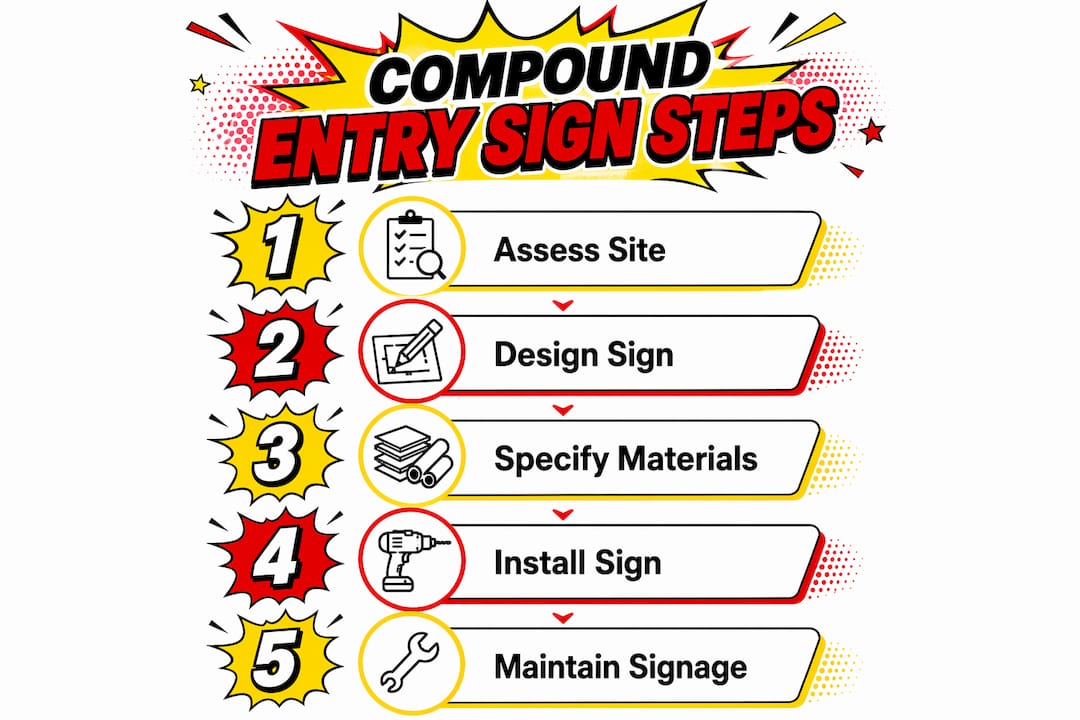
Two pieces of legislation set the baseline. The Health and Safety (Safety Signs and Signals) Regulations 1996 govern the format, colour, shape, and symbols used on all safety signs, requiring conformity to prescribed standards. CDM 2015 adds construction-specific duties, particularly around the information that must be visible at the site itself throughout the project lifecycle. CDM Regulation 18 also supports perimeter identification by suitable signs where fencing alone is not practicable, making a compound entry board part of your perimeter control strategy rather than a separate obligation.
Common triggers for a compound entry sign:
- The project is notifiable to the HSE (construction phase lasting more than 30 working days with more than 20 workers simultaneously, or exceeding 500 person-days)
- The site has a public frontage or borders a pedestrian area
- Multiple contractors or frequent visitors access the site
- The site involves a defined compound with gates and security fencing
What the regulations require in practice:
- Site entrance signage displaying key health and safety information
- PPE requirement signs at access points
- Hazard warning signs for specific construction risks
- Welfare facility signs within the compound
Signage complements perimeter fencing and your risk assessment. A sign is not a substitute for physical access control, but an incomplete or incorrectly formatted board may not satisfy your legal obligations any more than having no sign at all. Content accuracy carries regulatory weight.
What information must appear on a site information board?
The site information board at the main entrance is where several distinct obligations converge in one visible location. Get the content right and the sign does its job without anyone having to think about it.
Mandatory fields (legal and regulatory)
- Project name and site address — identifies the location for emergency services and regulators
- Principal contractor name, address, and telephone number — required under CDM 2015 for notifiable projects; the principal contractor is responsible for managing site information
- Principal designer name and contact details — required where one is appointed under CDM 2015
- CDM notification reference number — confirms the project is registered with the HSE
- Emergency contact number — must be current and monitored
- No unauthorised entry — access restriction, mandatory sign format (blue circle, white pictogram per ISO 7010)
- Mandatory PPE pictograms — hard hat, hi-vis vest, safety footwear as a minimum; use ISO 7010 symbols throughout
Recommended fields (best practice)
- Site working hours — reduces neighbour complaints and clarifies access windows
- Hoarding or developer contact — required by many local authority planning conditions
- First aid contact and location — keeps emergency information current
- Waste and environmental contact — useful on larger sites with environmental conditions
Pro Tip: Treat the site information board as emergency information, not just a compliance checkbox. Emergency services must read concise contact and location data immediately on arrival, so keep the layout uncluttered and the emergency number large enough to read from a vehicle.
Standardised ISO 7010 pictograms and correct colour coding reduce visitor confusion and are easier for enforcement officers and insurers to accept as compliant. A mandatory sign must use a blue circular background with a white pictogram drawn from the approved symbol set. Using a non-standard image does not meet the requirement, even if the intended message seems obvious.
How should you design a compound entry sign for legibility and durability?
Good design is not about aesthetics. On a construction site, it is about whether a delivery driver, an HSE inspector, or a paramedic can read the board in three seconds from ten metres away.
Size and type height
| Board type | Typical dimensions | Minimum body text height | Viewing distance |
|---|---|---|---|
| Standard entrance board | — | 20 mm | Up to 10 m |
| Large hoarding panel | — | 30 mm | Up to 20 m |
| Temporary A-frame / corflute | — | — | Up to 5 m |
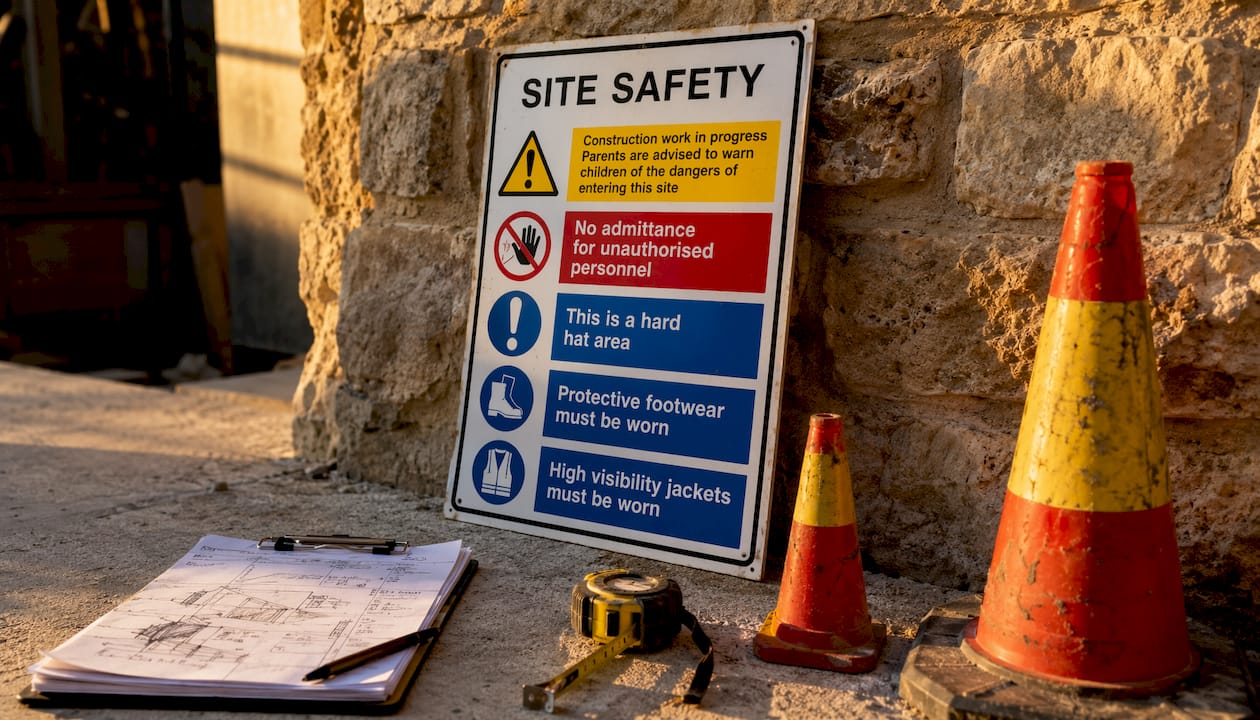
For a standard entrance board, a sans-serif typeface such as Arial or Helvetica at a minimum 20 mm cap height gives adequate legibility in daylight. Emergency numbers and the project name should be larger still, typically 30–40 mm, so they read at a glance.
Colour and contrast
Follow the colour coding set by the 1996 Regulations and ISO 7010. High contrast between text and background (black on white, white on dark blue) is the baseline. Avoid dark text on mid-tone backgrounds, which loses legibility in low light or rain.
Materials
- Aluminium composite (Dibond): rigid, weather-resistant, UV-stable; the standard choice for semi-permanent site boards lasting 6–24 months
- Rigid PVC (Foamex): lighter and lower cost; suitable for shorter projects or internal compound areas
- Corrugated plastic (corflute): low-cost temporary option for short-duration works; not suitable for exposed or high-wind locations
- Hoarding-grade PVC banner: wide-format print on reinforced banner material, eyeleted for hoarding frames; cost-effective for large-format panels
For durability, specify a UV-laminate or anti-graffiti coating on any board exposed to the public. Reflective overlaminates improve night-time legibility near road junctions and are worth specifying on sites with 24-hour access or vehicle movements after dark.
Pro Tip: When briefing your supplier, ask for a proof at 1:1 scale for at least the header section. What looks legible on a monitor at 100% zoom often reads differently at actual size in outdoor light.
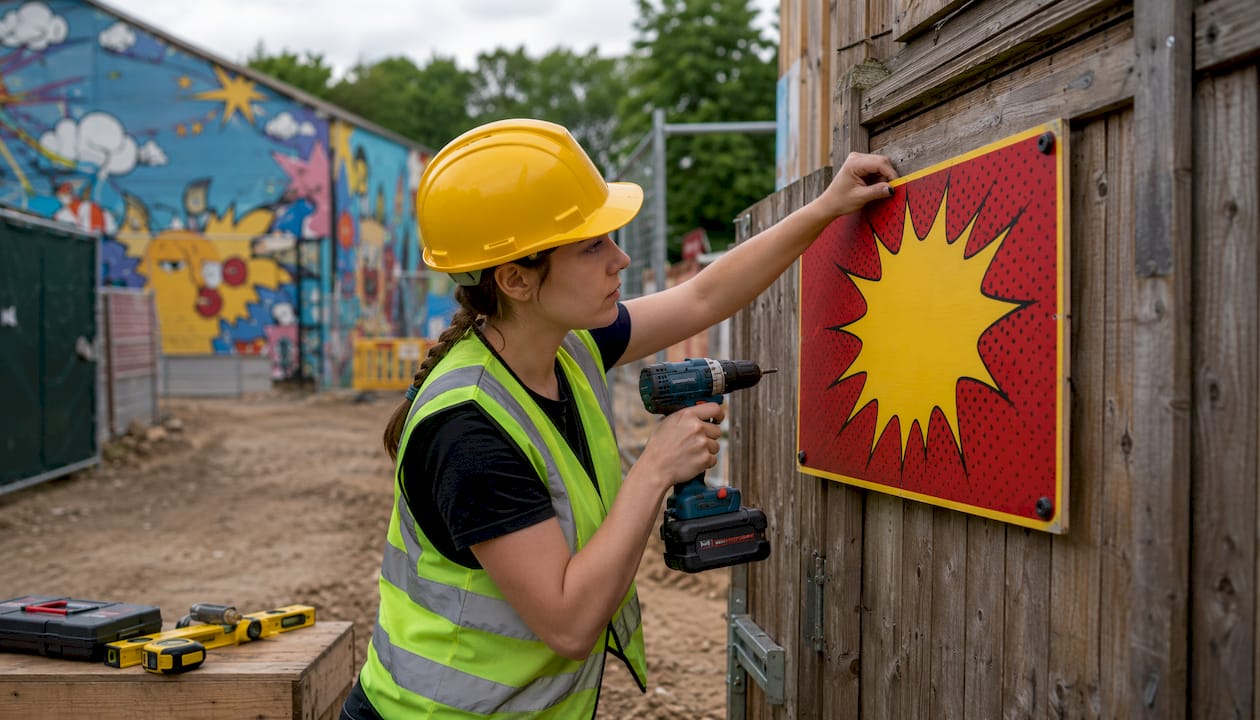
Designing compliant safety signage involves balancing regulatory colour standards with practical readability. The two are not in conflict; the regulations exist precisely because they work.
Where and how should you install a compound entry sign?
The sign must be visible at every access point before anyone enters a hazardous zone, and readable by approaching traffic and pedestrians from a safe distance.
Placement rules
- Position at the main entrance gate, facing outward toward the public highway or approach road
- On multi-access sites, place a board at each staffed or gated entry point
- Mount so the bottom of the sign is no lower than 500 mm from ground level; the centre of the board should sit at approximately 1.5 m eye height for pedestrians
- Avoid placing behind fencing, vegetation, or temporary structures that obstruct sightlines
- On hoarding-fronted sites, fix the board flush to the hoarding face at the gate post
Lighting and visibility
Where the site operates outside daylight hours, illuminate the board or specify a reflective finish. A simple external LED floodlight directed at the board is the most practical solution for temporary sites. Perimeter signage must communicate access restrictions clearly, particularly where the site borders a public right of way.
Installation checklist
- Confirm the mounting surface (hoarding post, steel frame, masonry, or freestanding post)
- Select fixings appropriate to the substrate (stainless steel screws for timber, chemical anchors for masonry)
- Check the board is level and square before final fixing
- Verify the sign is visible from the site entrance and from the approach road in both directions
- Photograph the installed sign and record the date for your site H&S file
For property signage installation on hoarding or compound gates, a freestanding post-and-panel system gives flexibility to reposition the board as site access points change during the project.
What does bespoke compound entry signage cost in the UK?
Costs vary by size, material, and whether installation is included. Typical UK market rates for bespoke printed boards vary widely and are intended as a budgeting guide rather than fixed prices. Small temporary boards cost less than standard aluminium composite entrance boards, which in turn cost less than large hoarding panels. Installation and design fees depend on project complexity and site conditions.
What drives cost:
- Board size and material specification
- Number of colours and complexity of artwork
- Lamination or anti-graffiti coating
- Installation access (scaffolding, MEWP, or restricted hours add cost)
- Quantity (unit cost falls significantly on orders of five or more boards)
Lead times for a standard bespoke board run from three to seven working days from approved artwork to dispatch. Rush production (24–48 hours) is available from most specialist suppliers at a premium. Factor in delivery and installation scheduling when planning site mobilisation, as signage is typically one of the first items installed during compound set-up, before offices and storage areas are operational.
Who is responsible for maintaining compound entry signage?
Under CDM 2015, the principal contractor holds practical responsibility for managing site information and safety measures throughout the construction phase. That includes keeping the compound entry sign accurate, legible, and securely fixed.
Routine maintenance checks (recommend monthly or after any incident):
- Legibility: check for fading, graffiti, or physical damage
- Accuracy: confirm all contact details and contractor names are current
- Fixings: check for loose screws, bent frames, or boards that have shifted
- Lighting: test any illumination and replace failed lamps promptly
When personnel change, update the sign before the new person takes responsibility, not after. An outdated emergency contact on a site board is a compliance failure and a practical risk.
Pro Tip: Log each sign check in your site H&S file with a date, the name of the person who checked it, and any remedial action taken. This record takes two minutes to complete and provides clear evidence of due diligence if the site is inspected.
Replace rather than repair when the board has sustained physical damage that affects legibility, when regulatory changes require new content, or when weathering has degraded the print to the point where text is difficult to read at normal viewing distance. A safety signage checklist built into your site inspection routine makes this straightforward to manage consistently.
Practical templates for a compound entry board
Three short template variants cover the most common scenarios. Copy the relevant one into your supplier brief and fill in the bracketed fields.
Template 1: Basic compliance board (non-notifiable project)
- Project name: [Project title]
- Site address: [Full postal address]
- Principal contractor: [Company name] | Tel: [Number]
- Emergency contact: [24-hour number]
- No unauthorised entry
- PPE required: Hard hat, hi-vis vest, safety footwear
Template 2: Expanded board (CDM notifiable project)
All fields from Template 1, plus:
- Principal designer: [Name and company] | Tel: [Number]
- CDM notification reference: [F10 reference number]
- Site working hours: [e.g. Monday–Friday, 07:30–18:00]
- First aid: [Location on site] | [First aider name and number]
Template 3: Hoarding and branding board
All fields from Template 2, plus:
- Developer / client name and logo
- Project description (one line: e.g. “New residential development, 48 units”)
- Planning reference: [Local authority reference]
- Public enquiries: [Developer contact or PR number]
For construction site signage examples showing how these templates translate into finished boards, including layout hierarchy and pictogram placement, Pikpikpow’s project gallery gives a practical reference point.
Briefing your supplier:
- Supply artwork files as PDF or AI at 1:1 scale, minimum 300 dpi for any raster elements
- Confirm the board dimensions and material specification in writing before artwork is finalised
- Request a digital proof and sign it off before production begins
- Agree a named approval contact to avoid delays at the proofing stage
Pikpikpow designs and installs compound entry signage across the UK
Compound entry signage is one of the first things people see when they approach your site. A well-produced board signals that the project is professionally managed, which matters to clients, neighbours, and regulators alike.
Pikpikpow provides bespoke design, manufacture, and installation of site information boards and signage systems for construction clients across the UK. The service covers everything from initial artwork and compliance checking through to material selection, production, and on-site fixing. Whether you need a single entrance board for a short-duration project or a full hoarding package with branding and safety signage, the team handles the brief-to-install process so you can focus on the build. Get in touch with Pikpikpow for a quote and turn your site brief into a compliant, professionally finished board.
Key takeaways
A compound entry sign is a legal requirement on CDM notifiable projects and best practice on all construction sites with a defined perimeter; the principal contractor is responsible for its accuracy and upkeep throughout the build.
| Point | Details |
|---|---|
| Legal framework | CDM 2015 and the Health and Safety (Safety Signs and Signals) Regulations 1996 both govern site entrance signage content and format. |
| Mandatory content | Every board must show project name, site address, principal contractor contact, emergency number, access restrictions, and PPE requirements. |
| Design and materials | Aluminium composite with a minimum 20 mm body text height is the standard for a semi-permanent entrance board. |
| Maintenance responsibility | The principal contractor must keep the sign accurate, legible, and securely fixed; log each check in the site H&S file. |
| Pikpikpow | Pikpikpow designs, manufactures, and installs bespoke compound entry boards for UK construction clients, from single entrance signs to full hoarding packages. |
Why well-designed site signage is worth the investment
Site managers often treat the compound entry board as a box to tick during mobilisation. That is understandable, given the number of competing priorities at the start of a project. But a poorly produced sign, one that fades within six weeks, carries an outdated contact number, or uses non-standard pictograms, creates real problems: an HSE inspector who cannot read the board clearly, an emergency service that wastes time identifying the right contact, or a planning officer who flags non-compliant hoarding information.
The cost difference between a cheap corflute board and a properly specified aluminium composite panel with UV laminate is modest relative to the overall project budget. The difference in durability, legibility, and the impression it creates is significant. Well-maintained, site-specific signage communicates professionalism and a genuine safety culture, not just regulatory compliance. That matters to clients who visit the site, to subcontractors who form their first impression at the gate, and to the public who walk past every day.
Invest in the sign once, maintain it properly, and it does its job for the entire project lifecycle without further thought.
Useful sources and standards
- Health and Safety (Safety Signs and Signals) Regulations 1996 — HSE guidance (L153)
- Construction (Design and Management) Regulations 2015 — HSE overview
- What information must be displayed on a building site sign — Lasting Impressions
- What signs are required on a building site — Lasting Impressions
- Construction site safety sign FAQs — Caledonia Signs (ISO 7010 pictogram guidance)
- Construction site security UK: legal duties guide — LegalDocuments.co.uk (CDM Regulation 18 and perimeter signage)
- Types of construction signage: a practical guide for UK sites — Pikpikpow
- Signage compliance: UK regulations, rules and enforcement — Pikpikpow
Consult the HSE website directly for the current legal text and any updates to CDM notification thresholds. If your project involves hoarding on a public highway or adjacent to a listed building, check your local authority’s planning conditions, as these often specify additional content requirements beyond the statutory minimum.