

TL;DR:
- Most potential customers notice shopfront signage first, making it crucial for attracting foot traffic.
- Effective signage should be high contrast, well-lit, consistent with branding, and clearly visible.
- Continuous investment and regular updates in signage best practices can boost brand recognition and sales.
Eight out of 10 potential customers walk into a shop purely because the signage caught their eye. That single fact should reshape how you think about your shopfront. Yet many business owners treat signage as an afterthought, something to sort out once everything else is in place. This guide changes that. You will learn what shopfront signage actually is, which design principles make it work, which types suit your business, and how to implement it without costly mistakes. Whether you run a retail outlet, manage a commercial premises, or oversee a construction site, effective shopfront signage drives foot traffic and brand awareness in ways that few other investments can match.
Table of Contents
- Defining shopfront signage: More than just a sign
- Key design principles for effective shopfront signage
- Types of shopfront signage and their business impact
- Practical steps for choosing and implementing signage
- Our take: Rethinking your approach to shopfront signage
- Unlock your business potential with professional signage
- Frequently asked questions
Key Takeaways
| Point | Details |
|---|---|
| Signage defines your business | Your shopfront signage is often the first impression customers have of your business. |
| Design impacts results | Readable, well-designed signage can significantly boost footfall and brand recognition. |
| Choose the right type | Match your signage type to your business goals, budget, and location for optimal impact. |
| Invest in quality | High-quality, professionally executed signs last longer and deliver better returns. |
Defining shopfront signage: More than just a sign
Shopfront signage refers to any visual graphic, display, or lettering positioned on the exterior of a business premises to communicate identity and attract attention. It is the first thing a customer sees before they ever step through your door. Done well, it does far more than display a name.
At its core, shopfront signage serves four key roles:
- Branding: It tells passers-by who you are and what you stand for, instantly.
- Information: It communicates opening hours, services, and contact details without anyone needing to ask.
- Customer attraction: It pulls people in from the street, turning casual foot traffic into genuine enquiries.
- Wayfinding: It helps customers locate you within a larger retail environment, business park, or commercial complex.
The most common types of shop exterior signage include flat panel fascia signs, illuminated box signs, 3D lettering, projecting signs, and window graphics. Each serves a slightly different purpose, and the best shopfronts often combine two or three types to maximise impact.
Consistency is critical. Your signage should reflect the same colours, fonts, and tone as your other brand materials. A sign that looks disconnected from your website or packaging creates confusion rather than confidence. Readability matters just as much. According to design best practices, shopfront signage needs high contrast, legible fonts, simple messaging, brand consistency, and strategic lighting and placement to be effective.
Pro Tip: Before committing to a final design, step back and view your proposed sign from the street. If you cannot read the core message within three seconds, simplify it. For a broader overview of all the options available to you, the ultimate guide to shop signage covers every format in detail.
Key design principles for effective shopfront signage
With the basics established, it is time to explore what makes signage stand out. Good design is not about being decorative. It is about being clear, visible, and immediately understood.
Contrast and legibility are the starting points. Dark text on a light background, or vice versa, ensures your message is readable at a distance. Avoid fonts with excessive flourishes or very thin strokes. Clean, bold typefaces perform consistently better on exterior signage.

Lighting transforms a sign from daytime asset to round-the-clock marketing tool. Illuminated fascia signs and backlit lettering remain visible after dark, which is particularly valuable for hospitality, retail, and commercial businesses with evening trade. As signage best practice confirms, signs must be readable at a distance and under varying lighting conditions, and simplicity and contrast are what make that possible.
Colour and material choices should complement both your brand and your surroundings. A bold, primary-coloured sign works well on a high street. A more restrained palette suits a professional services office or upmarket boutique.
| Design feature | Effective | Ineffective |
|---|---|---|
| Font choice | Bold, clean typeface | Decorative or script fonts |
| Colour contrast | High contrast (dark/light) | Low contrast, similar tones |
| Messaging | One clear message | Multiple competing messages |
| Lighting | Illuminated for all hours | No lighting, dark after sunset |
| Size | Proportional to viewing distance | Too small to read from the street |
When designing your shop sign, always consider the viewing angle. A sign positioned above a doorway reads differently to one mounted at eye level. For inspiration on layouts that genuinely increase footfall, explore these signage ideas to boost footfall and consider how each principle applies to your specific premises.
Pro Tip: Test your sign’s visibility at different times of day and from various distances, including across the street and from 20 metres away. What looks sharp on a screen can appear very different in real-world conditions. If you manage a construction or commercial site, the same principles apply when you design site signage for impact.
Types of shopfront signage and their business impact
Next, let us break down the signage options available and the results they deliver. Choosing the right type depends on your business model, premises, and budget.
Physical sign types remain the backbone of shopfront branding:
- Fascia signs: Mounted above the shopfront, these are the most common type and provide maximum brand visibility.
- Projecting signs: Extend outward from the building, making them visible to pedestrians walking parallel to the shopfront.
- Window graphics and decals: Cost-effective and versatile, ideal for promotions, privacy screening, or brand reinforcement.
- Awnings: Combine practical shelter with branding space, particularly effective for cafés, restaurants, and boutiques.
Digital signage is growing rapidly. Dynamic screens allow you to update messaging without reprinting, display promotions in real time, and create interactive customer experiences. The upfront cost is higher, but the flexibility can deliver strong returns over time.
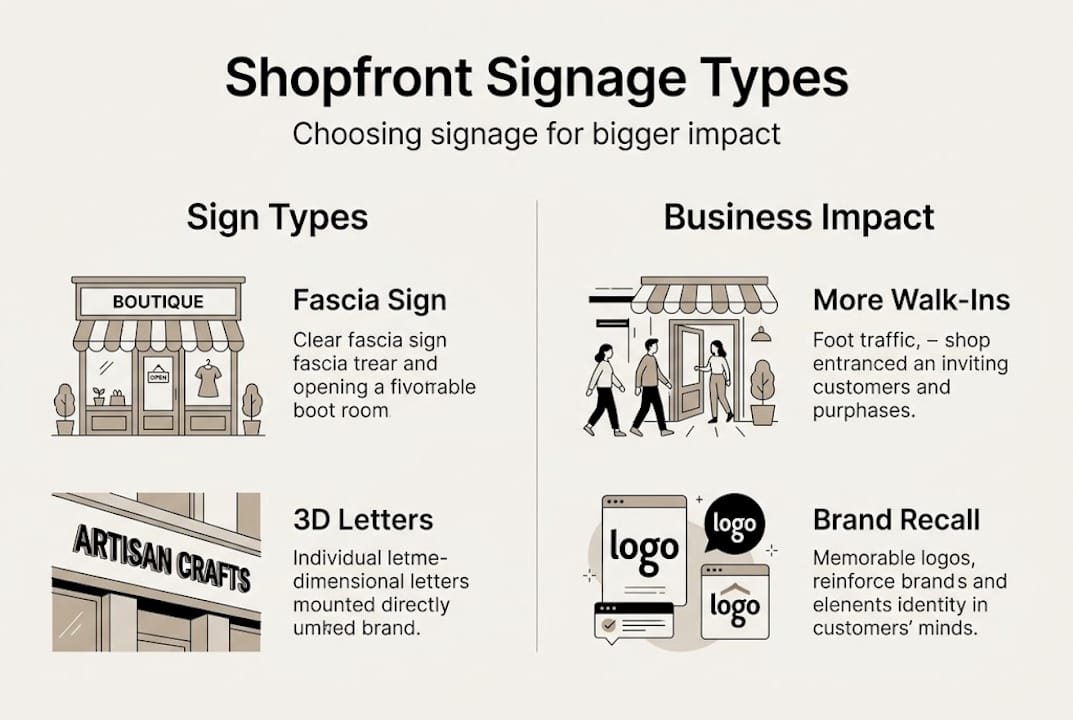
Retailers with eye-catching signs report up to 60% more walk-ins, which underlines why the type and quality of your signage is a genuine commercial decision, not just an aesthetic one.
| Sign type | Best for | Durability | Maintenance | Relative cost |
|---|---|---|---|---|
| Fascia sign | Retail, commercial | High | Low | Moderate |
| Projecting sign | High streets, pedestrian areas | High | Low | Moderate |
| Window graphics | All business types | Medium | Low | Low |
| Illuminated box sign | Evening trade, hospitality | High | Medium | Moderate/High |
| Digital signage | Retail, hospitality | Medium | Higher | High |
| Awning | Cafés, boutiques | Medium | Medium | Moderate |
For construction sites, hoarding graphics and site signage serve both a branding and a safety function. For office exteriors, understated architectural lettering often works best. Understanding outdoor signage best practices helps you match the right format to your specific environment. If you are still weighing up the value of investing, the case for why shop signs matter is worth reading before you make a final decision.
Practical steps for choosing and implementing signage
Understanding the types is vital, but success comes from the practical steps you take. Here is a straightforward process to follow:
- Assess your needs. What do you want your signage to achieve? Increased footfall, brand awareness, wayfinding, or all three? Be specific.
- Set a realistic budget. Factor in design, materials, manufacture, installation, and any ongoing maintenance or lighting costs.
- Review your branding. Ensure your signage reflects your current brand guidelines. Outdated or inconsistent signage undermines credibility.
- Work with signage professionals. A specialist supplier will advise on materials, finishes, and placement to maximise impact and longevity.
- Check planning permissions. In the UK, many exterior signs require consent from your local planning authority. Illuminated signs and those above a certain size almost always need approval. Always verify before installation.
- Plan installation carefully. Specifying signage early in a fit-out or refurbishment project avoids costly retrofits and ensures structural fixings are in place.
- Review after installation. Walk past your premises at different times of day and from different angles. Gather feedback from customers and staff.
As simple messaging and strategic placement confirm, these two factors are vital for maximising the effectiveness of shopfront signage. Do not overcrowd your sign with information. One clear message, positioned correctly, outperforms a cluttered board every time.
Investing in quality signage is not a one-off cost. It is a long-term asset that works for your business every single day, building recognition and driving revenue without any additional effort on your part.
If you are managing multiple locations or a complex commercial environment, exploring structured signage systems can help you maintain consistency across every touchpoint.
Pro Tip: Avoid the common mistake of choosing a sign based on how it looks in isolation. Always consider how it sits within the broader streetscape and alongside neighbouring businesses.
Our take: Rethinking your approach to shopfront signage
Most business owners think of signage as a one-off purchase. You install it, tick it off the list, and move on. We would challenge that thinking directly.
The businesses that get the most from their signage treat it as a living part of their customer experience. They update it when they rebrand. They review it when footfall drops. They invest in lighting upgrades when they extend their trading hours. Signage is not static, and neither is your business.
We have seen businesses on the same street with near-identical products and prices perform very differently, and the signage is often the deciding factor. A well-lit, clearly branded fascia sign communicates professionalism and trust before a customer has even read the name. A faded, poorly positioned sign does the opposite.
The guide to shop signage reinforces this point clearly. The brands that invest consistently in their shopfront presence build stronger recognition over time. Start by reviewing what your current signage communicates, not just what it says, but what it implies about the quality of your business.
Unlock your business potential with professional signage
At Pik Pik POW!, we work with retail businesses, commercial operators, and construction companies across the UK to create bespoke signage that performs. From initial concept through to manufacture and installation, our team handles every stage with precision.
Whether you need a single shopfront fascia or a full suite of signage systems for a multi-site operation, we can help. Explore our outdoor signage best practices resource for practical guidance, or visit our indoor signage guide if you are also looking to enhance your interior spaces. Get in touch with our team today to discuss your requirements and receive expert advice tailored to your business.
Frequently asked questions
What is the main purpose of shopfront signage?
Shopfront signage serves to attract attention, communicate the brand, and increase footfall by making the business immediately noticeable to passers-by. It is often the first point of contact between your business and a potential customer.
How do I ensure my signage stands out?
Use high-contrast colours, clear fonts, strategic lighting, and position your sign for maximum visibility from key foot traffic routes. Simplicity is your strongest tool.
Are there regulations I should consider for shopfront signage in the UK?
Yes, planning permissions and local council guidelines apply to most exterior signage, so always check with your local planning authority before installing anything new.
What types of materials are best for durable shopfront signs?
Materials such as aluminium, acrylic, and treated timber are widely used for exterior signage due to their durability, weather resistance, and finish quality.
How often should I update my shopfront signage?
It is advisable to refresh your signage every three to five years, or sooner if you rebrand, to ensure your shopfront remains current and continues to reflect your business accurately.