TL;DR:
- Construction signage is highly regulated and essential for safety and legal compliance.
- Proper sign selection, placement, and maintenance reduce accidents and aid site operations.
- Incorporating digital signage and ongoing reviews enhance effectiveness and address modern challenges.
Construction signage is far more regulated than most people assume. A missing or incorrectly coloured sign is not just a minor oversight; it can result in serious injury, enforcement action, or significant fines. Many site managers treat signage as an afterthought, something to sort out quickly before work begins, but the reality is that it sits at the heart of legal compliance and daily safety. This guide explains what construction signage actually covers, which regulations apply, how to choose the right sign for each situation, and how to avoid the practical pitfalls that catch even experienced teams off guard.
Table of Contents
- What is construction signage and why does it matter?
- The main types of construction signage explained
- Key regulations and compliance standards for construction signage
- Common challenges and modern solutions in site signage
- Why effective construction signage is more than just ticking boxes
- Get expert support for your site signage needs
- Frequently asked questions
Key Takeaways
| Point | Details |
|---|---|
| Signage saves lives | Proper construction signage drastically reduces accident rates and keeps teams safe. |
| Know the regulations | Understanding HSE, OSHA, and local standards keeps your site compliant and avoids penalties. |
| Adapt for real sites | Effective signage evolves with project phases and workforce needs, including languages and formats. |
| Beyond compliance | Active training and regular updates make signage truly effective, not just a formality. |
What is construction signage and why does it matter?
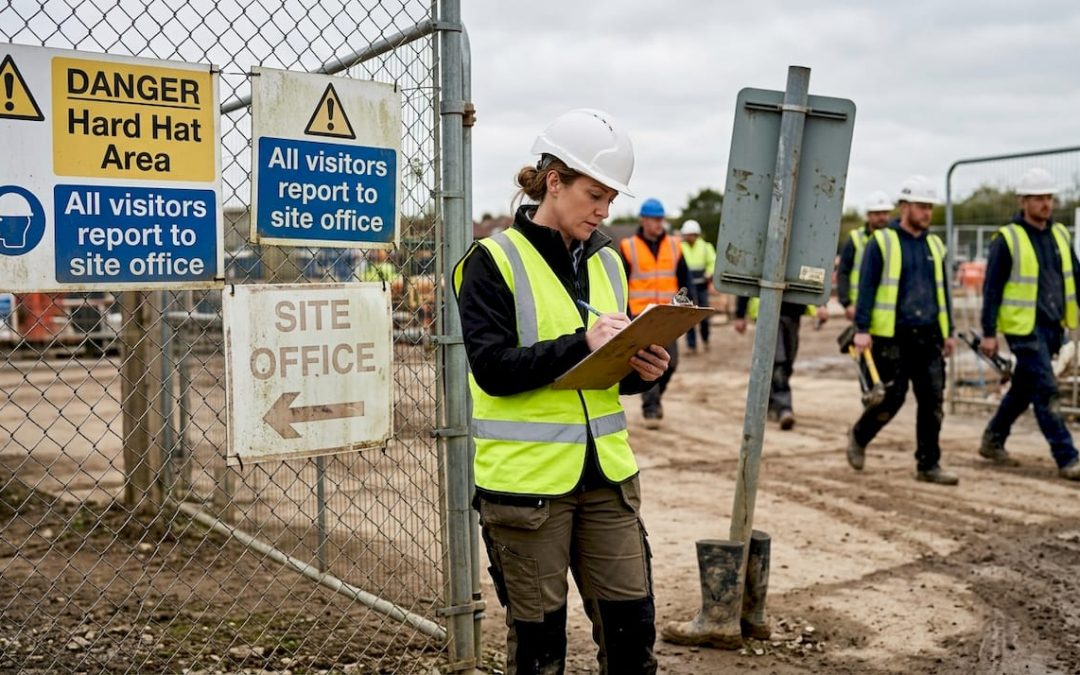
Construction signage refers to the full range of visual markers, notices, boards, and symbols used on a building or civil engineering site. These include everything from hazard warnings at the site entrance to directional notices inside the structure itself. The purpose is straightforward: to communicate critical information quickly and clearly to everyone present, whether that is a site worker, a delivery driver, or a visiting engineer.
The legal basis for signage is not optional. In the UK, the Health and Safety Executive (HSE) sets out requirements under the Health and Safety (Safety Signs and Signals) Regulations 1996, which align with European standards for colour coding and pictograms. In the United States, both OSHA and the Manual on Uniform Traffic Control Devices (MUTCD) govern what must be displayed and how. Understanding the types of construction signage that apply to your site is the essential first step.
The practical impact of getting signage right is significant. Sites with clear, well-maintained signage experience fewer accidents, smoother inspections, and better day-to-day operations. Workers know where to go, what to avoid, and what protective equipment to wear before they even ask a supervisor. Conversely, poor signage creates confusion, slows work, and exposes your business to liability.
Signage is not just about telling people what not to do. It actively shapes how people move through and interact with a site, reducing the need for constant verbal instruction and supervision.
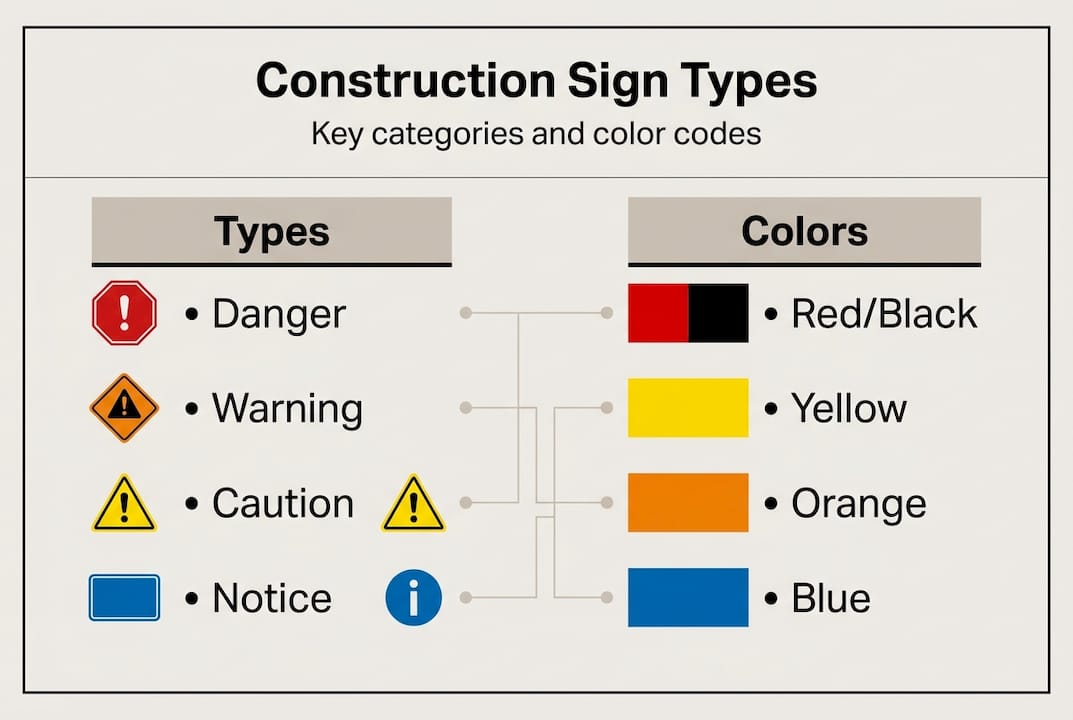
The key categories, as defined by OSHA standards, include six distinct sign types: Danger signs in red, white, and black for immediate risks such as falls over six feet or high voltage; Warning signs in orange and black for serious but less immediate hazards like heavy equipment; Caution signs in yellow and black for minor or moderate injury risks; Notice signs in blue and white for general instructions including PPE requirements; Safety Instruction signs in green and white for first aid and exit information; and traffic control signs governed by MUTCD Part 6.
Familiarity with construction signage terminology helps you communicate clearly with suppliers, inspectors, and your own team, reducing the risk of ordering the wrong sign or placing it incorrectly.
Pro Tip: Always document which signs are placed where and when they were last inspected. A simple sign register protects you during audits and demonstrates due diligence to enforcement officers.
The main types of construction signage explained
With a solid foundation on what signage is, it is essential to distinguish between the types and their functions on site. Each category carries specific colour codes, messages, and legal weight. Choosing the wrong type for a given hazard is itself a compliance failure.
Here is a numbered process for identifying the right sign for each risk:
- Assess the severity of the hazard. Is there an immediate risk of death or serious injury, or is the risk minor?
- Match the severity to the correct sign category using the colour code system.
- Select the appropriate pictogram or text message for the specific hazard.
- Confirm the sign meets the relevant standard for your jurisdiction, whether HSE, OSHA, or both.
- Place the sign at the correct height and location so it is visible before the hazard is reached.
The table below summarises the main categories, their colours, and the standards that govern them.
| Sign type | Colour scheme | Risk level | Standard reference |
|---|---|---|---|
| Danger | Red, white, black | Immediate death or serious injury | OSHA 1926.200, HSE |
| Warning | Orange, black | Potential death or serious injury | OSHA 1926.200 |
| Caution | Yellow, black | Minor or moderate injury | OSHA 1926.200 |
| Notice | Blue, white | General instructions, PPE | OSHA 1926.200 |
| Safety instruction | Green, white | First aid, emergency exits | OSHA 1926.200 |
| Traffic control | Variable | Public and worker traffic | MUTCD Part 6 |
In the UK, HSE regulations align closely with ISO 7010 pictogram standards, which means the visual symbols are largely consistent with those used across Europe. However, the precise wording and colour tolerances can differ from OSHA requirements. For multinational contractors working on both sides of the Atlantic, this distinction matters. A sign that is fully compliant in the US may not satisfy a UK inspector.
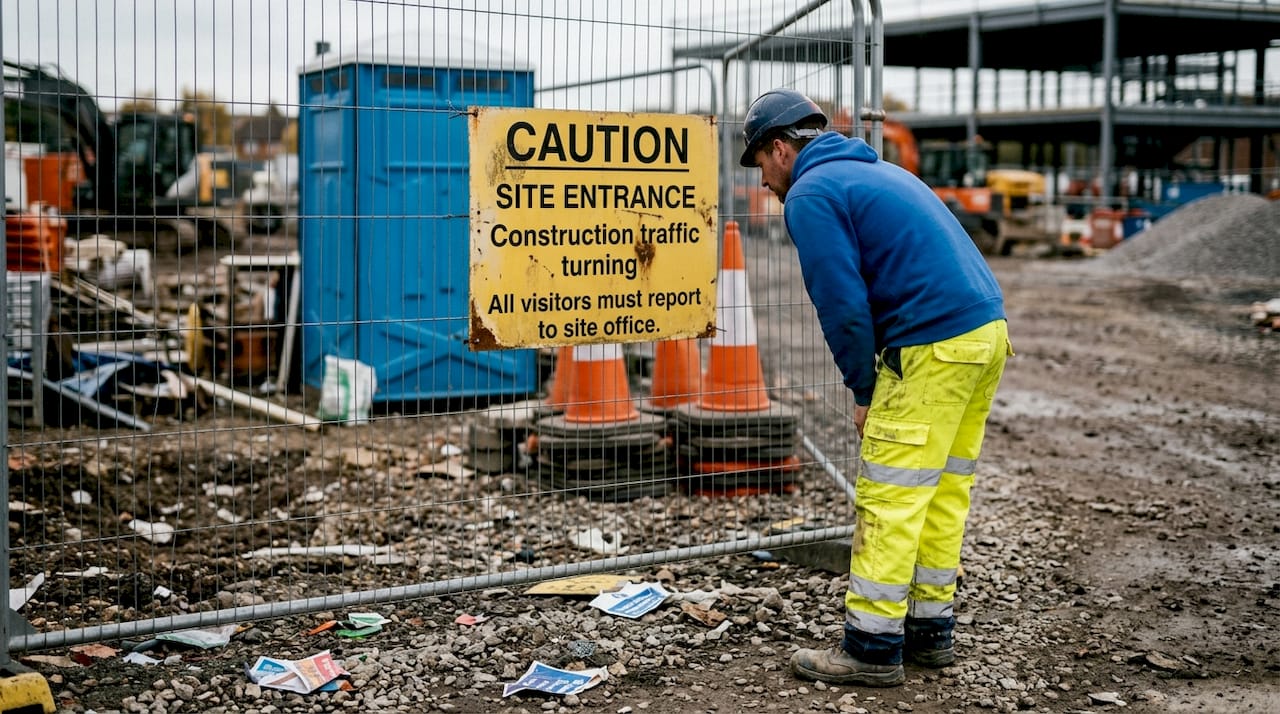
For construction safety signs to be effective, they must also be legible at the distance from which a worker would first encounter the hazard. Font size, contrast, and placement height all affect whether a sign actually does its job. Good wayfinding solutions within a site reduce the cognitive load on workers and help visitors navigate without needing constant guidance.
Key regulations and compliance standards for construction signage
Knowing sign types is vital, but managers must also navigate the regulations that govern their correct use. In the UK, the primary framework is the Health and Safety (Safety Signs and Signals) Regulations 1996, enforced by the HSE. These require employers to use safety signs wherever a risk cannot be adequately controlled by other means. The regulations specify colour, format, and pictogram requirements.
In the US, OSHA signage requirements under 29 CFR 1926.200 apply to construction sites, while the MUTCD governs traffic control on public roads adjacent to or within site boundaries. Importantly, MUTCD and OSHA overlap but remain distinct frameworks, and some US states enforce rules that are stricter than federal minimums. Multinational contractors must account for both sets of rules simultaneously.
Compliance is checked through site inspections carried out by HSE inspectors in the UK or OSHA compliance officers in the US. Penalties for non-compliance range from improvement notices and fines to prosecution in serious cases. Beyond the legal risk, a poorly signed site is more likely to feature in an accident investigation, which carries reputational consequences that outlast any fine.
Here is a checklist of must-do compliance actions for construction managers:
- Conduct a signage risk assessment before work begins on each new phase.
- Ensure all signs meet the correct colour and format standards for your jurisdiction.
- Check that signs are visible, undamaged, and not obscured by materials or equipment.
- Maintain a written record of sign placement and inspection dates.
- Update signage whenever site conditions, hazards, or access routes change.
- Brief all workers and visitors on the signage system during induction.
The table below summarises the main standards and their scope.
| Standard | Jurisdiction | Scope |
|---|---|---|
| HSE Safety Signs Regulations 1996 | UK | All workplace safety signs |
| OSHA 29 CFR 1926.200 | USA | Construction site signs |
| MUTCD Part 6 | USA | Traffic control on and near sites |
| ISO 7010 | International | Pictogram design and colour |
For a full overview of signage compliance regulations in the UK, it is worth reviewing the HSE guidance alongside your own risk assessments. You can also find practical signage safety tips to support day-to-day management.
Pro Tip: If your client specifies signage requirements in the contract, those requirements may be stricter than the legal minimum. Always read the contract before ordering signs, as failing to meet client standards can trigger contractual penalties even if you are legally compliant.
Common challenges and modern solutions in site signage
Complying with the law is only half the battle; real sites raise new challenges that require creative and up-to-date solutions. Three issues come up repeatedly on construction projects of any size.
First, language barriers. Construction sites in the UK and US frequently employ workers who speak a range of languages. A text-heavy sign in English alone will not communicate effectively to a multilingual workforce. The solution is to prioritise pictogram-based signs that meet ISO 7010 standards, supplemented by multilingual text where necessary. Some contractors produce site-specific induction materials in multiple languages to reinforce what the signs mean.
Second, evolving site conditions. A phased construction project looks very different in month one compared to month six. Hazards move, access routes change, and new risks emerge. Signage that was accurate at the start of a project can become misleading or irrelevant as work progresses, and outdated signs are a known cause of accidents and compliance failures.
Third, sign blindness. This occurs when workers see the same signs every day and stop registering them consciously. Over-signage makes this worse. A site covered in dozens of notices creates visual noise, and workers begin to filter out all of them, including the important ones.
Common pitfalls and practical fixes:
- Blocked signs: Carry out weekly walkarounds to check that materials, vehicles, and temporary structures have not obscured signs.
- Outdated signs: Review all signage at the start of each new project phase and remove anything that no longer applies.
- Over-signage: Audit the total number of signs on site. If a hazard has three signs within two metres, remove the redundant ones.
- Language gaps: Use pictogram-led signs and provide multilingual briefings at induction.
- Sign fatigue: Rotate sign positions periodically and use colour contrast to draw attention to the most critical notices.
Digital signage for construction sites offers a practical solution to several of these issues. Variable Message Signs (VMS) can be updated remotely to reflect changing conditions, display multilingual messages, and draw attention through movement or brightness. For larger or longer-duration projects, investing in digital signage solutions can reduce the administrative burden of managing a large static sign inventory. A well-designed site signage system integrates static and digital elements to cover all scenarios.
Pro Tip: Schedule a formal signage review at every project milestone, not just at the start. Tie it to your existing progress meetings so it becomes a routine part of project management rather than a separate task.
Why effective construction signage is more than just ticking boxes
At Pik Pik POW!, we have worked with enough construction clients to know that the sites with the best safety records are not simply the ones with the most signs. They are the ones where the team actually understands and respects the signage in place.
Research consistently shows that signs alone are insufficient without accompanying training and enforcement. Some studies record low glance rates at signs even when they are clearly visible, which means a worker can walk past a correctly placed, fully compliant sign and not register it at all. That is not a signage problem in the traditional sense. It is a culture problem.
The managers who get this right treat signage as part of a broader safety conversation, not as a substitute for one. They brief workers on what each sign means and why it is there. They act when signs are ignored. They update signage when conditions change rather than waiting for an inspection to flag it. They use safer signage practices as a baseline and build genuine engagement on top of it.
Compliance gives you the foundation. Culture determines whether that foundation actually protects people. Both matter, and neither is sufficient without the other.
Get expert support for your site signage needs
If you want to move beyond minimum compliance and build a signage system that genuinely supports safety on site, specialist support makes a real difference.

At Pik Pik POW!, we design and manufacture construction signage tailored to your site requirements, from durable static boards to fully integrated signage systems that cover every phase of your project. We also offer digital signage solutions for sites that need flexible, updateable displays, as well as wayfinding signage to keep workers and visitors moving safely through complex environments. Get in touch with our team to discuss your next project and find out how we can help you meet your compliance obligations without compromise.
Frequently asked questions
What are the main types of construction signage?
The main types are danger, warning, caution, notice, safety instruction, and traffic control signs, each with distinct colours and messages matched to the severity of the risk or the nature of the instruction.
What regulations apply to construction signage in the UK?
Construction signage in the UK must comply with the Health and Safety (Safety Signs and Signals) Regulations 1996, enforced by the HSE, with additional requirements for roadside signage under UK traffic regulations.
How do I prevent sign blindness on site?
Regularly reviewing, updating, and decluttering signage while providing staff training reduces sign blindness; over-signage creates confusion and should be actively managed by removing signs that no longer apply.
Are digital signs allowed on construction sites?
Yes, digital and Variable Message Signs can be used on construction sites, particularly for dynamic updates on larger sites, provided they meet the relevant colour, legibility, and content standards for your jurisdiction.