
TL;DR:
- Architectural signage is a purposeful system that enhances navigation, branding, and space aesthetics.
- Proper planning, early specification, and design best practices are essential for effective signage.
- Well-designed signage improves customer experience, reinforces brand identity, and ensures legal compliance.
Most businesses spend considerable time choosing paint colours, furniture, and lighting for their spaces, yet signage is frequently treated as an afterthought. That is a costly oversight. Architectural signage is not decoration. It is a functional system that shapes how people navigate your building, perceive your brand, and feel within your space. Effective signage boosts customer engagement and supports brand recall in ways that few other investments can match. In this guide, we cover what architectural signage actually is, the main types and their roles, how to use signage to strengthen your brand and improve space functionality, and the design practices that separate good signage from great signage.
Table of Contents
- What is architectural signage?
- Types of architectural signage and their roles
- How architectural signage enhances brand visibility and space functionality
- Design best practices and common mistakes
- Why most businesses overlook signage — and what to do differently
- Get started with custom architectural signage solutions
- Frequently asked questions
Key Takeaways
| Point | Details |
|---|---|
| Signage is strategic | Architectural signage shapes how customers see, navigate, and remember your brand. |
| Types serve functions | Each type of signage—wayfinding, branding, or statutory—supports specific business goals. |
| Plan early, avoid pitfalls | Early integration in your project’s design phase ensures compliance and maximises visual impact. |
| Focus on user experience | Well-designed signage guides, informs, and reassures everyone moving through your space. |
What is architectural signage?
Architectural signage refers to any signage that is purposefully integrated into the design and function of a built environment. It goes well beyond a printed poster or a generic label. These are sign systems that work in harmony with the architecture, interior design, and brand identity of a space, serving specific objectives rather than simply identifying a room or a business.
The core objectives of architectural signage are:
- Wayfinding: Helping people move through a space efficiently and without confusion
- Branding: Reinforcing your visual identity at every touchpoint within the building
- Regulatory compliance: Meeting legal requirements for health, safety, and accessibility
- Aesthetics: Contributing to the overall look and feel of the environment
What separates architectural signage from generic signage is intentionality. A standard “fire exit” sticker placed wherever convenient is generic signage. A cohesive signage system where every directional, statutory, and branded sign shares consistent materials, typography, and placement logic is architectural signage.
Practical examples include office floor directories at reception, wayfinding totems in retail parks, branded feature walls in corporate lobbies, room identification plaques in hotels, and donor recognition walls in public institutions. Each of these serves a clear function while contributing to the identity of the space.
Architectural signage enhances navigation, aesthetics, and brand identity within any built environment, making it a foundational element of commercial interior design rather than a finishing touch.
For businesses operating across multiple sites, the consistency that architectural signage provides is particularly valuable. Visitors and staff should experience the same clarity and brand impression whether they walk into your Manchester office or your London showroom. That consistency builds trust and reinforces professionalism at every level.
When you think about the spaces that feel genuinely well designed, whether a premium hotel lobby, a flagship retail store, or a modern co-working space, the signage is almost always doing significant work behind the scenes. It guides without confusion, informs without clutter, and brands without shouting.
Types of architectural signage and their roles
Different types of architectural signage perform various roles, from safety to branding to navigation, and understanding each category helps you plan a signage system that covers all your business needs.
Here is a breakdown of the main categories:
- Wayfinding signage: Directional signs, floor maps, and totems that guide visitors through your space
- Statutory signage: Legally required signs covering fire safety, health and safety, and accessibility
- Branding signage: Logos, taglines, feature walls, and reception backdrops that communicate your identity
- Informational signage: Room names, floor numbers, opening hours, and operational notices
- Digital signage: Screens and interactive displays that update content in real time
| Type | Primary purpose | Best location | Typical materials |
|---|---|---|---|
| Wayfinding | Navigation | Corridors, entrances, car parks | Aluminium, acrylic, PVC |
| Statutory | Legal compliance | All areas, especially exits | Rigid plastic, metal |
| Branding | Identity reinforcement | Reception, feature walls | Brushed metal, acrylic, vinyl |
| Informational | Space orientation | Doors, desks, counters | Acrylic, glass, metal |
| Digital | Dynamic communication | Lobbies, retail floors | LED screens, interactive panels |
Reception signage and health and safety boards are a useful contrast. Your reception sign is a branding asset. It sets the tone for every visitor’s first impression and should reflect your brand’s quality and personality. A health and safety board, by contrast, is a statutory requirement. Its job is clarity and legal compliance, not aesthetics, though good design can still make it look professional.

Explore wayfinding signage options if your space involves multiple floors, departments, or entry points, as this is often where visitor experience breaks down most visibly.
For a broader view of how these types work together in practice, the indoor signage guide covers real-world applications across sectors.
Pro Tip: Regulatory and evacuation signage is one of the most overlooked categories in commercial fit-outs. Businesses often focus on branding and wayfinding but neglect to audit whether their statutory signs meet current UK standards. Non-compliance can result in enforcement action, so treat this category as a priority, not an optional extra.
How architectural signage enhances brand visibility and space functionality
With an understanding of the key signage types, we can see how each supports business goals. The benefits are both measurable and practical.
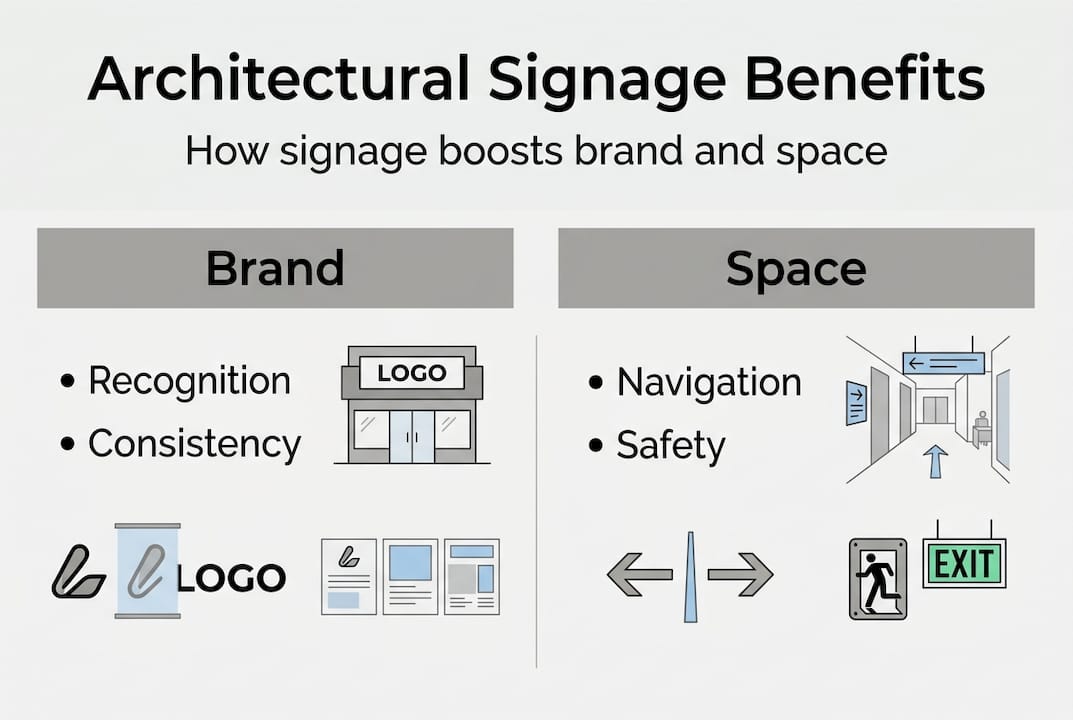
| Benefit | Impact | Evidence |
|---|---|---|
| Brand recall | Stronger recognition among visitors | Consistent visual identity across touchpoints |
| Navigation efficiency | Reduced visitor confusion and staff interruptions | Clear wayfinding reduces misdirection |
| Compliance | Reduced legal risk | Meets UK health, safety, and accessibility standards |
| Customer experience | Higher satisfaction and perceived professionalism | First impressions shaped within seconds of entry |
Effective signage increases customer engagement and supports brand perception in ways that are difficult to replicate through digital marketing alone. Physical spaces carry emotional weight, and signage is one of the primary tools you have to shape that experience.
The Design Council’s wayfinding guide reinforces that well-planned environments reduce cognitive load for visitors, meaning they spend less mental energy finding their way and more time engaging with your business.
To audit and improve your current signage for both visibility and functionality, follow these steps:
- Walk the space as a visitor would. Enter from the main access point and note every moment of uncertainty or confusion.
- Photograph every existing sign. Assess condition, consistency, and legibility across all sign types.
- Check statutory compliance. Verify that all health, safety, and accessibility signs meet current UK regulations.
- Map your brand touchpoints. Identify where branding signage is absent or inconsistent.
- Prioritise by impact. Address wayfinding gaps and compliance issues first, then focus on brand enhancement.
- Brief a specialist. Work with a signage provider who can assess your space holistically rather than supplying individual signs in isolation.
For a structured approach to improving navigation specifically, the wayfinding steps guide offers a practical framework suited to UK commercial environments.
Statistic callout: Research consistently shows that poor wayfinding costs businesses time, money, and customer goodwill. Visitors who cannot find their way quickly form negative impressions that are hard to reverse, regardless of the quality of your product or service.
Design best practices and common mistakes
Understanding what makes signage effective, the next focus is ensuring yours is both striking and compliant. Good design and careful planning are what separate signage that works from signage that gets ignored or, worse, causes problems.
Well-planned signage needs to be considered from the early stages of a project for best results. When signage is specified late, you often end up with compromises: signs that do not align with the architecture, materials that clash with the interior finish, or placements that are structurally awkward.
Here are the key steps for successful signage implementation:
- Specify signage during the design phase, not after construction or fit-out is complete
- Establish a signage brief that covers brand guidelines, materials, tone, and compliance requirements
- Involve your signage supplier early so they can advise on buildability and material suitability
- Test legibility at the intended viewing distance and in the actual lighting conditions of the space
- Review against UK accessibility standards, including font size, contrast ratios, and tactile requirements for visually impaired users
- Plan for maintenance and updates, particularly for informational and digital signage that will need to change over time
The sign design best practices resource from the British Sign and Graphics Association provides useful technical guidance for UK businesses planning new installations.
Common design mistakes to avoid include:
- Inconsistent typography across sign types, which undermines brand cohesion
- Poor contrast between text and background, reducing legibility especially in low light
- Overcrowding information on a single sign, causing visitors to disengage
- Ignoring height and placement relative to eye level and viewing angles
- Neglecting accessibility requirements, which is both a design failure and a compliance risk
Pro Tip: Involve your signage supplier in pre-construction meetings if you are fitting out a new space. Their input on substrate compatibility, fixings, and lighting integration can save significant time and cost further down the line.
Why most businesses overlook signage — and what to do differently
Across the industry, we see the same pattern repeatedly. Businesses invest heavily in interior design, branding, and digital presence, then allocate a minimal budget to signage at the very end of a project. The result is signage that feels disconnected from the space and the brand it is supposed to represent.
The reason this happens is partly budget sequencing and partly a lack of awareness about what signage can actually do. Many decision-makers still see it as a commodity purchase rather than a strategic one. That view is worth challenging.
Branded signage matters for business success in ways that go beyond aesthetics. It shapes first impressions, supports operational efficiency, and communicates brand values to every person who enters your space. Treating it as a living part of your workspace strategy, rather than a one-off installation, means reviewing it regularly, updating it when your brand evolves, and investing in quality that lasts.
The businesses that get signage right tend to think about it the same way they think about their website or their customer service: as an ongoing commitment to the experience they deliver.
Get started with custom architectural signage solutions
If this guide has made one thing clear, it is that architectural signage is far more than a finishing touch. It is a system that supports your brand, your people, and your customers every single day.
At Pik Pik Pow!, we design and manufacture bespoke signage systems for businesses across retail, commercial interiors, construction, and beyond. Whether you need a complete wayfinding overhaul, a striking reception installation, or a digital signage solution that keeps your content fresh, we can help. Our team works with you from brief through to installation, ensuring every sign serves its purpose and reflects your brand with precision. Explore our indoor signage guide to see how we approach projects across different sectors.
Frequently asked questions
What makes signage ‘architectural’?
Architectural signage integrates with the design, function, and branding of a building, making it a purposeful system rather than a standalone label or poster. It is designed to work with the space, not simply sit within it.
Why is early signage planning important?
Specifying signage early leads to better outcomes, fewer compromises, and reduced errors during installation. It also ensures your signage aligns with the architecture and brand from the outset.
How can signage improve customer experience?
Effective signage increases engagement and supports brand perception by making spaces easier to navigate, improving accessibility, and reinforcing your identity at every point of contact.
Are there legal requirements for business signage in the UK?
Yes. Statutory signage compliance is essential for UK businesses, covering health and safety, fire safety, and accessibility regulations that apply to most commercial premises.
What trends are shaping architectural signage in 2026?
Digital and sustainable signage solutions are leading the way in 2026, with businesses increasingly combining LED displays, eco-friendly materials, and integrated wayfinding into cohesive signage systems.