

What is indoor branding and why does it matter?
Indoor branding, also called environmental or interior branding, is the purposeful use of interior design elements to communicate your company’s identity, values, and culture throughout a physical space. It goes well beyond placing a logo on a wall. Every material choice, colour decision, lighting scheme, and piece of signage works together to tell your brand’s story to employees, clients, and visitors alike.
The benefits of indoor branding are measurable. Research links well-designed office environments to a 24% boost in job satisfaction and productivity gains of around 13% at 12 months and 9% at 24 months, as recorded in a prominent UK biophilic workplace study. A branded interior also builds internal trust, turning your workspace into a tangible extension of company culture rather than just a functional room.
Key benefits at a glance:
- Stronger brand recognition among clients and visitors
- Improved employee engagement and sense of belonging
- Consistent messaging across all physical touchpoints
- Positive first impressions that reinforce your online presence
- A workspace that actively supports your operational goals
What makes indoor branding effective?
Effective indoor branding relies on several elements working in harmony. No single element carries the whole load; the power comes from their combination.
Style and theme alignment. Your interior aesthetic should reflect your brand personality. A heritage law firm and a creative tech agency will make very different choices, and both can be right, provided every decision traces back to the same brand brief.

Colour palettes. Brand colours are the natural starting point, but they rarely work alone. Blues and greys tend to support trust and focus, while greens and oranges can energise communal zones. Balancing energising tones in collaborative areas with calmer shades in retreat spaces keeps both functionality and brand expression coherent.
Materials and finishes. Timber, glass, concrete, and fabric each carry associations. Warm textures signal approachability; clean lines and glass suggest transparency and forward thinking. Choose materials that reflect your values and will hold up over time.
Signage and wayfinding. Clear, well-placed signage reinforces your brand narrative while helping people navigate your space. Wayfinding should complement the architecture, not fight it.

Lighting. Natural light improves wellbeing and colour accuracy. Where artificial lighting is necessary, task lighting at 300–500 lux is the standard recommendation for office environments, with layered levels creating visual interest without a cave-like effect.
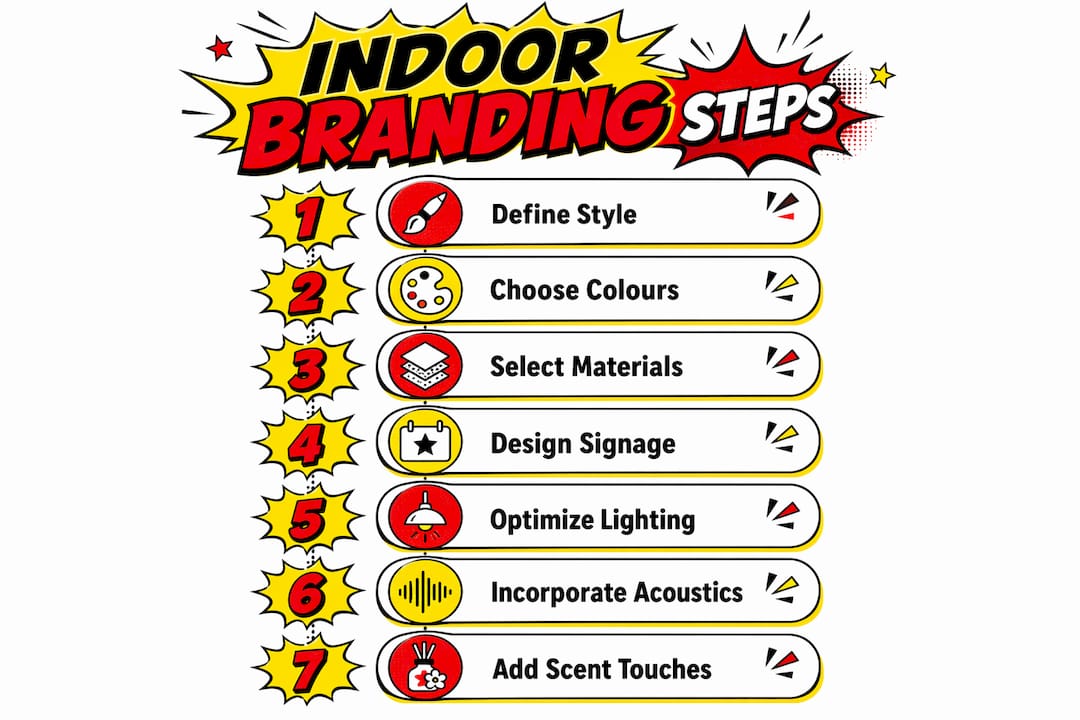
Acoustics. Sound-absorbing panels, soft furnishings, and ceiling baffles reduce noise in open-plan areas without compromising the feel of the space.
Scent and multisensory touches. Scent is often overlooked, but retail environments have used it deliberately for years. A subtle, consistent fragrance in a reception area can make a lasting impression.
Pro Tip: Use biophilic design elements such as indoor plants, timber finishes, and natural light to support wellbeing. A UK study found productivity gains of 12.98% at 12 months in a biophilic building, sustained at 9.17% at 24 months.
How to integrate branding into your office or commercial interior
A structured approach prevents costly mistakes and keeps the result coherent.
Define your brand values and visual identity. Before selecting a single colour or material, clarify what your business stands for and what feeling you want the space to evoke. Use your logo guidelines, tone of voice, and brand standards as the foundation for every design decision.
Audit your existing space. Map the layout, measure ceiling heights, note plug socket locations, and identify which areas receive natural light. This survey shapes what is possible before any budget is committed.
Select and test your colour scheme. Apply brand colours to feature walls or accent zones first, rather than committing to a full repaint. Test samples under both natural and artificial light before finalising.
Place signage and graphics deliberately. Reception areas suit bold storytelling: timelines, mission statements, and large-scale graphics. Meeting rooms call for restraint; calming visuals and softer tones support focused conversation. Commercial interior signs should guide movement and reinforce identity without cluttering the space.
Choose furniture and fixtures that reinforce your brand. Colour-coordinated seating, stitched logos on meeting room chairs, and branded accessories create a unified look that signals attention to detail.
Design for flow and function. Zone the space by purpose: energising tones for breakout areas, neutral finishes for focus zones, and layered branding in client-facing areas. Open layouts with glass partitions signal transparency; quiet pods signal care for individual wellbeing.
Plan for budget and maintenance from the start. Interchangeable poster frames, digital screens, and printed canvases let you refresh messaging without a full redesign. Budget for periodic updates alongside the initial fit-out.
Indoor environmental quality, including air quality, temperature, and lighting, shapes how employees perceive their own productivity. Getting these fundamentals right amplifies every branding decision layered on top.
Common pitfalls in indoor branding and how to avoid them
Most indoor branding projects run into the same handful of problems. Knowing them in advance saves time and money.
- Inconsistent branding across zones. A bold reception followed by a bland corridor breaks the narrative. Carry brand cues, even subtle ones, through every area.
- Overusing the logo. Repeating your logo on every surface reads as insecure rather than confident. Use it at key touchpoints and let colour, material, and tone carry the identity elsewhere.
- Ignoring functional needs. A visually striking space that is difficult to navigate or acoustically uncomfortable will frustrate the people who use it daily.
- Treating branding as an afterthought. Brand design applied after a fit-out is complete rarely integrates well. Bring it into the brief from day one.
- Underestimating maintenance. Vinyl graphics peel, printed canvases fade, and painted surfaces scuff. Factor in a maintenance schedule from the outset.
Pro Tip: On a tight budget, black-cut lettering on raw or affordable backing materials can deliver a bespoke branded look at a fraction of the cost of fabricated signage. Colour-blocking carpets and varied furniture orientation can also create distinct branded zones without construction work.
How professional signage supports your indoor branding
Signage is where indoor branding becomes concrete and legible. Well-integrated signage enhances both brand visibility and wayfinding, improving the experience for everyone who enters your building.
Different areas call for different signage types:
| Area | Recommended signage type | Purpose |
|---|---|---|
| Reception | Large-format dimensional lettering, backlit panels | Brand statement, first impression |
| Corridors and stairwells | Wayfinding signs, directional graphics | Navigation, brand consistency |
| Meeting rooms | Door plaques, frosted glass graphics | Room identification, privacy cues |
| Breakout and social areas | Wall graphics, printed canvases | Culture, team identity |
| External-facing windows | Frosted or printed window film | Privacy, brand visibility |
UK businesses must also meet legal and accessibility requirements. The Equality Act 2010 requires signage to be accessible to people with visual impairments, which means considering font size, contrast ratios, and tactile or Braille elements where appropriate. Compliance with UK accessibility standards avoids costly retrofits and protects you from legal risk.
Checklist for selecting signage:
- Does the material suit the environment (humidity, traffic, light exposure)?
- Does the finish align with your brand palette and quality standards?
- Is the typeface legible at the intended viewing distance?
- Does the installation method suit the substrate without causing damage?
- Is the signage maintainable and replaceable without a full redesign?
Pikpikpow works with UK businesses across retail, commercial interiors, and construction to deliver wayfinding and interior signage that meets both brand and compliance requirements. Maintaining painted interior finishes and branded surfaces over time is equally important; interior finish maintenance guidance can inform your upkeep schedule, particularly in high-traffic or humid environments.
How to measure whether your indoor branding is working
Measuring the effectiveness of indoor branding requires a mix of qualitative feedback and observable indicators. There is no single metric, but the following methods give you a reliable picture.
Employee surveys. Run short pulse surveys before and after a rebrand or fit-out. Ask specifically about how the space makes staff feel, whether it reflects the company’s values, and whether it supports their work. Tracking these responses over time reveals whether the investment is holding its impact.
Visitor and client feedback. Ask new clients or candidates what they noticed about your space. Unsolicited comments about the environment are a strong signal that the branding is landing.
Retention and recruitment data. A well-branded workspace supports talent attraction. If your offer-acceptance rate or staff retention improves after a fit-out, the environment is likely a contributing factor.
Spatial usage patterns. Are breakout zones being used? Are meeting rooms booked consistently? Low usage of a branded area often signals a mismatch between the design intent and how people actually work.
Brand consistency audits. Conduct a periodic walk-through against your brand standards. Check whether colours, materials, and signage still match your current identity, particularly after a rebrand or office expansion.
How Pikpikpow can bring your indoor branding to life
Pikpikpow is a UK-based design, signage, and print company with hands-on experience across retail, commercial interiors, construction, and the TV and film industry. From bespoke signage systems to digital signage solutions, the team combines design expertise with precision manufacturing to deliver results that are built to last and built to impress.
If you are ready to turn your interior into a genuine brand asset, get in touch with Pikpikpow to discuss your project.
Key takeaways
Effective indoor branding combines consistent visual identity, purposeful signage, and a well-designed spatial layout to engage employees and impress visitors across every area of your building.
| Point | Details |
|---|---|
| Brand consistency builds trust | A consistent interior reinforces company culture and turns your workspace into a tangible brand extension. |
| Signage drives both identity and navigation | Well-placed interior signage improves wayfinding and reinforces your brand narrative throughout the building. |
| Biophilic design boosts productivity | A UK study recorded productivity gains of 12.98% at 12 months in a biophilic building, sustained at 9.17% at 24 months. |
| Job satisfaction rises with good design | Office branding is linked to a 24% increase in job satisfaction and productivity gains of around 13% at 12 months, sustained at 9% at 24 months. |
| Measure impact with surveys and audits | Pulse surveys, visitor feedback, and periodic brand consistency audits reveal whether your indoor branding is delivering. |