TL;DR:
- Safety signage compliance in the UK requires risks to be controlled through standardised signs based on BS EN ISO 7010, placed appropriately, and regularly audited. These signs communicate residual hazards after other safety measures, with proper design, placement, and materials ensuring effectiveness and legal conformity. Regular reviews linked to risk assessments prevent sign creep and maintain clarity, promoting workplace safety and regulatory adherence.
Safety signage compliance is defined as the use of clear, standardised signs to communicate significant residual risks that remain in a workplace after all other practical controls have been applied. In the UK, this obligation sits under the Health and Safety (Safety Signs and Signals) Regulations 1996, which transpose a European Directive into domestic law and set out precisely when and how signs must be used. The internationally recognised standard BS EN ISO 7010 underpins the design of those signs, specifying the shapes, colours, and symbols that make hazard communication consistent across industries and languages. This guide to safety signage compliance walks you through the legal framework, sign selection, placement rules, common pitfalls, and a practical checklist approach so you can manage your obligations with confidence.
What does the guide to safety signage compliance require under UK law?
UK safety signs are only required where, despite implementing other relevant measures, a significant risk to health and safety remains. This is a critical distinction. Signs are not a first line of defence; they are a residual control measure applied after engineering controls, safe systems of work, and personal protective equipment have already been considered.
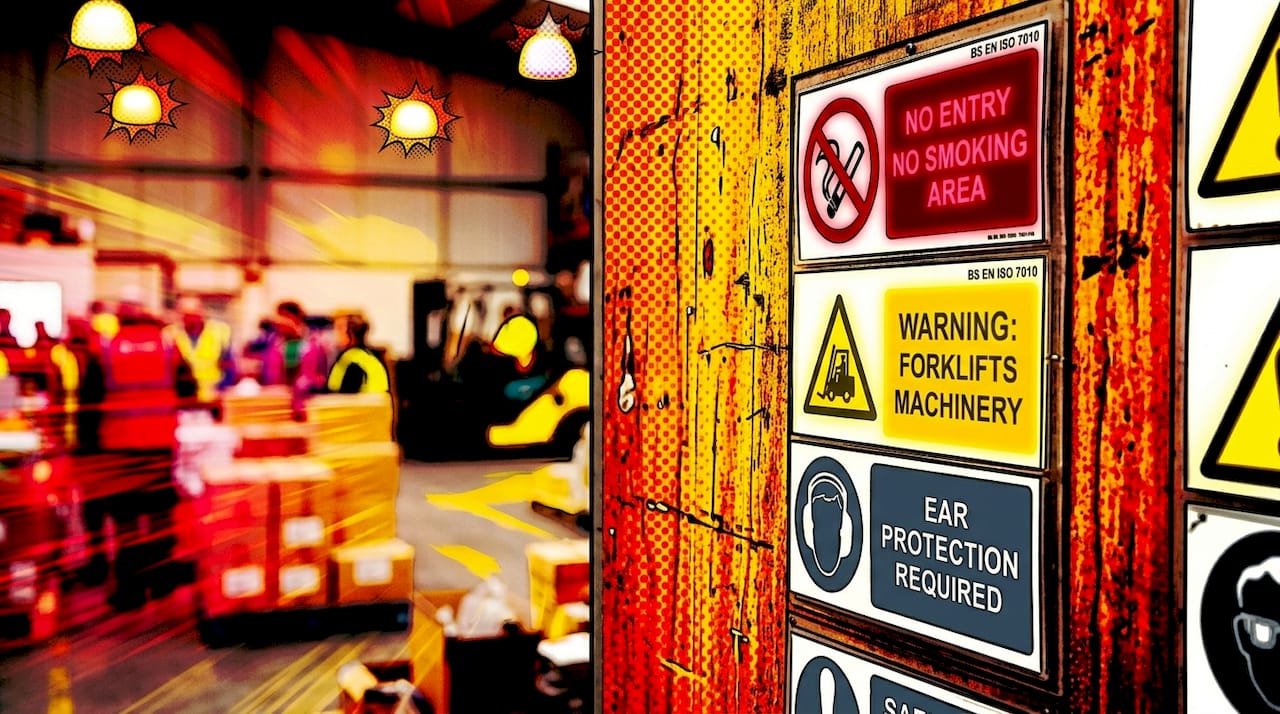
The Health and Safety (Safety Signs and Signals) Regulations 1996 place a duty on employers to provide and maintain appropriate safety signs wherever a risk assessment identifies that a significant residual risk exists. The risk assessment outcome determines which signs are needed, where they go, and in what format. Without a current risk assessment, your signage provision has no legal foundation.
The HSE’s guidance on the Regulations covers five categories of sign that employers need to understand:
- Prohibition signs (red circle with diagonal bar): indicate actions that must not be taken, such as “No smoking” or “No unauthorised entry.”
- Mandatory signs (blue circle): indicate actions that must be taken, such as “Wear hard hat” or “Use handrail.”
- Warning signs (yellow triangle): alert workers to a hazard, such as “Forklift trucks operating” or “Overhead cables.”
- Safe condition signs (green rectangle): indicate escape routes, first-aid points, and emergency exits.
- Fire safety signs (red rectangle): identify fire-fighting equipment and fire alarm call points.
Each category has a defined colour and shape under BS EN ISO 7010, which harmonises safety signs across the UK and EU to aid recognition regardless of language. This matters particularly in multilingual workplaces, where a pictogram communicates faster and more reliably than text alone.
How do you select and design compliant safety signs?
Sign selection starts with your risk assessment output, not a catalogue. Once you have identified a residual significant risk, you match it to the appropriate sign category and then choose a symbol from BS EN ISO 7010. That standard specifies classification, shape, and colour combinations for every recognised hazard type, giving you a legally defensible and internationally understood sign.
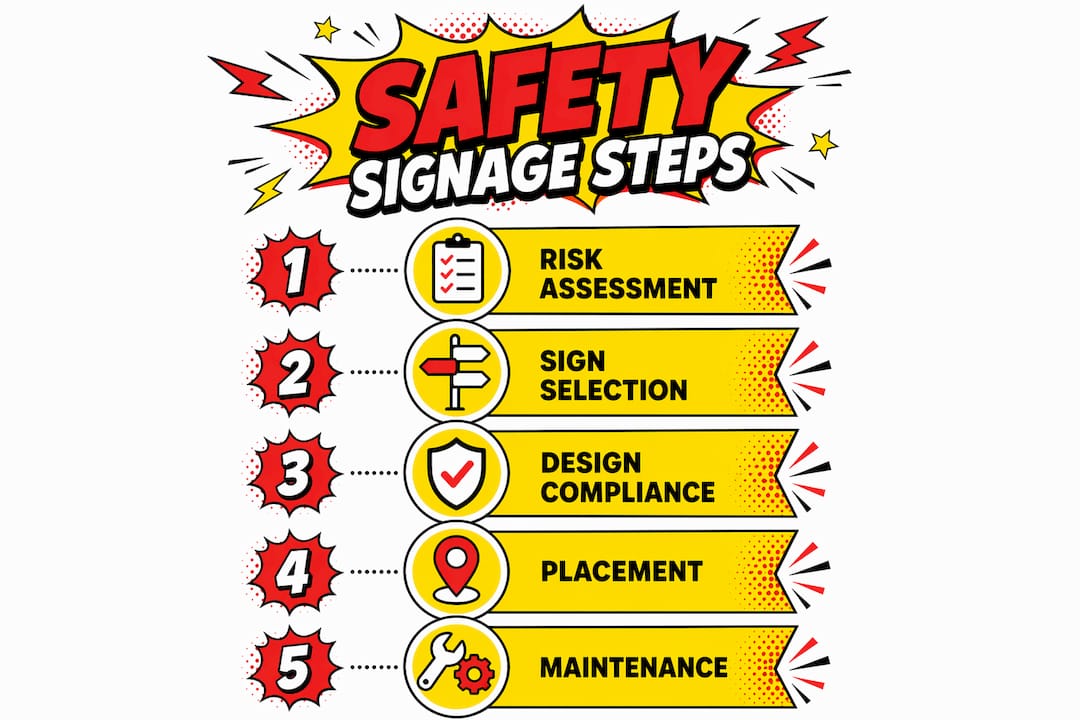
The table below summarises the five sign types, their design characteristics, and typical applications:
| Sign type | Shape | Colour | Typical use |
|---|---|---|---|
| Prohibition | Circle with bar | Red on white | No smoking, no entry |
| Mandatory | Circle | White on blue | PPE requirements |
| Warning | Triangle | Black on yellow | Slippery floor, high voltage |
| Safe condition | Rectangle/square | White on green | Fire exit, first aid |
| Fire safety | Rectangle/square | White on red | Fire extinguisher, call point |
Beyond choosing the correct symbol, the design of the sign itself affects compliance. Sign wordings should be concise, easily readable, and convey accurate safety instructions. ISO 7010 is deliberately minimal on text because pictograms cross language barriers; a sign reading “Caution: wet floor” with a falling-person symbol communicates faster than a paragraph of instructions. Keep any supplementary text to a single short phrase.
Durability is also a compliance factor. A faded, cracked, or illegible sign fails its purpose and may constitute a breach of the Regulations. Choose materials appropriate to the environment: rigid PVC or aluminium for outdoor or industrial settings, self-adhesive vinyl for lower-risk indoor areas. Photoluminescent materials are required for fire exit signs in locations where lighting may fail.
Pro Tip: Match every sign to a specific hazard identified in your risk assessment and record that link in writing. If an inspector asks why a sign is present, or why one is absent, your risk assessment log is your evidence.
Avoid the temptation to add signs for every conceivable hazard. Excessive safety signage causes confusion and reduces comprehension effectiveness. Fewer, well-targeted signs communicate more clearly than a wall covered in warnings.
Where and how should you place safety signs for maximum effect?
Placement determines whether a sign actually prevents harm. A correctly designed sign in the wrong location is functionally useless. The following principles govern effective placement:
- Position signs at or slightly above eye level, typically between 1.5 and 2 metres from the floor, so they fall naturally within a worker’s field of vision.
- Place signs at the point of decision, not after it. A “hard hat area” sign belongs at the entrance to the zone, not inside it.
- Ensure signs are not obscured by equipment, racking, doors, or other signage. Carry out a walk-through from the perspective of someone unfamiliar with the site.
- Use adequate lighting or photoluminescent signs in areas where natural or artificial light may be insufficient.
- In large or complex sites, use directional safe condition signs to guide workers to exits and first-aid facilities without ambiguity.
Signs should be affixed securely, regularly checked for legibility, and updated or removed as hazards change. A sign that refers to a hazard that no longer exists is not just unnecessary; it trains workers to ignore signage, which undermines your entire safety communication system.
Sign sizing matters too. A sign that is too small to read at the relevant viewing distance fails the legibility requirement. As a working rule, the minimum height of the symbol on a safety sign should be approximately 1/100th of the viewing distance. A sign viewed from 10 metres therefore needs a symbol at least 100mm tall.
Pro Tip: Conduct a signage walk-through with a new employee or visitor who is unfamiliar with your site. If they cannot identify hazards and safe routes from the signs alone, your placement or sizing needs attention.
For construction sites specifically, signage on UK construction sites carries additional considerations around temporary works, changing hazard zones, and contractor access, all of which require a dynamic approach to sign placement and review.
What are the most common safety signage compliance mistakes?
Most compliance failures are not the result of ignorance of the law. They stem from poor process management over time. The following numbered list covers the mistakes that appear most frequently during HSE inspections and internal audits:
- Sign creep. Outdated, duplicated, or excessive signs accumulate over months and years as new hazards are added but old signs are never removed. The result is a cluttered environment where workers stop reading signs altogether.
- Disconnection from risk assessments. Signs are added reactively after an incident or complaint rather than being tied to a current, documented risk assessment. This means the sign provision does not reflect actual site risks.
- Non-standard symbols. Using custom-designed or non-ISO symbols because they look clearer to you is a common error. Workers trained on BS EN ISO 7010 symbols may not recognise bespoke designs, and non-standard signs may not satisfy the Regulations.
- Inadequate employee training. Compliance requires that workers understand what signs mean. Providing signs without training on their meaning, particularly for non-English-speaking staff, leaves a significant gap in your legal duty.
- Failure to review after site changes. Refurbishments, new machinery, changed workflows, and new contractors all alter the risk profile of a site. Signage must be reviewed whenever a material change occurs, not just at the annual safety audit.
- Treating signage as a substitute for other controls. A sign warning of a slippery floor does not replace the duty to fix the floor. Signs identify prohibited or required actions and warn of hazards; they do not eliminate the hazard itself.
Addressing these six points in your compliance management process will resolve the majority of issues that arise during inspections. The UK signage compliance regulations and their enforcement mechanisms are well documented, and inspectors know exactly where to look.
How do you build a safety signage checklist for ongoing compliance?
A safety signage checklist is the practical tool that converts your legal obligations into a repeatable management process. The checklist should be tied directly to your risk assessment register so that every sign on site has a documented reason for being there.
The table below outlines the core components of an effective checklist:
| Checklist item | What to verify |
|---|---|
| Risk assessment currency | Confirm the assessment is dated within the last 12 months or following any site change |
| Sign inventory | List every sign on site with its location, type, and the hazard it addresses |
| Condition check | Inspect each sign for fading, damage, obstruction, or illegibility |
| Placement review | Confirm each sign is at the correct height, angle, and viewing distance |
| Regulatory alignment | Verify symbols match BS EN ISO 7010 and categories match the Regulations |
| Training records | Confirm all relevant staff have received sign recognition training |
| Removal log | Record any signs removed because the associated hazard no longer exists |
Safety managers who link signage decisions to risk assessment outputs achieve tailored compliance rather than a generic checklist approach. The checklist is not a substitute for that risk-based thinking; it is the audit trail that proves you have applied it consistently. Integrate your signage check into your regular health and safety audit cycle, whether that is quarterly, six-monthly, or triggered by site changes.
For businesses operating across multiple sites or in sectors such as construction, retail, or manufacturing, a standardised checklist template applied consistently across locations is the most efficient way to maintain workplace signage compliance and demonstrate due diligence to inspectors.
Key takeaways
Safety signage compliance in the UK requires a risk-based approach, standardised sign design under BS EN ISO 7010, correct placement, and regular audit to remain legally defensible and genuinely effective.
| Point | Details |
|---|---|
| Risk assessment first | Signs are only legally required where a significant residual risk remains after other controls are in place. |
| Use BS EN ISO 7010 symbols | Standardised symbols under ISO 7010 ensure recognition across languages and satisfy UK regulatory requirements. |
| Avoid sign overload | Excessive signage reduces comprehension; fewer, well-placed signs communicate more effectively. |
| Placement and sizing matter | Signs must be at eye level, unobscured, and sized for the viewing distance to meet legibility requirements. |
| Audit regularly | A structured checklist linked to your risk assessment register is the most reliable way to maintain ongoing compliance. |
What we have learned from years of safety signage work
From Pikpikpow’s perspective, the single biggest compliance problem we see is not businesses ignoring the law. It is businesses treating signage as a box-ticking exercise rather than a communication tool. A site covered in thirty signs, half of which refer to hazards that were resolved two years ago, is not safer than a site with eight well-chosen, well-placed signs. It is actually more dangerous, because workers learn to tune out the noise.
The risk-based approach mandated by the HSE is not bureaucratic caution. It is genuinely the most effective way to design a signage system. When every sign on your site can be traced back to a specific hazard in your risk assessment, you have a system that is both legally sound and operationally useful. When signs accumulate without that discipline, you get sign creep, and sign creep gets people hurt.
We also see businesses underestimate the importance of sign quality in compliance. A faded sign is not a compliant sign. A sign printed on the wrong substrate that warps within six months is not a compliant sign. Investing in durable, correctly specified materials is not a premium; it is part of meeting your legal duty. The cost of replacing a degraded sign is always lower than the cost of a prohibition notice or a civil claim.
The practical advice we give every client is this: start with your risk assessment, match your signs to it, place them correctly, and review them whenever anything changes. That process, applied consistently, is what compliance actually looks like.
— PikPikPOW!
Get compliant, durable safety signage from Pikpikpow
If your signage audit has identified gaps, or you are setting up a new site and need to get your safety signs right from the start, Pikpikpow can help. We supply a full range of safety signage systems designed to meet UK workplace compliance requirements across construction, retail, manufacturing, and commercial interiors. Every sign we produce uses the correct BS EN ISO 7010 symbols, appropriate materials for the environment, and print quality that holds up over time.
Whether you need a single mandatory sign or a complete site signage package, our team will work with you to match your requirements to your risk assessment. Speak to Pikpikpow today to review your options and request a quote.
FAQ
What regulations govern safety signage in the UK?
The primary legislation is the Health and Safety (Safety Signs and Signals) Regulations 1996, supported by BS EN ISO 7010, which standardises sign symbols, shapes, and colours across the UK and EU.
When are safety signs legally required?
Safety signs are required only where a significant risk to health and safety remains after all other practical control measures have been applied, as determined by a workplace risk assessment.
What is sign creep and why does it matter?
Sign creep occurs when outdated, duplicated, or unnecessary signs accumulate on site over time without review. It causes confusion, reduces the effectiveness of genuine safety communication, and is a common finding during HSE inspections.
How often should safety signs be audited?
Signs should be checked as part of your regular health and safety audit cycle and reviewed immediately after any material change to the site, such as new machinery, refurbishment, or a change in working practices.
Do safety signs need to use ISO 7010 symbols?
Yes. UK regulations require harmonised symbols aligned with BS EN ISO 7010 to ensure clarity and recognition. Custom or non-standard symbols may not satisfy the Regulations and can cause confusion, particularly in multilingual workplaces.