
TL;DR:
- UK signage compliance involves meeting planning laws for external signs and safety regulations for internal signs.
- Non-compliance can lead to fines, sign removal, and reputational damage, emphasizing the importance of proper adherence.
- Regular audits and expert support help businesses maintain effective, legal signage that enhances safety and branding.
Ignoring signage rules is a gamble many UK businesses lose. Fines for illegal signs range from £500 to over £2,875 for a single breach, and enforcement officers can order removal at your expense. Signage compliance covers both your external business signs and the safety signs inside your premises. Get it wrong, and you risk disruption, reputational damage, and significant financial penalties. Get it right, and your signage becomes a genuine business asset. This guide walks you through exactly what compliance means, which regulations apply, and how to protect your business while reinforcing your brand.
Table of Contents
- What signage compliance means in the UK
- Core UK signage regulations: planning, safety, and standards
- Process: achieving and maintaining compliant signage
- Risks and penalties: consequences of signage non-compliance
- Common challenges and expert tips for UK signage compliance
- A sharper perspective: compliance is about more than just ticking boxes
- Partner with signage experts for seamless compliance
- Frequently asked questions
Key Takeaways
| Point | Details |
|---|---|
| Compliance saves money | Following signage rules avoids costly fines and operational disruption. |
| Different signs, different rules | External advertisement and internal safety signage each have specific regulations businesses must follow. |
| Maintain and review | Regular audits, maintenance, and staff training are essential for ongoing compliance. |
| Local authority matters | Requirements and thresholds may differ, so always check your local council’s guidance before installing signs. |
What signage compliance means in the UK
Many business owners think of signage compliance as purely a planning matter. In reality, it covers two distinct but equally important areas.
Signage compliance in the UK refers to meeting regulations for external advertisements and internal safety signage. External signs are governed by planning law, which controls what you can display, where, and how it must look. Internal safety signs fall under health and safety legislation, which sets strict standards for colour, shape, size, and pictograms.
Both types of compliance have a direct impact on your operations:
- External signs: Regulated under planning law, affecting fascia signs, projecting signs, window graphics, and illuminated displays
- Internal safety signs: Governed by health and safety law, covering fire exits, hazard warnings, first aid points, and mandatory instruction notices
- Conservation areas and listed buildings: Subject to additional restrictions that can override standard consent rules
- Construction sites: Required to display specific warning, prohibition, and mandatory signs for worker and public safety
The dual purpose of signage compliance is worth emphasising. You are not simply avoiding a fine. You are creating a safer environment for staff and customers, and you are demonstrating professionalism. A business that manages its signage rules and enforcement proactively signals to customers, employees, and regulators that it takes its responsibilities seriously.
Compliance is not just a legal obligation. It is a visible statement of how seriously you run your business.
For retail and commercial businesses, this matters because your signage is often the first thing a customer sees. For construction sites, HSE guidance on safety signs makes clear that correct signage can be the difference between a safe site and a preventable incident. Compliance protects people and your business simultaneously.
Core UK signage regulations: planning, safety, and standards
Now that you understand what signage compliance covers, it is important to know the specific laws and standards you are working within.
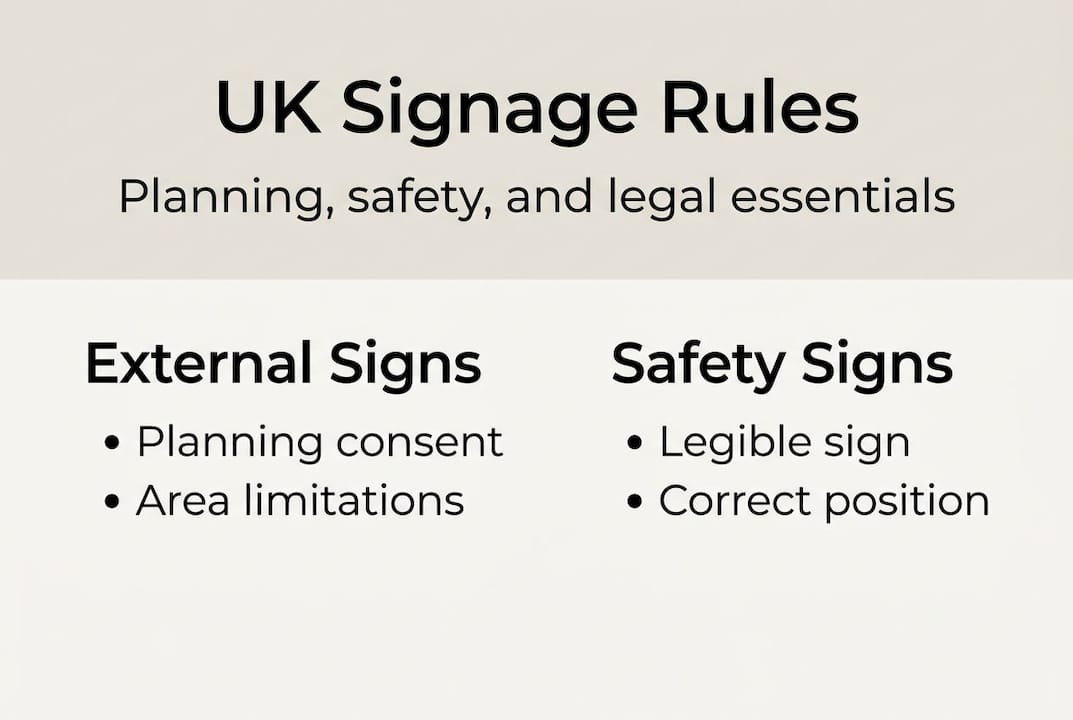
The primary regulations governing external business signs in England are the Town and Country Planning (Control of Advertisements) (England) Regulations 2007. For internal workplace safety signs, the Health and Safety (Safety Signs and Signals) Regulations 1996 applies. These two frameworks define almost every compliance obligation your business faces.
Here is a summary of when different signage types require consent or must meet specific standards:
| Sign type | Regulation | Consent or standard required |
|---|---|---|
| Standard fascia sign | Town & Country Planning 2007 | Deemed consent (Schedule 3) |
| Illuminated sign | Town & Country Planning 2007 | Express consent usually required |
| Sign over 0.3 sqm | Town & Country Planning 2007 | Express consent required_Regulations_1996) |
| Fire exit sign | H&S (Safety Signs) Regs 1996 | BS EN ISO 7010 standard |
| Hazard warning sign | H&S (Safety Signs) Regs 1996 | BS EN ISO 7010 standard |
| Heritage/listed building sign | Local planning authority | Specific local consent required |
For external signage, the process depends on the type of consent that applies:
- Deemed consent: Automatically granted for signs that meet Schedule 3 criteria, such as standard shop fascia signs below a set size
- Express consent: Required for larger, illuminated, or unusual signs. You apply to your local planning authority, and the process typically takes up to eight weeks
- Exempt signs: Some very small or temporary signs fall outside planning control entirely
For internal safety signs, the shop sign planning permission process is separate. Your obligation is to conduct a risk assessment, identify hazards, and ensure the correct standardised signs are in place. Colour coding matters: red for prohibition, yellow for warning, blue for mandatory actions, and green for safe conditions or emergency routes.
Pro Tip: If you operate in a conservation area or manage a listed building, always check with your local authority before installing any new sign. Standard deemed consent categories may not apply, and proceeding without approval can result in an enforcement notice.
For health and safety signage in commercial premises, signs must also be kept legible, correctly positioned, and maintained to remain effective.
Process: achieving and maintaining compliant signage
With a clear grasp of the rules, here is how your business can work through compliance step by step.
The consent and compliance process involves obtaining deemed consent under Schedule 3 classes, applying for express consent via the local authority within an eight-week window, or identifying exempt categories. For safety signs, it requires a risk assessment, correct placement, ongoing maintenance, and employee training.
Here is the practical sequence for external signage:
- Assess the sign you need: size, location, illumination, and content
- Check whether your sign qualifies for deemed consent under Schedule 3
- If not, submit an express consent application to your local planning authority
- Once approved, commission your sign from a reputable supplier
- Arrange professional installation in line with the approved specification
- Schedule regular maintenance checks to keep the sign in good condition
For internal safety signage, the process runs alongside your existing health and safety obligations:
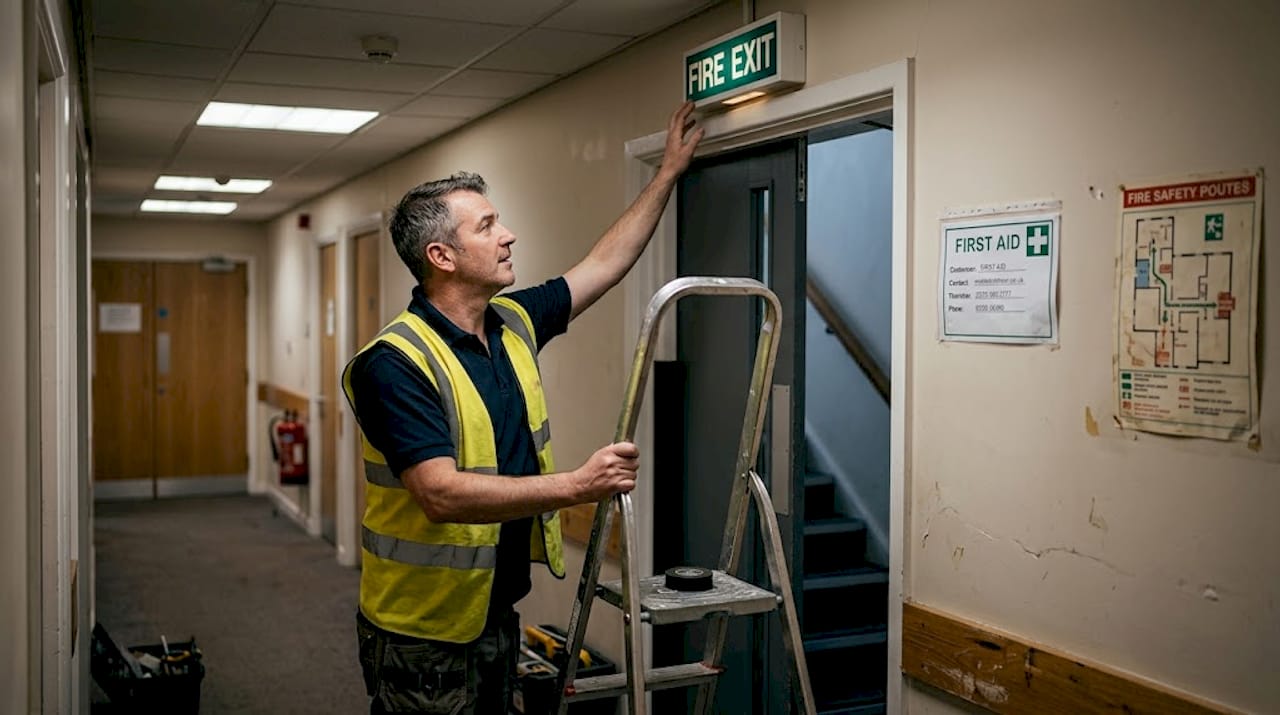
- Conduct a site risk assessment to identify where signs are needed
- Source signs that meet BS EN ISO 7010 pictogram and colour standards
- Install signs in clearly visible positions at appropriate heights
- Brief staff on what each sign means and what action to take
- Review sign condition and placement as part of regular audits
| Aspect | External signage | Internal safety signage |
|---|---|---|
| Governing law | Town & Country Planning Regs 2007 | H&S (Safety Signs) Regs 1996 |
| Consent process | Deemed, express, or exempt | Risk assessment driven |
| Key standards | Local authority planning rules | BS EN ISO 7010 |
| Maintenance | Visual condition checks | Regular audit and replacement |
| Staff training | Not required | Mandatory |
You can find detailed guidance on the advertisement consent process through your local authority portal. For installation best practice, our signage installation guide walks through the key considerations for UK businesses.
Pro Tip: For complex projects involving listed buildings, conservation areas, or large-scale commercial developments, engaging a specialist signage supplier early in the process saves time and reduces the risk of a rejected application.
Risks and penalties: consequences of signage non-compliance
Understanding the process helps you comply. Knowing what happens if you do not should sharpen your focus further.
Fines for illegal signage range from £500 to over £2,900, and enforcement does not stop at the financial penalty. Local authorities can issue a removal notice, requiring you to take down the sign at your own cost. Persistent non-compliance can result in prosecution.
Real UK cases illustrate just how costly this can become:
- ResinPrint: Fined £2,875 for an illegal sign in Reading
- Oxford Road business: Fined £2,437 for non-compliant external signage
- Barking shop owner: Fined £1,315 for illegal signs on their premises
Beyond the direct financial penalties, there are wider operational and reputational risks:
- Forced removal of signage disrupts trading, particularly for retail businesses relying on footfall
- Local press coverage of enforcement action damages your brand in the community
- In conservation areas and heritage zones, penalties can be more severe and enforcement quicker
- Construction sites face additional scrutiny, where missing or incorrect signage safety tips can attract HSE intervention as well as planning enforcement
The cost of getting compliant signage designed and installed correctly is almost always lower than the combined cost of fines, removal, and reputational damage.
For more context on the scale of enforcement action, illegal signage cases across the UK show that local authorities are increasingly active in pursuing non-compliant businesses. Do not assume your area is a low-risk exception.
Common challenges and expert tips for UK signage compliance
Having covered the risks, it helps to look at the practical obstacles businesses face and how to overcome them.
Local variation is a genuine challenge. Deemed consent may be overruled in special cases. Conservation areas and rural locations often apply stricter rules than town centres. Construction sites require weatherproof materials and high-visibility formats that go beyond standard commercial sign specifications. And safety signs are only effective when staff have been properly trained to understand and act on them.
Here are the most common compliance challenges to plan for:
- Digital and illuminated signs: Bright, moving, or large-format digital displays almost always require express consent, even if similar static signs would qualify for deemed consent
- Heritage zones: Signs in conservation areas or on listed buildings require specific local authority approval and must often match historical character guidelines
- Construction sites: Signs must be weatherproof, clearly visible, and meet types of construction signage standards for high-visibility warning and prohibition notices
- Maintenance failures: A compliant sign that becomes faded, damaged, or partially obscured can trigger an enforcement notice just as easily as an unconsented sign
- Staff awareness: Internal safety signs serve no legal or practical purpose if employees do not know what they mean
Pro Tip: Build a signage audit into your annual business review. Check that all external signs still match their consent approval, that internal safety signs are legible and correctly positioned, and that any new hazards identified in your risk assessment are reflected in updated signage. Investing in durable signage materials from the outset also reduces the frequency and cost of maintenance.
For detailed guidance on navigating consent requirements, the planning permission advice resource from UK Sign Shop is a practical starting point alongside your local authority portal.
A sharper perspective: compliance is about more than just ticking boxes
Most compliance guides stop at rules and penalties. That is useful, but it misses the bigger picture.
The businesses we work with that manage signage compliance best are not the ones who treat it as a box-ticking exercise. They are the ones who use compliance reviews as an opportunity to assess whether their signage is actually working. Is the fascia sign still legible from the pavement? Are the internal wayfinding signs helping customers navigate, or are they outdated and confusing?
Compliance creates a natural review cycle. Use it. A signage audit is a chance to refresh branding, update messaging, and improve customer experience, all while confirming you meet current standards. Businesses that think this way tend to have better-maintained, more effective signage because they treat it as a live business asset rather than a one-time installation.
The brands that understand signage durability for safety and branding as a combined priority consistently get better long-term value from their signage investment. Compliance and creativity are not in conflict. The best signage solutions satisfy both.
Partner with signage experts for seamless compliance
Navigating planning consents, safety standards, and material specifications is straightforward when you have the right team behind you.
At Pik Pik POW!, we help businesses across retail, construction, and commercial sectors design and install signage that is fully compliant and visually impactful. Whether you need help with signage systems for a new shopfront, digital signage solutions that meet local authority requirements, or expert guidance on shop sign design, our team manages the process from concept to installation. We combine design expertise with a thorough understanding of UK planning and safety regulations, so your signs work hard for your business without putting you at risk.
Frequently asked questions
Do all business signs need planning permission in the UK?
Not all signs need planning permission. Many standard shop fascia signs qualify for deemed consent, but illuminated, large, or unusual signs often require express consent from your local planning authority before installation.
What is the penalty for non-compliance with signage rules?
Penalties include fines from £500 to over £2,900, forced sign removal at your expense, and potential prosecution for repeated or serious breaches of planning or safety regulations.
What are the required safety signs for UK workplaces?
Most workplaces must display fire exit signs, no smoking notices, first aid point indicators, and health and safety law posters, along with task-specific warning signs based on your site risk assessment.
Are signage rules different in Scotland and Wales?
Yes. Scotland and Wales operate under distinct regional regulations, so always consult your local authority before installing or replacing any business signage outside England.
How do I check if my business sign is compliant?
Review your local council’s planning portal for consent requirements, conduct a site risk assessment for internal safety signs, and carry out a regular signage audit against current BS EN ISO 7010 standards and planning conditions.