

TL;DR:
- Regularly updating shopfront signage enhances visibility, drives customer footfall, and boosts sales through improved branding. Experts recommend reassessing signage every three to five years, considering factors like physical condition, brand changes, and regulations. Well-designed, illuminated signs with high contrast and legibility work continuously to reinforce your brand identity and maximize return on investment.
Updating your shopfront signs is one of the most direct investments you can make in customer footfall, brand recognition, and long-term revenue. Your sign is the first thing a passing customer sees, and first impressions matter far more than most business owners realise. Research consistently shows that well-maintained, visible signage drives measurable increases in walk-in traffic and sales. This article covers the measurable benefits of refreshing your signage, how often to do it, what design principles to follow, and how it compares to other marketing spend.
Why update shopfront signs: the measurable business case
Shopfront signage, known in the industry as fascia signage, is the primary visual identifier of your business from the street. The reasons to refresh signage go well beyond aesthetics. A 22% jump in walk-ins was recorded by one coffee shop within 60 days of installing a new illuminated fascia sign. That is a direct, near-immediate return from a single physical asset.
The data at a wider scale is equally compelling. A University of Cincinnati Economic Center study found that up to 60% of businesses saw an average 10% increase in sales after improving their signage. That figure represents businesses across sectors and locations, not just premium high-street retailers. The implication is clear: signage improvement is not a luxury reserved for large brands. It is a practical lever available to any business owner.
Faded, peeling, or outdated signs send a specific message to passing customers: that the business behind them is not paying attention. Customers use the condition of your exterior as a proxy for the quality of your products or service. A sign that was installed five years ago and has not been touched since may be actively costing you customers without you realising it.
The benefits of new shop signs extend beyond foot traffic. Fresh, consistent signage reinforces brand identity, builds trust with repeat visitors, and signals that your business is active and invested in its presence. Unlike a paid social media campaign or a print advertisement, your fascia sign works every hour of every day without additional spend.
“Signage is an owned advertising asset. Once installed, it continues building brand recognition with minimal ongoing cost, unlike digital ads that stop the moment your budget runs out.”
Pro Tip: Walk past your own shopfront at different times of day, including after dark, and assess what a first-time visitor actually sees. You may be surprised by what you have stopped noticing.
How often should businesses update their shopfront signage?
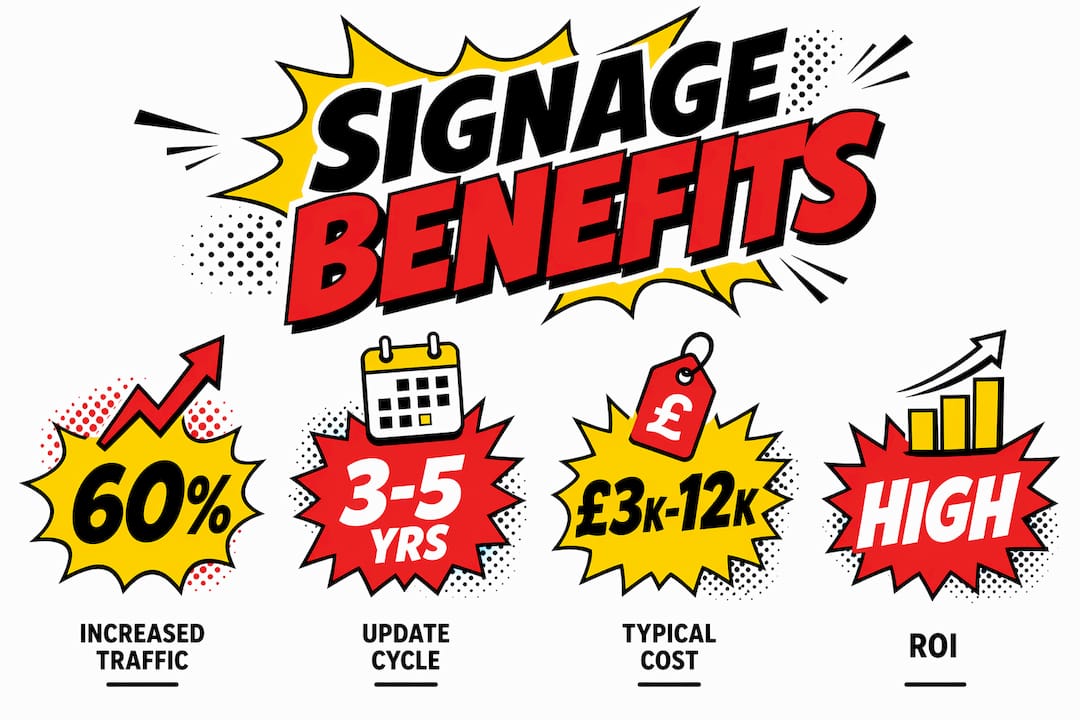
Industry experts recommend reassessing exterior signage every three to five years. This is not an arbitrary figure. It reflects the typical rate at which physical materials degrade, brand identities evolve, and customer expectations shift. Treating signage as a set-and-forget asset is one of the most common and costly mistakes in retail management.
The following factors determine whether your signage needs attention sooner rather than later:
- Physical condition. Signs fade, peel, or become misaligned with brand updates over time, directly impacting customer perception. UV exposure, rain, and temperature changes accelerate wear on vinyl lettering and printed panels.
- Brand changes. If you have updated your logo, colour palette, or trading name since the sign was installed, your exterior and your brand identity are now in conflict. Customers who know you online or from printed materials will notice the inconsistency.
- Local regulations. Planning permissions and landlord requirements change. A sign that was compliant five years ago may now fall outside current guidelines, particularly if your local authority has updated its shopfront design policies.
- Competitor activity. If neighbouring businesses have refreshed their signage recently, an outdated sign makes your premises look comparatively neglected, even if the business itself is thriving.
- Technology advances. LED illumination, digitally printed panels, and modular signage systems now offer longer lifespans and easier content updates than older materials. Switching to these formats can extend your next update cycle significantly.
Proactive reassessment is always cheaper than reactive replacement. A sign that fails in winter, with a burned-out light or a panel that has come loose, requires emergency attention at a higher cost and with greater disruption than a planned update.
Pro Tip: Schedule a signage review at the same time as your annual brand or marketing review. Treating it as part of your broader business planning prevents it from being overlooked until something goes visibly wrong.
What design and visibility factors should guide your sign update?
Good design is not the same as attractive design. The importance of updating store signs lies partly in getting the design right when you do update, not simply replacing like for like. Visibility and legibility are the two non-negotiable criteria. A sign that looks impressive in a designer’s mock-up but cannot be read from ten metres away has failed its primary purpose.
The key design and visibility factors to consider include:
- Font legibility. Sans-serif typefaces such as Helvetica, Arial, or custom brand fonts with clean letterforms read clearly at distance. Decorative scripts may suit your brand identity but should be used sparingly and at larger sizes.
- Colour contrast. High contrast between text and background, such as white on dark blue or black on yellow, dramatically improves readability in varied lighting conditions. Low-contrast combinations are the most common cause of sign blindness, where passersby register a sign exists but cannot read it.
- Sign size relative to frontage. A sign that is too small for the fascia is as ineffective as one that is too large and cluttered. The viewing distance from the pavement should determine minimum letter height.
- Illumination. Illuminated signage, whether front-lit, halo-lit, or LED-backlit, extends your visibility into evening hours and poor weather. For businesses open after dark, illumination is not optional.
- Material durability. Aluminium composite panels, acrylic lettering, and powder-coated steel all offer significantly longer lifespans than foam or basic PVC in outdoor conditions.
You can explore current signage design trends to understand which materials and formats are performing well for retail businesses in 2026. The shift towards modular systems and integrated illumination is particularly relevant for businesses planning their next update.
| Signage type | Best suited for | Illumination option |
|---|---|---|
| Flat fascia panel | Most retail frontages | Front-lit or halo-lit |
| Built-up letters | Premium or branded retail | Halo or LED-backlit |
| Lightbox sign | Food, leisure, and service | Internal LED |
| Projecting sign | Narrow frontages or pedestrian streets | Front-lit LED |
| Digital display | High-footfall or promotional retail | Self-illuminated |
Pro Tip: Ask your signage supplier to produce a scaled visual showing your proposed sign on a photograph of your actual frontage. This removes guesswork and reveals proportion and contrast issues before any fabrication begins.
How does updating shopfront signs compare to other marketing investments?
Signage is a high-ROI marketing channel that works continuously, unlike digital ads which stop delivering the moment your budget ends. This distinction matters when you are allocating a finite marketing budget across multiple channels. A paid search campaign generates clicks for as long as you pay for it. A well-installed fascia sign generates awareness and footfall for years.

The ROI of signage is admittedly harder to attribute precisely than a digital campaign with click-through data. However, the ongoing brand-building value of physical signage is fundamentally superior for businesses with a fixed location. Every person who walks or drives past your premises is a potential customer who sees your brand at no additional cost per impression.
Full fascia signage replacements in major UK urban areas range from £3,000 to £12,000, with targeted updates costing considerably less. Set against the 10% average sales uplift recorded in the University of Cincinnati study, the payback period for most retail businesses is measured in months rather than years. A business turning over £300,000 annually that achieves even a 5% uplift from improved signage generates £15,000 in additional revenue. That covers a full fascia replacement in a single year.
Neglecting signage while investing heavily in digital marketing creates a disconnect that customers notice. You can drive traffic to your website and social channels, but if the physical premises do not match the brand promise, conversion at the door suffers. Signage and digital marketing work together most effectively when they present a consistent brand identity across every touchpoint.
What practical steps should you take to update your signs?
Updating your shopfront signage effectively requires a structured approach rather than simply ordering a replacement for what you already have. The following steps cover the process from initial assessment to ongoing maintenance.
- Conduct a street-level visibility assessment. Stand across the road from your premises and evaluate your sign honestly. Check legibility, colour vibrancy, lighting, and whether the sign is visible from both directions of approach. Viewing from the street is the most reliable way to identify problems that familiarity has made invisible to you.
- Review your current brand guidelines. Confirm that your sign reflects your current logo, typeface, and colour palette. If your brand has evolved since the sign was installed, this is the moment to bring them into alignment.
- Check planning and landlord requirements. Contact your local planning authority or review your lease before commissioning any new signage. Many commercial leases require landlord consent for external alterations, and permitted development rules apply to shopfront signs in conservation areas and listed buildings.
- Brief a professional signage company. Provide your brand assets, frontage dimensions, and any regulatory constraints. A professional supplier will survey the site, advise on suitable systems, and produce visuals for approval before fabrication.
- Schedule installation to minimise disruption. Plan installation outside peak trading hours where possible. Coordinate with your team so that the premises are accessible and the changeover is managed cleanly.
- Set a maintenance schedule. Once installed, lighting checks and regular cleaning extend signage lifespan and preserve impact. A broken light or dirty panel undermines the investment far faster than physical wear alone.
Pro Tip: Budget for signage updates as a line item in your annual marketing plan rather than treating them as a one-off capital expense. This makes the cost predictable and prevents the reactive, rushed replacements that tend to produce inferior results.
Key takeaways
Updating shopfront signage every three to five years delivers measurable increases in foot traffic, sales, and brand recognition, making it one of the highest-ROI physical marketing investments available to retail businesses.
| Point | Details |
|---|---|
| Update cycle | Reassess fascia signage every three to five years to maintain brand alignment and physical condition. |
| Foot traffic impact | A new illuminated sign can increase walk-in customers by over 20% within 60 days of installation. |
| Sales uplift | Up to 60% of businesses report a 10% average sales increase after improving their signage. |
| Design priorities | Legibility, colour contrast, and illumination matter more than aesthetics alone when updating signs. |
| Marketing ROI | Signage works 24 hours a day with no ongoing cost per impression, unlike paid digital advertising. |
What we have learned from years of shopfront signage work
The single most common mistake we see from business owners is treating signage as a one-time decision rather than an ongoing brand asset. A sign installed at launch is often still in place a decade later, long after the brand has evolved, the materials have degraded, and the competitive environment has changed around it.
The second most common mistake is designing for the owner rather than the passing customer. We have worked with businesses whose signs looked genuinely impressive up close but were effectively invisible from the pavement because the font was too decorative, the contrast too low, or the illumination too dim. Good signage is not about what you like when you are standing in front of it. It is about what a stranger can read and register in two seconds from across the street.
What we have also observed is that businesses which invest in quality signage and maintain it properly tend to take their brand presence more seriously across every channel. The sign becomes a standard that the rest of the business rises to meet. That is not a small thing. It is the kind of compounding benefit that does not show up in a single data point but becomes obvious over time.
The technology available now, particularly modular signage systems and energy-efficient LED illumination, makes it easier and more cost-effective than ever to keep your exterior looking current. There is no good reason to leave an outdated sign in place when the tools to replace it are this accessible.
— PikPikPOW!
How Pikpikpow can help you update your shopfront signage
If your signage is overdue for a refresh, Pikpikpow works with retail businesses across the UK to design, fabricate, and install bespoke shopfront signage that performs from day one.
From initial site survey through to planning compliance and final installation, the team at Pikpikpow handles the full process. Whether you need a complete fascia replacement, new built-up lettering, or an illuminated lightbox, every solution is tailored to your brand, your frontage, and your location. Explore the full range of shopfront signage systems or get in touch directly to discuss your requirements. You can also review design options and materials to understand what will work best for your premises before committing to a brief.
FAQ
Why should I update my shopfront sign?
Updating your shopfront sign improves visibility, attracts new customers, and reinforces your brand identity. Research shows that businesses which improve their signage see an average 10% increase in sales, with some reporting foot traffic gains of over 20% within 60 days.
How often should a shopfront sign be replaced?
Industry guidance recommends reassessing exterior signage every three to five years. Physical wear, brand changes, and evolving local regulations all affect how frequently a full or partial update is needed.
What makes shopfront signage effective?
Effective signage combines legible fonts, high colour contrast, appropriate sizing for the viewing distance, and illumination for low-light visibility. Visibility and readability from the pavement take priority over decorative design choices.
Is updating signage worth the cost?
Full fascia replacements range from £3,000 to £12,000 in major UK urban areas, but the sales uplift data suggests most businesses recover that investment within a year. Signage also provides ongoing brand exposure at no additional cost per impression, unlike paid advertising.
What is sign blindness and how do I avoid it?
Sign blindness occurs when business owners become so familiar with their own signage that they stop noticing its faults, including poor legibility or faded colours. The best way to avoid it is to assess your sign from the street as a first-time visitor would, ideally at different times of day and from multiple approach angles.