

TL;DR:
- Effective gym signage enhances member navigation, experience, and retention far more than most gym operators realize. Accessibility, visual clarity, brand consistency, and regular updates are crucial to maintaining signage that supports safety and engagement. Operational discipline in signage management is essential for creating a professional environment that encourages member loyalty.
Signage is one of the most overlooked operational tools in any fitness facility. Most gym owners invest heavily in equipment and membership drives, yet give little thought to whether their signs actually work. What makes effective gym signage goes far beyond a logo on the wall. It directly shapes how members navigate your space, how they feel during their workout, and whether they stay long term. Member retention hinges on operational details like clear, current signage far more than most gym managers realise.
Table of Contents
- Key takeaways
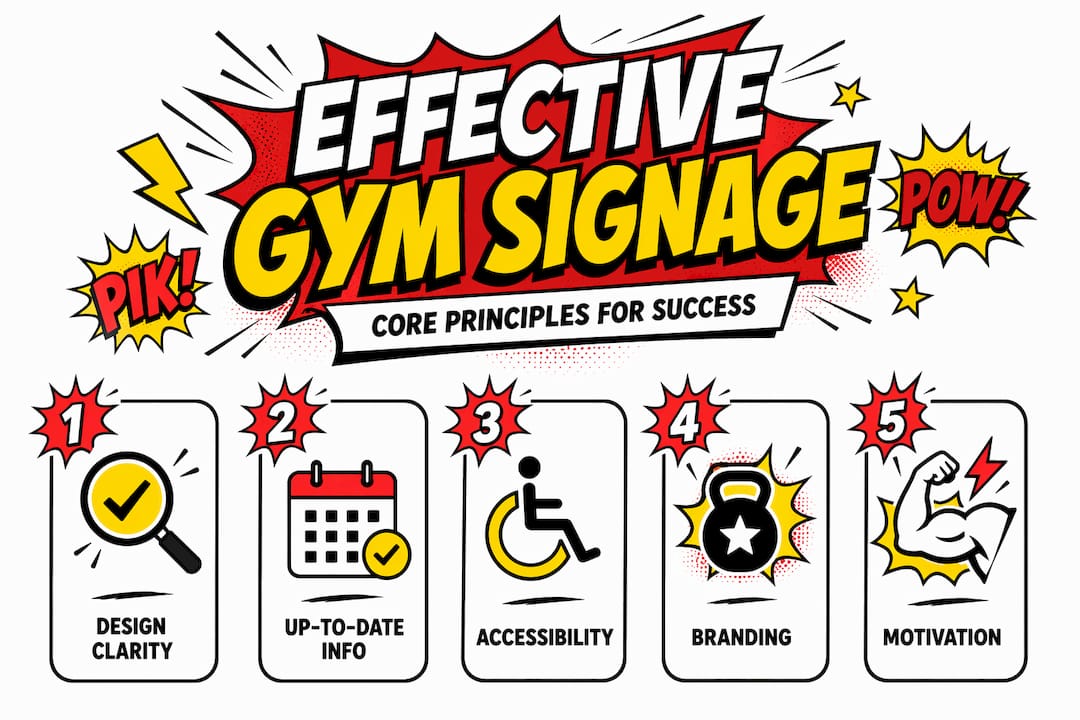
- What makes effective gym signage: core design principles
- Keeping gym signage accurate and up to date
- Digital signage for member experience and communication
- Legal and accessibility compliance in gym signage
- Branding and motivational messaging in gym signage
- Our honest take on effective gym signage
- How Pikpikpow can help with your gym signage
- FAQ
Key takeaways
| Point | Details |
|---|---|
| Design clarity is non-negotiable | High contrast, legible fonts, and appropriate sizing make signs accessible to all members. |
| Operational discipline drives results | Keeping signage current and tied to equipment workflows prevents member frustration and drop-off. |
| Digital signage builds community | Dynamic screens displaying schedules, spotlights, and leaderboards improve engagement and retention. |
| Compliance protects your business | Accessible signage meeting UK Equality Act and ADA-equivalent standards reduces legal risk and improves inclusivity. |
| Branding and messaging must balance | Following the 80/20 rule between informational and promotional content keeps members trusting your screens. |
What makes effective gym signage: core design principles
Good gym signage starts with visual clarity. If a member has to stop and squint to read a sign, it has already failed. The fundamentals are well established but frequently ignored in practice.
- Contrast and legibility: Dark text on a light background, or vice versa, is the baseline requirement. Pale grey text on a white wall is a common and costly mistake in gym interiors.
- Font choice and sizing: Sans-serif typefaces such as Arial or Helvetica read clearly from a distance. Body copy on instructional signs should be no smaller than 16pt, with headers significantly larger.
- Consistent brand identity: Your colour palette, logo placement, and font choices must be uniform across every sign in the facility. Inconsistency erodes trust in your brand, whether members consciously notice it or not.
- Motivational content placement: Inspirational quotes and member success stories belong on walls near cardio equipment and free weights, where members spend extended time. A quote above a toilet door adds nothing.
- Sign type differentiation: Wayfinding signs, instructional signs, safety signs, and promotional signs each serve a different purpose. Mixing formats or styles across types causes confusion. A well-structured indoor signage checklist can help you audit which sign types are present and whether each one is doing its job.
Accessibility is not optional. In the UK, the Equality Act 2010 requires reasonable adjustments to ensure disabled people can access your services. This applies directly to signage. Signs must include raised characters, braille, legible character height, and contrast to meet accessibility requirements. That covers room identification signs, directional signs, and facility information throughout the building.
Pro Tip: When specifying signage for a new or refurbished gym, treat accessibility compliance as a design brief requirement from day one, not an afterthought. Retrofitting tactile and braille elements later is significantly more expensive.
Keeping gym signage accurate and up to date
A well-designed sign that communicates the wrong information is worse than no sign at all. Operational discipline is where many gyms fall short, and it costs them members.
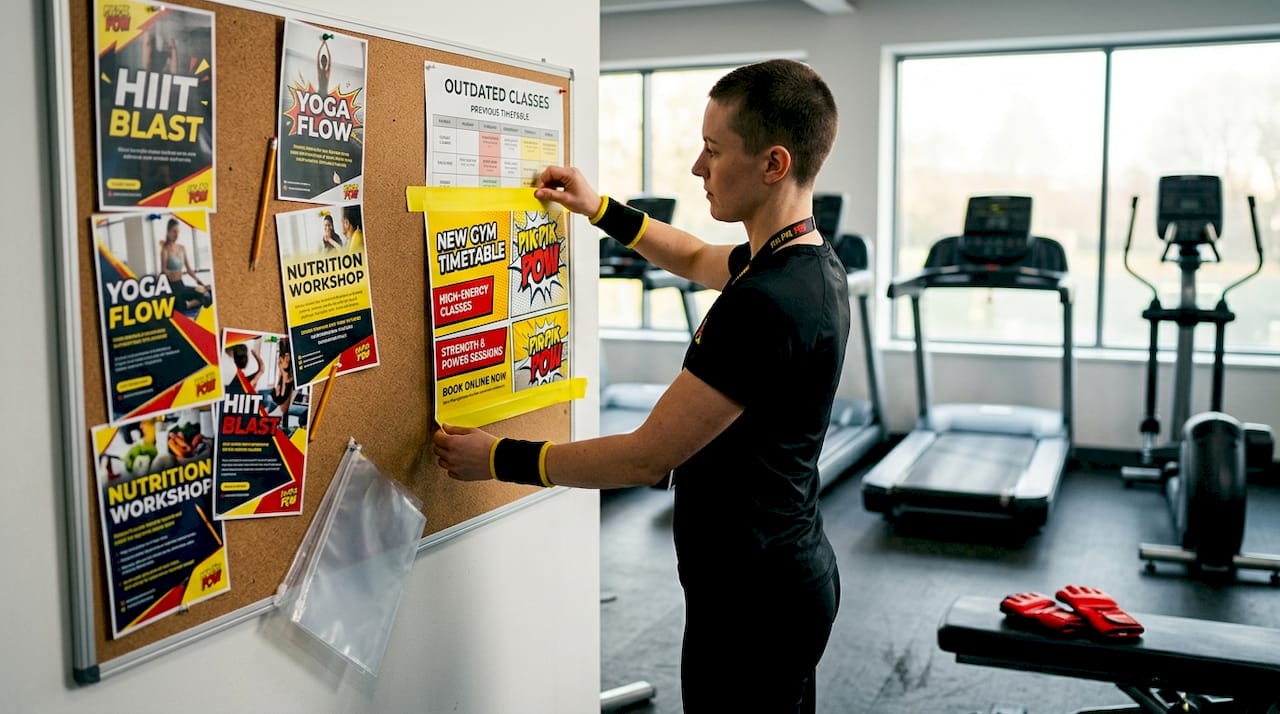
Consider out-of-service equipment. When a treadmill is down for repair and there is no clear sign explaining this, members waste time, feel frustrated, and form a negative impression of how the facility is run. Missing or inconsistent out-of-service signs create friction that directly affects return frequency. That is a retention issue, not just a communication one.
Here is a practical framework for keeping signage operationally sound:
- Assign sign ownership. Every sign category should have a named staff member responsible for checking accuracy on a set schedule. Wayfinding signs, class schedules, and equipment notices each need a designated owner.
- Link signage to maintenance workflows. When a piece of equipment is logged as out of service in your maintenance system, a corresponding sign should be placed automatically as part of that process. Integrating signage updates with equipment service schedules prevents the gaps that frustrate members.
- Schedule monthly audits. Walk the full facility once a month with a checklist. Check for damaged signs, outdated class information, and missing safety notices.
- Train all staff on sign protocols. Every team member should know how to request a replacement sign, where emergency safety signs are stored, and who to contact when a sign is missing or incorrect.
- Use digital signage for time-sensitive information. Class cancellations, temporary closures, and last-minute schedule changes are far better communicated via a digital screen than a hastily printed A4 sheet taped to a door.
Pro Tip: Create a simple “sign kit” for each zone of your gym, containing spare out-of-service notices, directional arrows, and safety reminders. When something goes wrong, staff can act immediately without waiting for a print order.
Digital signage for member experience and communication
Static signs communicate fixed information. Digital signage communicates with your members in real time, and that distinction matters enormously for member experience.
ScreenCloud’s 2026 guidance recommends treating digital signage as a 24/7 environment control channel, with structured placement by zone for maximum engagement. In practice, this means differentiating content by location.
| Zone | Recommended content | Format |
|---|---|---|
| Lobby / reception | Welcome messages, class schedules, announcements | Rotating slides, 10-15 second intervals |
| Cardio floor | Motivational quotes, member spotlights, timers | High-energy visuals, minimal text |
| Weight area | Form tips, instructional guides, competition leaderboards | Static or slow-rotating content |
| Changing rooms | Promotions, community notices, upcoming events | Low-brightness, text-forward |
The content balance matters as much as the placement. Following the 80/20 content rule means 80% of screen time is dedicated to community information, motivation, and member-relevant content, with no more than 20% used for promotions or upselling. Members who feel marketed at constantly begin to tune out your screens entirely.
Interactive and dynamic features take digital signage further. Member spotlights and live leaderboards create emotional connection and give members a reason to look up at the screen rather than scroll through their phone. Heart-rate display integrations, challenge boards, and milestone celebrations turn passive screens into active parts of the workout experience.
For gyms considering this step, exploring digital signage solutions built specifically for fitness environments is a practical starting point. Purpose-built systems handle content scheduling, zone management, and real-time updates without requiring a dedicated IT resource.
Legal and accessibility compliance in gym signage
Accessibility compliance in signage is not just a legal box to tick. It reflects the kind of facility you want to run, and it has direct implications for who feels welcome in your gym.
The core requirements for accessible signage are well documented. ADA guidance states that communication aids and services must be tailored to the individual’s communication method rather than applied uniformly. For gyms, this means thinking beyond a single standard sign template and considering the full range of members who use your facility.
| Signage feature | Requirement |
|---|---|
| Raised characters | Required on all permanent room identification signs |
| Braille | Grade 2 braille required below raised characters |
| Character height | Minimum 16mm, maximum 50mm for most signs |
| Contrast | 70% minimum contrast between characters and background |
| Mounting height | Centreline at 1,500mm from floor level |
| Finish | Non-glare surface required on tactile signs |
Auditing all entrances, rooms, and direction signs for correct sign types and placement is a recommended practice for both new builds and refurbished facilities. This audit should cover every decision point a member could encounter, from the car park entrance to individual studio rooms.
Staff training is an underrated part of accessibility compliance. A compliant sign on the wall means nothing if a staff member cannot assist a visually impaired member in navigating the facility. For more on this, the Pikpikpow guide on accessible signage for businesses covers the practical steps gym operators should take.
Branding and motivational messaging in gym signage
Your signs communicate your brand values whether you intend them to or not. A gym with inconsistent signage styles, mismatched colours, and generic stock imagery signals disorganisation. A gym with cohesive, well-considered signage signals professionalism and care.
Effective brand integration in signage comes down to a few consistent practices:
- Use your brand colour palette across all sign types. This includes safety signs where possible within legal constraints, wayfinding signs, promotional boards, and digital screens.
- Feature real members rather than stock photography. Member success stories on wall graphics create genuine social proof and strengthen the sense of community. Content such as member spotlights fosters emotional connection and encourages continued attendance.
- Keep motivational messaging on brand. A budget gym and a premium PT studio should not use the same tone in their motivational quotes. Every word on your wall communicates something about who you are and who you serve.
- Avoid sign overload. Too many signs in a single area dilutes the impact of each one. Prioritise the signs that directly serve member navigation and safety, then layer in motivational and brand content where space allows.
- Review signage content annually. Brand messaging evolves. A quote or visual that felt relevant two years ago may no longer reflect your gym’s identity or member base.
The psychological effect of your environment should not be underestimated. Cleanliness, lighting, and accurate signage all contribute to member satisfaction in ways that members feel but rarely articulate. Good signage is part of that invisible infrastructure.
Our honest take on effective gym signage
In my experience working with fitness facilities on signage projects, the gyms that get it right share one trait: they treat signage as an operational system, not a one-time design job.
I’ve seen brand-new facilities with stunning wall graphics and no wayfinding whatsoever. Members wander around looking for the changing rooms on their first visit and never quite shake that initial confusion. I’ve also seen older gyms with modest budgets that work brilliantly because every sign is in the right place, the content is always current, and the staff actually know what the signs say.
What I’ve learned is that style without substance fails quickly. The most expensive vinyl wrap on the planet will not fix a facility where the class schedule on the wall is three months out of date. Operational discipline is the unglamorous foundation of effective signage, and it is where most gym managers should focus first.
My practical advice: before you commission new signage, walk your facility as a first-time visitor. Note every moment where you are unsure where to go, what something means, or whether a piece of equipment is available. Those moments are your signage brief.
— PikPikPOW!
How Pikpikpow can help with your gym signage
If this article has helped you identify gaps in your current signage setup, the next step is working with a team that can translate those insights into physical results.

At Pikpikpow, we specialise in bespoke signage solutions for commercial interiors, including fitness facilities. Whether you need a full wayfinding and internal signage system designed from scratch, or you’re looking to add digital signage systems to improve real-time member communication, we can design and manufacture to your exact specification.
Our team combines design expertise with compliance knowledge, so your signage will not only look right but meet the accessibility and safety standards your facility requires. We work with you through design, production, and installation, keeping the process straightforward from brief to finished sign. Get in touch to discuss your gym signage needs.
FAQ
What are the key elements of effective gym signage?
Effective gym signage combines visual clarity, brand consistency, accurate content, and accessibility compliance. Signs must be legible, correctly positioned, and kept current to serve members well.
How does signage impact gym member retention?
Member retention is influenced more by consistent operational execution than marketing, and signage is a direct part of that experience. Outdated or missing signs create friction that reduces return frequency over time.
What are the legal requirements for accessible gym signage in the UK?
UK gyms must comply with the Equality Act 2010, which requires reasonable adjustments for disabled members. This includes tactile signs with raised characters and braille, adequate contrast, and correct mounting heights in line with accessibility standards.
How should digital signage content be structured in a gym?
Follow the 80/20 content rule: dedicate 80% of screen time to informational and motivational content, and no more than 20% to promotions. Differentiate content by zone, with higher-energy visuals on the cardio floor and more detailed information near free weights.
How often should gym signage be audited?
A full signage audit should be carried out at least monthly, covering accuracy, damage, and compliance. Out-of-service signs and class schedules should be checked and updated as part of daily operational routines.