For fit-out companies, a turnkey supplier combined with an internal QA and asset-management capability delivers the best balance of brand control, speed, and cost. Pikpikpow is the recommended partner for UK fit-out firms that need bespoke design, in-house production, and nationwide fitting under one commercial agreement. Fleet branding works best when treated as a strategic asset rather than a one-off purchase, and the companies that get the most from their vehicle livery are the ones that plan procurement properly from the start.
Before you brief any supplier, run through this checklist:
- Confirm your vehicle fleet list, including make, model, and year for each vehicle.
- Gather master brand assets: vector logo files, Pantone colour references, and any livery rules from your brand guidelines.
- Decide on installation scope: full wrap, partial graphics, or cut-vinyl decals.
- Request Chapter 8 compliance requirements if any vehicles operate on public highways in a safety-critical role.
- Ask your shortlisted supplier for a sample vehicle quote, a material datasheet, and a project timeline before signing anything.
The numbered steps that follow give you the full specification framework, cost model, and installation checklist to take that brief to completion.
- Confirm fleet list with vehicle make, model, and year.
- Gather vector brand assets and Pantone/PMS colour values.
- Define installation scope per vehicle type.
- Clarify Chapter 8 or British Standards obligations.
- Request a pilot-vehicle quote, material datasheet, and timeline from your chosen supplier.
Table of Contents
- What do vehicle graphics tools actually cover for fit-out companies?
- What design files and assets do you need to hand over?
- In-house production or outsourcing: which makes sense for your fleet?
- Which materials and finishes should you specify?
- How much do vehicle graphics cost in the UK, and how long do they take?
- What should you expect on installation day, and what aftercare is needed?
- How Pikpikpow delivers vehicle graphics for fit-out companies
- Key takeaways
- What fit-out companies consistently get wrong with vehicle graphics
- Pikpikpow: the vehicle graphics partner for fit-out companies
- Further reading and industry references
What do vehicle graphics tools actually cover for fit-out companies?
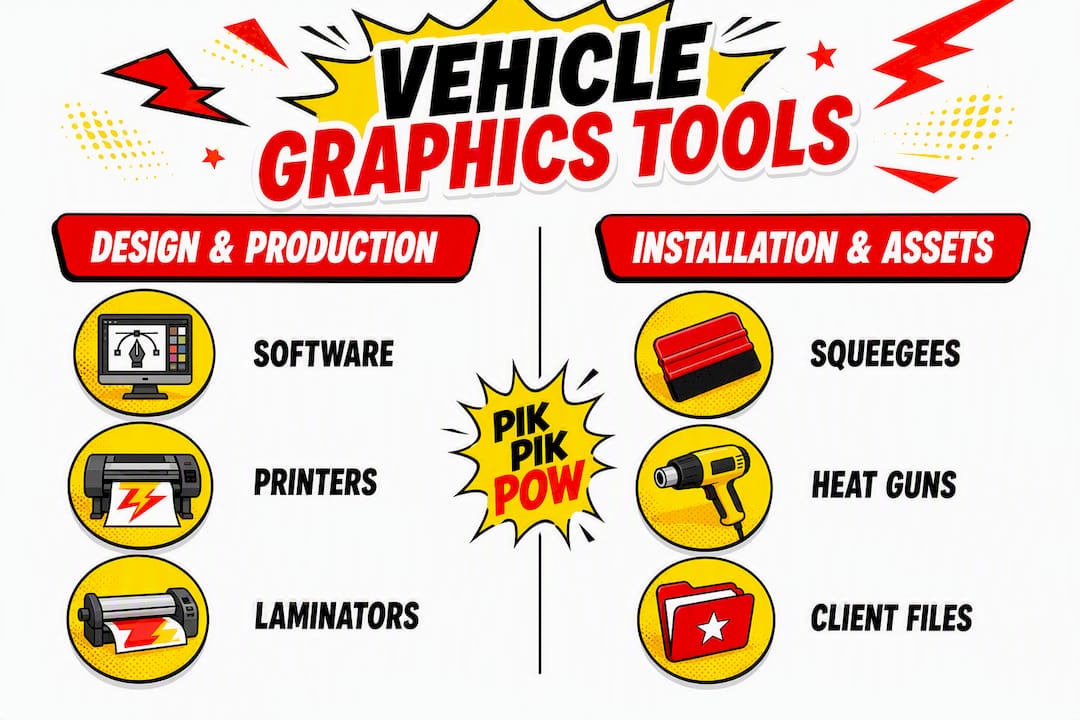
The phrase “vehicle graphics tools” spans four distinct categories, and procurement teams need to understand all of them whether they are buying a service or evaluating a supplier’s capability. The industry term for the full production chain is vehicle livery production, and it runs from digital design through physical installation.
Design software
Vector applications such as Adobe Illustrator and CorelDRAW handle logo artwork and cut-vinyl paths. Colour management tools convert Pantone spot colours to CMYK process values for print accuracy. PDF/X-4 is the standard file format for print-ready artwork supplied to wide-format printers.
Production equipment
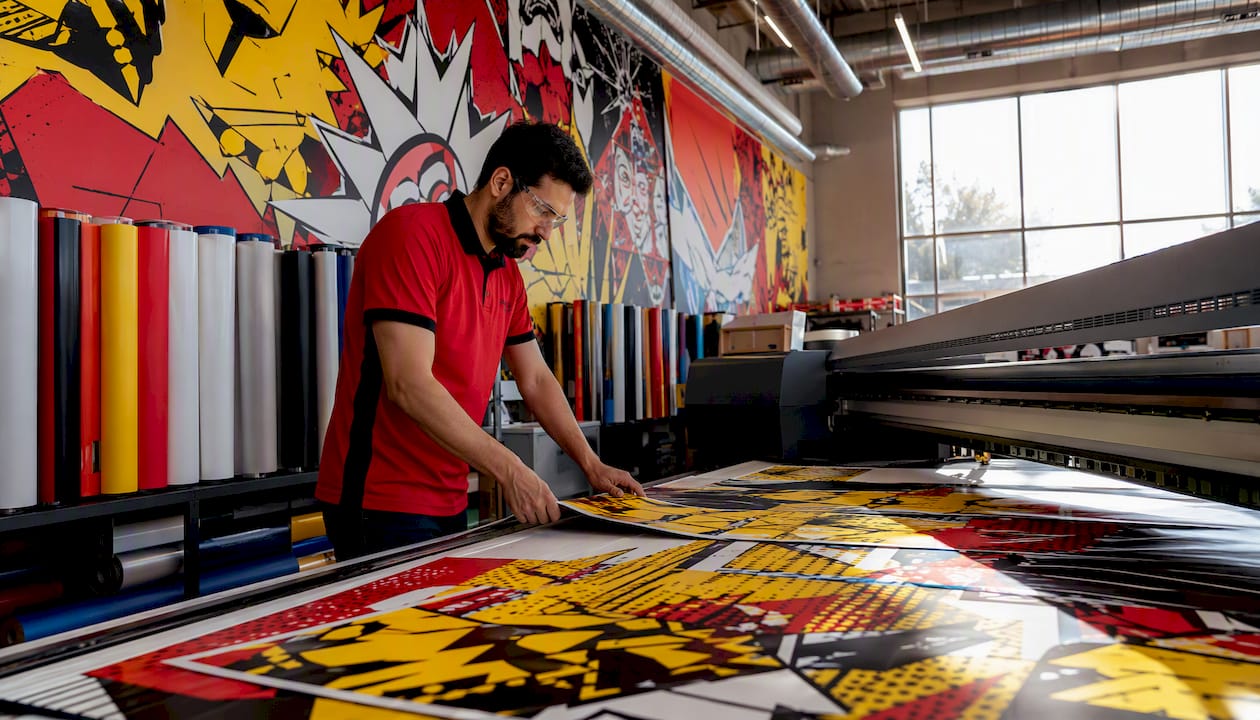
Wide-format printers using eco-solvent or UV-curable inks produce the printed panels. Laminators apply protective overlaminates. Vinyl cutters and plotters trim both printed and unprinted films to exact vehicle templates.
Installation tools and consumables
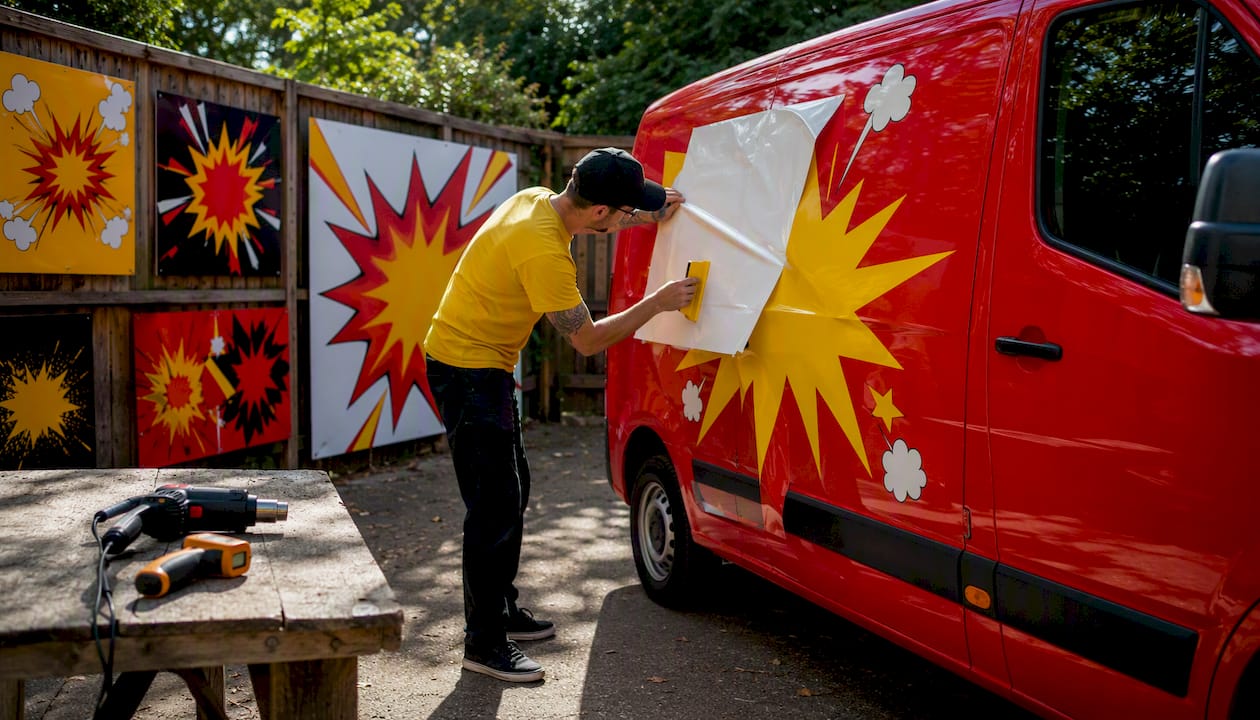
Squeegees, felt-edged application tools, heat guns, and infrared thermometers are the core graphics installation equipment. Surface preparation kits include isopropyl alcohol wipes, primer pens for recessed areas, and tack cloths. Consumables are the vinyls, laminates, adhesives, and primers themselves.
Client-supplied assets vs supplier responsibilities
| Responsibility | Fit-out company supplies | Supplier provides |
|---|---|---|
| Brand assets | Vector .ai/.eps logos, PMS values, livery rules | Print-ready files, registration marks, bleed |
| Vehicle data | Make, model, year, VIN or dieline request | Vehicle-specific templates, site survey |
| Approval | Signed proof sign-off | Physical or digital pre-production proof |
| Compliance | Chapter 8 brief, British Standards reference | Reflective material specification and fitting |
Vehicle choice also affects the tool and material decisions: flat panel areas on large vans suit full-wrap printing, while vehicles with complex curves or heavy glazing require cast vinyl and specialist contouring tools.
What design files and assets do you need to hand over?
Clean file handover is where most fit-out projects lose time. A supplier cannot begin production proofing until every asset is confirmed, so getting this right at the start saves days.
Your design deliverables checklist
- Master logo files in vector format (.ai or .eps), with all fonts outlined.
- Colour palette with Pantone/PMS values and their CMYK equivalents.
- Vehicle dielines or templates (your supplier should provide these if you supply the vehicle make and model).
- Phone numbers, URLs, and straplines as editable text, not embedded in a raster image.
- Any approved photography at a minimum of 150 dpi at final print size (300 dpi preferred).
- Written copy sign-off from your marketing or legal team before artwork is submitted.
What your installer handles
The supplier conducts a vehicle survey to record panel dimensions, door gaps, and handle positions. They produce print-ready proofs with trim marks and bleed, generate vehicle-specific templates, and prepare pre-production mock-ups for your approval. Pikpikpow’s vehicle graphics service includes this proofing stage as standard.
Common file mistakes that cause delays
Low-resolution images embedded in artwork, missing bleed areas, and RGB colour mode files are the three most frequent causes of production hold-ups. RGB files look correct on screen but shift noticeably when converted to CMYK for print. Always supply files in CMYK or with Pantone spot-colour references, and confirm bleed with your supplier before submission.
Pro Tip: Request a small-scale proof printed on the exact vinyl grade specified for your fleet before approving full production. Colour, finish, and adhesion can all vary between material grades, and catching a mismatch at proof stage costs a fraction of what a reprint does.
In-house production or outsourcing: which makes sense for your fleet?
Most fit-out companies reach this decision when they are either scaling a fleet or facing a rebrand. The answer depends on volume, frequency, and the skills already available internally.
Side-by-side comparison
| Criterion | In-house production | Outsourced to a specialist |
|---|---|---|
| Best for | High-volume, repeat work; tight emergency turnarounds | Variable fleet sizes; one-off rebrands; no trained installers |
| Cost shape | High capital outlay; lower unit cost at scale | No capital cost; predictable per-vehicle pricing |
| Lead-time profile | Flexible if equipment and staff are available | Dependent on supplier queue and scheduling |
| Quality consistency | Requires ongoing training and calibration | Managed by supplier; backed by warranty |
| Installation method | Full wrap, partial, cut vinyl | Full wrap, partial, cut vinyl, Chapter 8 reflective |
| In-house vs outsourced suitability | Suits firms with consistent higher volume and skilled staff | Suits most fit-out companies, especially for rebrands |
In-house production gives full control over design, production, and application, and can include Chapter 8-compliant chevrons and reflective safety markings. The trade-off is significant capital expenditure on wide-format printers, laminators, cutters, and a temperature-controlled fitting bay, plus the ongoing cost of trained installers.
Break-even signals for in-house investment
- Monthly wrap area consistently above 200 m² of vinyl.
- At least two trained, certificated installers on payroll.
- A dedicated fitting bay with controlled temperature and ventilation.
- A maintenance and calibration plan for print and cutting equipment.
- A confirmed project pipeline that justifies the capital payback period.
For most fit-out companies, particularly those managing variable fleet sizes or a single large rebrand, outsourcing to a turnkey supplier is the more cost-effective and lower-risk route.
Which materials and finishes should you specify?
Material choice determines how long your livery lasts, how it performs on site, and what it costs to remove or replace. Specifying the wrong vinyl grade is one of the most common and expensive mistakes in fleet graphics procurement.
Vinyl types
- Calendared vinyl: lower cost, suitable for flat or gently curved surfaces, typical lifespan of several years under UK conditions. Use for short-term campaigns or simple decals on flat panels.
- Cast vinyl: more conformable, suitable for complex curves and full wraps, typical lifespan of several years. The correct choice for full-vehicle wraps and any surface with deep recesses or rivets.
- Reflective vinyl: required for Chapter 8 highway safety markings on vehicles operating on public roads. Specify the correct retroreflectivity class for your application.
- Perforated window film: allows one-way vision through glazed areas. Useful for rear windows and side glazing where branding space is limited.
Finishes and laminates
Gloss laminates give strong colour vibrancy and are easy to clean. Matt laminates reduce glare and suit a more understated brand aesthetic. Satin sits between the two. Anti-graffiti laminates add a sacrificial layer that can be cleaned or replaced without damaging the base print, which is worth specifying for vehicles parked on public sites. UV-stable topcoats extend outdoor lifespan, particularly for vehicles exposed to prolonged sun or coastal salt spray.
Environmental choices
Eco-solvent inks offer a lower environmental impact than traditional solvent inks and are widely used in wide-format vehicle graphics production. Ask your supplier whether their print process uses eco-solvent or UV-curable inks, and whether the vinyl substrate is recyclable at end of life.
Warranty norms to request
Ask for a written warranty covering print fade, adhesive failure, and laminate delamination. A minimum of three years on cast vinyl with UV laminate is a reasonable baseline for UK fleet use.
How much do vehicle graphics cost in the UK, and how long do they take?
Budgeting for fit-out vehicle signage requires understanding the variables that drive both price and lead time. There is no single figure that covers every scenario, but the framework below gives you a working model.
Cost drivers
- Vehicle size and panel complexity (a long-wheelbase van costs more than a small van).
- Scope: full wrap costs significantly more than partial graphics or cut-vinyl decals.
- Material grade: cast vinyl and anti-graffiti laminates add cost over calendared film.
- Print run size: larger fleets attract volume pricing.
- Bespoke contouring around handles, mirrors, and wheel arches.
- Nationwide fitting logistics and regional scheduling.
Indicative budget bands (UK market)
| Vehicle type | Cut-vinyl decals | Partial graphics | Full wrap |
|---|---|---|---|
| Small van (e.g. Ford Transit Connect) | £150–£300 | £300–£900 | £900–£1,500 |
| Medium van (e.g. Ford Transit) | £200–£400 | £400–£1,200 | £1,200–£1,800 |
| Large van / Luton | £300–£600 | £700–£1,200 | £1,800–£3,000 |
| Site crew vehicle (4×4 / SUV) | £200–£400 | £500–£1,000 | £1,200–£2,500 |
These figures are indicative ranges for the UK market and exclude VAT. Actual quotes will vary by supplier, specification, and fleet volume.
Typical lead times
Design approval and proofing: 3–7 working days. Print production and finishing: 2–5 working days. Installation scheduling: 1–3 weeks depending on vehicle availability and regional fitting capacity. Allow several weeks from brief to completed installation for a standard fleet rollout, and longer during peak periods such as January and September.
Tips to reduce cost
- Standardise livery across the fleet to reduce design and template costs.
- Stagger installations by region to reduce travel and logistics charges.
- Pre-schedule rolling rebrands 6–12 months ahead to avoid peak-demand surcharges.
- Request volume pricing for orders covering five or more vehicles.
What should you expect on installation day, and what aftercare is needed?
A well-managed installation protects both the vehicle and the investment. Operations managers should know what to check before, during, and after fitting.
Pre-installation checks
- Inspect each vehicle for dents, rust, flaking paint, or previous adhesive residue. Uneven surfaces cause lifting and bubbling.
- Confirm authorised access to vehicles and keys on the agreed date.
- Agree a weather contingency plan for outdoor installations (vinyl should not be applied below 10°C or in direct rain).
- Arrange a clear, covered space for fitting where possible.
Day-of installation: what good looks like
- Technician cleans and degrease all surfaces with isopropyl alcohol.
- Paint-safe adhesive primers are applied to recessed or difficult areas.
- Graphics are applied in a temperature-controlled environment where possible.
- A tester strip is applied and inspected before full application begins.
- Registration and alignment are checked against the approved proof.
- Technician signs off each vehicle with a condition report.
Full and partial wraps are printed on high-quality vinyl and professionally applied; removal is possible without damaging paintwork when heat and specialist tools are used correctly.
Aftercare and maintenance
- Wait 48–72 hours after installation before washing the vehicle.
- Use a soft cloth or contactless wash; avoid jet washing at close range or abrasive cleaners.
- Inspect graphics every 6 months for lifting edges, fading, or damage.
- Report damage to your supplier within the warranty period for repair or replacement.
- Schedule removal and replacement at end of lifespan rather than leaving degraded graphics on vehicles.
How Pikpikpow delivers vehicle graphics for fit-out companies
Pikpikpow operates an end-to-end process designed for commercial clients who need consistent results across multiple vehicles and sites.
Process map
- Discovery: vehicle fleet audit, brand asset review, and specification of materials, finishes, and compliance requirements.
- Design proof: artwork development, vehicle-specific templates, and pre-production digital and physical proofs for client sign-off.
- Production: in-house wide-format printing using eco-solvent inks, laminating, and cutting to vehicle templates.
- Nationwide fitting: scheduled regional installation by trained technicians, with condition reports on each vehicle.
- Aftercare and asset management: warranty documentation, maintenance guidance, and ongoing support for repairs or fleet additions.
Capability trust signals
- Portfolio of completed signage and vehicle graphics projects across construction, retail, and commercial interiors.
- Nationwide fitting capability with regional scheduling to minimise vehicle downtime.
- Material datasheets and written warranties available on request for all vinyl grades and laminates.
- Single-point project manager assigned to each fleet rollout for clear communication and accountability.
To take the next step, request a sample vehicle quote and material datasheets directly from Pikpikpow, or ask to schedule a pilot installation on a single vehicle before committing to a full fleet rollout.
Key takeaways
A turnkey supplier with in-house production, nationwide fitting, and written warranties is the most reliable route for fit-out companies managing fleet graphics at any scale.
| Point | Details |
|---|---|
| Choose a turnkey partner | Outsourcing to a specialist with in-house production and nationwide fitting reduces risk and capital cost for most fit-out fleets. |
| Standardise livery early | Consistent templates across the fleet cut design costs and speed up future rebrands or additions. |
| Specify materials in writing | Request material datasheets and written warranties covering print fade, adhesive failure, and laminate delamination before signing off. |
| Schedule installations regionally | Staggering fitting by region reduces logistics costs and limits vehicle downtime across the fleet. |
| Pikpikpow as recommended partner | Pikpikpow provides bespoke design, in-house wide-format production, nationwide fitting, and aftercare for fit-out company fleets. |
What fit-out companies consistently get wrong with vehicle graphics
The gap between a successful fleet rollout and a costly one usually comes down to decisions made in the first two weeks of a project, not the installation itself.
Late design approvals are the single biggest cause of missed deadlines. When brand assets arrive incomplete or in the wrong format, the entire production schedule shifts. Suppliers cannot begin proofing until artwork is confirmed, and a week’s delay at that stage typically becomes two weeks by the time installation is rescheduled.
Inconsistent brand assets are a close second. Fit-out companies often have multiple versions of their logo in circulation across different departments, and it is not unusual for a supplier to receive three different logo files from the same client. Centralised brand guidelines, with a single approved asset pack, remove this problem entirely. Branding in construction spaces requires exactly this kind of discipline to deliver consistent results across sites and vehicles.
Vehicle condition surprises are another recurring issue. A vehicle that arrives for fitting with rust, previous adhesive residue, or bodywork damage cannot be wrapped without remediation. Suppliers cannot always absorb that delay, and the cost of rescheduling falls on the client. A pre-installation vehicle inspection, agreed in writing, prevents this.
What the most successful fit-out clients do differently is straightforward: they commission vehicle surveys early, lock livery templates before production begins, and insist on material datasheets and a rework SLA in the contract. They also dedicate QA time to the first five vehicles in a rollout before approving the remainder. That approach catches alignment, colour, and finish issues before they multiply across a fleet of twenty or thirty vehicles.
The practical advice from Pikpikpow’s operations team is consistent: request site surveys at the briefing stage, not after artwork is approved. Lock templates. And always ask for a written warranty that specifies what the supplier will do, and within what timeframe, if something fails.
Pikpikpow: the vehicle graphics partner for fit-out companies
Fit-out companies that want consistent, durable vehicle livery without the capital cost of in-house production have a clear alternative: a single supplier that handles design, production, and fitting from one point of contact.
Pikpikpow delivers custom vehicle graphics and wraps for commercial fleets across the UK, covering everything from initial vehicle survey and artwork development through to nationwide installation and post-fit aftercare. There is no need to manage separate design agencies, print suppliers, and fitting crews. One brief, one project manager, one warranty.
For fit-out companies managing a fleet rebrand or adding vehicles to an existing livery programme, the practical next step is to request a sample vehicle quote and material datasheets. You can also ask Pikpikpow to schedule a pilot installation on a single vehicle so you can assess quality and process before committing to a full rollout. Get in touch via pikpikpow.co.uk/signage-systems to start the conversation.
Further reading and industry references
- Pikpikpow vehicle graphics service page — capability statement, wrap types, and how to request a quote.
- What are vehicle graphics? — an introduction to vehicle graphics and their role in brand visibility for commercial fleets.
- Best vehicle for signage: a complete guide — practical guidance on vehicle selection and design considerations for maximum livery impact.
- Vehicle wrapping vs signs — a comparison of full wraps and decal-based signage to help procurement choose the right approach.
- Eco-solvent printing at Pikpikpow — detail on sustainable ink and material choices for environmentally conscious fleet specifications.
- Fleet branding as a strategic asset — LetsTalkFleet’s guidance on positioning vehicle livery within a wider brand programme.
- AEC Technical Advisory: signage standards — technical reference for signage systems and compliance considerations.
- Branding in construction spaces — Pikpikpow’s guidance on consistent brand application across construction and fit-out environments.