

TL;DR:
- Signage should be managed as a structured asset with unique IDs, inspections, and maintenance records. Proper management improves operational efficiency, supports branding, and increases property value through consistent signage upkeep. Digital signage enhances emergency response, reduces costs, and ensures timely communication across estates.
Signage is a managed infrastructure asset, not a one-off purchase, and its role in asset management directly determines how well your business tracks, maintains, and communicates across its physical estate. Asset managers who treat signage as a fixed asset subject to inspection, lifecycle planning, and performance measurement consistently achieve better operational outcomes than those who treat it as a sunk cost. From barcoded wayfinding panels in commercial buildings to illuminated fascia signs on retail units, every sign your organisation owns has a service life, a maintenance schedule, and a measurable impact on brand value. Understanding the role of signage in asset management is the first step to extracting full value from your signage investment.
How signage enhances asset visibility and tracking
Effective signage asset management begins with a complete, accurate inventory. Without one, your signage estate becomes what industry practitioners call “tribal knowledge”: information held informally by individuals rather than recorded in any system. Unique asset IDs such as barcodes or QR codes applied to each sign prevent redundant repurchasing and give facility managers a reliable record of every unit’s location, condition, and history.

Combining asset IDs with Geographic Information System (GIS) mapping takes this further. GIS allows you to plot every sign on a site plan, filter by type or condition, and identify gaps in coverage. This approach transforms a static list into a living asset register that supports both day-to-day operations and capital planning.
The contrast between signage asset tracking and traditional inventory methods is significant:
| Approach | Method | Key limitation |
|---|---|---|
| Traditional inventory | Spreadsheet or paper log | No location data, prone to gaps |
| Asset ID with barcode | Scannable label on each sign | Requires manual scanning on site |
| Asset ID with GIS | Mapped, searchable register | Higher setup cost, greater long-term value |
| Digital asset platform | Cloud-based, real-time updates | Best for large or multi-site estates |
The practical benefits of a structured signage register include faster audits, clearer maintenance histories, and reduced duplication. Asset managers at multi-site organisations report that a mapped register cuts audit time significantly compared to walking the estate with a clipboard.
Pro Tip: Modular sign systems, which use fixed bodies with interchangeable inserts, reduce update costs and remove dependence on specialist contractors for routine message changes. They are the preferred choice for asset-heavy environments where signage content changes regularly.
What impact does digital signage have on operational efficiency?
Digital signage changes the speed and reach of communication across a managed estate. The most striking evidence comes from property management: digital signage integration reduces emergency communication time from over 15 minutes to under 30 seconds, a 97% efficiency gain. That figure matters because emergency messaging failures carry real liability and reputational risk.
The operational benefits extend well beyond emergencies. Property managers who deploy digital signage report a 40–50% reduction in maintenance enquiries and a 63% reduction in staff time spent on tenant communication. Those savings compound over time and contribute directly to the return on investment, which can be achieved in as little as eight months through staff time savings and reduced printing costs.
Internal communication is another area where digital signage delivers measurable results. 91% of non-desk workers rate their internal communication as poor. Digital signage placed in high-traffic areas such as corridors, canteens, and loading bays reaches these workers passively, without requiring them to check email or log into an intranet. That makes it one of the few communication channels that genuinely reaches the full workforce.
Four operational improvements that digital signage delivers consistently:
- Emergency responsiveness. Alerts reach every screen on site within seconds, replacing slow manual processes.
- Tenant and visitor communication. Building notices, wayfinding updates, and event information display automatically without staff intervention.
- Reduced print costs. Recurring printed notices, menus, and schedules are replaced by screen content that costs nothing to update.
- Maintenance request reduction. Clear, current information on screens reduces the volume of queries directed at reception and facilities teams.
Best practices for signage lifecycle management
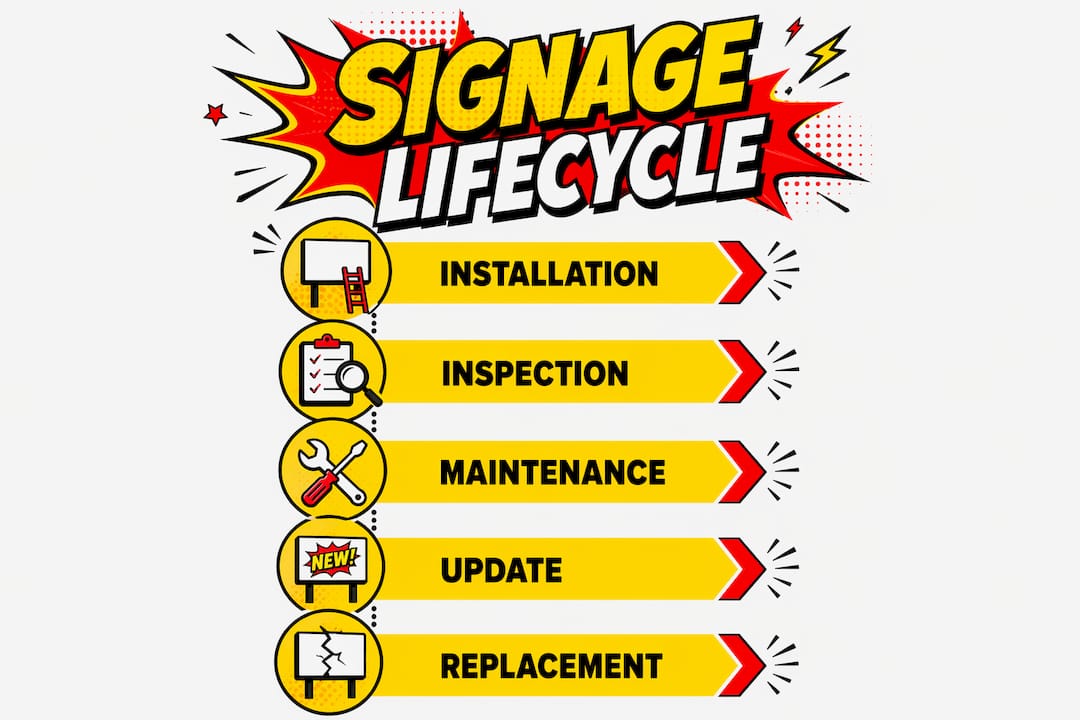
Signage lifecycle management is the practice of planning, maintaining, and renewing your signage estate in a structured way. Systematic inspection and maintenance programmes reduce emergency repairs by 50% and extend asset service life by 30–50%. Those are not marginal gains. They represent a direct reduction in unplanned capital expenditure.
A sound lifecycle programme covers four areas:
- Scheduled inspections. Illumination checks, structural integrity assessments, and surface condition reviews carried out on a fixed timetable.
- Compliance audits. Verification that signage meets current standards, including electrical safety regulations and accessibility requirements such as those set out in the Equality Act 2010.
- Condition grading. Each sign is rated on a simple scale (good, fair, poor, replace) so that budget decisions are evidence-based rather than reactive.
- Documentation. Every inspection, repair, and replacement is logged against the asset ID, creating a full service history.
Digital platforms such as Wayfindit create a single source of truth for signage assets, linking inspection records, photographs, and maintenance schedules to each sign in the register. This removes the risk of information being lost when staff change roles or leave the organisation.
| Lifecycle stage | Key activity | Outcome |
|---|---|---|
| Installation | Asset ID assignment, GIS mapping | Accurate baseline register |
| Routine maintenance | Scheduled inspections, illumination checks | Extended service life |
| Compliance review | Regulatory audit, documentation | Reduced legal and safety risk |
| End of life | Condition grading, planned replacement | Controlled capital expenditure |
Facility managers increasingly evaluate signage investment using cost per successful deployment rather than unit cost alone. This metric accounts for handling, storage, installation, and ongoing maintenance, giving a more accurate picture of total asset value.
Pro Tip: Prioritise signage by safety and visibility impact when allocating maintenance budgets. Exit signs, fire safety notices, and primary wayfinding panels should always be inspected first. Lower-priority decorative or promotional signs can follow a longer inspection cycle.
For construction environments specifically, signage compliance and safety requirements add another layer of urgency to lifecycle planning, as non-compliant signs on site carry direct regulatory consequences.
Does signage strategy affect brand consistency and property value?
Treating signage as a strategic asset rather than a line-item expense produces measurable differences in brand consistency and commercial property appeal. Quality signage reinforces brand awareness continuously without recurring costs, functioning as what practitioners describe as a silent salesperson. A well-maintained fascia sign or illuminated panel generates impressions around the clock at no additional spend.
From an accounting perspective, signage that meets the criteria for a fixed asset should be capitalised on the balance sheet and depreciated over its useful life, rather than expensed in the year of purchase. This treatment encourages proper budgeting for maintenance and replacement, because the asset appears on the register and demands attention at review time.
The comparison between treating signage as an expense versus a managed asset is clear:
| Treatment | Budget approach | Brand outcome | Maintenance behaviour |
|---|---|---|---|
| Expense | Ad hoc, reactive | Inconsistent, dated appearance | Emergency repairs only |
| Managed asset | Planned, lifecycle-based | Consistent, professional presence | Scheduled, proactive |
Businesses that measure signage impact through customer foot traffic, sales uplift, and brand recognition tracking gain the data they need to justify investment and plan renewals. Without measurement, signage decisions default to opinion rather than evidence.
Modular signage systems offer a practical middle ground between full custom installations and generic off-the-shelf products. They allow message updates without full replacement, reducing labour costs and removing dependence on specialist contractors. For commercial landlords and multi-site operators, modular systems also support brand consistency across properties without requiring identical bespoke fabrication at each site.
A well-maintained signage estate also contributes to commercial property value. Prospective tenants and buyers form first impressions from the physical environment, and exterior signage is one of the first things they assess. Faded, damaged, or inconsistent signs signal neglect and reduce perceived asset quality.
Key takeaways
Signage managed as a tracked, maintained infrastructure asset delivers measurable gains in operational efficiency, brand consistency, and lifecycle cost control.
| Point | Details |
|---|---|
| Signage as infrastructure | Treat every sign as a fixed asset with an ID, inspection schedule, and service history. |
| Asset IDs and GIS | Barcodes or QR codes combined with GIS mapping prevent redundant purchasing and support accurate audits. |
| Digital signage ROI | Digital signage can cut emergency communication time by 97% and reduce staff hours by over 60%. |
| Lifecycle management | Systematic inspection programmes reduce emergency repairs by 50% and extend service life by up to 50%. |
| Brand and property value | Maintained signage reinforces brand recognition continuously and supports commercial property appeal. |
Pikpikpow’s perspective on signage as a managed asset
The most common mistake we see is organisations treating signage as a project with a defined end point. They commission a new suite of signs, install them, and consider the job done. Three years later, half the illuminated units have failed, the modular inserts haven’t been updated, and the estate looks inconsistent. The signs are still there, but they’re no longer working.
Signage is infrastructure. It ages, it requires maintenance, and it needs to be planned for in the same way you plan for HVAC or electrical systems. The organisations that get the most from their signage investment are the ones that assign asset IDs from day one, schedule inspections before problems become visible, and budget for renewal rather than reacting to failure.
The integration of digital platforms into signage management is changing what’s possible. When every sign in your estate is linked to a digital record, you can see at a glance which units are due for inspection, which are non-compliant, and where your next capital spend should go. That level of visibility was genuinely difficult to achieve five years ago. Now it’s accessible to any organisation willing to set up the system properly.
The overlooked benefit is communication. Asset managers focus on the physical sign, but the message it carries is equally important. A sign that’s structurally sound but displaying outdated information is a liability, not an asset. Keeping content current is as much a part of lifecycle management as keeping the physical unit in good repair.
— Pikpikpow
Pikpikpow’s signage solutions for asset managers
Pikpikpow works with businesses across retail, construction, and commercial interiors to deliver signage that performs over the long term, not just at installation.
Our signage systems are designed with lifecycle management in mind, using modular formats that reduce update costs and support consistent branding across multi-site estates. For organisations moving towards digital communication, our digital signage solutions cover everything from display hardware to content management, with full support for emergency messaging and tenant communication. We also offer internal wayfinding signage for buildings where asset visibility and visitor navigation are priorities. If you want signage that functions as a managed asset rather than a one-off purchase, speak to the Pikpikpow team.
FAQ
What is the role of signage in asset management?
Signage functions as a managed infrastructure asset that supports tracking, maintenance, communication, and brand consistency across a physical estate. Assigning unique asset IDs and maintaining inspection records are the foundations of effective signage asset management.
How do asset IDs improve signage tracking?
Barcodes or QR codes applied to each sign create a unique identifier that links the physical unit to its location, condition history, and maintenance records. Without asset IDs, signage inventories rely on informal knowledge and are prone to gaps and redundant purchasing.
What are the financial benefits of digital signage?
Digital signage can deliver a return on investment in as little as eight months through staff time savings and reduced printing costs. Property managers report a 40–50% reduction in maintenance enquiries after digital sign deployment.
How often should commercial signage be inspected?
Inspection frequency depends on sign type and location, but a systematic programme covering illumination, structural condition, and compliance should run at least annually. Safety-critical signs such as exit notices and fire safety panels require more frequent checks.
Does signage affect commercial property value?
Well-maintained signage contributes positively to commercial property appeal by signalling professional management and consistent branding. Faded or damaged signs reduce perceived asset quality and can affect tenant and buyer confidence during property assessments.