

TL;DR:
- Building signage communicates a property’s identity and influences first impressions. Consistent, high-quality signage enhances brand recognition, aids navigation, and boosts operational efficiency. It offers a cost-effective, continuous marketing presence that should be strategically planned and maintained.
Building identification signage is defined as any exterior or interior sign system that communicates a property’s name, function, or ownership to visitors, staff, and the public. The role of building identification signage extends well beyond a name on a wall. It shapes first impressions, guides people through unfamiliar spaces, and reinforces brand credibility at every point of contact. Businesses that treat signage as an afterthought pay for it in lost footfall, confused visitors, and weakened brand perception. This guide explains what effective signage does, how it works across different building types, and what you need to get it right.
How does building signage influence brand perception?
Consumers form judgements about a business in under seven seconds, and exterior signage is the primary driver of that snap assessment. That figure matters because it means your fascia sign, entrance lettering, or forecourt totem is doing active selling before anyone walks through the door.
Consistent branding through signage increases brand recognition by over 20%. Recognition builds familiarity, and familiarity builds trust. A business with well-specified signage signals that it pays attention to detail in everything it does.
“Exterior signage serves as the business’s handshake on the street, conveying brand identity and inviting the intended audience.” The most effective installations combine signage, lighting, and layout as a coherent language that shapes customer expectations before they enter.
Design elements that communicate professionalism include:
- Typography: Clean, legible fonts at the correct scale for viewing distance
- Colour consistency: Brand colours matched precisely across all sign types, from fascia boards to window graphics
- Material quality: Brushed aluminium, acrylic, or powder-coated steel signal durability and care
- Illumination: Backlit or halo-lit lettering extends brand visibility into evening hours
Each of these choices sends a signal. A faded vinyl banner outside a professional services firm tells visitors the business does not invest in itself. A well-lit, architecturally integrated sign tells them the opposite.
What are the operational benefits of building identification signage?
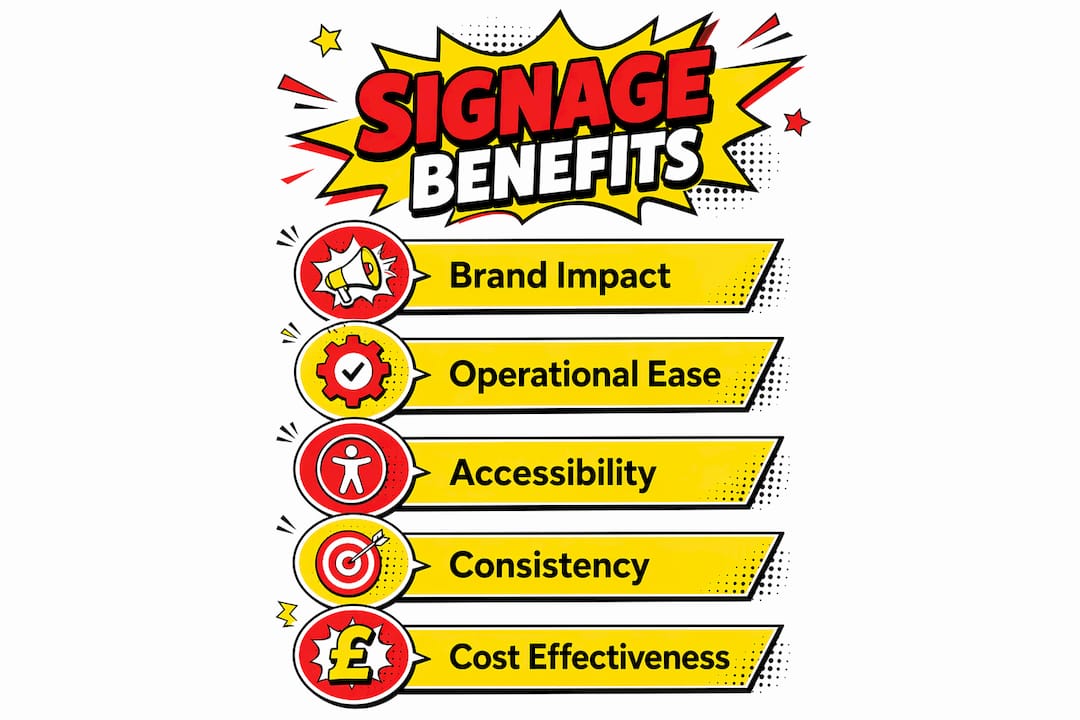
Clear wayfinding and identification signage are operational standards, not optional extras. They reduce navigation friction for visitors and employees alike, and they free reception staff from answering the same directional questions repeatedly.

The operational gains are most visible in complex environments. A hospital without clear floor identification signs creates anxiety and delays. A university campus without building name plates forces students to ask for help at every turn. An office block without directional signage in the lobby adds unnecessary friction to every client visit. Consistent signage is critical in offices, hotels, medical facilities, and educational buildings to maintain operational flow.
To get the most from your signage placement, follow these steps:
- Map the visitor journey from the street inward. Identify every decision point where a person could take a wrong turn.
- Place identification signs at eye level and at junctions. Signs mounted too high or around corners are missed.
- Use consistent naming conventions. If a floor is called “Level 2” on the directory, every sign in the building must say “Level 2,” not “Floor 2” or “2nd Floor.”
- Ensure signs are readable under all lighting conditions. Test contrast ratios in both daylight and artificial light.
- Review signage after any building reconfiguration. Outdated signs cause more confusion than no signs at all.
Pro Tip: Place a secondary identification sign at the point where visitors transition from car park to building entrance. This single addition reduces the most common navigation failure point in commercial properties.
Organisations that design signage strategically reduce the operational burden of repeated directional queries, freeing staff to focus on core tasks. That is a measurable efficiency gain, not just a comfort improvement.
What are the main types of building identification signs?
Building identification signs fall into four broad categories. Each serves a distinct purpose, and most buildings require a combination of all four.
| Sign type | Typical location | Primary function |
|---|---|---|
| Identification signs | Building exterior, entrance fascia | Display property name, number, or brand |
| Directional signs | Car parks, lobbies, corridors | Guide visitors toward a destination |
| Wayfinding signs | Stairwells, lift lobbies, floor plates | Help users orient themselves within a space |
| Informational signs | Reception areas, meeting rooms, toilets | Communicate rules, room names, or operational details |
Exterior signage and interior signage serve different audiences. Exterior signs target people approaching from the street or car park, so scale, contrast, and night-time visibility are the priority. Interior signs target people already inside, so clarity, consistency, and accessibility matter most.
Accessibility features are not optional in the UK. Signage must integrate tactile, visual, and auditory cues to support universal wayfinding. Braille room identifiers, raised lettering, and high-contrast colour combinations are standard requirements for compliant interior signage. Failing to include these at the design stage leads to costly retrofits later.
Pro Tip: Specify accessibility requirements at the briefing stage, not after manufacturing. Retrofitting tactile elements to an existing sign system typically costs significantly more than building them in from the outset.
For businesses looking at architectural signage options, the choice of material and fixing method also affects planning permission requirements, particularly for illuminated fascia signs on listed buildings or in conservation areas.
Why does signage consistency matter for brand equity?
Inconsistent signage signals operational neglect and reduces customer trust directly. Customers associate uniform colours, typography, and lighting with professionalism and reliability. When those elements vary across a building or between locations, the brand message fractures.
The practical consequences are significant:
- Mismatched colours across sign types suggest the business has no central design standard
- Different typefaces on interior and exterior signs create a disjointed visitor experience
- Worn or damaged signs left unrepaired communicate that maintenance is not a priority
- Inconsistent naming between digital directories and physical signs causes confusion and erodes confidence
Signage acts as a physical extension of a brand’s promise. Poor quality or inconsistency diminishes trust and brand equity over time. This is particularly damaging for multi-site businesses, where customers expect the same standard at every location.
Maintaining a unified signage system requires a written specification document that covers typeface, colour references (Pantone or RAL codes), approved materials, fixing methods, and sign dimensions. Without this document, every new sign becomes a judgement call, and judgement calls accumulate into inconsistency. Businesses with multiple sites benefit from working with a single supplier who holds the master specification and can replicate it accurately. Uniform signage design across locations strengthens customer trust and signals operational discipline.
For construction and development projects, branding in construction spaces requires the same discipline. Hoarding graphics, site identification boards, and temporary wayfinding must all follow the same design language as the permanent signage that will replace them.
Is building signage a cost-effective marketing investment?
Building identification signage provides continuous 24/7 brand exposure at a one-time installation cost. That is a fundamentally different economic model from digital advertising, which stops the moment the budget runs out.
Signage is regarded as one of the most cost-effective marketing investments by industry leaders. A well-specified exterior sign on a busy street generates thousands of impressions daily without any recurring cost. Over a five-year lifespan, the cost per impression is a fraction of what paid digital channels deliver.
Strategic placement amplifies this value. A business exterior that stands out with clear, well-lit signage draws attention from passing traffic and reinforces the brand for existing customers returning to the premises. Placement at road junctions, above entrances, and on boundary walls maximises the number of people who see the sign each day.
Sign design influences consumer behaviour through placement and visual hierarchy. A sign positioned at the natural sightline of an approaching pedestrian performs better than one mounted at roof level. The design hierarchy, meaning which information appears largest and most prominently, determines what visitors remember. Name first, then category, then contact detail. That order is not arbitrary. It mirrors how people process visual information when moving.
Key takeaways
Effective building identification signage combines brand consistency, clear wayfinding, accessible design, and strategic placement to deliver continuous visibility and operational efficiency at a one-time cost.
| Point | Details |
|---|---|
| First impressions are formed fast | Consumers judge a business in under seven seconds, making exterior signage your first and most important brand statement. |
| Consistency builds trust | Uniform typography, colour, and materials across all sign types signal professionalism and reinforce brand equity. |
| Wayfinding reduces operational burden | Clear directional and identification signs cut reception enquiries and navigation errors in offices, hospitals, and hotels. |
| Accessibility must be planned early | Tactile, visual, and auditory elements cost far less when specified at the design stage than when retrofitted later. |
| Signage delivers ongoing marketing value | A one-time installation provides 24/7 brand exposure with no recurring cost, unlike digital advertising. |
What we have learned from years of signage projects
At Pikpikpow, the most consistent mistake we see is businesses treating signage as the last item on a fit-out checklist. It gets specified late, budgeted too tightly, and installed in a rush. The result is a sign that does not quite match the brand guidelines, uses a slightly different shade of the corporate colour, and sits at the wrong height for the viewing distance. None of these errors are expensive to fix at the design stage. All of them are expensive to fix after installation.
The second pattern we see regularly is businesses that invest in a strong exterior sign and then neglect the interior. Visitors arrive, find the building easily, and then spend five minutes trying to locate the right floor or meeting room. That friction undoes the positive first impression the exterior sign created.
The businesses that get signage right treat it as a system, not a collection of individual items. They brief the exterior and interior together, specify accessibility requirements from the outset, and plan for maintenance from day one. They also update their signage when the brand evolves, rather than leaving outdated signs in place for years.
One practical recommendation: commission a signage audit before any refurbishment or rebrand. Walk the building as a visitor would, from the street to the final destination, and note every point where the signage fails or contradicts itself. That audit takes a few hours and saves significant cost in the specification phase.
— Pikpikpow
Professional signage solutions for your building
Pikpikpow works with businesses across retail, commercial interiors, construction, and the TV and film industry to deliver signage that performs from day one.
Whether you need a complete indoor signage system for a new office fit-out, a signage system that covers both exterior identification and interior wayfinding, or outdoor signage that maximises street-level visibility, the team at Pikpikpow handles design, manufacture, and installation under one roof. Every project starts with a clear brief and a written specification, so your signage matches your brand precisely and holds up over time. Get in touch to discuss your building’s requirements.
FAQ
What is building identification signage?
Building identification signage is any sign system that communicates a property’s name, number, or ownership to visitors and the public. It includes exterior fascia signs, entrance lettering, forecourt totems, and interior floor identification signs.
How does signage affect brand perception?
Consumers form judgements about a business in under seven seconds, with exterior signage as the primary influence. Consistent branding through signage increases brand recognition by over 20%, directly strengthening customer trust and credibility.
What types of building identification signs do I need?
Most buildings require a combination of identification signs, directional signs, wayfinding signs, and informational signs. The exact mix depends on building size, visitor volume, and accessibility requirements.
Does building signage need to meet accessibility standards?
Yes. UK signage must incorporate tactile, visual, and high-contrast elements to support all users. Specifying these requirements at the design stage avoids costly retrofits and ensures compliance from the outset.
Is building signage worth the investment compared to digital advertising?
Building signage provides continuous 24/7 brand exposure at a one-time installation cost, with no recurring fees. Industry leaders regard it as one of the most cost-effective marketing investments available to a business.