

TL;DR:
- Effective signage influences first impressions and significantly boosts tenant attraction and retention. Digital signage enhances communication, reduces inquiries, and fosters tenant satisfaction within commercial properties. Well-designed, adaptable signage systems provide operational benefits and support long-term building management success.
First impressions in commercial property are formed faster than most landlords realise. The role of signage in tenant attraction is consistently underestimated, yet the evidence is hard to ignore. 76% of consumers entered a business they had never visited before because of its signage. That same principle applies directly to commercial properties. Potential tenants, and their clients, judge a building before they step through the door. If your signage is unclear, tired, or absent, you are already losing ground before a single conversation begins.
Table of Contents
- How signage grabs attention and drives tenant interest
- Digital signage: enhancing tenant communication and retention
- Design strategies for effective commercial signage and wayfinding
- Measuring signage effectiveness: operational and tenant benefits
- Real-world impact: signage and branding boost tenant retention
- A fresh view on signage: more than just decoration
- Explore signage solutions to attract and retain tenants
- Frequently asked questions
How signage grabs attention and drives tenant interest
Exterior signage is the first communication a prospective tenant has with your property. Before any brochure, virtual tour, or agent introduction, the physical building makes its case. A well-executed fascia sign, a clear building identity board, or a well-lit entrance display tells a prospect that the property is professionally managed and worth their attention.
The data supports this directly. 68% of consumers purchased a product because a sign caught their eye. In a leasing context, that impulse translates into enquiries, viewings, and signed agreements. Signage effectiveness in leasing is not theoretical. It is a measurable driver of interest.
Beyond the exterior, internal and wayfinding signage plays an equally important role during viewings. When a prospective tenant visits your building with a letting agent, confusing corridors and unmarked floors create friction. That friction becomes associated with the property itself, not the visit.
Here is what effective signage achieves at the attraction stage:
- Clear external identity: Illuminated building names, directional boards from car parks, and entrance signage establish credibility immediately.
- Effortless navigation: Consistent floor directories, lift lobby signs, and suite numbering guide visitors without needing staff assistance.
- Cohesive visual presentation: Matching fonts, colour palettes, and materials across all signage communicate that the property is well managed.
- Reduced friction at reception: Clear signage to reception desks and meeting rooms reduces visitor confusion and makes the first experience smooth.
“The importance of signage for landlords cannot be overstated. A property that communicates clearly through its signage signals competence, care, and professionalism to every person who walks through the door.”
Understanding why signage matters for developers goes beyond aesthetics. It is about creating an environment where tenants feel confident bringing their own clients. That confidence is a genuine leasing advantage.
Digital signage: enhancing tenant communication and retention
Physical signage attracts tenants. Digital signage keeps them. Once a tenant is in your building, their day-to-day experience of how information reaches them directly affects whether they renew their lease.
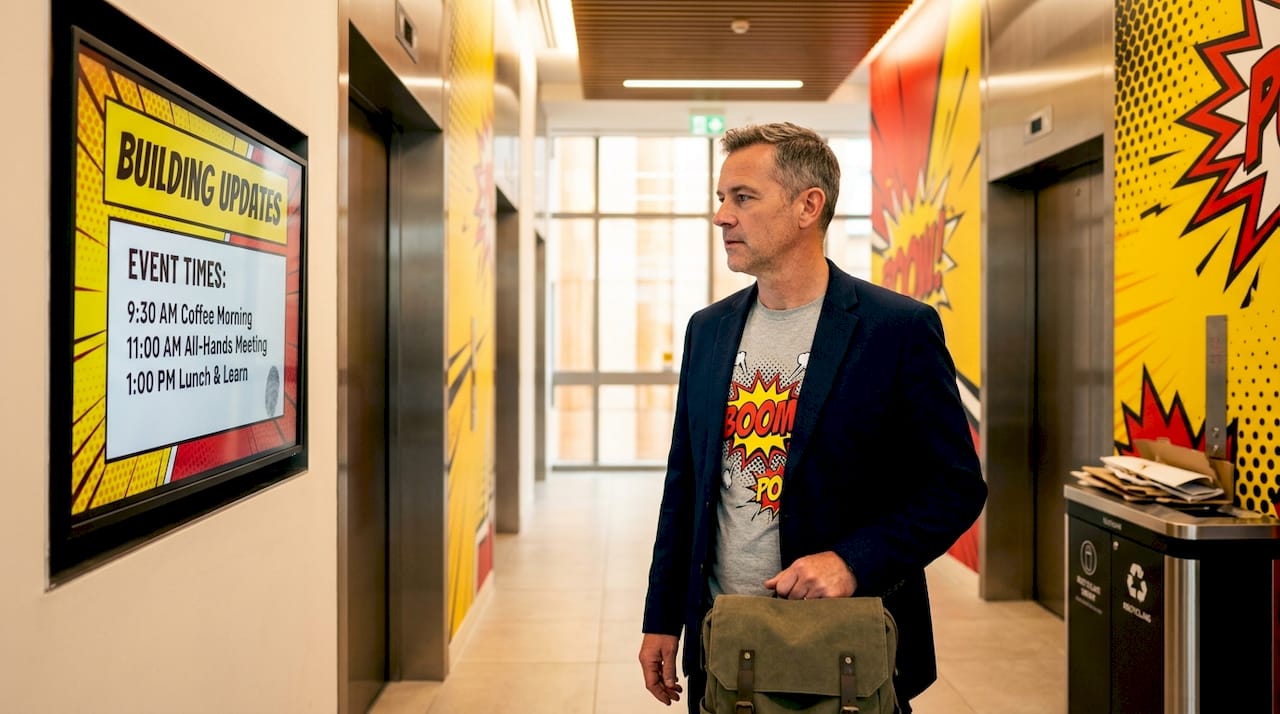
The results from deploying digital signage solutions in commercial properties are significant. A property management case study from Skyline Properties recorded a 40% reduction in email enquiries after installing lobby and lift digital screens. Tenant awareness of important notices jumped from 23% to 89% within 24 months. That is a transformation in how a building communicates.
| Communication method | Tenant awareness (before) | Tenant awareness (after) | Enquiry reduction |
|---|---|---|---|
| Email only | 23% | n/a | n/a |
| Email + digital signage | 23% | 89% | 40% |
Lobby and lift screens work because they reach tenants and their visitors during natural pause points in the day. A notice about a planned maintenance closure, a fire drill reminder, or a new on-site amenity gets seen because the screen is simply there, in the space, at the right moment. Email gets ignored. Screens get noticed.
The benefits of digital signage extend beyond communication. When tenants feel well-informed, their overall satisfaction with the property rises. Fewer surprises, fewer complaints, fewer reasons to look elsewhere at renewal time.
Pro Tip: Prioritise lift lobby placement for digital screens. Tenants spend an average of 30 to 60 seconds waiting for lifts multiple times a day. That is your most reliable captive audience in the entire building.
Design strategies for effective commercial signage and wayfinding
Good signage design is not about what looks impressive in a mood board. It is about what works reliably for every visitor, including those who are unfamiliar with the building, those with visual impairments, and those who are in a hurry.
Commercial interior signage design follows a layered hierarchy that most property managers do not think about deliberately, but every visitor feels instinctively.
The three tiers work as follows:
- Primary signage: Building name, main entrance identification, and car park directionals. These orient people before they are inside.
- Secondary signage: Floor directories, lift lobby identifiers, and corridor directionals. These guide people through the building efficiently.
- Tertiary signage: Suite numbers, room names, toilet signs, and emergency exit markers. These confirm arrival and handle everyday navigation needs.
W3C guidance on supported wayfinding makes clear that effective signage uses consistent visual hierarchy, redundancy (meaning the same information delivered in multiple formats), and clear landmarks. In practice, that means combining text labels with pictograms, using arrows that follow a consistent logic, and ensuring contrast ratios meet accessibility standards.
Accessible signage is not optional in the UK. The Equality Act 2010 places duties on building managers to ensure reasonable adjustments for disabled visitors. Tactile lettering, Braille panels, and high-contrast colour schemes are part of any responsible signage specification.
Key design principles for commercial wayfinding:
- Use a single typeface family across all signage for visual consistency.
- Maintain a minimum letter height of 15mm for signs read at close range, and 50mm for corridor signs read at distance.
- Apply pictograms alongside text to support visitors whose first language is not English.
- Ensure all directional arrows point in the direction of travel, not the direction of the destination (a common error that causes confusion).
Pro Tip: When specifying architectural signage for a new fit-out, plan for updates from the start. Use modular sign frames that accept new inserts without requiring full panel replacement. Tenants come and go, and your suite numbering and directory boards need to reflect current occupancy without expensive rework.
Measuring signage effectiveness: operational and tenant benefits
Signage investment is easier to justify when you treat it as an operational system with measurable outputs, not a one-off aesthetic decision. Property managers who track the right metrics find that good signage reduces workload and improves tenant satisfaction at the same time.
Here is a practical approach to measuring the impact of your signage:
- Baseline your current position. Before upgrading, record how many enquiries your reception or management team receives each week about directions, building amenities, and notice deadlines.
- Install or update signage with clear objectives. Define what the signage should achieve: reduce direction queries, increase awareness of notice boards, improve visitor navigation times.
- Measure again after 90 days. Track changes in enquiry volume, tenant satisfaction scores from any existing surveys, and staff time spent answering navigation or communication questions.
- Use tenant feedback actively. Ask tenants directly whether they and their clients find the building easy to navigate. Their answers highlight gaps your own observation may miss.
The signage system at Skyline Properties demonstrated exactly this approach. After installing digital screens, enquiry volume dropped 40% and tenant awareness rose from 23% to 89%. Those are not vanity metrics. They represent real reductions in management overhead.
| KPI | Before signage upgrade | After signage upgrade |
|---|---|---|
| Weekly direction enquiries | High | Significantly reduced |
| Tenant notice awareness | 23% | 89% |
| Email enquiries to management | Baseline | Reduced by 40% |
| Staff time on navigation queries | Significant | Minimal |
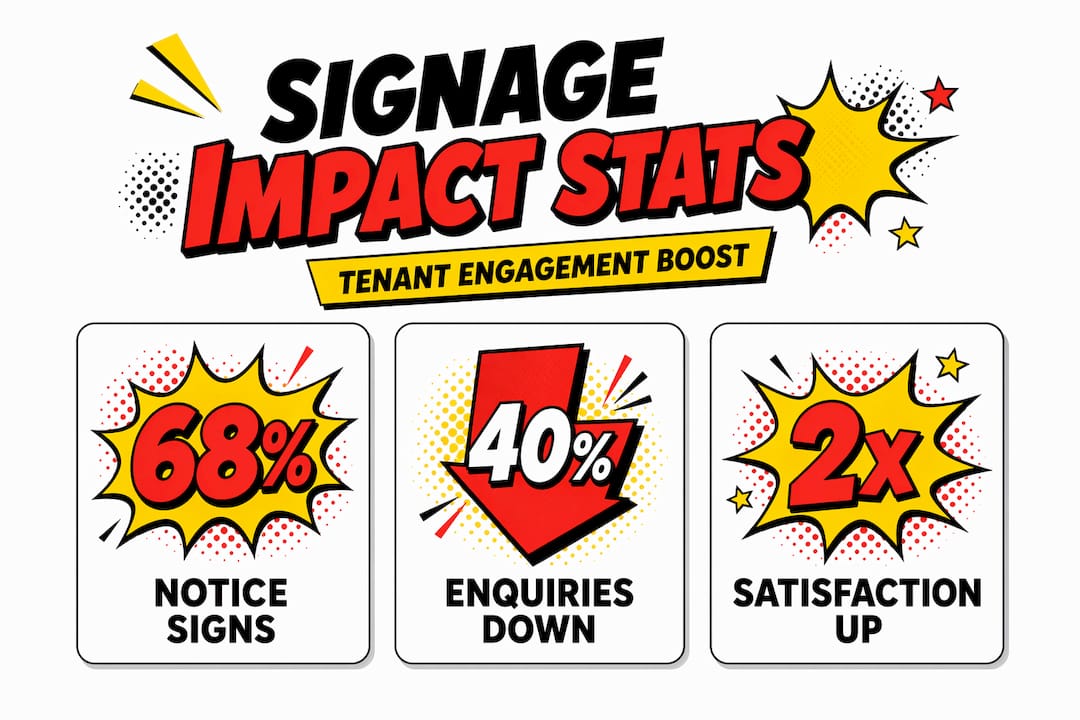
Framing signage as an operational investment, rather than a capital expense, also makes budget conversations with stakeholders considerably more straightforward.
Real-world impact: signage and branding boost tenant retention
The signs that draw in tenants at the attraction stage must be maintained and built upon throughout the tenancy if you want to retain them. Retention is where signage pays its most significant return.
A well-documented case study from a commercial condominium property in Orange County found that after a planned signage and branding upgrade, retention rose to 92% within 18 months. The reasons tenants gave for renewing were revealing: they cited the property’s professional appearance and the ease with which their clients could navigate the building.
“Tenants want to feel proud of their business address. A building that looks sharp, communicates clearly, and helps their clients find them without confusion is a building worth staying in.”
The role of branding in tenant attraction extends well beyond the initial lease decision. When a property has coherent, well-maintained signage throughout, tenants experience that quality every day. Their clients experience it too. That reflection on the tenant’s own business matters to them.
Practical retention benefits of strong signage include:
- Client confidence: Tenants whose clients can navigate the building easily are less likely to be embarrassed by poor wayfinding, which removes a genuine friction point in the renewal decision.
- Professional appearance: Well-maintained signage signals that the landlord is attentive and the property is well-managed, which builds trust over the course of a lease.
- Curb appeal for referrals: A visually strong property generates word-of-mouth interest from other businesses, giving landlords a pipeline of prospective tenants without additional marketing spend.
- Justification for rent reviews: Properties with strong visual communication in property marketing and on-site presentation can support higher rents at review, because the quality is demonstrably visible.
Strong signage and property branding are not simply about looking good. They are about creating an environment where tenants feel the landlord has invested in their success, not just the building’s structure.
A fresh view on signage: more than just decoration
Most conversations about signage in commercial property stop at “it should look professional.” That is a good start, but it misses the deeper operational function that signage performs when it is planned properly.
Here is a perspective that rarely gets aired: signage is a communication infrastructure. It is no different in principle from your building’s broadband or intercom system. When it works, nobody notices. When it fails, everyone feels it. A broken intercom creates complaints. Outdated signage creates visitor frustration and tenant churn in exactly the same way, but it is rarely diagnosed as the cause.
The most common mistake we see in commercial properties is signage that was designed for a specific tenant mix and never updated. A directory board that still lists a business that left three years ago tells every visitor that the building is not being actively managed. That is a powerful and entirely avoidable message.
Redundancy in wayfinding design is another underused principle. Redundancy means delivering the same navigational information in multiple ways: a floor directory at the lift, directional arrows in the corridor, and a room number on the door. Each layer supports the others. If a visitor misses the directory, the corridor arrow catches them. If they miss the arrow, the door number confirms arrival. Stress-free navigation is not an accident. It is a design outcome.
The third point that property managers consistently overlook is the updateability of their signage. Static, built-in sign panels look premium on installation day. Three years later, when tenants have moved around and the directory is covered in sticky labels, they look neglected. Specifying flexible wayfinding signage with modular inserts from the outset costs marginally more upfront and saves significantly on maintenance and replacement costs over the life of the lease.
Treat your signage as a system that needs to be maintained, updated, and measured, and it will return far more than its initial cost.
Explore signage solutions to attract and retain tenants
If the principles in this article have prompted you to reassess your property’s signage, the practical next step is straightforward. At Pik Pik POW!, we work with commercial property managers and developers across the UK to design and deliver signage that performs.
Whether you need a complete commercial signage system for a multi-tenanted office building, digital signage options to improve tenant communication in lobbies and lift areas, or internal wayfinding signage that guides every visitor confidently through your property, we can help. Our team handles design, manufacture, and installation, so you get a consistent result without managing multiple suppliers. Get in touch to discuss your property’s requirements and find out how the right signage can support your leasing and retention goals.
Frequently asked questions
How does signage influence tenant attraction in commercial properties?
Signage increases property visibility and helps potential tenants and their clients navigate easily, creating a positive first impression that encourages enquiries and lease interest. 76% of consumers entered a business they had never visited before based on its signage alone.
What are the benefits of digital signage for tenant communication?
Digital signage in lobbies and lifts improves notice awareness, reduces email overload, and increases tenant engagement with building communications. One case study recorded a 40% reduction in enquiries and a rise in tenant awareness from 23% to 89%.
What design features make signage effective for wayfinding?
Effective signage uses consistent visual hierarchy, multiple cues such as text alongside pictograms, strong contrast for readability, and accessible wayfinding features including tactile elements and Braille where required.
How can property managers measure the impact of signage upgrades?
Track operational KPIs such as tenant enquiry volume, staff time spent answering navigation questions, and tenant awareness of notices before and after any upgrade. A 40% enquiry reduction and an awareness increase from 23% to 89% are realistic benchmarks from documented case studies.
Can improved signage affect tenant retention rates?
Yes. Case studies show that cohesive, professional signage and branding can raise retention to 92% within 18 months, with tenants citing professional appearance and easier client navigation as key reasons for renewal.