

TL;DR:
- Effective signage in schools can shape learner identity, motivate participation, and enhance the overall learning environment. Signs that promote curiosity and interaction have a greater positive impact than those focused solely on rules or restrictions. Regular evaluation and student involvement in signage design are essential for fostering engagement and supporting a vibrant school culture.
Most educators think of signage as a practical afterthought. Put up a few notices, label the rooms, add a fire exit arrow, and that’s the job done. Research tells a very different story. The impact of signage on learning goes well beyond wayfinding. The messages, tone, and design of signs in your school or university actively shape how students see themselves as learners, how motivated they feel, and whether your physical environment supports or quietly undermines the culture you’re trying to build. Here’s what the evidence says, and what you can do about it.
Table of Contents
- Key takeaways
- How signage currently impacts learning environments
- Signage as a tool for active engagement
- Designing interpretive signage that actually works
- Environmental factors and the role of signage
- Implementing effective signage in your school
- Our perspective on signage and learning culture
- How Pikpikpow can help your school
- FAQ
Key takeaways
| Point | Details |
|---|---|
| Signage tone shapes identity | Rule-heavy signs frame students as problems to manage rather than active learners, reducing motivation. |
| Active use beats passive display | Students gain more from producing or interacting with signage than from simply reading it. |
| Measure signage effectiveness | Use attention and engagement metrics to evaluate signs and revise them iteratively. |
| Environment matters collectively | Signage works best as part of a broader, well-designed physical learning environment. |
| Co-design improves outcomes | Involving students and staff in signage content leads to more relevant, motivating messages. |
How signage currently impacts learning environments
Walk through most schools or universities and you’ll notice a pattern. Signs tell people what not to do. “No food or drink.” “Mobile phones must be switched off.” “This equipment is for staff use only.” These messages are understandable from a facilities management perspective, but research suggests they carry a cost that most institutions haven’t considered.
A report covered by Times Higher Education found that many university classroom signs are generic and restriction-focused, prioritising rules and technology policies over anything connected to learning. What’s more striking is the framing these signs create. They position both students and teachers as potential disruptions to be managed, rather than as participants in a shared educational process.
The same research found that signs shape learner identity, either encouraging a compliance mindset or an exploratory one. Signs that focus on problems and restrictions invoke a transactional, compliance-based atmosphere. Signs oriented around learning, curiosity, and participation do the opposite. They invite engagement, reflection, and a sense that the space belongs to those who learn in it.
This matters more than it sounds. The signage effects on education aren’t abstract. When a student walks into a room and the first thing they read is a list of prohibitions, that sets a psychological tone before a single lesson has started.
Here are the characteristics that distinguish unhelpful signage from genuinely educational signage:
- Restrictive signage focuses on what cannot be done, who is responsible for equipment, and how behaviour should be controlled
- Neutral informational signage covers room numbers, timetables, and directions without any learning-oriented framing
- Motivational signage connects the space to its purpose, celebrates learning, and invites students to participate actively
- Interactive signage prompts students to think, respond, or produce something in relation to the content displayed
Pro Tip: Review your current classroom and corridor signage from a student’s perspective. If the majority of messages are about rules or restrictions, you have a straightforward opportunity to shift the tone without a significant budget.
Signage as a tool for active engagement
One of the most practically relevant findings in recent research concerns the difference between signage that students passively read and signage that prompts them to do something. The distinction is significant, and the evidence is clear.
A 2026 study published in npj Science of Learning examined how different types of signs affected learning outcomes in STEM subjects taught in American Sign Language. The researchers compared two approaches. English-motivated signs used existing written language to label concepts. Concept-motivated signs were built around the underlying idea itself, designed to reflect the cognitive structure of the concept rather than just its name.
The findings were direct: concept-motivated sign production by learners predicted higher scores on post-tests. Students who actively produced signs connected to core concepts showed greater learning gains than those who passively engaged with pre-made labels. This is a meaningful result for anyone designing educational signage, because it shifts the question from “what should we display?” to “what should we invite students to create or respond to?”

This aligns with a broader principle in educational psychology. Learners who are prompted to produce concept-relevant outputs retain and apply knowledge more effectively than those who receive information passively. Signage, when designed well, can function as one of these prompts.
The practical implications are worth spelling out clearly:
- Replace static definition boards with prompt-style signs that ask students to recall, explain, or connect ideas
- Display partially completed concept frameworks that invite students to fill in missing elements
- Use corridor or common area signage to pose open questions linked to current topics across year groups
- Rotate content regularly so students engage with it afresh rather than habituating to fixed displays
Pro Tip: Treat classroom signage as a thinking prompt rather than a reference document. A sign that asks “What would happen if…?” does more cognitive work than one that states a definition.
Designing interpretive signage that actually works
Understanding that signage matters is only the start. The harder question is how to design and evaluate signs so they genuinely improve engagement rather than just occupying wall space.
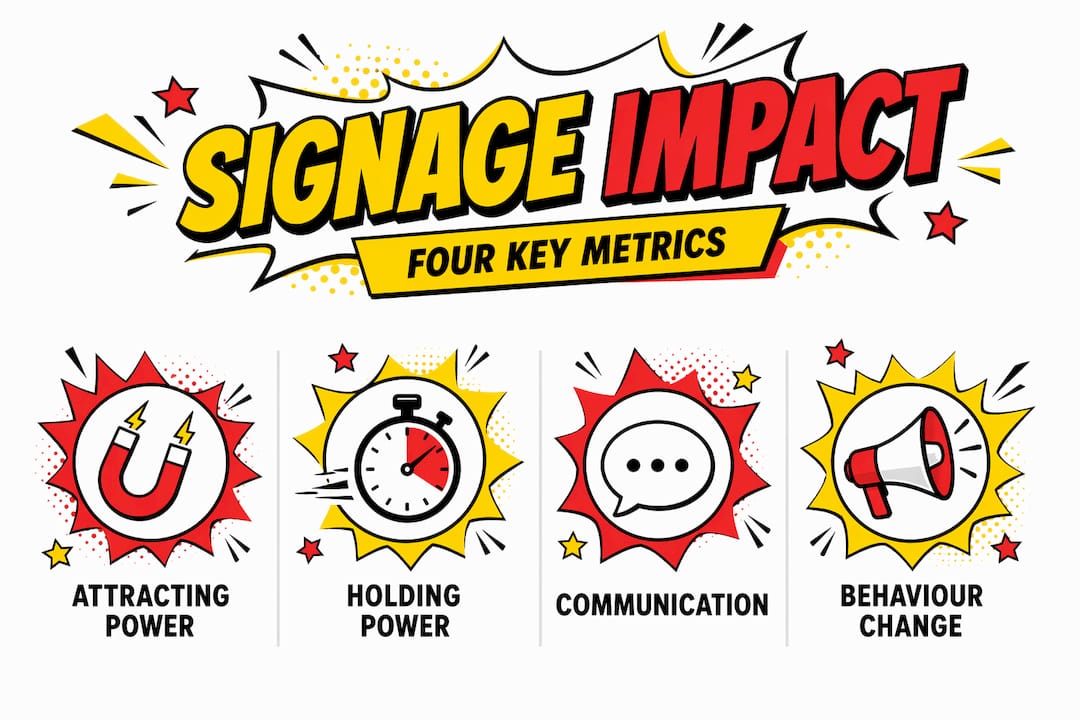
Research published by the University of Florida’s IFAS extension provides a practical framework drawn from interpretive signage in educational demonstration gardens, a context that transfers well to school environments. The key principles centre on four qualities that effective educational signage must have.
- Attracting power refers to whether a sign successfully draws a person’s attention in the first place. Colour contrast, size, positioning, and an arresting opening message all contribute. A sign that nobody looks at achieves nothing.
- Holding power refers to whether, once attention is captured, the sign maintains interest long enough for the content to be absorbed. Concise writing, a clear visual hierarchy, and a single focused message perform better than dense text.
- Communication power measures whether the intended message was understood and retained by the viewer. This can be tested through brief conversations or simple follow-up questions.
- Collateral behaviour tracks whether the sign prompted a behaviour change, whether that’s a student stopping to read further, attempting a task, or discussing the content with a peer.
These four metrics give you a structured way to evaluate signage effectiveness rather than relying on assumptions. The research also makes it clear that the best practice involves iteration. Pilot a sign, observe how students interact with it, collect feedback, and revise.
| Metric | What it measures | How to assess it |
|---|---|---|
| Attracting power | Whether the sign gets noticed | Observe how many students stop or look |
| Holding power | Whether students stay engaged | Track average reading or dwell time |
| Communication power | Whether the message was understood | Brief verbal or written follow-up questions |
| Collateral behaviour | Whether behaviour changed | Note actions taken after viewing the sign |
Storytelling and thematic coherence are also worth prioritising. Signs that connect to a broader narrative, a school value, a subject theme, or a shared goal, hold attention more effectively than isolated facts or instructions. Interpretive signage design that builds across a corridor or learning space creates an environment with genuine character.
Environmental factors and the role of signage
Signage doesn’t operate in isolation. A 2026 study published in Scientific Reports used AI-powered behavioural tracking to examine how indoor environmental quality affects student behaviour and engagement. The research found that air quality, temperature, and lighting all influence learning-related behaviours in measurable ways.
This matters for how you think about signage. Signage is one element within a broader physical environment, and its impact depends partly on what surrounds it. Well-designed motivational signage in a poorly lit, poorly ventilated room will have a limited effect because the broader environment is working against engagement. Conversely, strong environmental conditions combined with thoughtful signage create a genuinely supportive learning atmosphere.
The table below shows how several environmental factors interact with signage to support or hinder learning:
| Environmental factor | Effect on learning | How signage contributes |
|---|---|---|
| Lighting quality | Affects readability and alertness | Ensures signs are visible and properly positioned |
| Air and temperature | Influences concentration and comfort | Can be supported by clear guidance signage on ventilation procedures |
| Room layout | Shapes interaction and movement | Wayfinding and zoning signage helps students navigate purposefully |
| Wall surfaces and colour | Sets emotional tone of the space | Motivational and thematic signage reinforces positive atmosphere |
When planning signage improvements, think about the full context. Consider how to integrate signage with wider environmental improvements rather than treating it as a standalone project. The cumulative effect of multiple well-managed environmental factors is significantly greater than any single intervention alone.
Implementing effective signage in your school
Knowing the evidence is one thing. Putting it into practice requires a structured approach. Here is a clear process for reviewing and improving signage across your school or campus.
- Audit your current signage by walking through spaces and categorising each sign by its primary purpose: restriction, information, motivation, or interaction. Count how many fall into each category.
- Identify gaps and imbalances where you have too many rule-based signs and too few that connect students to learning goals or invite cognitive engagement.
- Co-design with staff and students to develop content that reflects genuine learning priorities. Students are more likely to engage with signs they feel they have shaped. This also surfaces insights about which messages resonate.
- Apply legibility and placement standards so that every sign is readable from the intended viewing distance, positioned at eye level for the relevant age group, and not competing with visual noise nearby.
- Prioritise a single message per sign. Signs that try to communicate multiple ideas at once lose readers quickly. Design each sign around one core cognitive idea relevant to the learning context.
- Use school signage guidance to inform how you plan wayfinding, safety, and motivational signage across different zones of your building.
Pro Tip: Pilot any new signage in a single room or corridor before rolling it out across the school. Gather informal feedback from students and staff after two to three weeks, then refine content and design before scaling up.
The role of signage in learning is most effective when it’s treated as a living part of the school environment rather than a fixed installation. Regular review and updates keep signage relevant and prevent habituation, where students stop noticing displays they’ve seen hundreds of times.
Our perspective on signage and learning culture
Working with schools on signage projects, I’ve noticed a consistent pattern. Administrators often come to us focused entirely on wayfinding: where do the room number plaques go, which corridors need directional arrows, how do we label the staff rooms. Those are legitimate questions. But what rarely gets asked is what the signs say about this school’s relationship with its students.
I’ve seen corridors plastered with behaviour reminders and policy notices that, taken together, read less like a school and more like a waiting room. That environment has a tone, even if nobody intended it. Students pick it up. Teachers feel it too.
What I’ve learned is that the most effective educational signage strategies treat the physical environment as an active participant in the learning culture. The schools that get this right don’t just hang motivational posters. They design signage that connects to what is actually being taught, that invites students to think or respond, and that gets refreshed when it stops being relevant.
One shift that makes a consistent difference is moving from installation thinking to iteration thinking. A sign is not a permanent fixture to be designed once and forgotten. It’s a communication channel that should be evaluated, updated, and improved just like any other part of your teaching practice. The evidence on measuring engagement metrics backs this up clearly. The schools that treat signage as a strategic communication tool rather than a facilities task are the ones that get real results from it.
— PikPikPOW!
How Pikpikpow can help your school
If you’re ready to put this evidence to work, Pikpikpow designs and manufactures signage built for educational environments. From modular signage systems that make it easy to update content across your campus, to digital signage solutions that allow you to rotate motivational and learning-focused messages in real time, we work with schools to create environments that genuinely support student engagement.
Our internal wayfinding signage helps students navigate spaces with confidence, while our design team can help you develop content that reflects your school’s values and learning goals. Whether you’re updating a single classroom or rethinking signage across a whole campus, we make the process straightforward.
FAQ
Does classroom signage really affect student motivation?
Yes. Research shows that restrictive versus learning-oriented signs directly influence how students perceive their role in a learning environment, with compliance-focused signage reducing motivation and exploration.
What type of signage improves learning outcomes most?
Signage that prompts learners to actively produce or respond to concepts produces stronger learning gains than passive informational displays, according to a 2026 npj Science of Learning study.
How do you measure whether educational signage is working?
Use four metrics: attracting power, holding power, communication power, and collateral behaviour. These interpretive signage metrics help you observe and quantify real engagement, allowing you to revise signage based on evidence.
How often should school signage be updated?
Signage should be reviewed regularly and updated whenever content becomes habituated or stops reflecting current learning priorities. Best practice involves piloting and iterating rather than treating signage as a permanent installation.
Where should motivational signage be placed in a school?
Focus on high-traffic transition areas such as corridors, entrance halls, and common rooms where students have brief moments of attention. Placement at eye level with strong visual contrast and a single clear message maximises the educational signage benefits in these spaces.