
TL;DR:
- Well-designed signage significantly enhances member navigation, perception of brand, and overall satisfaction.
- Investing in digital and physical signage early, at decision points, and maintaining content updates delivers measurable operational and retention benefits.
Signage’s impact on member experience is defined by how well-designed signs influence a person’s ability to navigate a space, form a perception of your brand, and leave feeling satisfied. This is not a soft, aesthetic concern. It is a measurable operational variable. Across healthcare, fitness, and transport sectors, facilities that invested in structured visual communication systems saw retention rates climb, satisfaction scores rise, and operational burdens fall. The discipline covering this is broadly known as environmental graphic design, and it encompasses wayfinding, digital displays, accessibility signage, and brand-integrated messaging. If you manage a facility and have not yet treated signage as a performance metric, the evidence below will change that view.
What measurable benefits does signage provide for member experience?
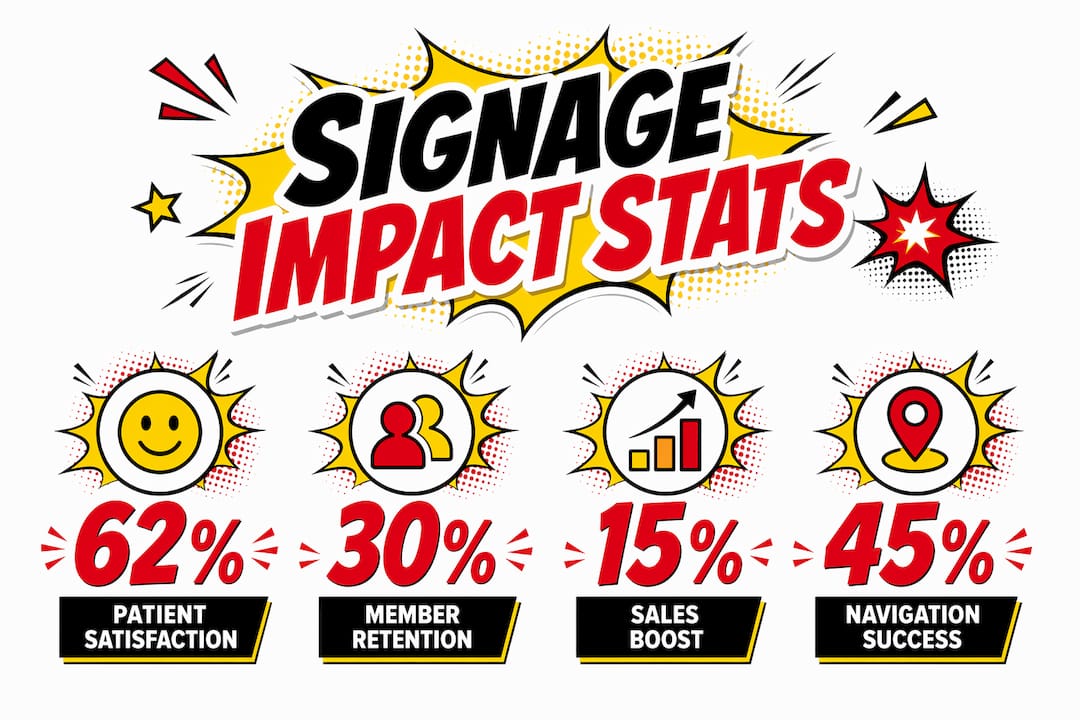
The numbers from recent case studies are specific enough to make a business case without any further argument. A regional medical centre deployed digital wayfinding signage and saw navigation stress drop from a score of 7.2 to 4.5, with patient satisfaction climbing from the 62nd to the 84th percentile. That is a 22-percentile-point gain driven almost entirely by clearer signage. For any NHS trust or private hospital group measuring HCAHPS-equivalent scores, that kind of shift represents a significant competitive and reputational advantage.
The fitness sector tells a similar story. Peak Performance Gyms rolled out a digital signage programme across their estate and recorded a 30% increase in member retention within twelve months. Their Net Promoter Score moved from 34 to 61, and the proportion of members describing the gym as feeling “like a community” rose by 78%. Those are not branding metrics in isolation. They reflect how members experience the physical space every time they walk through the door.
Transport environments show the same pattern at scale. A regional international airport introduced digital signage across its terminals and reduced missed connections by 34%, while passenger satisfaction improved by 31 points. Gate-change notifications that previously took 8 to 12 minutes to reach passengers were delivered in under 30 seconds after implementation. Directional enquiries to staff halved, freeing up operational resource.
“Signage at key transition points, such as arrivals, security checkpoints, and corridor junctions, reduces uncertainty and directly improves operational efficiency.” — Regional International Airport case study
Retail data reinforces the pattern further. According to MarketsandMarkets analysis, retail digital signage boosts sales by 29 to 33% and customer satisfaction by over 45% when implemented effectively. Repeat buyer activity also increased by approximately 30% post-implementation. These figures confirm that signage is not a cost centre. It is a revenue and retention driver.
| Sector | Key metric improvement | Source |
|---|---|---|
| Healthcare | Patient satisfaction: 62nd to 84th percentile | Regional medical centre case study |
| Fitness | Member retention up 30%; NPS from 34 to 61 | Peak Performance Gyms case study |
| Airport | Missed connections down 34%; satisfaction up 31 points | Regional International Airport case study |
| Retail | Sales up 29–33%; customer satisfaction up 45%+ | MarketsandMarkets analysis |
How does signage design influence attention and navigation success?
Good signage does not just present information. It competes for attention in a visually busy environment, and it either wins that competition or it does not. Eye-tracking research conducted at Lowe’s by Neurons Inc. found that shoppers found aisles 40% faster when navigation signage was optimised for visual salience. Signs designed with high contrast, clear hierarchy, and correct spatial positioning captured gaze more reliably and reduced the time members spent searching.

The same research revealed a counter-intuitive problem. When a promotional campaign sign was placed directly below a navigation sign, eye-tracking showed that shoppers’ attention was captured by the campaign material first, causing them to miss the wayfinding information entirely. The navigation sign was present and technically correct. It simply lost the attention competition. This is a critical lesson for facility managers who layer promotional content on top of directional signage without considering the visual hierarchy.
Spatial positioning matters as much as design quality. Signs placed at decision points, where a person must choose a direction, perform significantly better than signs placed mid-route. The best placement for wayfinding signs is at junctions, entrances, and transition zones, not in the middle of a corridor where the decision has already been made.
Pro Tip: Before commissioning new signage, walk your facility as a first-time visitor and note every point where you feel uncertain about direction. Those are your priority locations. Signage placed anywhere else is secondary.
Key design principles that consistently improve navigation outcomes include:
- High contrast ratios between text and background, particularly for accessibility compliance
- Consistent typographic hierarchy so members know at a glance whether they are reading a primary destination or a secondary instruction
- Uncluttered sign faces with no more than three pieces of information per sign
- Correct mounting height, typically between 1.5 and 1.8 metres for eye-level reading in most adult populations
- Directional arrows that are unambiguous, pointing clearly rather than gesturing vaguely
What signage strategies improve member engagement and brand perception?
Improving member experience with effective signage requires more than pointing people in the right direction. The most successful facilities use signage as a layered communication system that serves navigation, community building, and operational efficiency simultaneously.
Deploy digital signage for dynamic content. Static printed signs cannot update in real time. Digital displays allow you to show live class schedules, event announcements, safety alerts, and member recognition content without reprinting anything. The digital signage solutions available today range from single-screen lobby displays to networked systems covering entire multi-floor facilities.
Combine wayfinding with accessibility adaptations. Healthcare wayfinding is most effective when it incorporates multi-language support, large text, and turn-by-turn visuals, alongside real-time rerouting for areas under maintenance or temporary closure. The same principle applies to gyms, co-working spaces, and leisure centres serving diverse member bases.
Use signage to build community identity. Peak Performance Gyms placed member stories, achievement boards, and motivational content throughout their facilities. The 78% rise in members describing the space as feeling like a community was not accidental. It was the direct result of signage that reflected members back to themselves. This is one of the most underused strategies in facility management.
Reduce operational burden through self-service information. When signage answers the questions members would otherwise ask staff, your team spends less time on directions and more time on service. The airport case study showed directional enquiries to staff halved after digital signage was installed. In a gym, leisure centre, or co-working space, that translates directly into staff capacity and member satisfaction.
Integrate signage into your brand identity from the outset. Signage that looks like an afterthought communicates exactly that. Commercial interior signage that aligns with your colour palette, typeface, and tone of voice reinforces brand trust at every touchpoint inside the facility.
What are the common pitfalls in signage implementation?
Most signage failures are not caused by poor design in isolation. They are caused by poor planning, lack of measurement, and the gradual accumulation of visual clutter that undermines even well-designed systems.
Promotional materials competing with navigation signs. As the Lowe’s eye-tracking study demonstrated, attention diverted by campaign signs directly reduces wayfinding effectiveness. Every time you add a promotional poster near a directional sign, you are running a visual competition that your navigation system may lose.
Outdated printed content. A sign showing a service that no longer exists, or a room that has been repurposed, actively damages trust. Members notice inconsistencies, and those inconsistencies signal poor management. Digital signage removes this problem entirely by allowing content to be updated centrally.
No measurement framework. Facilities that install signage and never evaluate its performance are guessing. Validating signage impact through eye-tracking, member surveys, or behavioural observation is the only way to know whether your investment is working. Even a simple quarterly audit of member feedback mentioning navigation or confusion is a start.
Ignoring accessibility requirements. Signage that works for the majority and fails for members with visual impairments, language barriers, or cognitive differences is incomplete. The hybrid signage systems combining physical and digital components have shown particular effectiveness in healthcare environments by reducing stress for diverse user groups.
Pro Tip: Conduct a signage audit every six months. Remove any sign that has not been reviewed in the past year and assess whether it still serves its original purpose. Clutter is the enemy of clarity.
Key takeaways
Effective signage directly determines how confidently members navigate, how positively they perceive your brand, and how likely they are to return.
| Point | Details |
|---|---|
| Signage drives measurable retention | Peak Performance Gyms recorded 30% higher member retention after deploying a structured digital signage programme. |
| Placement at decision points is critical | Signs positioned at junctions and entrances outperform mid-route signs because they reach members at the moment of choice. |
| Visual competition undermines wayfinding | Promotional signs placed near navigation signs divert attention and reduce wayfinding effectiveness, as confirmed by eye-tracking research. |
| Digital signage removes content decay | Real-time updates prevent outdated information from eroding member trust and reduce the operational cost of reprinting. |
| Accessibility adaptations serve all members | Multi-language support, large text, and real-time rerouting improve outcomes for diverse member populations across all facility types. |
Signage as a facility management discipline, not a design afterthought
At Pikpikpow, we have worked with enough facility managers to recognise a consistent pattern. Signage is almost always specified too late. It arrives as a finishing touch after the fit-out is complete, which means it is constrained by whatever wall space, ceiling height, or cable routing happens to be available. The facilities that achieve the strongest member experience outcomes are the ones where signage is specified early in the design process, treated as infrastructure rather than decoration.
The other thing we see regularly is an over-reliance on either physical or digital signage alone. Physical signs are durable, cost-effective, and require no power or connectivity. Digital signs are flexible, updatable, and capable of carrying dynamic content that physical signs cannot. The best systems use both, with physical signs handling permanent wayfinding and digital screens handling time-sensitive or community-focused content.
What most articles on this subject do not say clearly enough is this: signage is a member experience investment with a measurable return. The case studies cited here are not outliers. They reflect what happens when facility managers treat signage with the same rigour they apply to staffing, equipment, or programming. The facilities that do this consistently outperform those that treat signage as a budget line to minimise.
— PikPikPOW!
How Pikpikpow can help you get signage right
If the evidence in this article has prompted you to review your current signage setup, Pikpikpow offers bespoke signage solutions designed specifically for commercial facilities, leisure centres, co-working spaces, and retail environments.
From internal wayfinding signage that guides members confidently through your space, to fully networked digital signage systems that keep content fresh and relevant, Pikpikpow combines design expertise with precision manufacturing to deliver signage that performs. Explore our signage systems range or get in touch to discuss a tailored solution for your facility.
FAQ
What is the impact of signage on member experience?
Signage directly affects how easily members navigate a facility, how they perceive the brand, and how satisfied they feel overall. Case studies across healthcare, fitness, and transport sectors show measurable improvements in retention, satisfaction scores, and operational efficiency following structured signage investment.
How does digital signage improve member retention?
Digital signage improves retention by keeping content current, building community identity through member recognition and event promotion, and reducing the friction members experience when navigating or seeking information. Peak Performance Gyms recorded a 30% retention increase within one year of deploying a digital signage programme.
Where should wayfinding signs be placed for maximum effect?
Wayfinding signs perform best at decision points, specifically at entrances, corridor junctions, and transition zones such as lift lobbies or stairwells. Signs placed mid-route, where no directional choice is required, have significantly less impact on navigation outcomes.
Why does signage clutter reduce effectiveness?
When promotional or decorative signs share visual space with navigation signs, they compete for the same attention. Eye-tracking research at Lowe’s confirmed that campaign signage placed near wayfinding signs diverted gaze and caused members to miss directional information, increasing navigation errors.
How often should facility signage be reviewed and updated?
A signage audit every six months is a practical minimum for most facilities. Any sign displaying outdated information, referencing discontinued services, or showing visible wear should be replaced promptly, as inaccurate signage actively undermines member trust and satisfaction.