
TL;DR:
- Construction site signage uses standard symbols and colors mandated by UK safety law to alert and protect workers and visitors. Proper design, placement, and regular review of signs ensure effective communication and compliance, minimizing safety risks. Using site-specific hazard assessments and durable materials improves signage effectiveness throughout project phases.
Construction site signage is defined as the visual safety and communication system that alerts, instructs, and protects workers and visitors through standardised symbols, colour codes, and written notices aligned with UK health and safety law. Under the Health and Safety (Safety Signs and Signals) Regulations 1996, employers must provide compliant signage wherever significant hazards exist. Getting your construction site signage examples right is not optional. It directly affects whether people go home safely at the end of the day.
1. The five core types of construction site signage
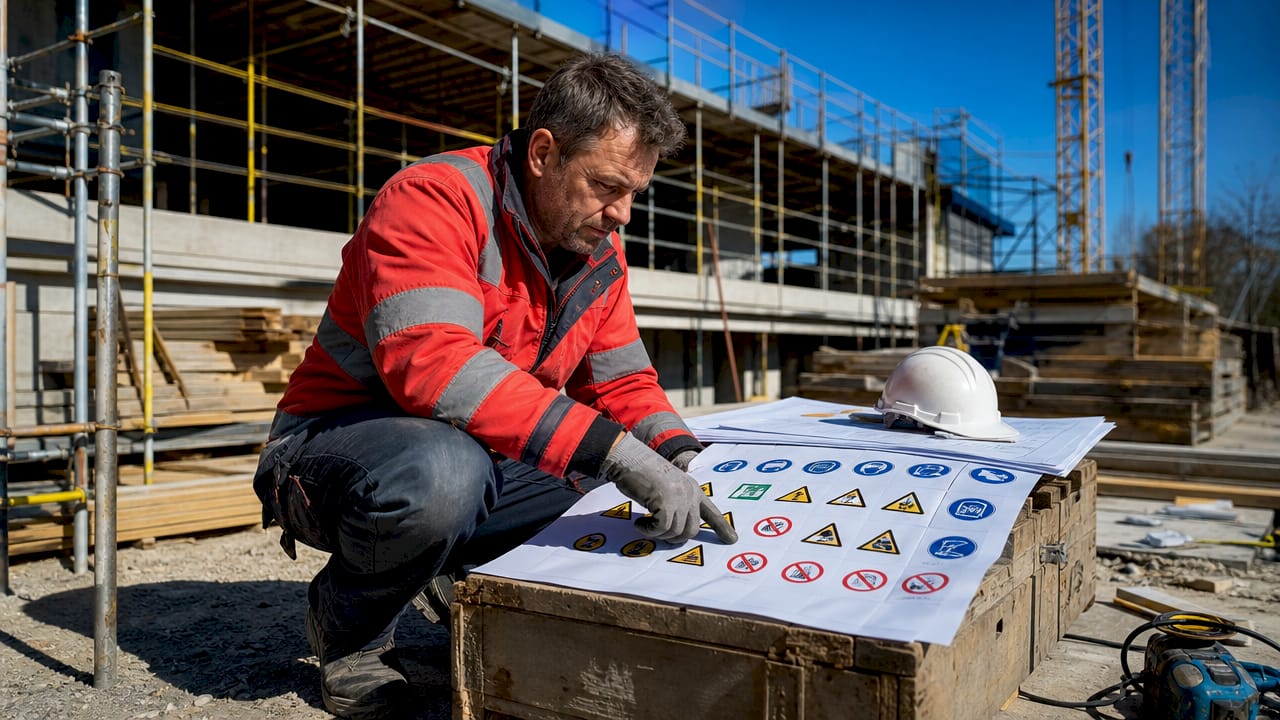
Construction signs fall into five categories, each with a distinct colour, shape, and purpose. Knowing the difference between them is the foundation of any compliant site.
- Mandatory signs use a blue circular background with white symbols or text. They instruct workers to take a specific action. Examples include “Hard hat must be worn in this area,” “Hi-vis jacket required,” and “Safety footwear must be worn.”
- Warning signs use a yellow or amber triangular format with black symbols. They alert workers to a hazard nearby. Examples include “Overhead loads,” “Uneven ground,” “Danger: deep excavation,” and “Risk of falling objects.”
- Prohibition signs use a red circular border with a diagonal bar over a white background. They forbid a specific behaviour. Examples include “No smoking,” “No unauthorised access,” and “No mobile phones beyond this point.”
- Safe condition signs use a green rectangular or square format with white symbols. They direct people to safety. Examples include “Emergency exit,” “Assembly point,” and “First aid post.”
- Fire equipment signs use red markings to identify the location of firefighting resources. Examples include “Fire extinguisher,” “Fire hose reel,” and “Fire alarm call point.”
ISO 7010 symbols are the recognised standard for each of these categories. They improve comprehension speed significantly, particularly in noisy environments where verbal instruction is not possible. Using ISO 7010 symbols across all five sign types creates a consistent visual language that workers can read at a glance.
2. Key design principles for effective construction signs
Good sign design is not about aesthetics. It is about whether a worker can read and act on a sign in under two seconds from the relevant distance.
The most common design failures on UK sites are undersized signs and text-heavy layouts. Sign size must match viewing distance. A sign readable at two metres is useless to a plant operator viewing from fifteen metres away. Size your signs based on the furthest point from which they need to be read, not the nearest.
Follow these design principles for every sign you commission or specify:
- High contrast: Use the standard colour pairings. Blue on white, black on yellow, white on green, white on red. Avoid custom colour schemes that reduce contrast.
- Minimal text: Rely on ISO 7010 symbols as the primary message. Use text only to clarify or supplement the symbol.
- Correct font size: Text should be legible at the intended viewing distance. Larger viewing distances require larger fonts, not just larger signs.
- Appropriate materials: For permanent outdoor use, aluminium composite and rigid UV-resistant PVC are the standard choices. Temporary signs on short-term projects can use corrugated plastic, but they must still meet size and contrast requirements.
- Avoid improvised signs: Handwritten notices or printed A4 sheets taped to site hoardings do not meet regulatory standards and reduce overall site credibility.
Pro Tip: For projects lasting more than three months, invest in aluminium composite signs. They resist weathering, maintain colour accuracy, and avoid the cost of repeated replacement that cheaper materials incur.
Using generic sign lists without a site-specific hazard assessment is one of the most widespread errors in construction signage. Your sign selection should reflect the documented hazards on your specific site, not a standard catalogue order.
3. Strategic placement of signs on site
The right sign in the wrong location provides no protection. Placement is as critical as the sign itself.
Fall hazard signs should be positioned at least 6 feet from a trench edge, not on the hazard itself. The purpose is to warn workers before they reach the danger zone, not after. This approach point principle applies to all hazard signage. Place the sign where a person will see it while they still have time and space to change their behaviour.
Safe condition signs, such as emergency exit arrows, must follow the pathway to safety rather than simply marking the destination. A single sign on the exit door is insufficient. Signs should guide workers from any point on site to the nearest exit, particularly in areas where sightlines are obstructed by plant, materials, or temporary structures.
Pro Tip: Walk your site as a new visitor would. If you cannot find the emergency assembly point, the first aid post, or the site entrance without prior knowledge, your signage placement needs revision.
For vehicle and pedestrian zones, signs must be visible to both audiences simultaneously. A speed limit sign positioned at cab height for a lorry driver is often invisible to a pedestrian. Consider dual-height placement or separate signs for each audience in shared zones. Site entrances require mandatory PPE signs at the point of entry, before workers and visitors step onto the site. Restricted access areas need prohibition signs at every access point, not just the primary entrance.
Exit signs require red letters at least 6 inches tall with a stroke width of 0.75 inches to meet minimum standards. These are not suggestions. They are the baseline below which a sign fails its legal purpose.
4. Specialised and site-specific signage examples
Beyond the five core categories, construction sites require signage tailored to specific operations and hazards. A residential development has different risks to a commercial fit-out or a civil engineering project. Your signage must reflect that.
Here are the most commonly required specialised signs across UK construction sites:
- Electrical hazard signs: “Danger: live electrical equipment,” “Do not operate,” and “Isolation point” signs are mandatory near energised panels, temporary distribution boards, and cable routes.
- Excavation warning signs: “Danger: deep excavation,” “Unstable ground,” and “No entry without authorisation” signs are required at all excavation perimeters.
- Chemical storage notices: COSHH-compliant hazard signs for storage areas containing fuels, solvents, adhesives, or other hazardous substances. These must identify the substance category and relevant precautions.
- Welfare and office area signs: “No smoking,” “Mind the step,” “Staff room,” “Canteen,” and “First aid” signs create a clear, professional welfare environment and meet fire safety requirements.
- Bilingual and custom signs: On sites with a multilingual workforce, bilingual signs in English and the relevant second language significantly improve comprehension. Custom signs can also incorporate company branding, project names, or specific site rules.
Road signage within construction zones covers speed limits, no entry, pedestrian crossing points, and site entrance and exit markers. These signs control traffic flow and reduce the risk of vehicle and pedestrian conflict, which remains one of the leading causes of serious injury on UK construction sites.
For fire safety, fire extinguisher location signs must conspicuously mark equipment at every point where firefighting resources are stored. Pairing these with fire protection compliance guidance, such as that outlined in construction fire safety standards, helps site managers align signage with their broader fire risk assessment.
Signage must be reviewed and updated as the project progresses. A sign relevant during groundworks may be redundant or misleading during the fit-out phase. Build a signage review into your monthly site safety inspection.
5. How to design construction signs: a practical checklist
Designing construction signage from scratch requires a structured process. Ad hoc decisions produce inconsistent results and compliance gaps.
Start with your site-specific risk assessment. Every sign you specify should correspond to a documented hazard or instruction in that assessment. If a hazard is not in your assessment, it should not drive sign selection. If it is in your assessment, it must have a corresponding sign.
Work through the following checklist when commissioning or reviewing your site signage:
- Identify the hazard or instruction the sign must communicate.
- Select the correct sign category (mandatory, warning, prohibition, safe condition, or fire equipment).
- Choose the ISO 7010 symbol for that hazard or instruction.
- Calculate the required sign size based on the maximum viewing distance.
- Select the appropriate material based on whether the sign is permanent or temporary and whether it will be exposed to weather.
- Confirm placement at the approach point, not the hazard itself.
- Review after each project phase to confirm signs remain accurate and visible.
For construction signage tips specific to UK sites, this checklist approach reduces the risk of gaps and ensures your signage programme holds up under a Health and Safety Executive inspection.
Key takeaways
Effective construction site signage requires the right sign category, correct ISO 7010 symbols, appropriate sizing for viewing distance, and placement at approach points rather than on the hazard itself.
| Point | Details |
|---|---|
| Use the five sign categories | Mandatory, warning, prohibition, safe condition, and fire equipment signs each have fixed colours and shapes. |
| Size signs for viewing distance | A sign readable at two metres is inadequate for plant operators viewing from fifteen metres away. |
| Place signs at approach points | Fall hazard signs belong at least 6 feet from the trench edge, not on the hazard itself. |
| Conduct site-specific assessments | Generic sign lists without a documented hazard assessment produce compliance gaps and reduced effectiveness. |
| Review signage at each project phase | Signs accurate during groundworks may be misleading or redundant during fit-out. |
Pikpikpow’s view on construction signage done properly
The most consistent mistake I see across UK construction sites is treating signage as a one-time purchase rather than a live safety tool. Site managers order a standard pack of signs at project start, install them, and consider the job done. Six months later, the site has changed entirely but the signs have not moved.
Good signage is a reflection of your current risk profile, not your risk profile at project mobilisation. A sign that no longer corresponds to an active hazard creates a different problem: workers begin to ignore signage generally because they learn it does not always reflect reality. That erosion of trust is far more dangerous than a missing sign.
The cost argument for quality materials is straightforward. Cheap corrugated plastic signs fade, warp, and become illegible within weeks of outdoor exposure. Replacing them repeatedly costs more than aluminium composite signs would have cost at the outset. Quality materials also signal to workers and inspectors that safety is taken seriously on your site.
Site-specific risk assessment before sign selection is not a bureaucratic step. It is the only way to produce a signage programme that actually reflects your hazards. Work with a professional signage supplier who understands construction compliance, and revisit your signage at every major project milestone. The latest construction signage thinking for 2026 reinforces this: dynamic, site-responsive signage outperforms static, set-and-forget approaches every time.
— PikPikPOW!
Pikpikpow construction signage solutions
Pikpikpow produces durable, standards-compliant construction signage for UK sites of every scale. From mandatory hard hat signs to custom bilingual notices and full site hoarding graphics, the range covers every category required under the Health and Safety (Safety Signs and Signals) Regulations 1996.

All signs are manufactured using UV-resistant materials suited to outdoor construction environments, with aluminium composite and rigid PVC options available for permanent and semi-permanent installations. Bespoke signs incorporating company branding, project-specific hazard details, or bilingual text are produced to order. Explore Pikpikpow’s full range of construction signage systems to find compliant, site-ready solutions for your project.
FAQ
What are the five types of construction site signs?
Construction signs are categorised as mandatory (blue circular), warning (yellow triangular), prohibition (red circular with diagonal bar), safe condition (green rectangular), and fire equipment (red markings). Each category has a fixed colour scheme and symbol format defined by UK regulations and ISO 7010.
How far from a hazard should warning signs be placed?
Fall hazard signs should be placed at least 6 feet from the hazard, such as a trench edge, so workers receive the warning before reaching the danger zone. The same approach point principle applies to all hazard signage on construction sites.
What size should construction site signs be?
Sign size must correspond to the maximum viewing distance from which workers or vehicle operators need to read them. Undersized signs that cannot be read from the required distance fail their safety purpose and may not meet regulatory standards.
Are ISO 7010 symbols required on UK construction sites?
ISO 7010 symbols are the recognised standard for safety signage in the UK and significantly improve comprehension speed over text-only or improvised signs. While the regulations specify sign categories and colours, using ISO 7010 symbols is the accepted method for meeting those requirements in practice.
When should construction site signage be reviewed?
Signage should be reviewed at each major project phase, such as the transition from groundworks to structural work or from structure to fit-out. Signs that no longer reflect active hazards should be removed or updated to maintain worker trust and regulatory compliance.