

TL;DR:
- Poor interior signage leads to visitor confusion, legal fines, and negative first impressions.
- UK regulations BS 8300, ISO 7010, and the Equality Act 2010 require compliant, accessible signage.
- Investing in quality, branded signage and proper installation offers significant brand and operational benefits.
Poor interior signage costs businesses more than most owners realise. Visitors get lost, staff waste time giving directions, and first impressions suffer before a single conversation takes place. Worse, non-compliant signage can expose your organisation to fines up to £250,000 under the Equality Act 2010. This guide walks you through everything you need to know about planning, designing, installing, and maintaining commercial interior signage in the UK. Whether you manage a single retail unit or a multi-floor office facility, the steps here are practical, actionable, and directly relevant to your environment.
Table of Contents
- Understand the essentials: regulations and requirements
- Planning your interior signage: audit and site survey steps
- Choosing the right signage: materials, types, and design best practices
- Installation and verification: getting it right first time
- The underrated ROI of quality interior signage
- Achieve seamless signage with expert support
- Frequently asked questions
Key Takeaways
| Point | Details |
|---|---|
| Compliance first | Ensuring BS 8300 and ISO 7010 compliance avoids legal and reputational risks for your business. |
| User-centred planning | A thorough signage audit involving real users leads to optimal navigation and accessibility. |
| Design with purpose | Choosing the right materials and styles integrates your brand and improves durability. |
| Installation matters | Professional installation with post-installation checks ensures effectiveness and peace of mind. |
| Expert support pays | Specialist signage partners streamline the process and help maximise business benefits. |
Understand the essentials: regulations and requirements
Before you order a single panel or brief a designer, you need to understand what the law requires. Commercial interiors in the UK must comply with BS 8300 and ISO 7010 for accessible, inclusive environments. BS 8300 covers the design of buildings to meet the needs of disabled people, while ISO 7010 sets the global standard for safety signs and symbols used in workplaces and public spaces.
Ignoring these standards is not a minor oversight. It puts your business at legal risk and excludes visitors who have a right to access your premises.
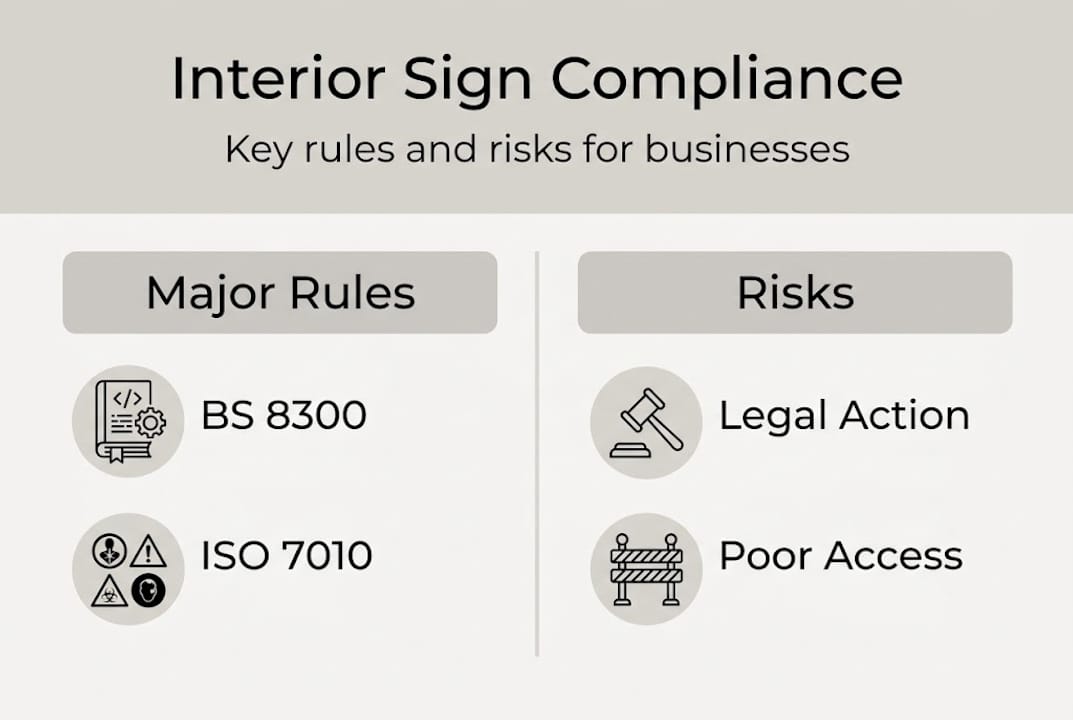
| Regulation | What it covers | Consequence of non-compliance |
|---|---|---|
| BS 8300 | Accessibility for disabled users | Equality Act enforcement, fines |
| ISO 7010 | Safety signs and symbols | Health and safety prosecution |
| Equality Act 2010 | Reasonable adjustments for access | Fines up to £250,000 |
| Fire Safety Order 2005 | Fire exit and emergency signage | Criminal prosecution, closure |
Think of compliance not as a burden but as a baseline. Getting it right protects you legally and signals to every visitor that your business takes inclusion seriously. Understanding why durable signage matters goes hand in hand with understanding why compliant signage matters.
Before you commission any signage, run through this checklist:
- Accessibility: Are signs positioned at correct heights for wheelchair users and those with visual impairments?
- Fire safety: Are all fire exits, assembly points, and fire equipment locations clearly signed with ISO 7010-compliant symbols?
- Branding: Do your signs reflect your current brand identity consistently across the premises?
- Legibility: Is font size, contrast, and lighting sufficient for all visitors?
Use a visibility and compliance checklist to structure this review properly. Completing it before you engage a supplier will save you time, money, and potential rework down the line.
Planning your interior signage: audit and site survey steps
With compliance requirements in hand, the next stage is understanding exactly what your space needs. A thorough site audit is the foundation of any successful signage project. A site audit is essential for identifying visibility issues and accessibility gaps before commission or install.
Here is a practical, numbered process to follow:
- Conduct a full walk-through of your premises. Move through the space as a visitor would, from the entrance to key destinations such as reception, toilets, meeting rooms, and fire exits.
- Identify high-traffic and decision points. These are locations where visitors are most likely to pause, look for direction, or become confused. Typical spots include entrances, corridor junctions, lift lobbies, and stairwells.
- Sketch your current sign locations. Record on a simple floor plan where signs currently exist and whether they are visible, legible, and correctly positioned.
- Record bottlenecks and problem areas. Note anywhere visitors or staff regularly ask for directions, or where movement becomes congested.
- Map branding opportunities. Identify blank walls, reception backdrops, or communal areas where signage could reinforce your brand identity.
Knowing signage impact in UK interiors gives you a stronger case for investing in the right locations. Once mapped, you can prioritise where new or replacement signage will have the greatest effect.
When assessing your space, pay particular attention to weak navigation points. Entry doors, reception desks, lift areas, and fire exits are all critical. If any of these lack clear, well-positioned signage, they represent both a customer experience problem and a potential compliance issue.

Accessibility checks are equally important at this stage. Verify that ramps, lifts, and service counters have appropriate signage and that directional information is available at heights suitable for wheelchair users.
Pro Tip: Involve both an experienced staff member and someone visiting your building for the first time during your walk-through. The contrast in their experience will reveal gaps that familiarity alone will mask. Wayfinding signs work best when designed from the perspective of someone who does not already know the layout.
Choosing the right signage: materials, types, and design best practices
Now with a clear plan, it is time to select the right signs to fit both your space and compliance requirements. Integrating branding and accessibility boosts results over treating each in isolation. The most effective signage systems achieve both simultaneously.
| Signage type | Ideal use | Recommended materials |
|---|---|---|
| Wayfinding | Corridors, junctions, entrances | Aluminium, PVC, acrylic |
| Directory | Reception, lobbies | Brushed steel, acrylic, printed panels |
| Safety signs | Fire exits, hazards, first aid | Photoluminescent, rigid plastic |
| Branding panels | Feature walls, reception backdrops | Dibond, foamex, vinyl, acrylic |
Material selection matters more than many people expect. For high-traffic areas, you need materials that are:
- Durable and scratch-resistant, particularly in corridors and near service counters
- Easy to clean, especially in healthcare, hospitality, and food environments
- Visually contrasting to background walls, as required by BS 8300 for legibility
- Lightweight but rigid for wall-mounted applications where fixings must remain neat and secure
The case for branded signage over generic alternatives is strong. Generic signage communicates function but nothing more. Branded signage reinforces your organisation’s identity at every touchpoint, creating a consistent experience that builds trust. Explore how architectural signage benefits extend well beyond aesthetics.
When it comes to design best practices, keep these principles in mind. Use clean, sans-serif fonts at sufficient size for the viewing distance. Incorporate universally recognised icons alongside text to support users with varying literacy levels. Ensure lighting is adequate, either through ambient illumination or backlit sign panels. Apply your brand colours consistently, whilst maintaining the contrast ratios required for accessibility.
Pro Tip: BS 8300 guidance recommends incorporating tactile and braille elements on key signs, particularly for room identification and critical wayfinding. This is especially relevant for healthcare, education, and public-facing commercial facilities. Good shop sign design tips apply equally to interior environments.
Installation and verification: getting it right first time
With your signs chosen, installation and sign-off are all that stand between planning and a compliant, effective environment. Post-installation checks against the site plan and accessibility standards prevent costly rework.
Follow this step-by-step installation process:
- Schedule installation with minimum disruption. Plan for out-of-hours or phased installation in occupied buildings to avoid disrupting operations.
- Brief your installation contractors fully. Share the site plan, compliance requirements, and any specific positioning instructions before work begins.
- Test sight lines during installation. Before fixing each sign permanently, check it is visible from the intended viewing distance and angle, and at varying user heights.
- Conduct a full user walk-through after installation. Move through the space again as a first-time visitor would, checking every sign for clarity, positioning, and legibility.
- Involve a compliance representative in the final sign-off. This may be your facilities manager, health and safety officer, or an external auditor, depending on your sector.
For a detailed breakdown of this process, refer to this effective wayfinding installation guide.
A missed compliance check is a £250,000 risk. Document every stage of your installation and keep records of your post-install walk-through for insurance and audit purposes.
This documentation is not optional if you operate in a regulated sector. It provides evidence that you took reasonable steps to meet your obligations. Use a wayfinding sign checklist to structure your final verification and ensure nothing is overlooked.
One practical point many businesses miss: lighting conditions change throughout the day. Check your signage in both natural and artificial lighting to confirm legibility at all times.
The underrated ROI of quality interior signage
Most organisations approach signage as a necessary expense rather than a business asset. They budget for it at the end of a fit-out project, treat it as a compliance task, and move on. That approach leaves a significant return on the table.
Quality interior signage delivers three outcomes that rarely appear in a project brief. First, it builds brand authority before a staff member says a word. A visitor’s first impression is formed within seconds of entering your space, and signage is a large part of that experience. Second, it reduces confusion and the operational cost of repeated wayfinding questions to staff. Third, it provides documented compliance cover that protects your business in the event of an access-related complaint or audit.
We have seen the contrast between generic and well-branded signage play out across many commercial projects. Generic signs function. Branded signs communicate. The businesses that treat the value of branded signage as a strategic investment consistently report stronger visitor experience feedback and greater staff confidence in their environment.
The contrarian insight here is simple. You do not build trust with your customers through conversation alone. You build it through every detail of the environment you create for them, and signage is one of the most immediate and legible signals you control.
Achieve seamless signage with expert support
If you want to realise the full advantages described in this guide, specialist support makes a meaningful difference. Navigating compliance, material selection, design, and installation simultaneously is demanding work, and errors at any stage carry real cost.
At Pik Pik POW!, we work with UK businesses across retail, commercial interiors, and facilities management to deliver signage that meets both brand and compliance requirements. From initial audit through to final installation, our team provides bespoke solutions that are built to last. Explore our signage systems solutions and internal wayfinding signage services, or find out more about our architectural signage expertise. Get in touch to discuss your project and find out how we can help.
Frequently asked questions
What are the key UK standards for commercial interior signage?
BS 8300 and ISO 7010 are the main standards, covering accessibility and safety requirements for commercial environments across the UK.
How can I ensure my signage is accessible for all visitors?
Use clear sans-serif fonts, tactile and braille elements, and position signs at heights accessible to all users. Integrating accessibility in design from the outset is far more effective than retrofitting it later.
What are common pitfalls with interior sign installation?
Skipping post-installation checks or overlooking sight lines frequently leads to failed inspections and costly rework. Post-installation checks are an essential part of any compliant signage project.
How often should interior signage be reviewed?
Best practice is to audit your interior signage annually and immediately after any major layout change, refurbishment, or update to compliance standards.
Can I update my signs for branding without breaching compliance?
Yes, provided all required accessibility and safety elements are maintained. Branding and compliance work together effectively when both are built into the design brief from the start.