
TL;DR:
- Managing branded signage across multiple locations involves complex coordination and risk mitigation. Proper preparation, including site surveys, clear workflows, and centralised documentation, is crucial to ensure smooth rollouts. Post-installation verification and ongoing maintenance sustain brand consistency and prevent costly rework.
Managing a branded signage project workflow across multiple retail locations or corporate sites is genuinely difficult. Deadlines slip, brand assets get misinterpreted, and installation crews arrive at sites that were never properly surveyed. For marketing and operations managers, these are not abstract risks. They are the daily reality of scaling signage across a growing estate. This guide walks you through the preparation, execution, and verification steps that separate a smooth rollout from a costly rework cycle, so you can maintain brand consistency and keep projects on schedule.
Table of Contents
- Understanding the challenges of branded signage rollouts
- Preparing for your branded signage project
- Executing the branded signage installation
- Verifying and maintaining brand consistency post-installation
- Rethinking signage project workflows: lessons from experience
- Streamline your branded signage projects with Pik Pik Pow!
- Frequently asked questions
Key Takeaways
| Point | Details |
|---|---|
| Centralise workflows | Use a single system to connect briefs, design, and installation status for consistent brand delivery across locations. |
| Plan installations carefully | Schedule installs around store hours with buffer time and pilot runs to minimise disruptions and errors. |
| Build controlled signage briefs | Link approved brand assets to technical deliverables to avoid misinterpretation and ensure quality. |
| Segment projects in phases | Divide work into discovery, deployment, and support phases to clarify roles and improve coordination. |
| Leverage expert partners | Use professional vendors with end-to-end capabilities to streamline your branded signage projects efficiently. |
Understanding the challenges of branded signage rollouts
Before you build any process, you need to understand where multi-location signage projects typically break down. The problems are predictable, which means they are also preventable.
The most common failure point is inadequate site preparation. Teams often rely on drawings or assumptions rather than verified measurements, and the result is fabricated signage that does not fit. A fascia sign ordered 20mm too wide because a site survey was skipped can set an entire rollout back by weeks once you factor in reprinting, redelivery, and rescheduling installation crews.
Coordination between delivery windows and store operations is another frequent source of delays. A busy retail environment cannot simply close for a morning to accommodate a signage team. Signage installation guidelines must account for trading hours, staff availability, and health and safety requirements from the outset. Multi-store rollouts require pre-install surveys, sequenced deliveries, install windows aligned to store hours, pilot installs, and buffer time to prevent delays.
The third challenge is cascading rework. When one site installs incorrectly and no one identifies the problem until four more sites have followed the same process, the cost multiplies fast.
Key risks to plan for:
- Inaccurate site dimensions leading to fabrication errors
- Misaligned brand assets between marketing approvals and production files
- Poor communication between internal teams and external fabricators
- Installation scheduling that conflicts with store trading hours
- No defined escalation process when on-site problems arise
Pro Tip: Run a pilot install at your most complex or representative site first. Treat it as a live test, document every issue, and use the findings to refine your process before rolling out to remaining locations.
With these challenges clear, the next step is preparing effectively to mitigate risks and deliver a consistent rollout.
Preparing for your branded signage project
Good preparation is where the real project management for signage happens. The decisions you make at this stage determine whether your installation phase runs to schedule or descends into reactive problem-solving.
Start by compiling a controlled signage programme brief. This document links your approved brand assets, including colour specifications, typography, logo clearance rules, and material guidelines, directly to the technical deliverables required at each site. It becomes the single reference point that both your marketing team and your fabrication vendor work from. Centralising workflows in a single system that connects briefs, designs, and job status across locations without duplication is one of the most effective things you can do to manage a signage programme.
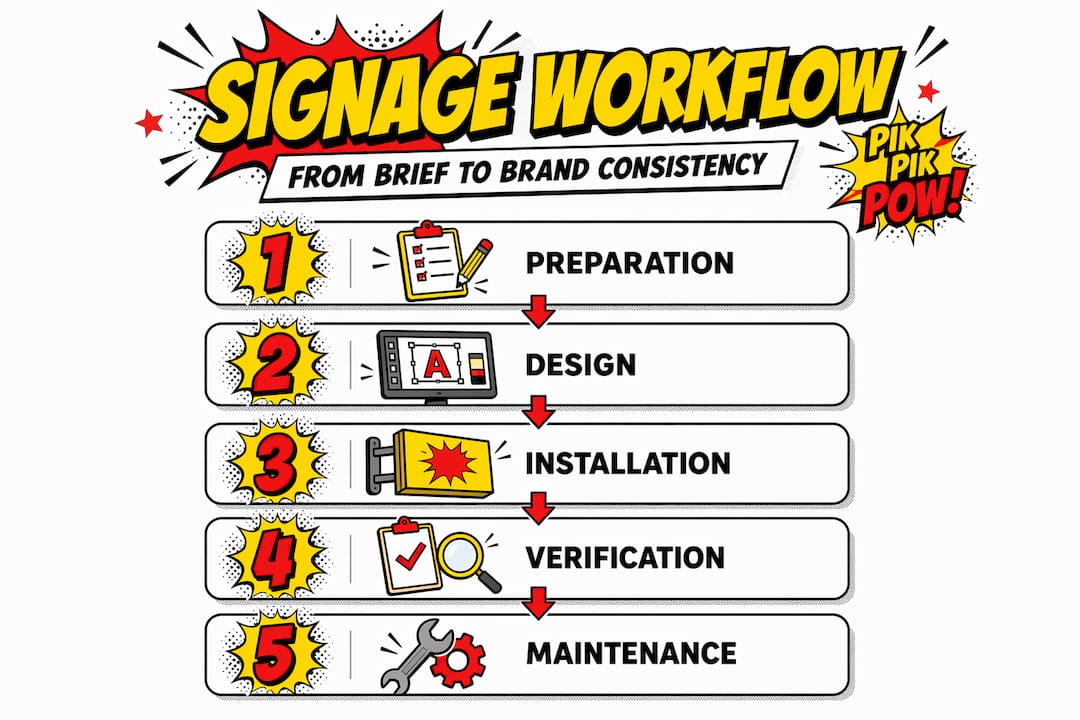
The steps for signage development in the preparation phase look like this:
- Define project scope and site list. Confirm the number of locations, the signage types required at each, and any site-specific constraints such as listed building restrictions or landlord approvals.
- Standardise your site survey template. Every location should be measured using the same data capture method. Include photographs, existing fixings, power supply locations for illuminated signage, and surface material.
- Build a master asset library. Store approved artwork files, brand guidelines, and material specifications in one centralised platform. Version control is essential here.
- Clarify vendor roles and approval workflows. Who approves artwork? Who signs off on fabrication proofs? Define these before production begins, not during it.
- Set your project timeline. Include lead times for each signage type, survey windows, installation scheduling, and buffer periods.
| Preparation task | Responsible party | Deadline trigger |
|---|---|---|
| Site surveys completed | Operations manager | Before design brief |
| Brand assets approved | Marketing lead | Before production |
| Fabrication proofs signed off | Both teams | Before manufacture |
| Installation schedule confirmed | Operations manager | Two weeks pre-install |
| Landlord or planning consent | Legal/property team | As early as possible |
Pro Tip: When designing signage consistently across multiple locations, create a master artwork template for each signage type and populate it with site-specific variables such as store name or address. This avoids recreating artwork from scratch for every location and significantly reduces approval time.
Having established your preparation, the next stage is executing the installation with the same level of discipline.
Executing the branded signage installation
Execution is where planning meets reality. Even well-prepared projects encounter on-site surprises, and the strength of your branded signage production process depends on how well your team can respond without derailing the broader schedule.
The effective signage project steps for the installation phase are:
- Confirm site access and logistics. Verify entry points, parking for installation vehicles, and whether any goods lifts or specialist access equipment are needed.
- Run your pilot install. Choose a site that represents the typical complexity of your estate. Debrief your installation crew and internal team immediately afterwards.
- Sequence deliveries to match the install schedule. Signage arriving at a site before the crew is ready creates storage problems and damage risk. Coordinate fabrication dispatch with confirmed installation dates.
- Brief installation crews clearly. Provide printed or digital installation packs for each site, including approved artwork references, fixing specifications, and escalation contacts.
- Document in real time. Require crews to submit photographs of each completed element before moving to the next. This creates an audit trail and catches issues immediately.
Installation success depends on operational sequencing including pre-planned site access, off-hours windows, delivery sequencing, pilot installs, and buffer time to prevent cascading rework.
| Installation phase | Key action | Common risk if skipped |
|---|---|---|
| Pre-installation | Site access confirmed and briefed | Crew delays, wasted visits |
| Pilot install | Document all issues and adjustments | Repeated errors across all sites |
| Active rollout | Real-time photo documentation | Undetected installation errors |
| Sign-off | Crew and manager sign completion | Disputes over quality post-install |
During the active rollout, keep a live project tracker that shows the status of every location. A simple spreadsheet can work, but a dedicated project management platform gives you much better visibility, particularly if you have teams working across different regions simultaneously.
Pro Tip: Schedule installations that require heights, electrical connections, or external access during off-hours where possible. Overnight or early-morning windows remove customer and staff safety risks and typically allow crews to work faster without interruptions.
Once installation is underway, ongoing monitoring ensures nothing falls through the gaps.
Verifying and maintaining brand consistency post-installation
Installation completion is not the end of the project. It is the beginning of the verification and maintenance phase, and it is the phase that most teams underinvest in.

A centralised workflow creates a single source of truth that tracks all projects and assets, enabling teams to maintain consistent brand presentation and reduce rework. Your verification process should build on this foundation.
Post-installation verification should cover:
- Visual compliance checks. Compare installed signage against approved artwork using the real-time photographs submitted by crews. Flag any deviations immediately.
- Brand standard reporting. Generate a simple report for each location confirming that signage meets the required specifications. This is particularly important when multiple vendors or installation crews are involved.
- Structural and functional checks. Confirm that illuminated signs are fully operational, fixings are secure, and any removable elements such as window vinyls are correctly aligned and bubble-free.
- Ongoing maintenance scheduling. Build a maintenance calendar that accounts for the expected lifespan of each signage type. External signs exposed to UV light and weather will need periodic inspection and replacement. Fading or damaged signage directly affects how customers perceive your brand.
Digital signage solutions can assist with ongoing brand management by allowing centralised content updates without requiring physical replacements across every location.
Cross-functional involvement matters here. Operations, facilities, and marketing should all have defined roles in day-to-day signage management so that issues are reported and resolved quickly, rather than sitting unnoticed until they become expensive problems.
Pro Tip: Build a simple signage health-check into your regular store visit or audit process. A five-minute visual review of each sign type on every site visit creates an early-warning system for damage, fading, or misaligned branding before it becomes a brand presentation issue.
Rethinking signage project workflows: lessons from experience
Most marketing and operations managers approach signage projects the same way they approach a one-off print order: brief a supplier, approve a design, and wait for delivery. This thinking works for a single location. It fails, often expensively, at scale.
The fundamental shift you need to make is from viewing each signage requirement as an isolated task to treating your entire programme as a managed process with defined phases and clear ownership. We would describe it as Day Zero, Day One, and Day Two thinking. Day Zero is discovery and planning. Day One is deployment and installation. Day Two is operations and support. The handoff between each phase needs to be explicit, documented, and agreed by all parties before work begins.
The biggest scaling improvement comes from centralising the workflow so that everyone works from the same source of truth, reducing rework and misalignment between marketing approvals and fabrication execution.
What we see repeatedly is that the gap between marketing’s expectations and what fabrication actually produces comes down to one thing: the brief. When a marketing team approves a brand guideline and a fabricator receives a partial artwork file and a verbal description, the result is rarely what anyone intended. A controlled signage programme brief that connects approved assets directly to technical specifications closes this gap before it costs you anything.
The other lesson worth sharing is this: centralised documentation is not a nice-to-have. It is the mechanism that makes everything else work. When approvals, site surveys, artwork files, and installation records all live in the same accessible system, your signage project steps become auditable, repeatable, and scalable. Without it, you are rebuilding the process from memory every time.
Streamline your branded signage projects with Pik Pik Pow!
Running a signage rollout across multiple locations takes more than good intentions. It takes the right partner.
At Pik Pik Pow!, we work with marketing and operations teams at retail chains and corporate offices to deliver end-to-end branded signage projects, from initial survey and design through to fabrication and installation. Our signage systems are built for multi-location brand programmes, giving you consistent quality across every site. If you are managing ongoing brand presence, our digital signage solutions allow centralised content updates without the logistics of physical replacements. Our team provides expert installation support with scheduling that works around your trading hours, and our installation guide gives you a clear picture of what to expect at every stage. Get in touch to discuss your project.
Frequently asked questions
What is the most important step in managing a multi-location branded signage project?
Centralising your workflow and using a single source of truth for designs, briefs, and project status is the single most effective step, as it reduces rework and keeps marketing and fabrication teams aligned across every location.
How can pilot installs benefit a branded signage rollout?
Pilot installs expose site-specific problems before they are repeated across every location. Buffer time for adjustments after the pilot prevents those problems from causing cascading delays throughout the rest of the rollout.
Why is it important to align installations with store operating hours?
Scheduling installs outside of trading hours minimises disruption to staff and customers, and gives installation crews better access and more time to work safely. Off-hours install windows are considered a standard part of efficient retail rollouts.
What role does ongoing maintenance play after signage installation?
Ongoing support and maintenance keeps displays on brand and fully functional well beyond the installation date, preventing fading, damage, or non-operational illuminated signs from undermining your brand appearance.
How does treating signage projects in phases improve project management?
Segmenting projects into stages such as discovery, deployment, and support clarifies who owns each part of the process, reduces confusion after go-live, and creates a structured handoff between your planning, installation, and operations teams.