

TL;DR:
- Managing multi-site signage involves complex brand governance, regulatory compliance, and operational coordination across locations. Proper processes, clear guardrails, and unified technology are essential to maintain consistency and prevent brand drift as site numbers increase. Local champions and targeted audits help sustain quality without overwhelming resources.
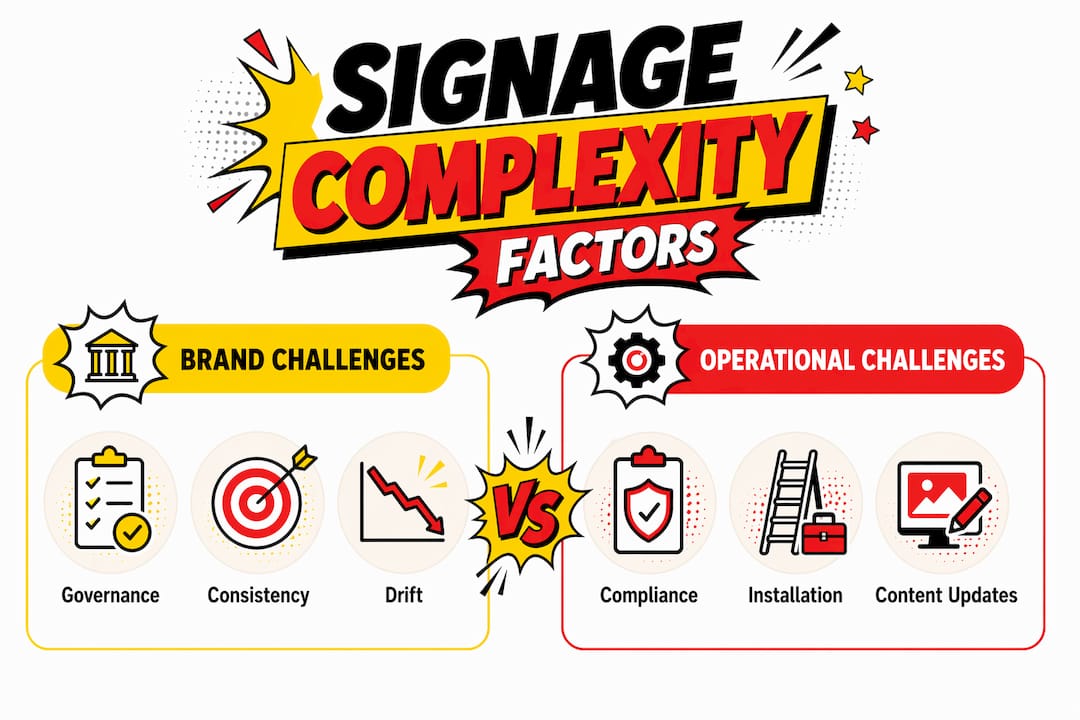
Multi-site signage complexity is defined as the compounding difficulty of maintaining consistent, compliant, and operationally sound signage across two or more business locations. The challenge is not simply about producing more signs. It arises from the collision of brand governance, local regulatory requirements, installation logistics, and technology integration, all of which must work in concert across sites that may differ in size, layout, and local rules. For marketing and operations managers, understanding why multi-site signage is complex is the first step to managing it well.
Why multi-site signage is complex: brand consistency at scale
Brand consistency across multiple sites is harder than it looks. Brand drift is rarely intentional; it results from unclear ownership and local pressures that push site managers to make their own adaptations. A regional manager who cannot get a quick approval from head office will often commission a sign locally, using the wrong typeface or colour. Multiply that across 20 or 50 sites and the brand starts to fragment.
The root cause is usually governance, not design. When decision rights are unclear, local teams fill the gap. Unclear decision rights and misaligned incentives are the primary drivers of brand drift in multi-site businesses. A retail chain might have a perfectly crafted brand guideline document, but if no one owns the approval process at site level, that document sits unused.
Over-centralisation creates the opposite problem. Central brand teams acting as gatekeepers increase frustration and slow decisions, which pushes local teams to act without approval. The result is the same: inconsistent execution. The fix is a governance model that sets clear guardrails while giving local teams enough authority to act quickly within them.
Common causes of brand inconsistency across sites include:
- No single owner for signage decisions at site level
- Brand guidelines that are too rigid to accommodate local building constraints
- Inconsistent briefing of local contractors or print suppliers
- No audit process to catch drift before it becomes entrenched
- Pressure to open sites quickly, cutting corners on signage sign-off
Pro Tip: Create a one-page signage brief for each site type in your portfolio. It should specify approved colours, typefaces, sign formats, and materials. Local teams can then act within those parameters without needing central approval for every decision.
Learning how to design signage for brand impact before you roll out across locations saves significant rework later.
How do local regulations complicate signage across different sites?
Regulatory complexity is one of the most underestimated challenges of multi-site signage. Municipal regulations such as height restrictions, setbacks, and material rules vary widely between local authorities and directly affect what you can install and where. A fascia sign that is perfectly legal in one borough may require a full planning application in the next.

The variation goes beyond aesthetics. Health and safety requirements, including rules around illuminated signage near roads, fire-rated materials in commercial interiors, and allergen or HFSS labelling in food retail environments, differ by sector and jurisdiction. Each site effectively has its own compliance profile.
Key regulatory variables that affect signage planning across locations include:
- Height and projection limits set by local planning authorities
- Listed building or conservation area restrictions on materials and illumination
- Health and safety requirements for construction site signage, including mandatory safety signs under UK regulations
- Sector-specific rules such as HFSS advertising restrictions for food and drink businesses
- Landlord consent requirements in leased retail or commercial premises
Compliance also evolves. A rule that applied at your first ten sites may change by the time you reach thirty. Keeping a live compliance register for each site, updated whenever local rules change, prevents costly retrofits. Pikpikpow works with businesses across retail, construction, and commercial interiors, and the compliance requirements for construction signage alone illustrate how much variation exists even within a single sector.
What operational challenges come with multi-location signage rollouts?
Operational complexity grows faster than site count. Businesses scaling past 50 sites frequently experience operational friction and data corruption when relying on ad hoc or copy-paste signage processes. What works at five locations breaks at fifteen. The processes that feel manageable at fifteen collapse at fifty.
The core operational difficulties fall into four areas:
Scheduling and coordination. Installing signage across multiple sites simultaneously requires precise coordination of manufacturers, installers, and site managers. A delay at one site can cascade across a whole rollout programme.
Installation quality control. Without a documented installation standard and a sign-off process, quality varies between sites. One installer may mount a sign at the correct height; another may not. The brand pays the price.
Data and reporting. Knowing the current status of every sign across every site is harder than it sounds. Without a central tracking system, operations teams rely on email chains and spreadsheets, which quickly become unreliable. Treating data as a daily decision tool rather than a weekly report improves responsiveness and reduces errors significantly.
Maintenance and updates. Signage degrades. Illuminated signs fail. Seasonal or promotional content needs updating. Without a scheduled maintenance programme, sites drift out of compliance or look neglected.
Designating a super-user at each site, someone who bridges head office decisions and local realities, is a proven way to prevent operational breakdown at scale. This person does not need to be a signage expert. They need to understand the brand standards, know who to call when something goes wrong, and have the authority to reject non-compliant work.
Pro Tip: Use documented installation checklists rather than verbal briefings. A checklist shared with every installer and site manager creates a consistent standard and a paper trail if something goes wrong. Tools that support contractor documentation can help teams manage this at scale.
A clear signage installation guide reduces the risk of inconsistent results across your locations.
Does digital signage make multi-site management harder or easier?
Digital signage adds capability but also adds complexity. Synchronising digital content across POS systems, kiosks, mobile apps, and external aggregators requires central control of a kind that many businesses have not yet built. When each channel updates independently, message drift occurs quickly.
The table below compares the primary complexity factors for traditional and digital signage across multiple sites.
| Complexity factor | Traditional signage | Digital signage |
|---|---|---|
| Content updates | Requires physical replacement | Can update centrally in real time |
| Brand consistency | Risk of local print variation | Risk of channel-by-channel drift |
| Compliance tracking | Manual audit of physical signs | Requires data integrity across platforms |
| Installation complexity | High, one-time per sign | Moderate, plus ongoing software management |
| Reporting | Difficult without site visits | Possible in real time, if systems are unified |
The critical point is that digital signage only reduces complexity when the underlying technology stack is unified. Menu drift across multiple digital channels can corrupt downstream data and confuse customers if content is not centrally controlled. A business running separate systems for its in-store screens, its app, and its third-party delivery platforms will face the same consistency problems as one using physical signs, but with the added difficulty of data integrity failures.
The opportunity with digital signage is real. Real-time updates, remote content management, and centralised reporting all reduce the operational burden at scale. But those benefits only materialise when the architecture is planned from the start, not retrofitted after problems emerge.
How do you manage multi-site signage complexity effectively?
Managing signage complexity across multiple locations requires deliberate process design, not just good intentions. The businesses that do it well share a set of common practices.
Establish clear governance. Define who owns signage decisions at head office level and at site level. Document the approval process and make it fast enough that local teams do not feel the need to bypass it.
Set guardrails, not rules. Brand guidelines should specify what must be consistent (colours, typefaces, logo placement) and what can flex (sign size to fit a specific building, material choice within an approved range). Rigid rules invite workarounds.
Invest in site champions. A designated super-user at each location, trained in brand standards and empowered to enforce them, is more effective than any number of central audits.
Choose a unified technology platform. Whether you use physical or digital signage, manage it from a single system. Fragmented tools produce fragmented results.
Run regular audits with targeted signals. Leading organisations track selected meaningful signals rather than auditing everything. Customer feedback, photographic spot checks, and variance reports give you early warning of drift without creating audit fatigue.
Signage consistency builds trust with customers and protects brand equity. The businesses that treat signage as a managed system rather than a one-off project are the ones that maintain quality at scale.
Key takeaways
Multi-site signage complexity is driven by the interaction of brand governance failures, regulatory variation, operational fragmentation, and technology misalignment, all of which compound as site count grows.
| Point | Details |
|---|---|
| Brand drift is a governance problem | Unclear decision rights, not poor design, cause most signage inconsistency across sites. |
| Regulatory requirements vary by location | Each site has its own compliance profile; a live register prevents costly retrofits. |
| Operational processes must be documented | Copy-paste approaches fail past 15 locations; checklists and super-users prevent breakdown. |
| Digital signage requires unified architecture | Central control of all digital channels is necessary to prevent content and data drift. |
| Audits should target signals, not everything | Spot checks and customer feedback catch brand drift early without creating audit fatigue. |
What we have learned from working across multiple sites
The most common mistake we see is treating multi-site signage as a procurement exercise rather than a management discipline. Businesses spend considerable time choosing the right sign type and material, then underinvest in the governance and process that keeps those signs consistent over time. The result is a strong launch followed by gradual drift.
Over-centralisation is just as damaging as too little control. When every sign change requires sign-off from a central brand team, local managers stop asking and start improvising. The fix is not more approvals. It is clearer guardrails and faster decisions within them.
The businesses we work with that manage signage best share one characteristic: they treat their site champions as a genuine asset. These are not just people who receive instructions from head office. They are the people who flag when a landlord has restricted a sign position, when a local planning rule has changed, or when an installer has not followed the brief. That local intelligence is irreplaceable.
Technology helps, but only when it is implemented with a clear brief. We have seen businesses invest in digital signage platforms and then run them as if they were physical signs, updating content manually and inconsistently. The platform is only as good as the process behind it.
The practical advice we give every multi-site client is this: document your standards, train your champions, and audit on signals rather than on everything. That combination keeps quality high without creating a bureaucratic burden that local teams will eventually route around.
— PikPikPOW!
How Pikpikpow supports multi-site signage programmes
Managing signage across multiple locations requires a supplier who understands both the design and the operational side of the challenge.
Pikpikpow works with businesses across retail, construction, and commercial interiors to deliver signage systems built for consistency at scale. From bespoke fascia signs and architectural signage to digital signage solutions that synchronise content across locations, the team combines design expertise with precision manufacturing. Pikpikpow also brings practical knowledge of UK planning and compliance requirements, which means your signage is built to pass local authority scrutiny from the start. If you are managing signage across multiple sites and want a supplier who can support the full process, get in touch with the Pikpikpow team.
FAQ
What makes multi-site signage harder than single-site signage?
Multi-site signage requires coordinating brand consistency, local compliance, installation quality, and content management across locations that each have different physical constraints and regulatory requirements. The complexity compounds as site count grows.
How does brand drift happen across multiple locations?
Brand drift is rarely intentional; it results from unclear ownership and local pressures that push site teams to make their own signage decisions without central approval.
What is a super-user in multi-site signage management?
A super-user is a designated person at each site who understands brand standards and bridges communication between head office and local teams. Super-users prevent operational breakdowns and maintain consistency without requiring constant central oversight.
When do copy-paste signage processes start to fail?
Copy-paste approaches cause escalating problems from around 15 locations, where ad hoc processes produce data corruption and operational friction that manual workarounds cannot resolve.
Does digital signage reduce or increase complexity for multi-site businesses?
Digital signage reduces operational complexity only when all channels are managed through a unified platform. Without central control, digital channels drift independently and create the same consistency problems as unmanaged physical signage.