

TL;DR:
- Directional signage guides visitors effectively through complex sites, ensuring safety, compliance, and professional branding. Proper placement at decision points and early planning during design phases enhance navigation, reduce costs, and improve emergency response. Signage remains essential indoors where digital tools are unreliable and must meet legal requirements to protect liability and promote accessibility.
Directional signage is a visual communication system that guides people through complex sites by providing clear, immediate cues at key decision points. Understanding why directional signage matters on sites goes beyond convenience. It covers legal compliance, visitor safety, operational efficiency, and the professional image your site projects to every person who walks through it. Whether you manage a retail space, a hospital, a commercial building, or a construction site, the quality of your wayfinding signage shapes every visitor’s experience from the moment they arrive.
Why directional signage matters on sites for navigation and user experience
Clear directional signage reduces confusion before it starts. A successful wayfinding system answers visitors’ questions proactively, rather than waiting for someone to get lost and ask for help. That shift from reactive to proactive guidance is what separates a well-managed site from a frustrating one.

Professionally designed wayfinding signage increases customer satisfaction and perceived service quality by reducing visitor stress. Visitors who navigate independently feel more confident, and they associate that confidence with the quality of your business. The signage is not just pointing the way. It is communicating that you have thought carefully about their experience.
The benefits of directional signs are visible across very different environments:
- Retail spaces: Clear aisle and department signs reduce the time customers spend searching, which keeps them focused on buying rather than wandering.
- Hospitals and healthcare facilities: Directional signs at corridor junctions and lift lobbies reduce patient anxiety in an already stressful environment.
- Construction sites: Proper signage guides workers, delivery vehicles, and visitors efficiently, reducing delays and improving overall site organisation.
- Commercial office buildings: Wayfinding signs at reception, stairwells, and meeting room corridors prevent bottlenecks and reduce the burden on reception staff.
Pro Tip: Place signs at the moment a visitor faces a choice, not before or after. A sign at the entrance to a long corridor is far less useful than one at the junction where the corridor splits.
What are the regulatory and safety requirements for site signage?
Directional and safety signage is a mandatory requirement under health and safety regulations. Standardised signage under OSHA and ANSI standards is a legal obligation in 2026, not an optional extra. Compliance protects your business from fines and reduces liability by clearly communicating emergency routes and hazard zones to everyone on site.
Signage plays a critical role in emergency scenarios. When an alarm sounds, people do not stop to read lengthy instructions. They follow the nearest clear visual cue. Photoluminescent signs provide crucial visibility during blackouts or low-light emergencies without requiring any power source. They improve evacuation safety precisely because they work when electrical systems fail.
The table below summarises the key regulatory drivers for site signage in the UK and internationally:
| Requirement | What it covers | Why it matters |
|---|---|---|
| OSHA standards | Hazard communication and emergency exit marking | Mandatory on construction and industrial sites |
| ANSI standards | Standardised sign formats, colours, and symbols | Ensures consistent interpretation across all users |
| UK Health and Safety (Safety Signs and Signals) Regulations 1996 | Fire exit, prohibition, warning, and mandatory signs | Legal requirement for all UK workplaces |
| Photoluminescent signage | Low-light and power-failure visibility | Critical for safe evacuation in emergencies |
| Accessibility compliance | Tactile, Braille, and high-contrast formats | Required under the Equality Act 2010 |
Non-compliance carries real financial consequences. Fines for missing or inadequate safety signage can be substantial, and liability exposure in the event of an accident is significantly higher when signage was absent or unclear. Investing in safety signage compliance is far less costly than managing the aftermath of an incident.
The importance of site signage in regulatory terms also extends to accessibility. Signs must be legible for people with visual impairments, which means considering contrast ratios, font size, tactile elements, and mounting height. Getting this right from the outset avoids costly retrofits later.
How does directional signage influence site branding and professional perception?
Signage acts as a silent ambassador for your organisation. Uniform, professional signage signals site discipline and quality, while inconsistent or poorly maintained signs suggest the opposite. Investors, clients, and visitors form an impression of your business within seconds of arrival, and your signage is a major part of that first impression.
The impact of signage on visitor experience goes beyond navigation. A site with cohesive, well-designed directional signs communicates that the organisation behind it is competent and detail-oriented. A site with faded, mismatched, or missing signs communicates the opposite, regardless of what happens inside the building.
Balancing regulatory compliance with brand identity is achievable and worth the effort. Your directional signs can carry your brand colours, typefaces, and logo while still meeting all legal requirements for contrast, symbol use, and mounting position. The key is to plan this during the design or renovation phase rather than bolting it on afterwards.
- Consistency matters: All signs across a site should use the same typeface, colour palette, and symbol set. Inconsistency creates visual noise and undermines trust.
- Material quality reflects brand quality: Cheap, laminated paper signs communicate a temporary, low-investment approach. Durable, professionally printed signs communicate permanence and care.
- Maintenance is part of the brand: A sign that is faded, damaged, or obscured by clutter is worse than no sign at all. Build a maintenance schedule into your signage plan.
Pro Tip: When commissioning new signage, request a site audit first. A professional signage supplier will identify gaps, redundancies, and compliance issues before a single sign is printed.
Planning signage during design or renovation phases reduces costs, prevents retrofit confusion, and ensures accessibility compliance from the start. Early integration is the single most cost-effective approach to combining safety, navigation, and branding in one coherent system.
Why is physical directional signage still necessary despite digital tools?
GPS and digital mapping tools are effective for getting people to your front door. Inside a building or across a complex site, they become unreliable. Physical directional signage controls real-time pedestrian movement inside complex sites in a way that digital tools cannot replicate, particularly in emergency scenarios where speed and clarity are critical.
The limitations of digital navigation indoors are well established. Signal loss, battery failure, unfamiliar interfaces, and the cognitive load of reading a screen while moving all reduce the effectiveness of digital guidance. Physical signs require no device, no battery, and no learning curve.
A well-designed physical wayfinding system works as a multi-layered information system. Each layer serves a different purpose:
- Landmark signs at site entrances and main reception areas orient visitors to the overall layout and confirm they are in the right place.
- Zone signs at corridor junctions and floor transitions guide visitors toward the correct area of the building or site.
- Destination signs immediately outside rooms, offices, or facilities confirm the exact location and remove any remaining doubt.
- Reassurance signs along longer routes confirm that visitors are still heading in the right direction, reducing the anxiety of walking a long distance without confirmation.
This layered approach means that a visitor never has to rely on a single sign or retrace their steps. Each layer catches the gaps left by the previous one. Digital tools can complement this system, but they cannot replace it. A screen at reception showing a building map is useful. A clear sign at every junction is necessary.
Key takeaways
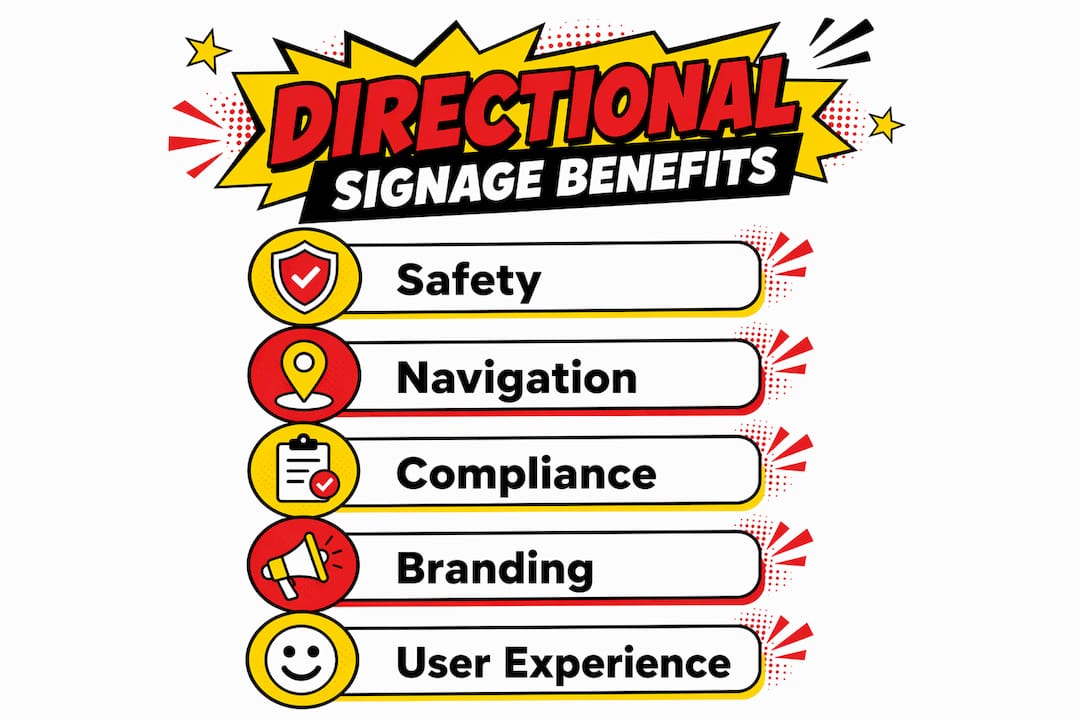
Directional signage is a legal requirement, a safety tool, a navigation system, and a brand asset, and treating it as all four is the only approach that delivers full value.
| Point | Details |
|---|---|
| Place signs at decision points | Signs at junctions and intersections guide visitors effectively; signs elsewhere create clutter. |
| Comply with OSHA, ANSI, and UK regulations | Standardised signage is a legal obligation that reduces fines and liability exposure. |
| Plan signage during design phases | Early integration cuts costs and ensures accessibility compliance from the outset. |
| Use photoluminescent signs for emergencies | These signs maintain visibility during power failures and are critical for safe evacuation. |
| Align signage with brand identity | Consistent materials, colours, and typefaces reinforce professionalism and visitor confidence. |
What we have learned from years of signage projects
The most common mistake we see on sites is too many signs, not too few. Facility managers often respond to navigation complaints by adding more signs, which compounds the problem. Signs placed only at decision points maximise effectiveness. Signs placed everywhere dilute the message and train visitors to ignore them.
The second mistake is treating signage as a last-minute purchase. We have worked on projects where signage was ordered in the final week before opening, which means no time for a proper site audit, no consistency check, and no accessibility review. The result is always a patchwork system that costs more to fix than it would have cost to plan properly.
The third thing we have learned is that the best signage systems combine all three functions in one coherent plan: safety compliance, navigation clarity, and brand identity. These are not competing priorities. A sign can carry your brand colours, meet ANSI contrast requirements, and guide a visitor to the right floor simultaneously. Separating these functions into different budgets and different suppliers is the reason so many sites end up with inconsistent, ineffective signage.
If you are planning a new site, a renovation, or simply reviewing what you already have, start with a decision-point audit. Walk the site as a first-time visitor. Count the moments where you face a choice with no clear guidance. Those are the gaps your signage needs to fill.
— PikPikPOW!
Signage solutions from Pikpikpow for your site
Pikpikpow designs and manufactures bespoke directional and wayfinding signage for businesses across retail, construction, commercial interiors, and the TV and film industry. Every project combines design expertise with durable materials to produce signage that meets regulatory requirements and reflects your brand.

Whether you need a complete signage system for a new build, compliance-focused health and safety signage for an existing site, or internal wayfinding signage for a commercial interior, Pikpikpow delivers print-ready solutions built to last. Get in touch to discuss your site requirements and receive a tailored quote.
FAQ
What is directional signage on a site?
Directional signage is a system of visual signs placed at decision points across a site to guide visitors, workers, and vehicles to their destinations safely and efficiently. It forms part of a broader wayfinding system that includes landmark, zone, destination, and reassurance signs.
Is directional signage a legal requirement in the UK?
Yes. The Health and Safety (Safety Signs and Signals) Regulations 1996 require UK workplaces to display appropriate safety and directional signs, including fire exit and emergency route markings. Failure to comply can result in fines and increased liability.
How does signage improve navigation on complex sites?
Effective wayfinding signage placed at corridor junctions, lift lobbies, and entrance points reduces visitor confusion and stress by providing clear guidance at every moment a choice must be made.
Why do physical signs outperform digital navigation indoors?
Digital tools lose effectiveness inside buildings due to signal loss and screen-reading difficulties. Physical signs require no device or battery and provide immediate, real-time guidance, which is critical during emergencies.
When should I plan signage for a new site or renovation?
Signage planning during construction or renovation reduces costs and prevents accessibility compliance issues. Early integration ensures signs are positioned correctly from day one rather than retrofitted at greater expense.