

TL;DR:
- Effective signage in show homes enhances navigation, reinforces brand identity, and boosts buyer confidence. Proper planning from the start ensures a cohesive system that increases conversions and perceived property value. Modern LED technology offers cost-effective, flexible, and environmentally friendly solutions that positively influence the sales process.
Signage in show home design is defined as the planned use of visual communication elements, from entry monuments to interior wayfinding, to guide buyers, reinforce brand identity, and shape the emotional experience of a property visit. In the property industry, this discipline is more formally known as environmental graphic design or branded environment strategy. The role of signage in show home design goes well beyond labelling rooms. It determines whether a visitor feels confident, engaged, and ready to buy, or confused and underwhelmed. Interior designers, property developers, and real estate agents who treat signage as a core design element, rather than a finishing detail, consistently see stronger buyer engagement and faster sales conversions.
How does cohesive branded signage enhance show home appeal?
Coordinated signage and architectural materials create immersive branded environments that accelerate sales by removing emotional disruption from the buyer journey. When every touchpoint, from the community entrance to the sales suite door, speaks the same visual language, visitors move through the space with confidence rather than hesitation.
The concept of a branded environment means that signage, graphics, materials, and spatial design work as a single system rather than independent elements. Brand 9 Signs, a specialist in homebuilder signage, describes this approach as one that converts casual traffic into confident prospects by maintaining a consistent narrative from the kerb to the kitchen. The practical result is that buyers arrive at the sales conversation already primed by the environment around them.
The numbers support this approach. Distinct, high-quality entry monuments increase approach conversions by 22% through clearer community branding. That figure, drawn from a 2026 Lennar case study conducted by Brand 9 Signs, shows that the first physical impression a buyer receives directly affects whether they walk through the door at all.
A fully cohesive signage system typically includes several layers working together:
- Community entry monuments that establish the development’s identity from the road
- Wayfinding signage directing visitors from the car park to the show home entrance
- Interior display panels reinforcing lifestyle messaging and development features
- Room and door signage completing the aesthetic and defining spatial boundaries
| Signage Layer | Primary Function | Buyer Impact |
|---|---|---|
| Entry monument | Brand identity at approach | Increases approach conversions |
| Wayfinding signs | Navigation from road to door | Reduces visitor drop-off |
| Interior displays | Lifestyle and feature messaging | Builds emotional connection |
| Room and door signs | Spatial definition and aesthetics | Raises perceived property value |
Pro Tip: Brief your signage supplier at the same time you brief your architect. Aligning signage specifications with the build’s material palette from day one prevents costly redesigns later.
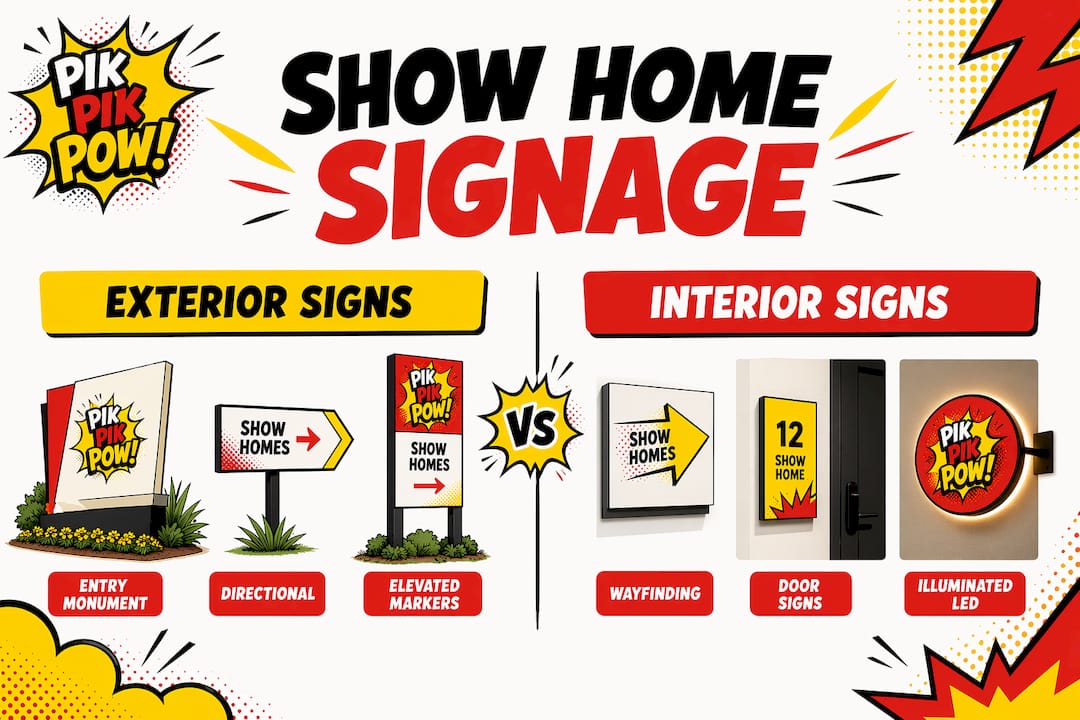
Standardised signage programmes also deliver operational advantages. Large developers using template-based systems report that maintenance complaints fall by 90%, enabling faster deployment across multiple sites. For developers managing several show homes simultaneously, that consistency is a significant time and cost saving.
What interior signage techniques elevate a show home’s atmosphere?
Interior signage is the layer of visual communication that buyers experience most closely. It shapes how they perceive room quality, navigate the space, and remember the property after they leave. The importance of signage in show homes at the interior level is frequently underestimated, yet it is where the most nuanced design decisions occur.

Door signage is a prime example of a detail that carries disproportionate weight. Door signs complete a space’s aesthetic and define psychological room boundaries, shaping visitor perception in ways that go unnoticed consciously but register emotionally. A well-chosen door sign communicates that every detail has been considered, which raises the perceived value of the entire property.
Effective interior signage techniques for show homes include:
- Illuminated feature signs placed in living areas or master bedrooms to create focal points and add warmth
- Wayfinding panels at corridor junctions that guide visitors without cluttering walls
- Lifestyle messaging boards in kitchens or utility rooms that highlight practical features
- Material and finish labels near specification displays, helping buyers understand upgrade options
LED and illuminated signage deserves particular attention for interior show home use. App-controlled LED signs allow developers and designers to adjust colour temperature, brightness, and messaging between viewings without any physical intervention. This flexibility means a show home can present a daytime atmosphere for morning appointments and a warmer evening mood for later visits, all from a single device.
The placement principle for interior signage is straightforward: position signs at natural decision points, not at every available surface. A visitor approaching a staircase needs directional guidance there. A visitor entering the master bedroom does not need a sign telling them what room they are in. Restraint in placement keeps the space feeling curated rather than instructional.
Pro Tip: Use the same typeface and colour palette across all interior signs as you use in the development’s sales brochure. This small consistency reinforces brand recognition and makes the overall experience feel considered.
Small design details such as door signage create a sense of curation that guests notice and remember, raising the perceived value of a space. That insight from interior design research confirms what experienced show home designers already know: buyers buy feelings, and signage shapes those feelings at every turn.
What are the best practices for planning show home signage?
Show home signage must be integrated into the initial site masterplan to avoid bottlenecks and ensure the sales suite is easily located. Treating signage as an afterthought creates two predictable problems: visitors cannot find the show home, and last-minute sign installations look rushed and inconsistent.
The recommended planning sequence is as follows:
- Agree the signage brief during the design development stage. Define typefaces, colours, materials, and sign types before any construction drawings are finalised.
- Map all visitor decision points on the site plan. Identify every location where a visitor must choose a direction, from the site entrance to each room transition inside the show home.
- Specify maintenance requirements for each sign type. Outdoor signs need weather-resistant finishes and scheduled cleaning. Interior signs need dust and fingerprint management protocols.
- Create a dedicated maintenance kit for each show home. Proactive maintenance including cleaning and repair supplies keeps signage looking premium throughout the sales cycle.
- Review signage performance at regular intervals. Visitor feedback and sales team observations often reveal navigation pinch points that were not apparent at the planning stage.
Avoiding signage clutter by displaying only critical navigational information at key decision points reduces visitor cognitive load. The principle is that every sign should answer a question the visitor is already asking. If no visitor would logically ask a question at a given location, no sign is needed there.
Pro Tip: Walk the show home as a first-time visitor before opening day. Note every moment of uncertainty about where to go or what to look at. Each moment of uncertainty is a sign placement opportunity.
Template-based signage programmes allow rapid, consistent installation across development portfolios. Developers using this approach can deploy show home signage across multiple sites without briefing a new supplier each time, which reduces both cost and the risk of inconsistency.
How can LED technology reduce costs and improve signage flexibility?
Modern LED signage technology has changed the economics of show home signage considerably. Traditional neon signs required physical replacement at approximately £500 per unit when they failed or needed updating. LED alternatives eliminate that cost entirely and add app-controlled customisation that traditional signs cannot match.
The shift from neon to LED is not purely financial. App-controlled LED signs allow designers and developers to adjust mood, colour, and messaging in real time. A show home kitchen can display a warm amber tone during evening viewings and a crisp white light during daytime appointments. That level of control was simply not available with traditional signage technology.
| Technology | Replacement Cost | Customisation | Lifespan |
|---|---|---|---|
| Traditional neon | ~£500 per unit | Fixed | 8–15 years |
| LED (standard) | Minimal | Limited | 15–25 years |
| App-controlled LED | Minimal | Full (colour, brightness, content) | 15–25 years |
Digital signage solutions also support modular deployment. A developer can install a core LED display system in a show home and update the content, whether that is pricing information, lifestyle imagery, or development news, without replacing any hardware. For long sales cycles, this flexibility is a genuine operational advantage.
Environmental benefits accompany the cost savings. LED technology consumes significantly less energy than neon equivalents and produces less heat, which matters in tightly staged show home interiors where temperature control affects visitor comfort. Developers managing large portfolios of show homes will find that the cumulative energy saving across multiple sites is material.
Aerial and elevated visual markers improve show home visibility more effectively than traditional low-level signs. Combining elevated external LED signage with a cohesive interior LED programme creates a consistent technological identity that reinforces the development’s premium positioning from the road to the living room.
Key takeaways
Effective show home signage works as a system, not a collection of individual signs, and that system must be planned from the earliest design stage to deliver consistent buyer engagement.
| Point | Details |
|---|---|
| Plan signage from day one | Integrate signage into the site masterplan to prevent navigation failures and last-minute installations. |
| Branded environments convert buyers | Cohesive signage systems increase approach conversions and build emotional confidence before the sales conversation begins. |
| Interior detail raises perceived value | Door signs and wayfinding panels shape buyer perception at the room level, lifting the overall quality impression. |
| LED technology cuts long-term costs | App-controlled LED signs eliminate replacement costs and allow real-time mood and content adjustments. |
| Maintenance is non-negotiable | Dedicated maintenance kits and scheduled reviews keep signage performing throughout the full sales cycle. |
What we have learned from show home signage projects
At Pikpikpow, we have worked across construction, commercial interiors, and retail environments long enough to see the same mistake repeated in show home projects: signage is commissioned after the interior design is complete, which means it is always a compromise. The space has been styled around furniture and finishes, and the signs are then squeezed in wherever they fit. The result is signage that looks like an addition rather than part of the design.
The developers who get this right treat signage as a structural element. They brief their signage supplier alongside their interior designer, not after. They specify sign materials that complement the architectural palette rather than contrast with it. And they walk the space before opening day to test whether a first-time visitor can navigate it without assistance.
We have also seen the consequences of signage clutter first-hand. Show homes that over-sign every room create an experience that feels more like a trade exhibition than a home. Buyers stop reading the signs entirely, which defeats the purpose. The most effective show homes we have worked on use signage sparingly and deliberately, placing it only where a visitor genuinely needs guidance or where a lifestyle message will land at the right emotional moment.
One observation that consistently surprises clients: the quality of the signage material communicates the quality of the build. A show home with premium stone finishes and a cheap foam-board sign on the door sends a contradictory message. Buyers notice the mismatch, even if they cannot articulate it. Matching sign materials to the build specification is one of the simplest ways to reinforce a premium positioning.
Our recommendation for any developer or designer reading this: schedule a signage review at the midpoint of your sales cycle, not just at launch. Visitor patterns change, sales team feedback accumulates, and what worked at opening day may need adjustment three months in. Signage is not a set-and-forget investment.
— PikPikPOW!
Show home signage solutions from Pikpikpow
Pikpikpow works with property developers, interior designers, and real estate agents across the UK to deliver signage that performs throughout the full sales cycle. From community entry monuments to interior wayfinding and app-controlled LED displays, every solution is designed to integrate with your build’s visual identity rather than sit alongside it.
Whether you need a complete signage system for a new development or a targeted refresh of an existing show home, Pikpikpow combines design expertise with precision manufacturing to produce signage that reflects the quality of your build. Our internal wayfinding signage and digital signage ranges are particularly well suited to show home environments where flexibility, durability, and visual consistency are all required. Get in touch with the Pikpikpow team to discuss your project requirements.
FAQ
What is the role of signage in show home design?
Signage in show home design guides visitors through the space, reinforces the developer’s brand identity, and shapes the emotional experience of the property visit. It functions as both a navigational tool and a visual communication system that influences buyer confidence and conversion rates.
How early should signage be planned for a show home?
Signage should be integrated into the initial site masterplan, at the same stage as architectural and interior design briefs. Late-stage signage planning leads to navigation failures and inconsistent installations that undermine the premium impression a show home is designed to create.
Does interior signage really affect buyer perception?
Door signage and interior wayfinding panels define psychological room boundaries and create a sense of curation that buyers notice and remember. Research from interior design specialists confirms that these details raise the perceived value of a space, even when buyers cannot identify exactly why.
What are the advantages of LED signage over traditional neon in show homes?
LED signage eliminates the approximately £500 per unit replacement cost associated with traditional neon and adds app-controlled customisation for colour, brightness, and content. This allows developers to adjust the show home’s atmosphere between viewings without any physical intervention.
How do you prevent signage clutter in a show home?
Place signs only at genuine visitor decision points, where a visitor is already asking a directional or informational question. Displaying only critical navigational information at key junctions reduces cognitive load and keeps the space feeling like a home rather than an exhibition.