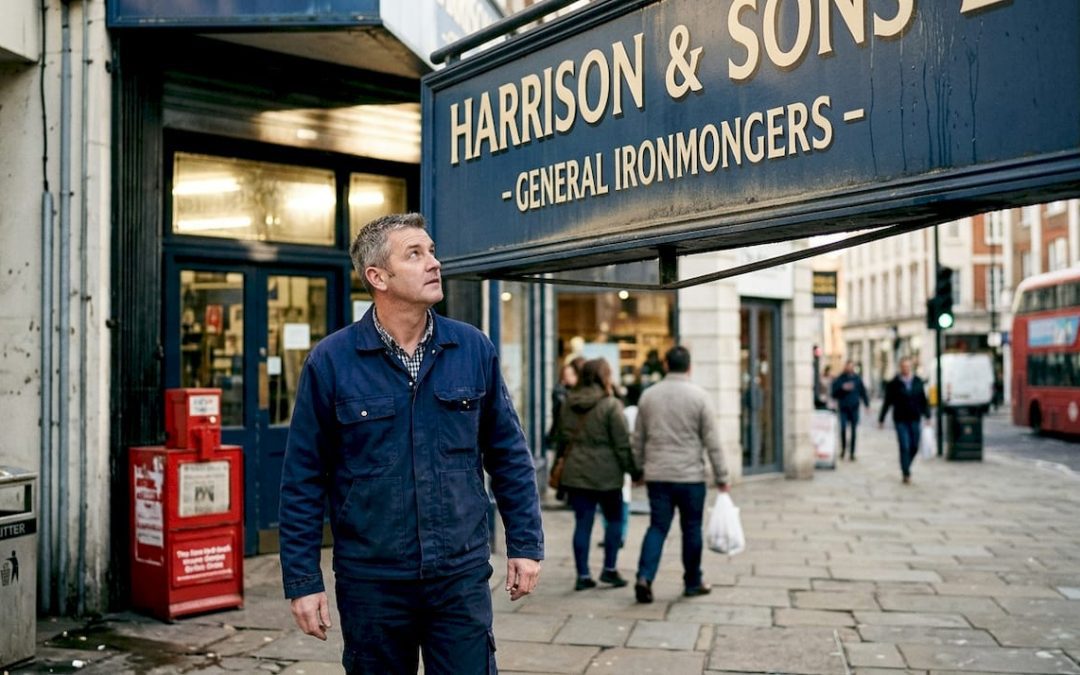
Many business owners treat signage as a one-off purchase, something to sort out at the start and revisit only when it falls apart. That approach carries real risk. Damaged or faded signs are not just an eyesore; they create regulatory exposure, undermine customer confidence, and quietly erode the brand equity you have worked hard to build. Whether you manage a retail unit, a commercial interior, or a construction site, the durability of your signage directly affects your safety record, your compliance standing, and how your business is perceived. This guide walks you through everything you need to know to make informed, lasting decisions about your signage investment.
Table of Contents
- What is durable signage?
- The business case for durable signage
- Durable signage for safety and compliance
- How durable signage boosts brand visibility
- Best practices: Choosing and maintaining durable signage
- Upgrade your business with expert signage solutions
- Frequently asked questions
Key Takeaways
| Point | Details |
|---|---|
| Safety and compliance | Durable signage is essential for meeting HSE standards and reducing legal risks. |
| Brand impact | Maintaining high-quality signage elevates customer trust and reinforces brand identity. |
| Long-term savings | Investing in durable signs minimises costly replacements and maintenance over time. |
| Practical application | Following best practices ensures your signage stays effective and visually appealing for years. |
What is durable signage?
Durable signage refers to signs built to withstand the conditions of their environment over an extended period, without significant degradation in appearance, legibility, or structural integrity. It is the opposite of temporary or short-term signage, which is designed for brief campaigns, events, or interim use.
The materials used are the primary differentiator. Durable signs are typically made from:
- Aluminium and stainless steel, which resist corrosion and hold up in outdoor environments
- High-density polyethylene (HDPE) and acrylic, which offer weather resistance and colour stability
- Treated or composite wood, suitable for interior architectural applications
- Dibond (aluminium composite material), widely used for fascia signs and construction hoardings
- UV-resistant vinyl laminates, applied over rigid substrates to protect printed graphics from fading
Temporary signage, by contrast, often uses foam board, standard PVC, or untreated materials that degrade quickly under UV exposure, moisture, or physical contact.
Durability is non-negotiable in specific settings. Safety signs on construction sites, wayfinding systems in commercial buildings, and outdoor retail fascia signs all face conditions that will destroy a poorly specified sign within months. As the HSE guidance makes clear, damaged signs risk fines and liability for the business responsible. Choosing the right substrate and finish from the outset is not a luxury; it is a practical necessity. Our signage materials guide covers the full range of options in detail.
The business case for durable signage
Understanding what makes signage durable, let us look at why durability translates directly into measurable value for your business.
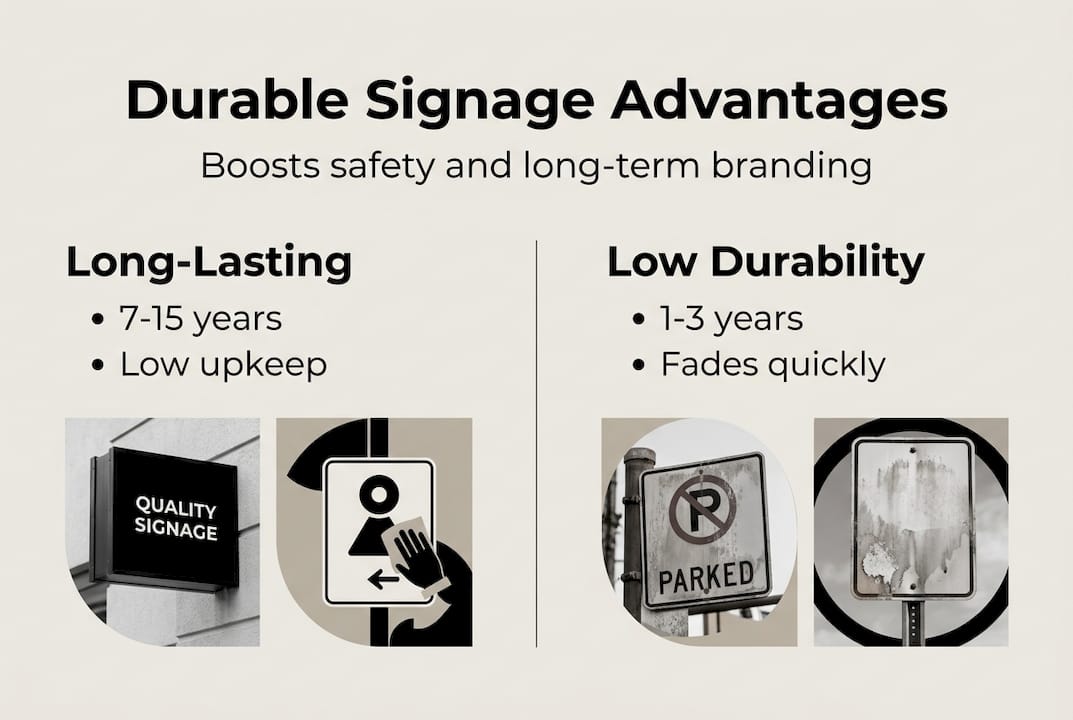
The most immediate financial argument is replacement cost. A cheap sign that lasts 18 months will cost you more over five years than a well-specified sign installed once and maintained properly. Factor in the labour cost of removal and reinstallation, potential downtime, and the disruption to your premises, and the savings from cutting corners disappear quickly.
| Factor | Durable signage | Low-cost signage |
|---|---|---|
| Average lifespan | 7 to 15 years | 1 to 3 years |
| Replacement frequency | Low | High |
| Compliance risk | Minimal | Significant |
| Brand consistency | Maintained | Inconsistent |
| Total cost over 10 years | Lower | Higher |
The compliance dimension is equally important. Damaged signs on premises and construction sites risk fines and liability under HSE regulations. A single enforcement notice or improvement notice can cost thousands of pounds, and that is before any civil liability arising from an incident linked to inadequate signage. Reviewing your signage compliance rules and ensuring your health and safety signage meets current standards is a straightforward way to reduce that exposure.
Brand reputation is the third pillar. A faded fascia sign or a cracked interior wayfinding panel tells customers that your business does not pay attention to detail. That impression forms in seconds and is difficult to reverse.
Pro Tip: Set a quarterly signage inspection schedule. Walk your premises and note any signs showing discolouration, physical damage, or illegibility. Catching small issues early prevents them from becoming costly replacements or compliance failures.
Durable signage for safety and compliance
While cost and branding are front of mind, safety and legal compliance are often overlooked but critical drivers for robust signage.
HSE regulations require that safety signs are not only present but legible, intact, and correctly positioned at all times. Clear, intact signage is required by HSE rules to prevent workplace hazards. A sign that has faded beyond readability, or that has been physically damaged, offers no protection and may actively increase your liability.
Key areas where durable signage is legally required include:
- Construction sites: Mandatory safety, prohibition, and warning signs under the Construction (Design and Management) Regulations 2015
- Chemical storage areas: Hazard identification signs compliant with COSHH regulations
- Machinery zones: Warning and instruction signs that must remain legible throughout the equipment’s operational life
- Emergency exits and fire routes: Signs must meet BS 5499 standards for photoluminescence and visibility
- Public-facing premises: Accessibility and wayfinding signs under the Equality Act 2010
“Signage that deteriorates in service is not a minor maintenance issue. It is a compliance failure with direct legal consequences for the duty holder.”
The British Standards that govern signage durability include BS EN ISO 7010 for safety signs and BS 5499 for fire safety signs. Both specify minimum performance requirements for materials, colours, and legibility under real-world conditions. Our health and safety sign guidance and construction signage standards pages provide further detail on what is required in each context.
How durable signage boosts brand visibility
Having seen the role of signage durability in compliance, let us look at its power for your brand’s reputation and visibility.
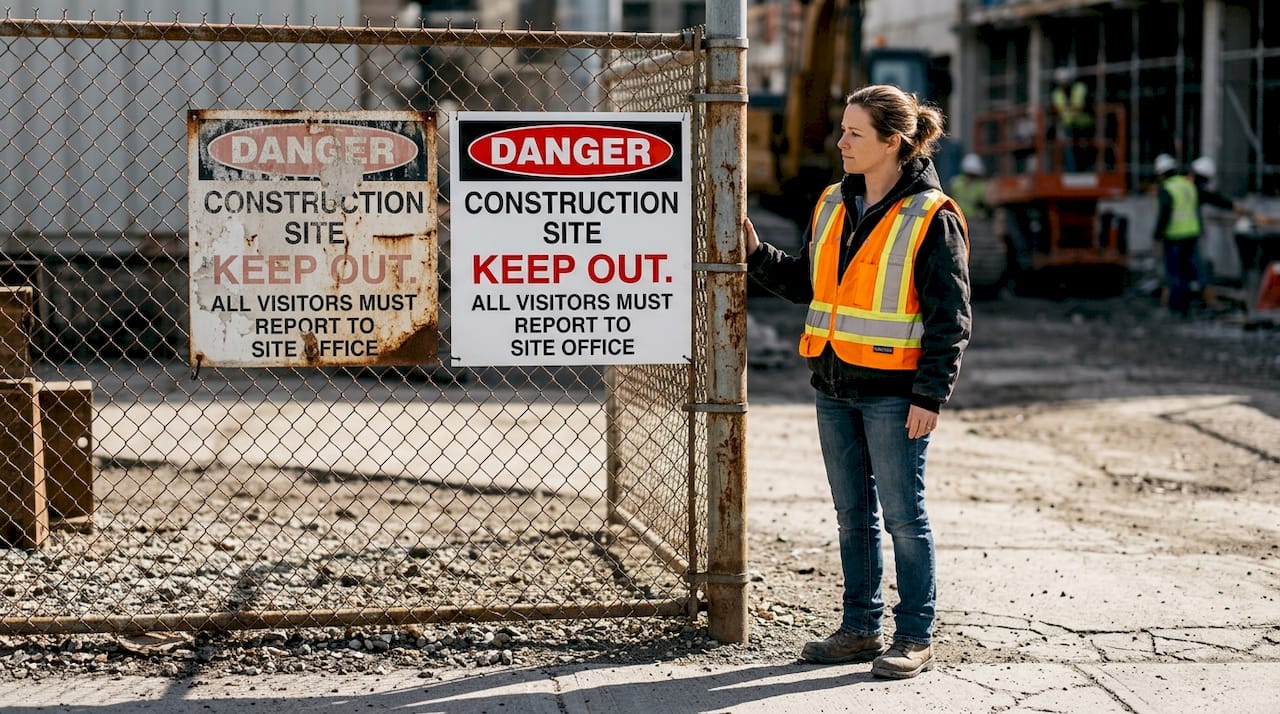
A sign that looks sharp on day one but fades within two years does not just look poor; it actively signals neglect. Damaged or faded signage reduces visibility and brand trust in ways that are difficult to quantify but easy for customers to feel.
| Signage type | After 1 year | After 5 years |
|---|---|---|
| Durable (UV-stable, powder-coated) | Minimal change in appearance | Consistent colour and legibility |
| Standard (untreated, basic print) | Noticeable fading and wear | Significant degradation, likely replaced |
| Brand impression (durable) | Strong and consistent | Reinforces professionalism |
| Brand impression (standard) | Acceptable initially | Undermines credibility |
For retail businesses, the fascia sign is often the first brand touchpoint a customer encounters. An upgrade from a tired, faded board to a well-lit, colour-accurate fascia can shift customer perception immediately. The same principle applies to interior signage in commercial spaces, where wayfinding panels, reception graphics, and branded wall displays all contribute to the overall impression of your business.
Pro Tip: Consistency across all signage touchpoints multiplies the effect. When your exterior fascia, interior wayfinding, and branded displays all use the same colours, fonts, and finishes, the cumulative brand impression is significantly stronger than any single sign alone. Our bespoke signage tips and guidance on how to design site signage can help you build that consistency. You can also explore the full range of signage solutions available for different business contexts.
Best practices: Choosing and maintaining durable signage
Knowing the value of durable signage, it is time to put that knowledge into practice with actionable steps.
Selecting and maintaining signage correctly is a process, not a single decision. Follow these steps to get it right:
- Assess the environment first. Is the sign going outdoors, in a high-traffic interior, or on a construction site? Each environment has different demands for UV resistance, impact resistance, and moisture protection.
- Match the material to the risk. Use aluminium composite or powder-coated steel for outdoor and construction applications. Use acrylic or aluminium for interior architectural signage. Consult our signage systems advice for environment-specific recommendations.
- Incorporate your branding from the outset. Specify your exact brand colours using Pantone or RAL references, and confirm that the chosen substrate and print process can reproduce them accurately over time. Cutting corners on colour matching leads to inconsistency across your estate.
- Choose the right finish. Matt, gloss, satin, and textured finishes all have different durability profiles. For outdoor use, powder-coated or anodised finishes on metal outperform painted surfaces significantly.
- Plan your maintenance schedule. Clean signs regularly using appropriate products for the substrate. Inspect fixings, edges, and printed surfaces at least quarterly. Address minor damage promptly before it spreads. Damaged signs are less effective and increase safety and compliance risks.
- Use a reputable supplier with proven materials. Ask for material specifications and warranties before committing. Our guide to choosing signage materials gives you the questions to ask and the answers to look for.
Pro Tip: When ordering signage for a large site or multi-location estate, order a small quantity of spare graphic panels at the same time. Reprinting a single panel months later often results in a colour mismatch due to batch variation. Having spares on hand means rapid, consistent replacement when damage occurs.
Maintenance is not just about aesthetics. Well-maintained signage retains its structural integrity, which matters for both safety and longevity. Routine care, similar in principle to asphalt maintenance for car parks, prevents small issues from becoming expensive failures.
Upgrade your business with expert signage solutions
With best practices in hand, securing the right signage partner is your next business move. At Pik Pik POW!, we work with business owners and facilities managers across retail, commercial interiors, and construction to deliver signage that performs from day one and keeps performing. Our materials are specified for longevity, our production is precision-controlled, and our team understands the compliance requirements your business faces.
Whether you need a complete signage systems overhaul, a move into digital signage solutions for dynamic environments, or a robust wayfinding solution for a complex interior, we can help you specify, design, and install it correctly. Get in touch with our team to discuss your requirements, or browse our category pages to see what is possible for your business.
Frequently asked questions
What makes signage durable?
High-quality materials, weather-resistant finishes, and professional installation all determine the longevity and resilience of signage. Choosing the right substrate for the environment is the single most important factor, as damaged signs risk fines and liability when they fail in safety-critical locations.
How does regular maintenance affect signage lifespan?
Routine cleaning, fixing minor damage quickly, and updating graphics as needed extends signage life and ensures it remains compliant. Neglecting maintenance allows small issues to escalate, and damaged signs increase both safety and compliance risks over time.
Is durable signage required by UK law?
Yes, especially for safety and health information signs. British Standards and HSE regulations specify durability and clarity requirements to prevent workplace hazards, and clear, intact signage is a legal obligation for most business premises and construction sites.
Can digital signage be as durable as traditional options?
Modern digital signage uses robust enclosures and weatherproofing, making it suitable for both outdoor and high-traffic areas. Advances in screen technology and protective housing mean digital displays can now match or exceed the operational lifespan of many traditional sign types.
What are the most common reasons for signage failure?
Poor material specification, prolonged UV exposure, vandalism, physical impact, and lack of routine maintenance are the leading causes of premature signage wear. Addressing these factors at the specification stage significantly reduces the likelihood of early failure.
Recommended
- Why branded signage matters for your business success
- Choosing Signage Materials The Ultimate Guide
- Role of Signage in Corporates – Driving Brand Impact
- Bespoke signage: boost branding & visibility in 2026
- Don’t Forget Line and Symbol Painting in Your Parking Lot Maintenance! – ProZone Ltd.
- Why is typography important in branding? | Brainiac Media