

TL;DR:
- Updating school signage enhances communication, safety, and brand visibility through modern digital systems that increase engagement by 45%. It enables swift emergency responses, simplifies content management, and reinforces community pride with consistent branding across campus locations. A strategic, phased approach involving audits, stakeholder input, and ongoing maintenance ensures effective implementation and lasting impact.
Updating school signage means replacing outdated or ineffective signs with modern, purpose-driven designs and technologies that improve communication, safety, and your school’s brand visibility. Schools moving from printed posters to digital signage systems see a 45% increase in student engagement, a figure that reflects a fundamental shift in how students absorb information. The case for why update school signage goes beyond aesthetics. It touches every part of school life, from how quickly staff can push a fire evacuation notice to how confidently a prospective family walks away from an open day. This guide covers the practical, strategic, and operational reasons to act now.
Why update school signage: the core case for change
Modern school signage, which the industry refers to as educational environmental graphics when it encompasses wayfinding, branding, and digital communication together, does far more than label rooms. The human brain processes visuals 60,000 times faster than text, which means a well-placed digital screen communicates a timetable change, a safeguarding message, or a canteen menu before a student has finished reading the first line of a printed notice. That speed advantage alone justifies the investment for most schools.

The benefits of updating signage fall into three clear categories: communication, safety, and brand identity. Each category compounds the others. A school with clear, consistent, on-brand signage communicates authority and care to every visitor, every day. Platforms such as Yodeck and Khazina Digital have made centralised content management accessible even to schools with limited IT resource, removing the excuse that digital signage is too complex to manage.
92% of teachers report that digital tools positively influence learning, which positions updated signage not as a facilities decision but as a pedagogical one. Administrators who frame signage renewal in those terms tend to secure budget approval faster. The importance of school signage, properly argued, sits at the intersection of operations, safeguarding, and school improvement.
How does digital signage transform school communication?
The shift from static boards to dynamic digital displays changes the relationship between information and audience. Static content becomes invisible within days. Content unchanged for more than two days loses student attention entirely, which means a printed timetable pinned in September is functionally ignored by October. Digital signage solves this by making content updates fast, targeted, and free from the cost of reprinting.
The operational benefits for administrators are significant:
- Centralised management: One update reaches every screen across every building simultaneously, removing the need for manual notice board maintenance.
- Role-based content control: Assigning content by staff area means the canteen manager updates menus, the pastoral lead manages safeguarding screens, and the admin office controls general announcements, each without affecting the others.
- Scheduled content: Screens can display different content at different times of day, showing arrival reminders at 8:30am and after-school club information at 3:00pm without any manual intervention.
- Interactive capability: Touchscreen kiosks in reception areas allow visitors to self-navigate, reducing the burden on front-of-house staff.
- Integration with school MIS: Systems like Yodeck can pull live data from school management information systems to display real-time timetable changes or room bookings.
Khazina Digital’s signage platform, widely used in UK schools, allows non-technical staff to drag and drop content into pre-designed templates, which means you do not need a dedicated IT manager to keep screens current and relevant.
Pro Tip: Assign content update responsibilities to a small group of staff or sixth-form students. Schools that distribute ownership of signage content see higher update frequency and more relevant messaging across campus.
Why is updated signage critical for campus safety?
Digital signage functions as a visual emergency broadcast system. Administrators can override all screens with evacuation maps, lockdown instructions, or critical safety notices with a single click, reaching every corridor, canteen, and common space at once. PA systems are limited by noise levels, hearing impairments, and the physical reach of speakers. Screens are not.
The speed advantage is measurable. Schools can push lockdown instructions to every screen in under 60 seconds, a capability that supplements voice announcements and works simultaneously across the entire site. During a noisy lunch period or a practical lesson with machinery running, a visual alert on a nearby screen is far more reliable than a PA message.
Key safety applications for updated school signage include:
- Displaying live evacuation routes specific to each building zone
- Showing safeguarding contact information and reporting procedures on a rolling basis
- Communicating visitor management protocols at reception and entry points
- Alerting staff to medical emergencies or site security issues without broadcasting to students
- Integrating with third-party emergency notification systems for automated alerts
Schools that integrate signage with their emergency notification systems gain a layer of redundancy that Ofsted and local authority safeguarding reviews increasingly expect to see documented. The impact of school signage updates on safety preparedness is not theoretical. It is a practical, auditable improvement to your duty of care.
Does updated signage strengthen school branding and community pride?
Signage is the most public-facing application of a school’s brand. Every parent, prospective family, contractor, and community member forms an impression of your school before they reach the reception desk, based entirely on what they see outside and in the entrance. A polished campus signals care and attention to detail, which directly influences enrolment conversion and the confidence families place in your leadership.
Consistent signage reinforces trust and pride among families, students, and staff. When your school colours, logo, and typography appear consistently across entrance signs, corridor graphics, sports hall banners, and digital displays, the school feels like a coherent, well-run institution rather than a collection of buildings that have accumulated notices over the years.
“Effective signage integrates branding and wayfinding, enhancing visitors’ experience and reinforcing identity across every touchpoint on campus.”
When planning a branding-focused signage update, prioritise locations in this order:
- Main entrance and gatehouse — the first and most powerful brand impression
- Reception and foyer — where visitors form their lasting opinion of the school’s culture
- Corridors and stairwells — high-traffic areas where student pride and school values can be reinforced daily
- Sports hall and gymnasium — visible during community events, parents’ evenings, and lettings
- Car park and external wayfinding — often neglected but critical for first-time visitors and open day attendance
- Canteen and social spaces — where students spend unstructured time and where brand tone of voice can be expressed informally
Design elements that carry the most brand weight include your school crest or logo, your official colour palette, your mascot mark if you have one, and your school values rendered in a typographic treatment that reflects your ethos. These are not decorative choices. They are strategic communication decisions.
Traditional versus modern signage: what are the real differences?
The limitations of traditional signage are not just aesthetic. They are operational and financial.
| Feature | Traditional signage | Digital signage |
|---|---|---|
| Update cost | Reprint required each time | No print cost for content changes |
| Update speed | Days to weeks | Minutes |
| Emergency use | Not possible | Full-screen override in under 60 seconds |
| Engagement | Fades after 2 days | Dynamic content maintains attention |
| Brand consistency | Varies by printer and age | Controlled centrally via CMS |
| Maintenance | Physical replacement needed | Software updates and screen servicing |
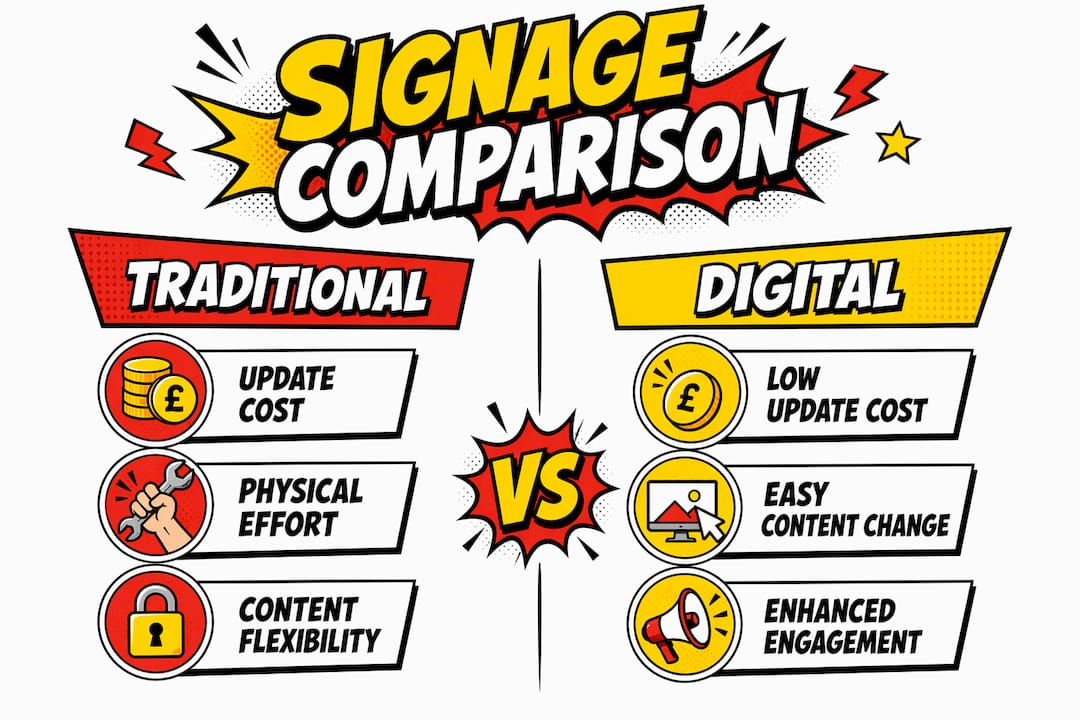
Paper posters and printed boards are not without value. For permanent wayfinding, room identification, and regulatory notices, durable physical signage remains the right choice. The mistake schools make is using printed materials for time-sensitive content, which creates the “wallpaper effect” where static content is ignored because students learn it never changes.
The most effective signage strategies for schools combine both formats. Physical signs handle permanent information. Digital screens handle everything that changes. This hybrid approach keeps costs manageable while delivering the responsiveness that modern school communication requires.
Pro Tip: Before investing in new screens, audit your existing signage for content that has not changed in over a month. That audit will show you exactly where digital signage will deliver the fastest return.
How to plan a school signage update project
A structured approach to signage renewal avoids the common pitfall of buying screens before identifying what problems they need to solve. Schools must identify clear communication or operational challenges before purchasing signage, not the other way around.
Follow these steps to plan your update effectively:
- Conduct a signage audit: Walk every area of your campus and document existing signage against your current brand guidelines. A signage audit aligned to brand standards speeds planning and identifies inconsistencies that undermine your visual identity.
- Engage stakeholders early: Involve teaching staff, support staff, students, and your governing body. Each group uses the campus differently and will surface needs you would not identify alone.
- Set measurable goals: Define whether you are prioritising safety communication, student engagement, visitor experience, or brand consistency. Goals determine which locations and technologies to prioritise.
- Select materials and platforms carefully: For physical signage, consider durability, weather resistance, and compliance with planning permissions. For digital, evaluate platforms on ease of use, not just feature count. You can explore school-specific signage systems to compare options suited to educational environments.
- Phase your implementation: Phased implementation prioritises high-impact locations to optimise budget and immediate impressions. Start with the main entrance and reception, then expand to corridors and specialist areas.
- Train your team: Identify who will manage content updates for digital screens and provide structured training before go-live. A system nobody knows how to use will revert to static content within weeks.
- Plan for maintenance: Budget for annual reviews of physical signage condition and software updates for digital systems. Signage is not a one-off project. It is an ongoing commitment to communication quality.
If you are working alongside a construction or renovation project, coordinating signage installation with your contractor from the outset avoids costly retrofitting later.
Key takeaways
Updated school signage delivers measurable improvements to communication, safety, and brand identity when planned strategically and maintained consistently.
| Point | Details |
|---|---|
| Digital signage boosts engagement | Schools switching to digital displays see a 45% increase in student engagement versus printed posters. |
| Safety response is faster | Digital screens push lockdown or evacuation notices to every campus screen in under 60 seconds. |
| Brand consistency builds trust | Consistent signage across all campus touchpoints reinforces community pride and supports enrolment. |
| Static content becomes invisible | Content unchanged for more than two days loses student attention and should be replaced with dynamic displays. |
| Phased planning reduces risk | Starting with high-impact areas like entrances and reception delivers immediate results within budget. |
Our view on school signage from Pikpikpow
Schools often treat signage as a facilities task rather than a communication strategy, and that framing is where most projects go wrong. We have worked with educational clients who installed screens in every corridor, only to find them displaying the same slide deck six months later because nobody owned the content. The technology was right. The planning was not.
The most important thing we tell school administrators is this: signage is an ecosystem, not a product. A new entrance sign or a digital display only delivers value if someone is responsible for keeping it current, on-brand, and purposeful. That means assigning ownership, building update routines into the school calendar, and reviewing signage as part of your annual communications plan rather than treating it as a one-off capital spend.
We also see schools fall into the trap of prioritising digital screens over physical brand presence. A beautifully designed entrance sign, a set of corridor graphics that reflect your school values, or a reception feature wall that tells your story to every visitor, these are not old-fashioned alternatives to digital. They are the foundation on which digital content sits. Get the physical environment right first, then layer in dynamic content where it adds genuine communication value.
The schools that get this balance right do not just look better. They communicate more clearly, respond faster in emergencies, and present a more confident identity to the families they are trying to attract and retain.
— PikPikPOW!
How Pikpikpow can help with your school signage update
Pikpikpow designs and manufactures bespoke signage for schools across the UK, covering everything from entrance and wayfinding signs to full digital signage solutions and interior brand graphics. Whether you are starting with a single reception feature wall or planning a campus-wide signage renewal, the team at Pikpikpow works with you from initial audit through to installation and aftercare.
Every project begins with understanding your school’s brand guidelines, communication goals, and budget. Pikpikpow then produces a phased proposal that prioritises high-impact areas first, so you see results quickly without overcommitting your budget. For schools combining physical and digital formats, Pikpikpow’s signage systems range covers both, with options suited to primary, secondary, and further education environments. Get in touch with the Pikpikpow team for a no-obligation consultation and site assessment.
FAQ
Why should schools update their signage now?
Outdated signage becomes invisible to students within days and fails to support modern safety and communication requirements. Digital and refreshed physical signage directly improves engagement, emergency response, and visitor first impressions.
What is the difference between digital and traditional school signage?
Traditional signage is static and requires physical reprinting to update, while digital signage allows instant content changes from a central system. Digital displays are particularly effective for time-sensitive information such as timetable changes, event notices, and emergency alerts.
How does updated signage improve school safety?
Modern digital signage systems allow administrators to override all screens instantly with evacuation routes or lockdown instructions, reaching every area of campus simultaneously and supplementing PA systems in noisy environments.
How much does a school signage update cost?
Costs vary significantly depending on the scope, materials, and whether digital displays are included. A phased approach starting with entrance and reception signage is the most cost-effective way to begin, with Pikpikpow providing tailored quotes based on your specific requirements.
How do I start planning a school signage update?
Begin with a full campus signage audit to identify what exists, what is outdated, and where the highest-impact opportunities are. Set clear goals around safety, engagement, or branding before selecting any products or platforms.