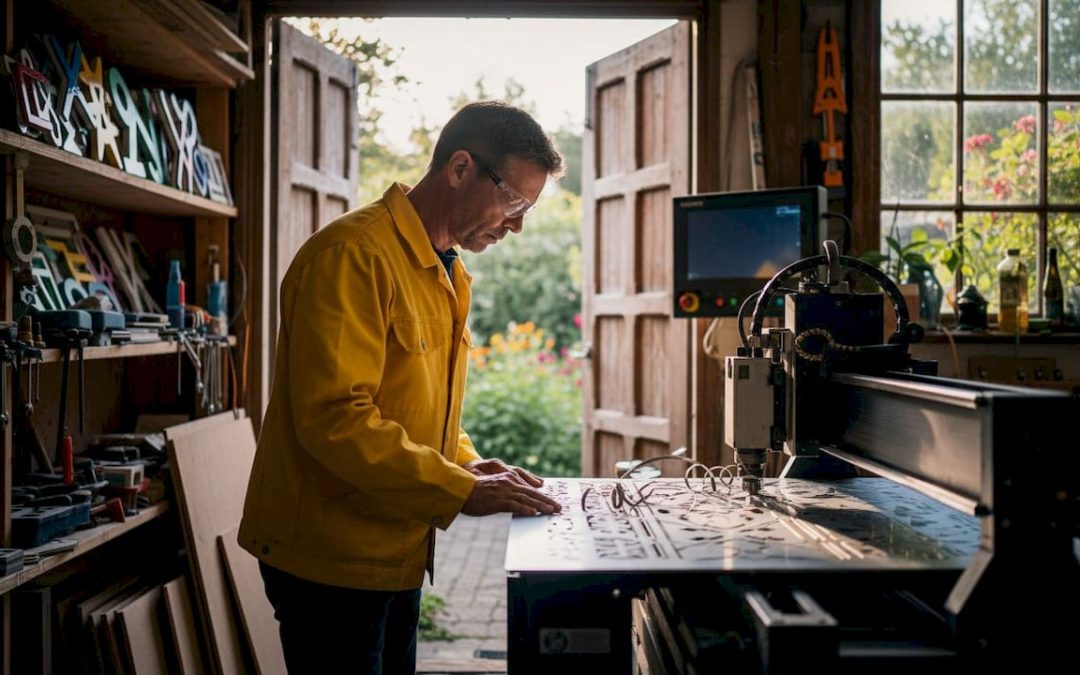
Precision manufacturing in signage is the application of computer-controlled technologies and exacting fabrication processes to produce signs with accurate dimensions, clean finishes, and consistent quality. For signage professionals, it is the difference between a sign that fits perfectly on site and one that requires costly rework. The core benefits are clear:
- Dimensional accuracy ensures signs fit installation sites without adjustment or remediation
- Technical drawings with exact measurements, tolerances, and material specifications prevent fabrication errors before they occur
- CNC routers, laser cutters, water jet cutters, and CAD software enable complex designs at scale
- Precise fabrication supports regulatory compliance, structural integrity, and long-term durability
- Precision-led processes can reduce total production time by defining dimensions and material requirements clearly before manufacturing begins
Table of Contents
- How signage manufacturing technology has evolved
- Key precision manufacturing technologies used in signage
- [The processo progettazione chiusure su misura: guida completa outlines strategies for avoiding delays and issues during signage manufacturing through precision-led processes, which can be applied effectively from concept to finish.](#the-processo-progettazione-chiusure-su-misura-guida-completahttpsgsgporteveronacompostprocesso-progettazione-chiusure-su-misura-guida-completa-outlines-strategies-for-avoiding-delays-and-issues-during-signage-manufacturing-through-precision-led-processes-which-can-be-applied-effectively-from-concept-to-finish)
- How precision manufacturing improves signage quality and efficiency
- Sustainability and eco-friendly practices in UK signage manufacturing
- How to get the most from precision manufacturing on your signage projects
- Challenges and limitations of precision manufacturing in signage
- Real-world examples of precision manufacturing in signage
- Precision manufacturing versus traditional signage methods
- Future trends in precision manufacturing for signage
- Pikpikpow brings precision manufacturing to your signage brief
- Key takeaways
How signage manufacturing technology has evolved
Early signage relied entirely on hand skills. Craftspeople painted lettering by hand, cut shapes with basic saws, and assembled components by eye. The results were often inconsistent, particularly across large batches or repeat orders.
Mechanical cutting tools improved throughput in the mid-twentieth century, but accuracy still depended heavily on the operator. The real shift came with CAD software, which moved design from paper sketches to technically precise digital files. Suddenly, every measurement could be verified before a single piece of material was touched.
The arrival of CNC machining and laser technology in commercial signage production changed the scale of what was possible. Complex lettering, intricate cut-outs, and illuminated channel letters became repeatable rather than exceptional. Today, modern workflows connect digital design files directly to fabrication machinery, with minimal manual intervention between the two.
- Hand craftsmanship produced unique but inconsistent results
- Mechanical tools improved speed without solving accuracy problems
- CAD software introduced verifiable, fabrication-ready design files
- CNC and laser technology enabled mass customisation at commercial scale
- Digital-to-fabrication integration now drives modern signage production
Key precision manufacturing technologies used in signage
CNC routers are the workhorse of most UK signage workshops. They cut aluminium composite, acrylic, foam PVC, and timber with computer-controlled accuracy, reproducing the same profile repeatedly without drift. For fascia signs, dimensional lettering, and routed panels, CNC delivers the consistency that hand cutting cannot.
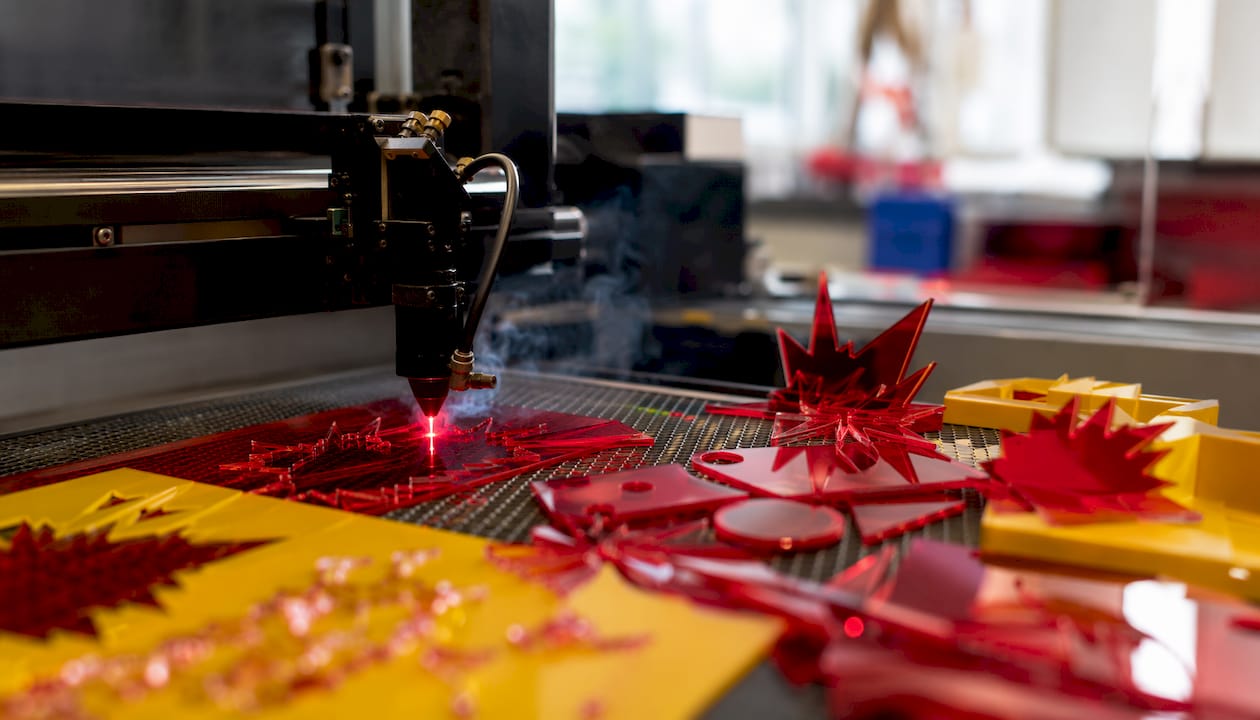
Laser cutters excel where fine detail matters. They produce clean, smooth edges on acrylic, thin metals, and wood, making them the preferred tool for intricate logos, small lettering, and decorative elements. The heat-affected zone is minimal on well-calibrated machines, which preserves material integrity at the cut edge.
Water jet cutters handle thicker or harder materials, including stone, thick steel plate, and glass composites, without applying heat. Because the cutting action is purely mechanical, there is no thermal distortion, which is critical when tight tolerances are required on dense substrates.
CAD software underpins all three. Tools such as AutoCAD and SolidWorks produce fabrication-ready drawings that include structural details, mounting specifications, and electrical layouts for illuminated signs. Once a design is locked, the file travels directly to the cutting machine, removing the manual transcription step that historically introduced errors.
Pro Tip: Involve your fabricator at the CAD stage, not after sign-off. Confirming material availability and machine tolerances before the design is locked prevents the most common and expensive mismatches between what is drawn and what can actually be built.
The integration of CAD with CNC and laser machinery shortens production cycles and reduces rework by guiding cutting tools directly from digital files.
The processo progettazione chiusure su misura: guida completa outlines strategies for avoiding delays and issues during signage manufacturing through precision-led processes, which can be applied effectively from concept to finish.
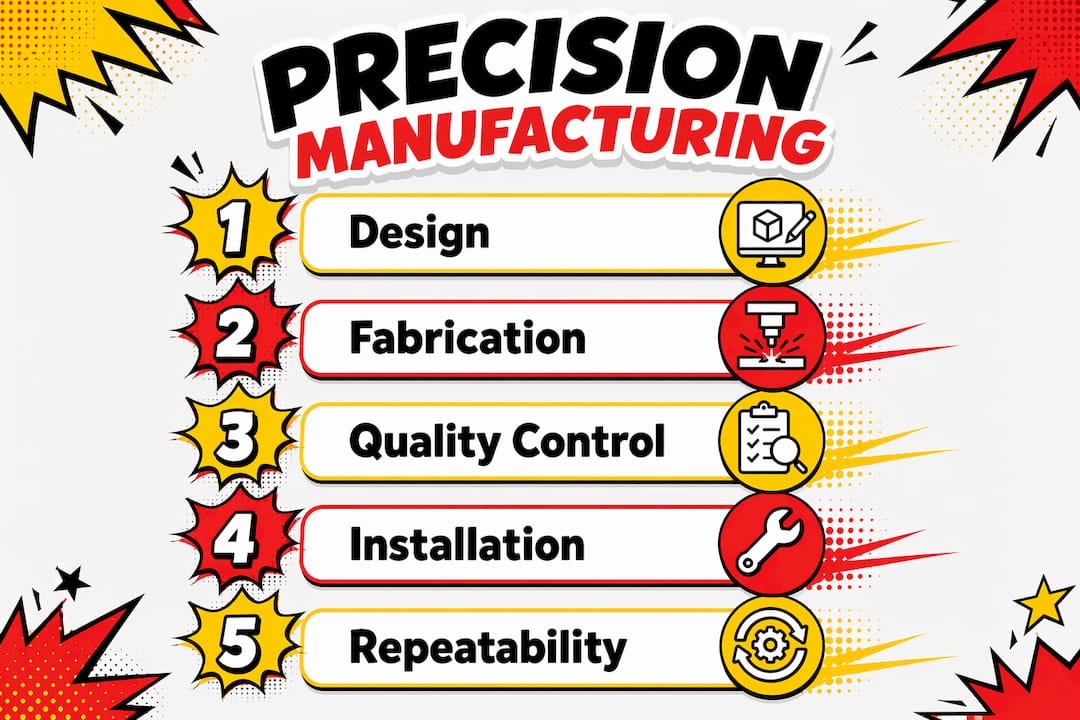
A well-run signage project follows a structured sequence, with precision built into every stage rather than checked at the end.
| Stage | Technologies used | Key quality checkpoint |
|---|---|---|
| Concept and design | CAD software, 3D modelling | Dimensions verified against site survey data |
| Prototyping | CNC router, laser cutter | Tolerance and fit confirmed before full production |
| Material selection | CAD specification sheets | Material matched to environment and cutting method |
| Fabrication and cutting | CNC router, laser cutter, water jet | Cut accuracy checked against drawing tolerances |
| Printing and graphics | Large-format printers | Graphic dimensions aligned to physical substrate |
| Finishing and surface treatment | Powder coating, vinyl application | Coating adhesion and colour consistency checked |
| Electrical integration | LED drivers, CAD electrical layouts | Wiring verified against CAD before enclosure |
| Installation | Technical drawings, site survey | Sign positioned against drawing reference points |
Critical considerations at each phase:
- Design: use 3D CAD modelling to assess structural feasibility before committing to a design direction
- Prototyping: verify tolerances physically, not just on screen, particularly for components that interlock or stack
- Material selection: match substrate to both the cutting technology and the installation environment; outdoor aluminium behaves differently from interior acrylic under temperature change. The right material choice directly affects longevity and cut quality
- Fabrication: confirm that the cutting file matches the approved drawing version before the machine runs
- Printing: align print files to the physical substrate dimensions, accounting for any bleed or wrap
- Finishing: apply surface treatments before electrical components are fitted to avoid masking or contamination
- LED integration: CAD electrical layouts should specify driver locations, cable runs, and access points for maintenance
- Installation: construction site signage and permanent architectural signs both require installation drawings that account for fixing methods and structural loads
How precision manufacturing improves signage quality and efficiency
Fixing a fabrication error during installation costs up to 10 times more than catching it at the design stage. That single figure explains why precision at the front end of a project is a financial decision, not just a quality one.
Precision reduces dimensional errors and material wastage. When cutting paths are optimised in CAD before the machine runs, offcuts are minimised and material yield improves. Across a batch of signs, those savings accumulate quickly.
Repeatability is another practical gain. Once a CNC or laser file is validated, every subsequent unit comes out to the same specification. For retail rollouts or wayfinding systems across multiple sites, that consistency is what keeps a brand looking coherent. Better adherence to design intent also means fewer client revisions and faster sign-off.
Faster turnaround times follow naturally from fewer errors. When the design file is fabrication-ready and the material is correctly specified, production moves without interruption. For clients with tight installation windows, that reliability is often as valuable as the sign itself.
Sustainability and eco-friendly practices in UK signage manufacturing
Precision manufacturing supports more responsible production, and that matters increasingly to UK clients and specifiers.
- Optimised cutting plans in CAD reduce material waste by nesting shapes efficiently on each sheet
- Precision processes minimise waste and energy consumption through better resource management
- Eco-friendly substrates such as recycled aluminium composite and FSC-certified timber can be machined accurately without compromising cut quality
- Consistent material specification makes offcut management and recycling more practical, as offcuts are predictable in size and type
- Production planning software reduces energy use by batching similar jobs and minimising machine idle time
- LED integration in illuminated signage, planned through CAD electrical layouts, reduces long-term energy consumption compared with fluorescent alternatives
The broader point is that precision and sustainability reinforce each other. Less waste, fewer reprints, and fewer site remediation visits all reduce the environmental footprint of a signage project.
How to get the most from precision manufacturing on your signage projects
Getting the full benefit of precision manufacturing requires decisions made early, not adjustments made late.
Pro Tip: Incorporate relevant British Standards and local planning requirements into your technical drawings at the concept stage. Discovering a compliance issue after fabrication begins is one of the most avoidable causes of project delay in UK signage work.
Follow this checklist when setting up a precision-led signage project:
- Conduct a thorough site survey before design begins, capturing fixing points, structural constraints, and utility locations
- Use CAD and 3D modelling to stress-test the design against fabrication constraints, including material thickness and machine bed sizes
- Confirm material availability and lead times with your fabricator before locking the design
- Include installation details, fixing methods, and structural loads in the technical drawings, not as an afterthought
- Define tolerances explicitly in the drawing pack so the fabrication team knows the acceptable range for each dimension
- Plan graphics application around the physical substrate dimensions, not the other way around
- Build a sign-off checkpoint between design and fabrication where the fabricator reviews the file for buildability
Custom signage workflows that integrate design and fabrication considerations from the outset reduce project surprises and improve delivery predictability. The bespoke signage workflow guide from Pikpikpow covers this process in detail for project managers.
Challenges and limitations of precision manufacturing in signage
Precision manufacturing is not without its constraints, and understanding them helps you plan projects more realistically.
Capital cost is the most immediate barrier. CNC routers, laser cutters, and water jet systems require significant investment in both equipment and maintenance. For smaller sign shops, access to these technologies often means working with specialist fabricators rather than owning the machinery outright.
Setup time can offset speed gains on very short runs. Programming a CNC file and setting up the machine takes time that only pays off once the run length justifies it. For a single bespoke sign, a skilled fabricator working manually may sometimes be faster than a full CNC setup.
Material limitations apply to each technology. Laser cutters are not suited to highly reflective metals without specialist optics. Water jet cutters struggle with very thin or fragile materials that cannot withstand the cutting pressure. CNC routers require rigid workholding, which can be difficult for irregular or pre-formed substrates.
Human skill remains essential despite automation. A CNC machine cuts what the file tells it to cut. If the CAD file contains an error, the machine reproduces that error precisely. Operator knowledge, design review processes, and fabrication checkpoints are still the safeguard against systematic mistakes.
Finally, not every design translates cleanly from screen to shop floor. Organic shapes, very fine details below a machine’s minimum feature size, and designs that ignore material grain or structural logic can all create fabrication problems that precision technology alone cannot solve.
Real-world examples of precision manufacturing in signage
Retail rollouts illustrate the value of precision most clearly. When a national retailer installs the same fascia sign across dozens of locations, every unit must fit the same bracket system and carry the same visual weight. CNC-routed aluminium composite panels, cut from a single validated file, deliver that consistency. Without it, each site becomes a bespoke installation problem.
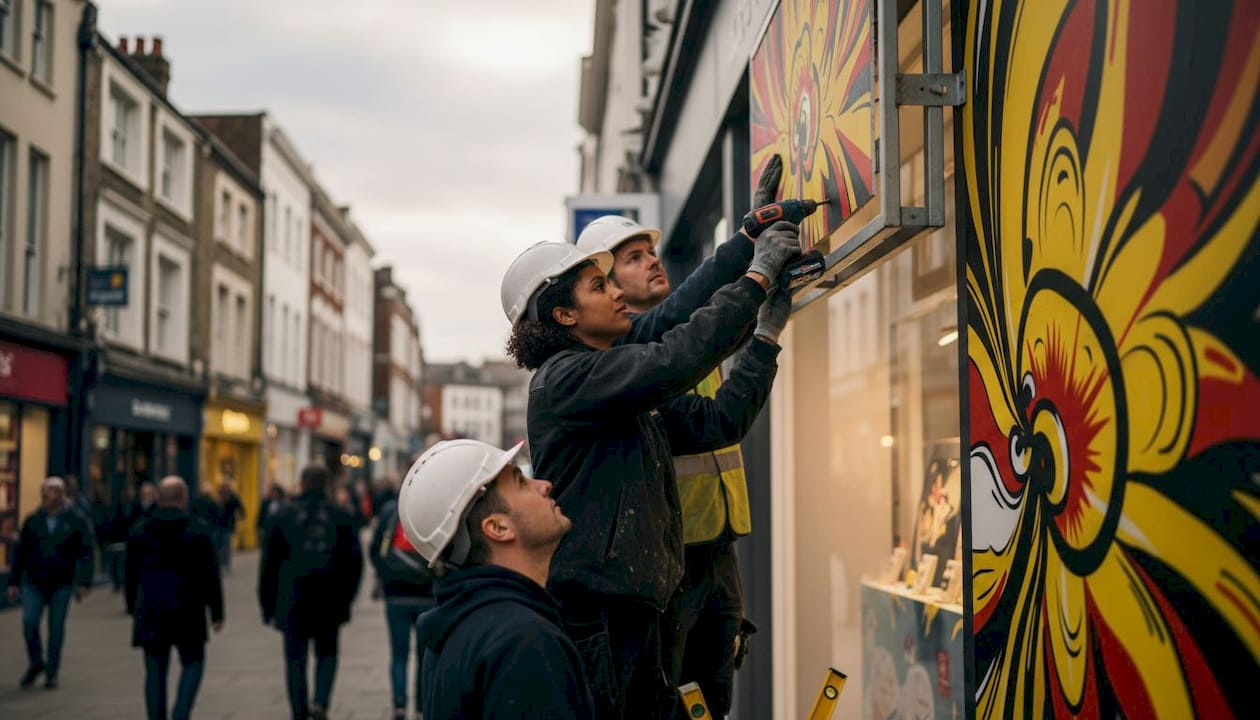
Architectural signage for commercial interiors demonstrates a different dimension of precision. Wayfinding systems in hospitals, airports, and office buildings require signs that align with building grids, meet accessibility standards, and integrate with structural fixings specified by architects. CAD drawings that include mounting details and structural calculations make that coordination possible before anyone arrives on site.
Illuminated channel letters for shopfronts show how precision affects both appearance and function. The letter faces, returns, and backs must fit together within tight tolerances for the LED modules to sit correctly and the light to distribute evenly. A few millimetres of variation in the return depth changes the visual output noticeably. CNC-formed aluminium returns, cut to the CAD specification, eliminate that variation.
For the TV and film industry, where signage is often built to tight deadlines and must photograph convincingly under studio lighting, precision manufacturing allows complex props and set dressing to be produced quickly and accurately from digital files, with no time lost to manual adjustment on set.
Precision manufacturing versus traditional signage methods
The contrast between precision manufacturing and traditional hand-craft methods is most visible in three areas: accuracy, repeatability, and scalability.
Traditional methods depend on operator skill. An experienced sign writer or fabricator can produce excellent work, but the result varies between individuals and between sessions. Precision manufacturing removes that variability by encoding the specification in the digital file and letting the machine execute it consistently.
Repeatability is where the gap is widest. A hand-cut letter can be reproduced, but matching it exactly requires the same template, the same operator, and the same conditions. A CNC file reproduces the same letter to the same tolerance every time, regardless of who runs the machine or when.
Scalability follows from repeatability. Traditional methods scale by adding skilled labour, which is expensive and slow to train. Precision manufacturing scales by running more machine hours from the same validated file, which is faster and more cost-predictable.
Traditional methods retain advantages in certain contexts. One-off artistic signs, hand-painted lettering, and gilded glass work carry a craft quality that machine production cannot replicate. For heritage projects or bespoke artistic commissions, hand skills remain the right choice. For commercial signage at any meaningful scale, precision manufacturing delivers better outcomes on quality, cost, and timeline.
Future trends in precision manufacturing for signage
Several developments are reshaping what precision manufacturing can deliver for signage producers in the UK.
Automation and robotics are moving beyond cutting into finishing and assembly. Robotic arms are already used in some larger fabrication facilities for consistent paint application and component handling, reducing the manual steps that introduce variability late in the production process.
Additive manufacturing, commonly known as 3D printing, is expanding the range of forms that can be produced economically. Complex three-dimensional letterforms and decorative elements that would require extensive CNC machining time can now be printed directly, particularly in smaller formats.
Software integration is tightening the link between design, production planning, and machine control. Platforms that connect CAD files to production scheduling and material ordering reduce the administrative gap between design approval and fabrication start, cutting lead times further.
Sustainable material development is accelerating. New substrates designed for precision cutting, including bio-based polymers and recycled composites, are becoming available at commercial scale, giving specifiers more options for projects with environmental requirements.
Finally, augmented reality tools for site survey and installation planning are reducing the gap between the digital model and the physical installation. When an installer can overlay the CAD model onto the actual wall before drilling, the risk of misalignment drops considerably.
Pikpikpow brings precision manufacturing to your signage brief
Pikpikpow is a UK-based design and signage company that combines strong design expertise with precision fabrication to produce bespoke indoor and outdoor signage for retail, construction, commercial interiors, and the TV and film industry.
Where many suppliers treat design and production as separate stages, Pikpikpow builds fabrication considerations into the design process from the start. That means fewer revisions, faster production, and signs that arrive on site ready to install. From precision-manufactured signage systems to wide-format printing and architectural sign solutions, the full production process is handled under one roof. Get in touch with Pikpikpow to request a quote for your next signage project.
Key takeaways
Precision manufacturing in signage reduces costly errors, improves repeatability, and cuts production time by up to 20% when fabrication requirements are defined clearly at the design stage.
| Point | Details |
|---|---|
| Early error detection saves money | Fixing fabrication errors at installation costs up to 10 times more than catching them at the design stage. |
| Production time savings | Precision-led processes can reduce total production time by up to 20% through clear upfront specification. |
| Technology drives consistency | CNC routers, laser cutters, and CAD software together eliminate the variability that manual methods introduce. |
| Sustainability benefits | Optimised cutting plans and better resource management reduce material waste and energy use across production. |
| Pikpikpow’s approach | Pikpikpow integrates design and precision fabrication from brief to installation for bespoke UK signage projects. |