TL;DR:
- Prop signage is any actor-interacted sign used on screen, differentiating it from set dressing. It communicates story elements visually while aiding actor performance, with design and material choices impacting production quality. Proper planning and collaboration ensure prop signage contributes seamlessly to narrative, professionalism, and brand identity.
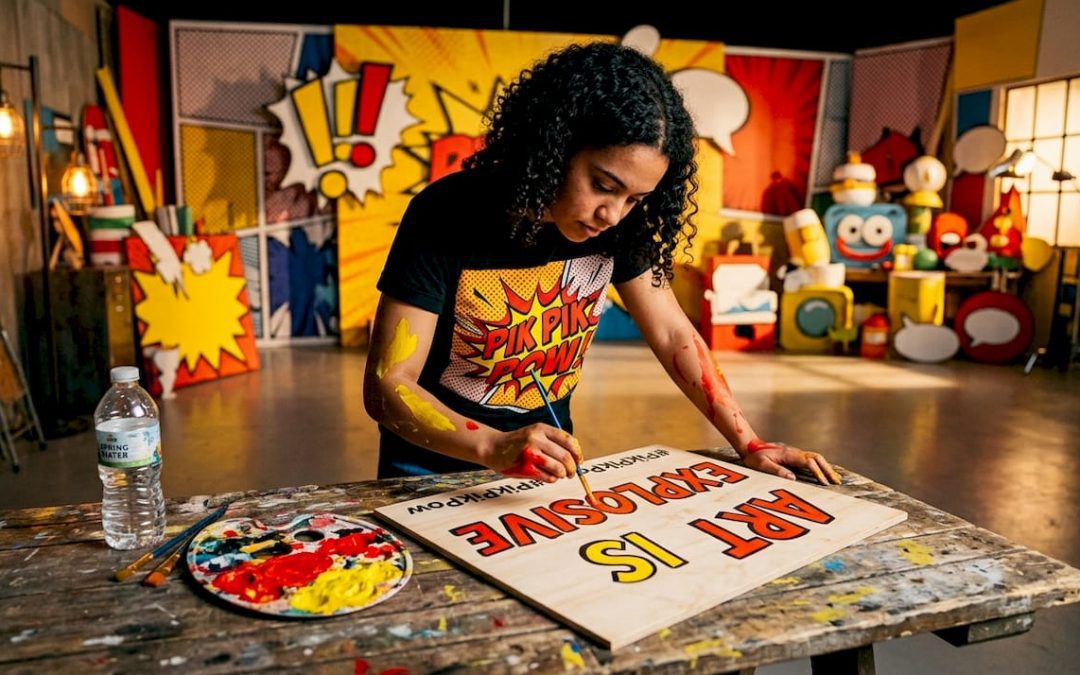
Prop signage is one of those production elements that rarely gets discussed in pre-production meetings, yet it shapes what audiences see and feel on screen. If you work in film, television, or commercial production, you have almost certainly handled prop signage without necessarily calling it by name. The term can cause confusion. Is it a prop? Is it set dressing? Does it belong to the art department or the props master? This article answers all of that directly. You will find a clear definition of prop signage, an explanation of its storytelling role, practical guidance on materials and creation, and best practices for integrating it on set.
Table of Contents
- Key takeaways
- The definition of prop signage
- How prop signage tells stories without words
- Types and real-world examples of prop signage
- How to create effective prop signage
- Applying prop signage on set: best practices
- My take on prop signage and its real value
- How Pikpikpow can support your prop signage needs
- FAQ
Key takeaways
| Point | Details |
|---|---|
| Prop signage defined | Prop signage is any sign that actors interact with on screen, distinguishing it from static set dressing. |
| Storytelling function | Prop signs communicate character, location, and theme without dialogue, making them a visual storytelling tool. |
| Two main categories | Hero prop signage requires fine detail for close-ups; background prop signage supports atmosphere and continuity. |
| Material choice matters | High-resolution printed PVC is the industry standard for durability, visual clarity, and repeated use. |
| Production coordination | Effective prop signage requires close collaboration between the props department and the art department from the earliest planning stage. |
The definition of prop signage
At its core, prop signage refers to any sign, placard, board, or printed visual element that is used as a prop within a film, commercial, television production, or event setting. The word “prop” comes from the theatrical term “property,” which describes any object managed by the props department during a production.
The key distinction separating prop signage from other on-set signs comes down to actor interaction. If an actor picks up a sign, holds it, reads from it, or directly engages with it during a scene, it is a prop. If a sign hangs on a wall purely to fill the background and no performer touches it, it belongs to the set dressing category, managed by the art department.

Hero props versus background props
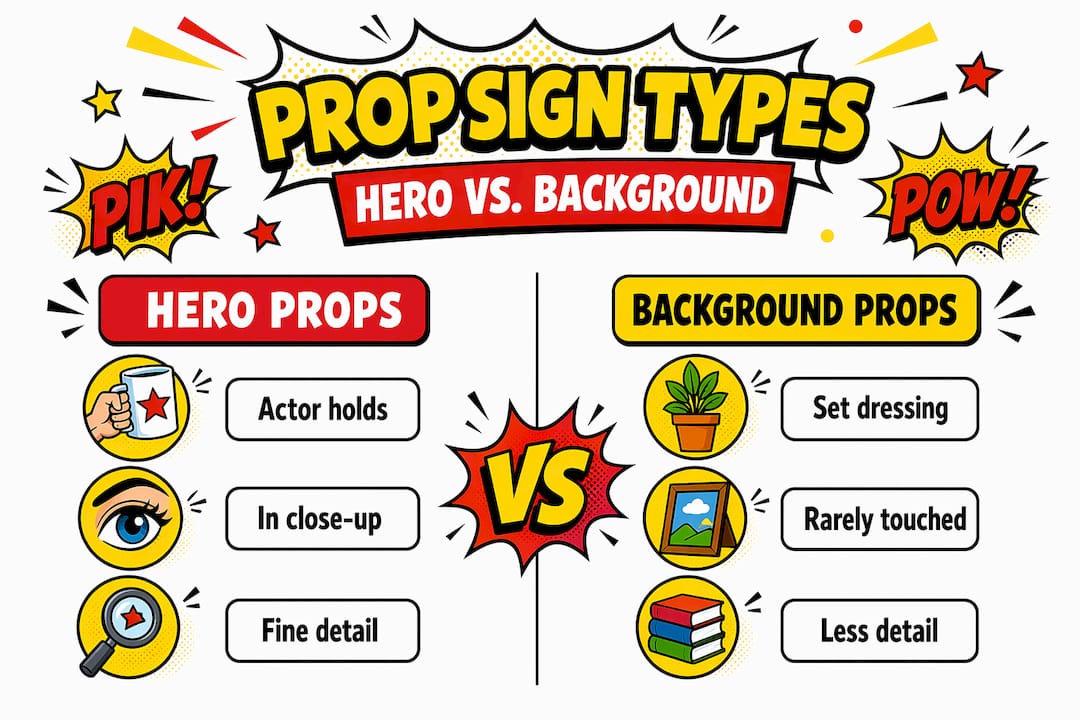
Within prop signage itself, there is an important split:
- Hero prop signage appears in close-up shots and receives direct camera scrutiny. Hero props may need working lights, specific textures, or tactile details that hold up under a macro lens.
- Background prop signage sits in the mid or far distance of a shot. It reinforces atmosphere and period accuracy without being examined in detail. Visual consistency matters more than surface finish at this range.
Think about a protest scene in a drama series. The signs carried by actors are hero prop signage, printed with legible, thematically relevant text and built to withstand being waved about for multiple takes. The signs taped to shop windows in the background are set dressing, not props at all.
Examples across film and commercial contexts
Prop signage turns up in a wide range of productions:
- Branded shop signs that characters carry or interact with in commercials
- Placards held by actors in political drama or documentary recreation
- Menu boards that characters read aloud in a restaurant scene
- Directional or wayfinding signs that actors point to or follow on screen
- Promotional boards used in brand activation shoots where talent must be seen engaging with the product message
Pro Tip: Always confirm with the props master and director whether a sign will be touched by talent before committing to a material or finish. A beautiful printed sign can warp or crack when handled repeatedly under hot studio lighting.
How prop signage tells stories without words
Prop signage acts as a silent storyteller, delivering information about place, time period, social status, and character in a single frame. This is one of the most powerful and underutilised aspects of production design.
Consider a simple example. A character walks into a room carrying a hand-painted sign reading “LAST DAY OF BUSINESS.” The audience absorbs the financial context of that scene without a single line of exposition. The prop sign did the work. This is visual subtext in its most direct form.
Emotional and thematic reinforcement
Props in acting serve as tools that reinforce character development and emotional context, and signage props are particularly effective because they carry language. A torn, faded sign tells a story of neglect. A brightly lit neon sign suggests energy or commerce. The condition, font, colour, and material of the sign all communicate to the audience before any performer opens their mouth.
This is why experienced props masters treat prop signage as a design decision rather than a logistics one. The sign is not just filling space. It is contributing meaning.
“Props are the vocabulary of the visual language filmmakers use to tell their stories. A well-chosen prop can say more about a character than pages of dialogue.” — Beverly Boy Productions
How signs support actors on set
Beyond what they communicate to the camera, prop signs also help actors ground themselves in a scene. Holding a physical object, particularly one with clear context, gives performers something tangible to react to. Props management by the department ensures that these objects are coherent with the character’s world, supporting believable performance and maintaining narrative consistency across multiple takes and shoot days.
Types and real-world examples of prop signage
Prop signage takes many physical forms depending on the production context. Understanding these types helps you specify the right solution before you go into production.
Handheld versus environmental prop signage
| Type | Common use | Key requirement |
|---|---|---|
| Handheld prop signs | Protest scenes, event shoots, photo booths | Lightweight, durable, easy to grip |
| Environmental prop signs | Shopfronts, wayfinding on set, period signage | Weather-resistant, visually accurate at distance |
| Branded commercial props | Product launches, activation events | On-brand graphics, close-up ready finish |
| Cultural and themed signs | Heritage productions, celebrations, weddings | Thematic accuracy, recognisable visual identity |
Photo booth prop signage is a well-established category in the events industry. Professional event prop signs are typically double-sided, weigh around one pound for comfortable handling, and are printed on 6mm PVC for vibrancy and long-term durability. They are designed for high-volume use at birthdays, weddings, corporate gatherings, and graduations, where guests will pick them up repeatedly throughout an event.
Cultural prop signage carries identity and tradition, adding meaning beyond decoration. Statement fans, heritage phrases, and culturally resonant imagery all function as prop signage in contexts where community identity matters as much as visual impact.
In commercial shoots, prop signage also appears as branded merchandise boards, point-of-sale materials held by talent, and directional signs that guide the viewer’s eye toward a product. Strategic placement of prop signage reinforces brand messaging in ways that traditional on-screen advertising cannot replicate.
How to create effective prop signage
Creating prop signage that works on camera requires more than printing a design on a board. You need to think about material performance, visual clarity, and the physical demands placed on the sign during production.
Recommended approach for production-grade prop signage
- Define the sign’s role first. Establish whether it is a hero prop or a background element before specifying any material. Hero signs need close-up-ready finishes and stronger construction.
- Choose the right substrate. UV-printed 5mm PVC is a standard choice for prop signage because it offers durability, high colour saturation, and a surface that holds up under repeated handling and studio lighting.
- Design for camera, not for print. On-screen typography needs to be larger and bolder than standard print design. Thin fonts and small type can become unreadable even at moderate camera distances.
- Control the weight. Signs that actors carry for multiple takes must be comfortable. Heavy boards cause fatigue and disrupt performance. Lightweight builds with clear graphics are the professional standard.
- Double-side where practical. Double-sided printing adds utility. In event and photo booth contexts, it means every angle produces a usable image. On set, it removes the risk of a blank reverse appearing in a wide shot.
Pro Tip: Request a physical proof before the shoot day, not just a digital mockup. Colours can shift between screen and print, and scale can be difficult to judge from a PDF. A proof eliminates costly reprints on the day.
For guidance on durable signage materials, it is worth reviewing what works across different production environments before committing to a specification.
Applying prop signage on set: best practices
Good prop signage only delivers results if it is integrated into the production thoughtfully. Here are the key principles to follow when applying prop signage in film and commercial projects.
- Plan placement around narrative requirements. Where a prop sign appears in frame should serve the story. Work with the director and director of photography during prep to confirm eyelines, shot sizes, and whether the sign needs to be readable by the audience or simply visible.
- Coordinate between departments early. Logistical coordination between props and set departments is necessary to maintain continuity and thematic coherence. A sign created by the props department that clashes with the art department’s colour palette will create problems in post.
- Manage continuity rigorously. Prop signs must look identical across multiple shooting days, especially if coverage is split. Photograph every sign at the end of each day and keep spares for anything that may get damaged.
- Use prop signage for brand storytelling in commercials. When shooting brand content, prop signs can reinforce messaging, create product context, and make advertising feel more naturalistic. A character interacting with a brand sign reads very differently to a cut-away product shot.
- Test under actual lighting conditions. Studio lights and location lighting affect how printed materials read on camera. Gloss finishes can produce unwanted reflections. Matt laminates are generally safer for close-up hero signs.
My take on prop signage and its real value
I have worked with production teams across the TV and film sector, and the same pattern comes up consistently. Prop signage gets left until late in prep. It gets treated as a quick print job rather than a design decision. And then, on the shoot day, someone notices that the sign an actor is holding does not match the period, or the font looks wrong at 4K, or it is too heavy to hold comfortably for more than a few minutes.
In my experience, the productions that get prop signage right treat it the same way they treat costume. Every sign that enters frame tells the audience something. It has a period. A tone. A condition. A social context. Getting those details correct costs very little extra effort at the specification stage. Getting them wrong costs retakes, reshoots, or expensive post-production fixes.
The other thing I see underestimated is the role of prop signage in commercial work. Brands spend significant budgets on production and then use generic-looking signs on set that undermine the overall visual identity. A properly designed prop sign, built to the same brand standards as every other asset in the shoot, makes the whole production feel more considered. Audiences notice, even when they cannot articulate why.
If you are new to prop signage production, start by asking one question during prep: what does this sign need to communicate, and to whom? The answer shapes every decision that follows.
— PikPikPOW!
How Pikpikpow can support your prop signage needs
At Pikpikpow, we work directly with film and commercial production teams across the UK, producing signage that is built for the demands of professional shoots. Whether you need custom signage systems for a period drama set or precision-printed props for a brand activation campaign, we combine design expertise with print manufacturing that meets production-grade standards.
Our professional printing services cover a full range of substrates, including high-resolution PVC and matt-laminated boards suited to both hero and background prop signage applications. We can produce single items or full batch runs, with turnaround times designed around production schedules rather than standard retail lead times. If you have an upcoming shoot and need prop signage that performs on camera, contact the Pikpikpow team to discuss your brief.
FAQ
What is prop signage?
Prop signage is any sign or printed visual element that actors interact with on screen during a film, television, or commercial production. It is managed by the props department and is distinct from set dressing, which remains in the background without actor contact.
What is the difference between prop signage and set dressing?
The difference comes down to interaction. If talent touches, holds, or reads a sign during a scene, it is a prop. If the sign simply exists as background detail without being handled, it is classified as set dressing.
What materials are used for prop signage?
High-resolution printed PVC is the most widely used material for prop signage, offering durability, colour vibrancy, and a surface that withstands repeated handling. Five or six millimetre PVC is standard, with matt laminate finishes preferred for close-up camera work to reduce glare.
What are the main types of prop signage?
The two primary types are hero prop signage, which appears in close-up and requires fine surface detail, and background prop signage, which supports atmosphere and period accuracy at a distance. Handheld signs, environmental signs, branded commercial props, and cultural themed signs all fall within these two categories.
How do I commission prop signage for a production?
Work with a specialist signage and print supplier who understands production timelines and camera requirements. Confirm the sign’s role in the scene first, specify the correct substrate for that use, and always request a physical proof before the shoot day.