

TL;DR:
- Modular signage consists of standard, interchangeable components that can be updated without replacing entire signs. It offers cost-effective, quick, and flexible solutions ideal for sectors with frequently changing spaces, such as retail, education, and corporate environments. Proper management, including scheduling and stock control, maximizes benefits and ensures consistent branding over time.
Modular signage is defined as a system of standardised, interchangeable components, including frames, panels, inserts, and connectors, that can be assembled, updated, and reconfigured without replacing the entire sign. The industry also refers to this approach as a modular signage system or managed signage infrastructure. For professionals in retail, education, and corporate environments, this distinction matters: you are not buying a sign, you are investing in a long-term asset that adapts as your spaces change. The core benefits are flexibility, reduced maintenance costs, and consistent branding across multiple sites or floors, all without the disruption of full sign replacement.
What is modular signage made of, and how does it work?
A modular signage system is built from four standard components: frames, panels, inserts, and connectors. Each part has a defined role, and the system only works because every component is manufactured to the same tolerances. That standardisation is what makes the whole approach practical.

Frames provide the structural housing, typically fabricated from aluminium. Aluminium is preferred for modular signage because it is durable, lightweight, and maintains a professional appearance over time. Panels sit within the frame and carry the visual content. Inserts are the changeable graphic or text elements, often printed on card, acrylic, or vinyl. Connectors hold everything together using clips, rails, or magnetic attachments, depending on the system specification.
Assembly is straightforward by design. Standardised accessories such as stainless steel clips and pre-drilled holes mean that most modules require no specialist tools. Individual modules typically weigh between 3kg and 5kg, which means a single person can handle installation without additional labour. That weight range also reduces the risk of wall damage during fitting or updates.
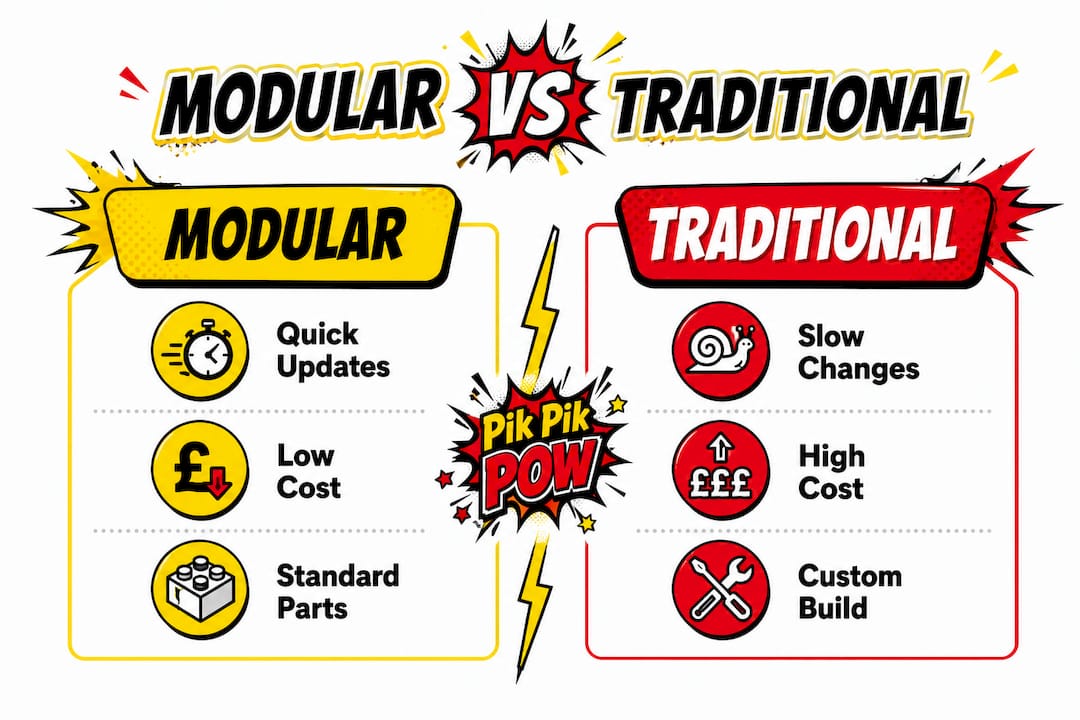
The table below compares modular signage components against their equivalents in a traditional fixed signage setup.
| Feature | Modular signage | Traditional signage |
|---|---|---|
| Panel replacement | Swap insert or module only | Full sign removal required |
| Installation time | 15–30 minutes per module | Several hours, often two people |
| Wall impact | Minimal, reuses fixings | High, new fixings each time |
| Maintenance skill needed | Low, no specialist tools | Medium to high |
| Component reuse | Yes, across sign types | No, bespoke per sign |
What are the main benefits of modular signage solutions?
The financial case for modular signage is clear. Individual module repairs typically cost £15–£40, compared with £150–£400 for a full panel replacement on a traditional sign. That difference compounds quickly across a large estate with dozens or hundreds of signs.
Beyond cost, the benefits cover four practical areas:
- Installation speed. Modular installation takes 15–30 minutes per module for a single person, versus the longer timeframes and additional manpower that traditional methods require. Faster installation means less disruption to staff and visitors.
- Brand consistency. Standardised rails, inserts, and end caps can be reused across different sign types throughout a building or across multiple sites. Every sign looks the same because every sign uses the same components.
- Reduced wall damage. Modular systems require less intrusive updates, preserving wall integrity when signs need to change. Traditional signage often leaves behind holes, marks, or residue that require remedial work.
- Sustainability. Modular signage reduces printing waste by replacing only the insert rather than the entire sign. Reusable hardware means fewer materials go to landfill over the system’s lifetime.
Scalability is another practical advantage. A retail chain opening a new branch can order the same frames and connectors used across existing sites. An educational institution can update room names at the start of each academic year without calling in a contractor.
Pro Tip: Keep a small stock of common inserts and replacement modules on site. On-site spare parts prevent urgent message changes from becoming lengthy procurement projects, and they cost very little to hold.
Pairing modular signage with modular furniture for flexible workspaces follows the same logic: standardised, reconfigurable assets reduce long-term costs and support spaces that change frequently.
How does modular signage compare to traditional signage in practice?
The practical differences between modular and traditional signage show up most clearly in three areas: maintenance time, brand control, and facility management workload.
Traditional static signage requires full removal and replacement whenever content changes. That process involves a contractor visit, new fixings, potential wall repairs, and a lead time measured in days or weeks. Modular systems reduce that process to a panel swap that a facilities team member can complete in under half an hour.
| Lifecycle metric | Modular signage | Traditional signage |
|---|---|---|
| Content update time | Under 30 minutes | Days to weeks |
| Update cost | £15–£40 per module | £150–£400 per sign |
| Brand consistency risk | Low, standardised components | High, bespoke production each time |
| Wall repair frequency | Rare | Common |
| Long-term scalability | High | Low |
Brand control is where modular systems deliver a less obvious but significant advantage. When every sign in a building uses the same frame and insert specification, the facilities team controls what goes on the wall. Without that structure, departments often produce their own printed notices, which creates inconsistent signage versions that undermine the overall brand. A managed modular system removes that risk by making the approved format the easiest option.
For facility managers, the workflow benefit is equally important. Modular signage functions as a managed asset that supports building changes and brand cohesion indefinitely. You plan for it, stock it, and update it on a schedule, rather than reacting to each change as a one-off project.
What are the practical applications of modular signage across sectors?
Modular signage solves different problems depending on the sector, but the underlying need is the same: spaces change, and signage must keep up.
Modular systems offer flexibility for changing room names, directional signage, and event notifications across retail, education, and corporate environments. That flexibility is what makes them the preferred choice for any organisation managing a large or frequently changing estate.
- Retail. A shop floor changes layout for seasonal promotions, new product ranges, or wayfinding updates. Modular signage lets the retail team swap promotional inserts overnight without waiting for a print contractor. For retail signage best practices, the ability to update quickly is a direct commercial advantage.
- Education. Universities and schools rename rooms, reassign spaces for events, and update departmental signage at the start of each term. A modular system means the estates team can handle all of those changes in-house, on the same day, using the same components.
- Corporate offices. Multi-floor offices with changing project teams, hot-desking areas, and meeting room bookings need signage that reflects the current state of the building. Modular systems support consistent internal branding across every floor without a bespoke production run each time.
- Multi-tenant buildings. Property managers serving multiple tenants can use the same frame system throughout, swapping inserts when tenants change. The hardware investment is made once; only the printed content changes.
- Digital integration. Digital modular signage, where electronic display panels slot into the same frame system as printed inserts, is a complementary technology for high-traffic areas. It suits locations where content changes daily, such as reception areas or campus noticeboards, and connects naturally with digital signage solutions that sit alongside physical systems.
Clear, up-to-date modular signage also reduces visitor confusion and cuts the number of times staff are interrupted to give directions. That is a measurable operational benefit in busy facilities.
Key takeaways
Modular signage is the most cost-effective and operationally practical approach for any organisation managing signage across dynamic, frequently changing spaces.
| Point | Details |
|---|---|
| Cost savings are significant | Module repairs cost £15–£40 versus £150–£400 for full traditional sign replacement. |
| Installation is fast and simple | A single person can install a 3–5kg module in 15–30 minutes with no specialist tools. |
| Brand consistency requires governance | Documented sign schedules and naming approval processes prevent departments creating off-brand versions. |
| On-site stock prevents delays | Holding common inserts and spare modules removes procurement delays for urgent updates. |
| Sustainability is a real benefit | Replacing only inserts rather than full signs reduces printing waste and material use over time. |
What we have learned from deploying modular signage
The hardware is the easy part. After working with organisations across retail, commercial interiors, and education, the pattern is consistent: the facilities that get the most from their modular signage system are the ones that treat it as a managed process, not just a product purchase.
The most common mistake is buying a good system and then running it informally. Without a documented sign schedule and a defined approval process for naming changes, departments start producing their own versions. Within six months, the building has a mix of approved modular signs and ad hoc printed sheets taped to walls. The system looks inconsistent, and the investment is undermined.
Cleaning protocols matter more than most decision-makers expect. Different cleaning agents damage different sign materials, and without a written playbook specifying which products are approved for each surface, you get appearance drift across the estate. Signs in one wing look pristine; signs in another look faded. That inconsistency is avoidable with a single-page cleaning guide distributed to the facilities team.
The organisations that plan for change from the outset get the best return. If you know a building will be reconfigured in 18 months, specify a modular system now and hold the right stock. The cost of doing that is small. The cost of retrofitting signage after a refurbishment is not.
— PikPikPOW!
Modular signage from Pikpikpow
Pikpikpow designs and supplies modular signage systems for retail, education, and corporate environments across the UK. Every system is built for durability and ease of update, so your team can manage changes in-house without contractor visits or lengthy lead times.
Whether you need internal wayfinding signage for a multi-floor office, a flexible system for a campus estate, or branded retail signage that keeps pace with your promotions calendar, Pikpikpow can specify the right solution. Get in touch with the team to discuss your requirements and receive a tailored recommendation.
FAQ
What is modular signage in simple terms?
Modular signage is a sign system built from standardised, interchangeable parts, including frames, panels, and inserts, that can be updated or reconfigured without replacing the entire sign.
How does modular signage work in practice?
A facilities team member swaps the insert or panel within an existing frame, typically in 15–30 minutes, using clips or rails rather than specialist tools or contractor support.
What are the main benefits of modular signage?
The main benefits are lower maintenance costs (£15–£40 per module versus £150–£400 for full replacement), faster installation, reduced wall damage, and consistent branding across sites.
Which sectors use modular signage most?
Retail, education, and corporate offices use modular signage most frequently because their spaces change regularly and require frequent updates to room names, directions, and promotional content.
Can modular signage include digital displays?
Yes. Digital display panels can slot into the same frame system as printed inserts, making digital and physical modular signage complementary in high-traffic or frequently updated locations.