

Over 60% of consumers have made purchase decisions based on signage quality, yet many UK businesses overlook indoor signage as a strategic asset. From retail shopfronts to corporate reception areas, the signs inside your premises directly influence customer behaviour, brand perception, and navigation efficiency. This guide explains what indoor signage is, why it matters for your business, and how to implement solutions that comply with UK standards whilst maximising commercial impact.
Table of Contents
- What Is Indoor Signage And Why Does It Matter?
- Materials, Design And Compliance Essentials For Indoor Signage
- Integrating Digital Indoor Signage: Features And Common Pitfalls
- Maximising Impact: Practical Tips And Updates For 2026 Indoor Signage
- Explore Professional Indoor Signage Solutions With Pik Pik Pow
Key takeaways
| Point | Details |
|---|---|
| Purchase influence | Indoor signage quality directly affects over 60% of consumer buying decisions and brand trust |
| Navigation improvement | Effective wayfinding signage can enhance customer movement efficiency by up to 20% |
| Legal compliance | UK businesses must meet Equality Act 2010 requirements including tactile and Braille elements |
| Digital advantages | Modern digital signage offers cloud management, multi-user collaboration, and dynamic content updates |
| Sales boost potential | Regular signage updates can generate measurable sales increases of approximately 10% |
What is indoor signage and why does it matter?
Indoor signage encompasses all visual communication displays used inside buildings for branding, information delivery, navigation, and safety purposes. Unlike outdoor signage that attracts passers by, internal wayfinding signage guides customers through your space whilst reinforcing brand identity at every touchpoint. For UK businesses operating in retail, commercial, construction, and corporate environments, indoor signage serves as a silent salesperson working around the clock.
The business case for strategic indoor signage is compelling. Research demonstrates that effective indoor signage significantly enhances brand visibility and customer navigation within commercial spaces. When customers can locate products quickly and understand your brand story through well placed visual elements, engagement increases by up to 30% whilst wayfinding efficiency improves by 20%. These aren’t marginal gains but meaningful performance improvements that directly impact your bottom line.
Different sectors deploy indoor signage for distinct purposes:
- Retail environments use point of sale displays, promotional banners, and directory signs to drive purchases and guide shoppers
- Corporate offices deploy reception signage, wayfinding graphics, and brand wall installations to create professional first impressions
- Construction sites require safety notices, directional markers, and compliance signage to meet regulatory standards
- Commercial interiors utilise architectural graphics, room identification, and environmental branding to enhance spatial experiences
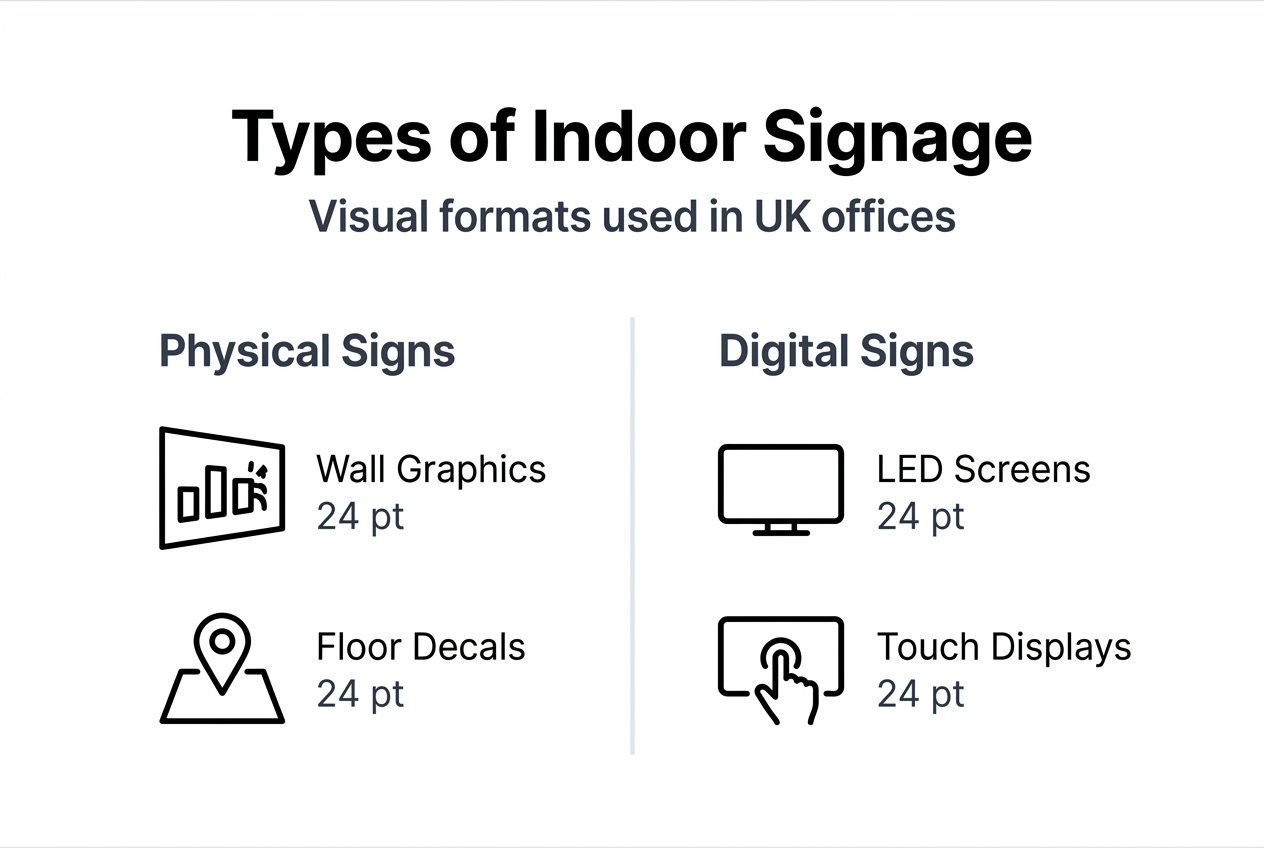
The variety of indoor signage formats available includes wall graphics, hanging banners, floor decals, window manifestations, digital screens, acrylic panels, and illuminated displays. Each type serves specific functional and aesthetic purposes, allowing you to create a coordinated visual system that works seamlessly across your entire premises.
Materials, design and compliance essentials for indoor signage
Selecting appropriate materials for indoor signage requires balancing durability, aesthetic appeal, and budget constraints. Vinyl offers versatility and cost effectiveness for wall graphics and temporary displays. Acrylic provides a premium appearance with excellent light transmission properties, making it ideal for reception areas and corporate environments. Metal signage delivers unmatched durability and sophistication, particularly suited for architectural applications and high traffic zones. Your choice depends on location requirements, expected lifespan, and brand positioning.

Design strategy extends far beyond aesthetic preferences. Signage quality and visibility significantly influence consumer purchase decisions, making design a critical business consideration rather than a superficial concern. Effective signage design integrates clear typography, appropriate colour contrast for readability, intuitive iconography, and consistent brand elements that create visual cohesion across your space. The most impactful signage materials retail brand impact strategies align every visual element with your broader marketing identity.
Legal compliance represents a non negotiable dimension of indoor signage planning. The Equality Act 2010 mandates accessibility requirements including tactile and Braille elements for many indoor signs, particularly those indicating permanent rooms and spaces. Failure to meet these standards exposes your business to legal penalties, discrimination claims, and reputational damage. Beyond legal obligations, accessible signage demonstrates social responsibility and ensures all customers can navigate your premises independently.
| Material | Durability | Cost | Best applications |
|---|---|---|---|
| Vinyl | Moderate | Low | Wall graphics, temporary displays |
| Acrylic | High | Medium | Reception signs, directional panels |
| Metal | Very high | High | Architectural features, exterior facing |
| Digital screens | Variable | High | Dynamic content, promotional messaging |
Pro Tip: Coordinate your signage design with your overall interior aesthetics from the project outset rather than treating signs as afterthoughts, creating a unified spatial experience that amplifies brand recognition and customer comfort.
Integrating digital indoor signage: features and common pitfalls
Digital signage represents the cutting edge of indoor communication technology, offering dynamic content capabilities that static signs cannot match. Modern digital signage CMS should support features like multi-user collaboration, reusable templates, granular timing controls, and cloud management. These capabilities allow you to update messaging instantly across multiple screens, schedule content around specific events or times of day, and maintain brand consistency whilst enabling local customisation.
The technical advantages of digital signage solutions include real time content updates, integration with data feeds for live information display, remote management from any location, and the ability to test different messages to optimise customer response. You can display promotional content during peak shopping hours, switch to informational messaging during quieter periods, and adapt instantly to changing business conditions without printing costs or installation delays.
However, failed screen networks are often organisational problems rather than technical failures. Many businesses invest in impressive hardware but neglect the content strategy and team coordination required for effective operation. Common pitfalls include unclear content ownership across departments, lack of scheduled planning for updates, inconsistent messaging that confuses customers, and insufficient training for team members responsible for content management.
Best practices for successful digital signage implementation:
- Establish clear content ownership with designated team members responsible for creation, approval, and scheduling
- Implement planner-style scheduling systems that allow cross-team visibility and coordination of campaigns
- Create reusable content templates that maintain brand consistency whilst enabling efficient updates
- Invest in comprehensive training for all users to ensure confident system operation
- Set regular review cycles to assess content performance and adjust messaging based on customer response
Pro Tip: Treat digital signage as a strategic communication channel requiring ongoing management rather than a set-and-forget installation, allocating dedicated resources and establishing governance processes from day one.
The digital signage industry continues evolving rapidly, with emerging capabilities including artificial intelligence powered content optimisation, integration with mobile devices for personalised experiences, and advanced analytics that measure viewer attention and engagement.
Maximising impact: practical tips and updates for 2026 indoor signage
Regular signage updates generate measurable commercial returns. Studies reveal that nearly 60% of businesses saw a 10% increase in sales simply by refreshing their signage. These improvements stem from renewed customer attention, alignment with current promotional campaigns, and the elimination of outdated or damaged signs that create negative brand impressions. Your signage should evolve alongside your business rather than remaining static for years.
Maintenance practices protect your signage investment and prevent gradual degradation that customers notice before you do. Establish quarterly inspection schedules to identify fading, damage, or outdated information. Clean signs regularly using appropriate methods for each material type. Address issues promptly rather than allowing small problems to compound into expensive replacements. Well maintained signage signals professionalism and attention to detail that influences customer perceptions of your entire operation.
| Aspect | Static signage | Digital signage |
|---|---|---|
| Initial cost | Lower | Higher |
| Update flexibility | Requires reprinting and reinstallation | Instant remote updates |
| Content variety | Single fixed message | Unlimited rotating content |
| Engagement potential | Moderate | High with dynamic elements |
| Maintenance needs | Minimal cleaning | Technical support and content management |
| Energy consumption | None | Ongoing electricity costs |
Strategic approaches to maximise signage impact include:
- Align signage updates with marketing campaign launches to create cohesive customer experiences across all touchpoints
- Refresh seasonal messaging to maintain relevance and capture timely opportunities
- Test different sign placements and messaging to identify highest performing configurations
- Integrate modern signage systems with your broader customer journey mapping
- Track customer response metrics such as dwell time, conversion rates, and navigation efficiency to evaluate ROI
- Coordinate wayfinding signage solutions with your space planning to guide traffic flow strategically
For 2026, emerging trends include augmented reality elements that enhance traditional signage with digital overlays, sustainable materials that reduce environmental impact whilst maintaining quality, and data driven personalisation that adapts messaging based on customer demographics and behaviour patterns. Forward thinking businesses are exploring these innovations to differentiate their customer experience whilst maintaining core signage fundamentals.
Explore professional indoor signage solutions with Pik Pik Pow
Transforming your indoor signage from functional necessity to strategic asset requires expertise in design, materials, compliance, and installation. Pik Pik Pow specialises in bespoke signage solutions tailored to UK businesses across retail, commercial, construction, and corporate sectors.
Our comprehensive signage systems services span traditional and digital signage solutions, ensuring you access the optimal approach for your specific requirements. We combine strong design capabilities with precision manufacturing to create impactful, durable signage that elevates your brand and enhances your spaces. Our team understands UK compliance standards including Equality Act 2010 requirements, ensuring your signage meets legal obligations whilst maximising commercial effectiveness. Whether you need sophisticated internal wayfinding signage for complex premises or dynamic digital displays for retail environments, we deliver solutions that work. Contact us for a consultation and discover how professional signage transforms your customer experience.
Frequently asked questions
What is indoor signage?
Indoor signage refers to all visual communication displays installed inside buildings for purposes including branding, information delivery, wayfinding, safety notices, and promotional messaging. Unlike outdoor signage designed to attract external attention, indoor signage guides customers through your space whilst reinforcing brand identity and facilitating specific actions.
How does indoor signage improve customer experience?
Indoor signage enhances wayfinding by helping customers locate destinations quickly, reducing frustration and improving navigation efficiency by up to 20%. Well designed signs increase dwell time and engagement by creating visual interest and communicating value propositions effectively. Consistent signage strengthens brand identity visually, building trust and recognition across every customer touchpoint within your premises.
What are the legal requirements for indoor signage in the UK?
UK indoor signs must comply with the Equality Act 2010, which mandates accessibility features including tactile elements and Braille on signs identifying permanent rooms and spaces. Building regulations also govern fire safety signage, emergency exit markers, and hazard warnings. Failure to comply can result in significant fines and legal repercussions alongside reputational damage from excluding customers with disabilities.
What features should I look for in digital indoor signage?
Prioritise systems supporting multi-user collaboration, reusable templates, batch actions, and cloud-based management for operational flexibility. User-friendly content management interfaces reduce training requirements and encourage regular updates. Flexible scheduling capabilities allow you to programme content changes around specific times, events, or triggers. Cloud hosting enables remote access for updates from any location whilst ensuring content backup and system reliability.
How often should I update my indoor signage?
Update promotional and seasonal signage quarterly at minimum to maintain customer interest and relevance. Replace or refresh any damaged, faded, or outdated signs immediately to prevent negative brand impressions. Permanent wayfinding and identification signage requires updates only when space usage changes or compliance requirements evolve. Digital signage content should rotate regularly, with promotional messages changing weekly or even daily to maximise engagement and test messaging effectiveness.
Recommended
- Role of Signage in Commercial Interiors: UK Impact
- News and Updates: Get the Latest Updates and Information – Pik Pik Pow
- Digital Signage – Transforming UK Retail Visibility
- Blog Archives – Pik Pik Pow
- Custom Made Wall Signs: Creating Meaningful Spaces – FunLifeNow
- Interne communicatie digital signage: 8 tips voor 2026