
What are the main types of gym signage?
Gym signage falls into six core categories, each serving a distinct purpose in your facility. Understanding them upfront helps you plan a cohesive, compliant fit-out rather than bolting signs on as an afterthought.
- Gym banners: large-format printed displays for promotions, events, and brand presence at entrances and reception areas
- Wayfinding signs: directional, identification, and informational signs that guide members through your facility
- Motivational and branding signage: wall-mounted quotes, murals, and branded panels that reinforce gym identity and lift member energy
- Illuminated signs: LED neon, backlit panels, and lightbox displays that add visual impact and improve visibility in low-light areas
- Wall graphics and vinyl wraps: full-colour murals, floor graphics, and vinyl decals that transform spaces and create immersive environments
- Safety signage: legally required signs covering prohibitions, warnings, mandatory instructions, and emergency escape routes, all governed by UK law
UK gyms in 2026 must balance bold visual identity with compliance obligations under the Health and Safety (Safety Signs and Signals) Regulations 1996 and the BS EN ISO 7010 pictogram standard. Getting that balance right from the start saves you time, money, and the risk of a compliance gap.
1. Gym banners and their applications
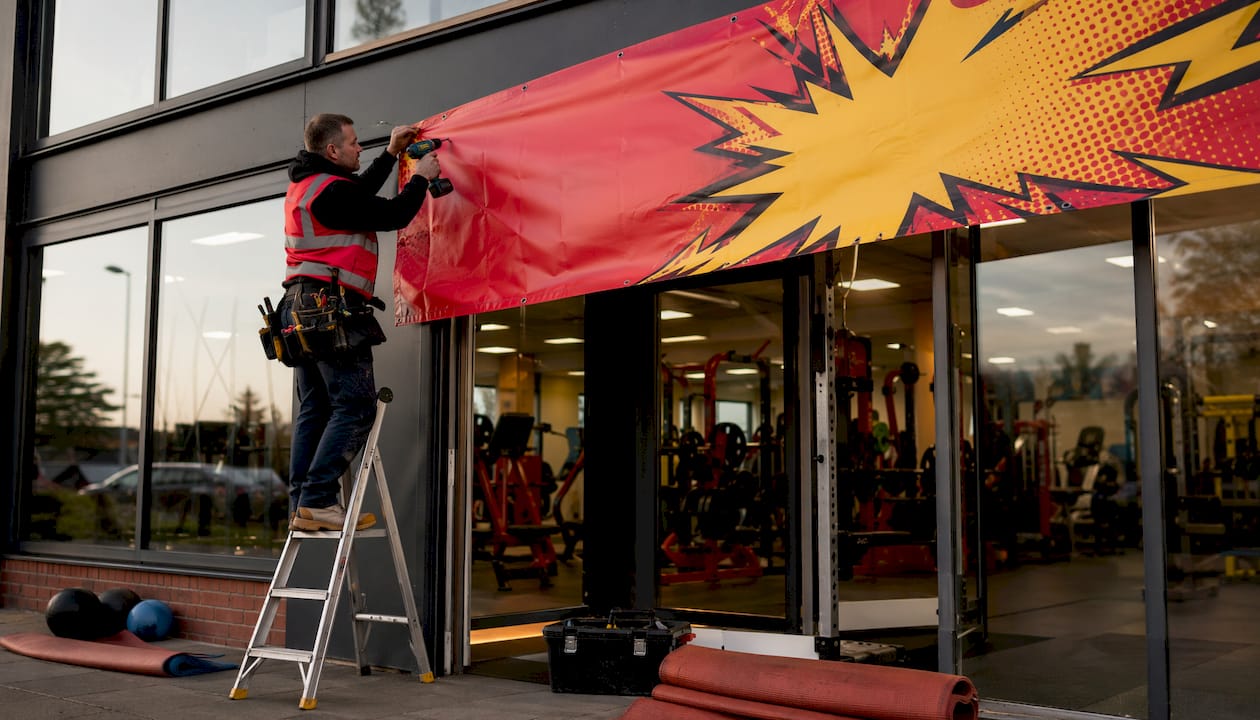
Banners are one of the most flexible and cost-effective gym advertising solutions available to facility operators. They work hard at entrances, reception desks, event spaces, and along the perimeter of training floors, delivering high-visibility messaging without permanent installation.
Common banner types used in gyms:
- Vinyl PVC banners: weather-resistant and suited to both indoor and outdoor use; UV-stable inks prevent fading in sun-exposed reception areas or window-facing walls
- Fabric banners: lighter and more premium in finish, often used for membership campaigns, class launches, or seasonal promotions where a polished look matters
- Roller banners (pull-up displays): freestanding and portable, ideal for reception areas, PT consultation zones, or temporary event setups
- Mesh banners: perforated for outdoor use where wind load is a concern, such as external fencing or car park-facing walls
For maximum impact, position banners at eye level near the main entrance, beside reception, and at the entrance to key zones such as the weights floor or studio. Print quality matters in a gym environment: anti-moisture finishes and scratch-resistant laminates extend banner life considerably in high-humidity spaces. Promotional use cases range from membership drives and class timetables to personal training packages and seasonal challenges.
2. Wayfinding signs: guiding gym members effectively
Clear wayfinding reduces friction for new members and keeps your facility feeling organised. There are four main types of wayfinding signage relevant to gyms: directional (arrows and route guidance), identification (room and zone labels), informational (maps, timetables, facility details), and regulatory (rules and safety instructions).
Placement priorities for gym wayfinding:
- Main entrance and reception: directional arrows to changing rooms, gym floor, studios, and car parking
- Changing rooms and toilets: clear identification signs with universally understood symbols
- Emergency exits: mandatory illuminated or high-contrast signs at every exit point
- Stairwells and corridors: directional signs at every decision point, particularly in multi-floor facilities
- Equipment zones: identification signs labelling free weights, cardio, functional training, and stretching areas
Material choice affects both durability and legibility. Rigid PVC, aluminium composite (ACP), and acrylic all perform well in gym environments, resisting moisture and the cleaning products used in daily maintenance. High-contrast typography and universally understood pictograms are non-negotiable for legibility at a distance. UK accessibility standards require mounting directional signage between 1400mm and 1700mm in height to ensure visibility for wheelchair users, per BS 8300 and the Equality Act 2010.

3. Motivational and branding signage in gyms
Motivational and branding signage does more than decorate a wall. It shapes how members feel about your facility from the moment they walk in, reinforcing your gym’s identity at every touchpoint. Popular forms include large-format quote panels, branded imagery, logo walls, and zone-specific murals.
Key considerations for motivational fitness centre signs:
- Material durability: rigid PVC, ACP, and acrylic are the standard choices, resisting sweat, humidity, and the cleaning cycles typical in fitness environments
- Placement: high-traffic zones such as the gym floor, studio entrance, and changing room corridors benefit most from motivational messaging
- Brand consistency: fonts, colours, and imagery should align with your overall brand identity across every panel and graphic
- Accessibility: bold colour contrasts must remain legible for members with visual impairments, balancing visual energy with readability
Member engagement and retention are directly influenced by the environment you create. A gym that feels considered and well-branded communicates professionalism and care, which members notice. If your brand leans into a bold, high-energy aesthetic, motivational signage is where that personality can come through most clearly, provided it stays accessible and legible for everyone.
4. Illuminated signs: enhancing gym ambiance and visibility
Illuminated signs add a layer of visual energy that printed panels alone cannot match. For gyms, the two most practical formats are LED neon flex signs and backlit lightbox panels. LED neon is popular for reception areas, studio entrances, and feature walls, offering a vibrant glow with low energy consumption. Backlit panels work well for brand logos, directional signs in darker corridors, and zone identification in areas with limited natural light.
Why illuminated signage suits gyms in 2026:
- Energy-efficient LED technology keeps running costs low compared with older fluorescent or neon tube alternatives
- Backlit signs remain legible in low-light conditions, supporting both navigation and safety
- LED neon flex signs are durable, shatter-resistant, and available in custom shapes that suit bold brand identities
- Illuminated emergency exit signs are a legal requirement under the Health and Safety (Safety Signs and Signals) Regulations 1996, so the infrastructure for illuminated signage is already present in most facilities
Placement decisions should be deliberate. A backlit logo panel behind reception creates an immediate brand impression. LED neon quotes or slogans on the gym floor add atmosphere without distracting from training. For corridors and stairwells, backlit directional signs improve safety during early morning or evening sessions when ambient light is low.
5. Wall graphics and vinyl wraps for gyms
Wall graphics and vinyl wraps are among the most transformative indoor gym signage options available. A well-executed mural or full-wall vinyl wrap can turn a plain training space into an immersive environment that members genuinely want to spend time in. Floor graphics serve a dual purpose, adding visual interest while also functioning as directional cues or zone markers.
Materials and durability in gym environments:
- Cast vinyl outperforms calendered vinyl in high-humidity spaces, conforming better to textured surfaces and lasting longer under regular cleaning
- Anti-slip laminates are mandatory for floor graphics in any area where members train or walk in socks or bare feet
- Matt laminates reduce glare on wall graphics under gym lighting, improving legibility and visual comfort
- Printed murals using UV-stable inks resist fading even in sun-exposed areas near windows or skylights
Installation on painted plasterboard, brick, or concrete each requires a different preparation process, so surface assessment before print production avoids costly reprints. Maintenance is straightforward: most vinyl graphics can be wiped down with standard gym cleaning products without degrading the print. For a gym with a bold brand identity, wall graphics are the single most cost-effective way to create a distinctive, memorable space.
6. Safety signage requirements and best practices for UK gyms
Safety signage in UK gyms is a legal obligation, not an optional extra. The Health and Safety (Safety Signs and Signals) Regulations 1996 require permanent signboards wherever a significant risk to health and safety remains after all other control measures have been applied. For gyms, that covers a wide range of scenarios, from wet floors and heavy equipment to emergency evacuation routes.
The four mandatory sign types under UK law:
- Prohibition signs (red circle with diagonal bar): indicate actions that are forbidden, such as no unauthorised access to plant rooms or no outdoor footwear on the gym floor
- Warning signs (yellow triangle): alert members to hazards such as wet floors, heavy loads, or electrical equipment
- Mandatory signs (blue circle): prescribe required behaviour, such as wearing appropriate footwear or wiping down equipment after use. Mandatory signs must have a blue background covering at least 50% of the sign
- Emergency escape and first-aid signs (green rectangle): mark exit routes, first-aid kits, defibrillators, and assembly points
Key compliance point: The HSE advises against overusing safety signs, as excessive signage dilutes the impact of critical information and causes member confusion. Use signs only where risks cannot be managed by other means.
All safety signs must use standardised pictograms per BS EN ISO 7010, ensuring they are universally understood regardless of language. For gyms during construction or refurbishment, the same regulations apply to the site itself. Accessibility under the Equality Act 2010 requires high-contrast text and symbols, with mounting heights between 1400mm and 1700mm for wheelchair users.
7. Expert insights on designing effective gym signage in the UK
Effective gym signage design starts with behaviour, not aesthetics. Colour zoning is one of the most practical tools available: by assigning distinct colours to different areas of your facility, you help members orient themselves intuitively without needing to read every sign. A weights zone in deep red, a studio in electric blue, and a recovery area in cool green creates a visual map that members absorb passively over time.
Practical design principles for UK gym operators:
- Establish a colour palette that serves both your brand identity and your wayfinding system before any print production begins
- Use consistent typography across all sign types: one font family for headings, one for body text, applied uniformly from safety signs to motivational panels
- Specify materials upfront based on zone conditions: ACP or acrylic for wet areas, cast vinyl for high-traffic floors, rigid PVC for standard wall-mounted signs
- Plan your installation sequence so that wayfinding and safety signs are in place before the facility opens, not added reactively
Pro Tip: Plan universal access signage mounting heights (1400mm–1700mm per BS 8300) at the design stage, not during installation. Retrofitting signs to the correct height after walls are finished costs significantly more and often requires replating or repainting.
Balancing a bold visual identity with accessibility obligations is achievable with the right design brief. High-contrast colour combinations, clear pictograms, and legible font sizes at the specified mounting heights satisfy both the Equality Act 2010 and the visual energy a modern gym brand demands. If you want to understand how effective gym signage brings these principles together in practice, the design brief is the place to start.
8. Cost considerations and budgeting for gym signage
Gym signage budgets vary considerably depending on the mix of sign types, materials, and installation complexity you choose. A clear-headed approach to budgeting prevents overspend on decorative elements at the expense of compliance-critical safety signs.
Factors that drive signage costs:
- Material specification: acrylic and ACP cost more than rigid PVC but last longer in wet or high-traffic zones, reducing replacement frequency
- Print complexity: full-colour murals and bespoke vinyl wraps carry higher production costs than standard directional or safety signs
- Illumination: LED neon and backlit panels involve both manufacturing and electrical installation costs, which should be factored into your fit-out budget from the outset
- Volume: ordering all signage from a single supplier in one production run typically reduces unit costs compared with piecemeal ordering
- Compliance requirements: safety and accessibility signs are non-negotiable budget items; cutting costs here creates legal exposure
A practical approach is to tier your budget: allocate first for legally required safety and accessibility signage, second for wayfinding and identification signs, and third for motivational, branding, and decorative elements. This order ensures compliance is never compromised by budget pressure. Getting quotes that include design, print, and installation as a package gives you a clearer total cost than pricing each element separately.
9. Digital and interactive signage options
Digital signage is growing in gym environments because it removes the need to reprint every time your timetable, pricing, or promotional message changes. A screen-based display at reception or in the studio corridor can cycle through class schedules, membership offers, and motivational content without any physical reprinting.
Practical digital signage formats for gyms:
- Digital display screens: wall-mounted or freestanding screens showing class timetables, announcements, and promotional content; content is updated remotely via a content management system
- Interactive touchscreen kiosks: used for self-service check-in, class booking, or facility maps in larger leisure centres
- LED video walls: high-impact installations for reception areas or studio feature walls, combining branding with dynamic content
- Digital wayfinding displays: screen-based maps and directional systems, particularly useful in multi-floor or multi-zone facilities
The main trade-off with digital signage is upfront cost versus long-term flexibility. Hardware and installation costs are higher than static print, but the ability to update content instantly makes digital formats particularly well-suited to gyms with varied class programmes or frequent promotional campaigns. Pikpikpow’s digital signage solutions cover both the hardware specification and content display requirements for fitness facilities. For gyms investing in their online presence alongside their physical environment, pairing strong in-facility signage with gym SEO services helps attract new members before they even walk through the door.
10. Complying with UK accessibility regulations for gym signage
The Equality Act 2010 places a duty on gym operators to make reasonable adjustments so that disabled members are not placed at a substantial disadvantage. For signage, this translates into specific design and installation requirements that go beyond general good practice.
Key accessibility requirements for UK gym signage:
- Mounting height: directional and identification signs should be mounted between 1400mm and 1700mm from floor level, per BS 8300 and the Inclusive Mobility guidance, to ensure visibility for wheelchair users
- Colour contrast: text and symbols must achieve sufficient contrast against their background; light text on a dark background or vice versa is the standard approach
- Font legibility: sans-serif typefaces at adequate point sizes improve readability for members with low vision; avoid decorative or script fonts for functional signage
- Tactile and Braille elements: in larger leisure facilities, tactile lettering and Braille on key identification signs (such as changing room doors and lift buttons) supports members with severe visual impairments
- Pictograms: universally understood symbols reduce reliance on text, benefiting members with literacy difficulties or those for whom English is not a first language
- Lighting: signs in corridors and stairwells must be adequately lit so that contrast and legibility are maintained in all conditions
Accessibility compliance is not a separate design exercise from your main signage scheme. The most practical approach is to build contrast ratios, mounting heights, and font specifications into your design brief from the start, so every sign produced meets both your brand requirements and your legal obligations simultaneously. For guidance on accessible gym wayfinding that satisfies the Equality Act 2010, the design stage is the right time to address it.
Key takeaways
UK gym operators who plan their signage mix around compliance, accessibility, and brand identity from the outset avoid costly retrofits and create facilities that work for every member.
| Point | Details |
|---|---|
| Six core signage types | Banners, wayfinding, motivational, illuminated, wall graphics, and safety signs each serve a distinct function. |
| Safety signs are a legal requirement | The Health and Safety (Safety Signs and Signals) Regulations 1996 mandate permanent signboards for prohibitions, warnings, mandatory instructions, and emergency routes. |
| Accessibility mounting height | BS 8300 and the Equality Act 2010 require directional signs mounted between 1400mm and 1700mm for wheelchair user visibility. |
| Mandatory sign colour rule | Mandatory signs must have a blue background covering at least 50% of the sign, per BS EN ISO 7010. |
| Budget in compliance order | Allocate budget for safety and accessibility signs first, wayfinding second, and decorative or motivational signage third. |
Get your gym signage right with Pikpikpow
Pikpikpow designs and produces bespoke gym signage for UK fitness facilities, from wayfinding and safety systems to full-wall vinyl wraps and illuminated brand panels. Every project is built around your brand identity, your compliance obligations, and the practical realities of a working gym environment.
Whether you are fitting out a new facility or refreshing an existing one, the team at Pikpikpow handles design, print, and installation as a single joined-up process. Get in touch to discuss your project.