

TL;DR:
- Signage functions as a continuous, accessible communication tool that enhances public engagement and safety. It operates 24/7, reaches diverse audiences, and supports independent wayfinding in complex environments. Proper design and system consistency are crucial for effective public liaison and community trust.
Signage is defined as any visual display that communicates information, direction, or identity to a public audience. In the context of public liaison, the role of signage is to serve as a continuous, accessible channel between authorities, organisations, and the communities they serve. Unlike office hours or digital apps, physical and digital signs operate around the clock, reaching residents regardless of connectivity or language. For professionals in public relations, community engagement, and urban planning, understanding how visual messaging functions as a communication tool is not optional. It is a core operational competency.
How does signage improve public communication and engagement?
Signage is a 24/7 communication channel that functions without staff intervention, making it one of the most reliable tools in any public liaison strategy. A resident walking past a municipal notice board at 11pm receives the same quality of information as one visiting a council office at noon. That consistency builds trust over time.

Municipal digital notice boards illustrate this well. They allow residents to access local news, planning updates, and safety alerts without downloading an app or creating an account. This removes barriers for older residents, those with limited digital literacy, and anyone who values anonymity. The anonymity factor is particularly significant: crime reporting via signage prompts increases community participation in public safety without requiring individuals to identify themselves.
Signs for public communication also serve audiences that formal channels routinely miss. Multilingual signage, plain-language notices, and pictogram-based displays reach people who may not engage with council newsletters or social media. The public signage impact in these cases is not just informational. It is inclusive.
Pro Tip: When planning a public liaison signage programme, map your audience segments first. Identify which groups are least likely to engage with digital channels, then design signage specifically to reach them.
Key communication benefits of effective signage in public settings include:
- Delivering time-sensitive updates such as road closures, event notices, and emergency alerts without requiring staff presence
- Providing consistent messaging across multiple locations simultaneously
- Reducing the volume of enquiries directed at reception desks and contact centres
- Supporting anonymous community reporting mechanisms for safety concerns
- Reinforcing key messages from other communication channels, including print and digital campaigns
What are the key design principles for signage to maximise public liaison effectiveness?
Good design is not an aesthetic preference. It is a functional requirement. Signage that fails to communicate clearly fails its purpose entirely, regardless of how well it is positioned or how much it cost to produce.
Legibility and viewing distance
The cap-height rule is the industry standard for legibility planning. Approximately 1 inch of capital letter height is required for every 25 feet of viewing distance. A sign intended to be read from 50 feet away therefore needs lettering at least 2 inches tall. Failure to apply this standard is one of the most common causes of signage failure in public spaces. Professionals commissioning signs for large open areas, transport hubs, or construction sites must specify viewing distances at the brief stage, not as an afterthought.
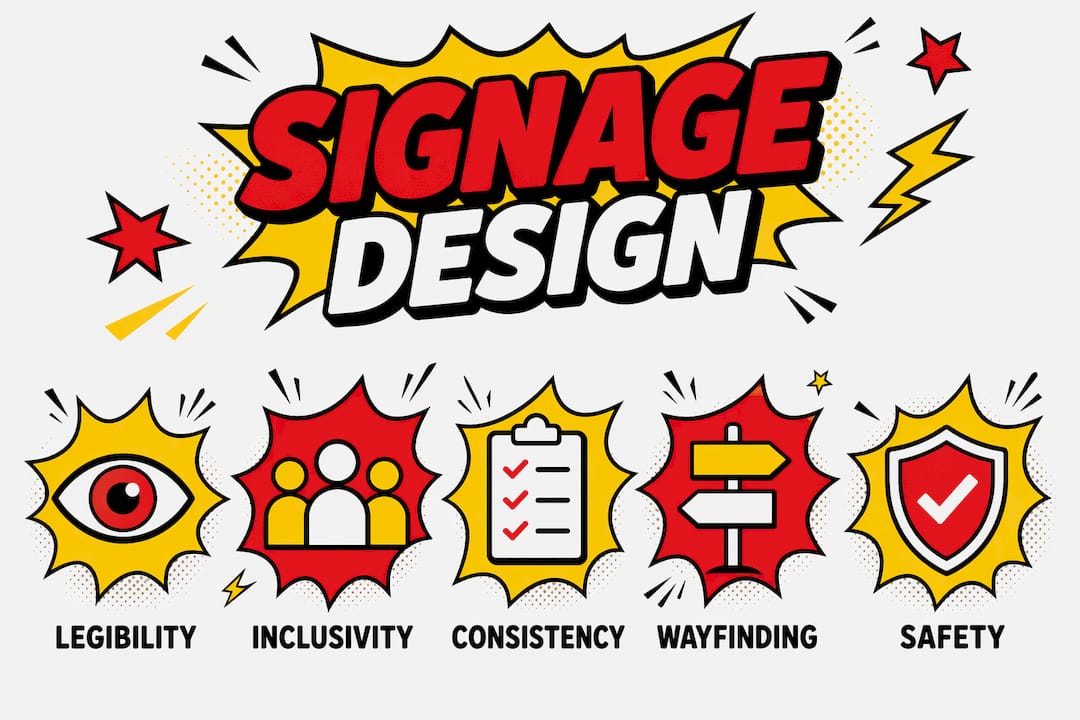
Contrast between text and background is equally critical. Dark text on a light background, or vice versa, outperforms low-contrast combinations in all lighting conditions. Glare, shadow, and seasonal light changes all affect legibility outdoors, so material choice must account for the full range of environmental conditions a sign will face.
Multilingual and inclusive design
Multilingual public signage acts as a systemic tool for informal societal education. When residents see their language represented in public spaces, it reinforces the legitimacy and prestige of that language within the community. For public liaison professionals, this is not simply a courtesy. It is a signal of institutional respect that directly affects community trust.
Pictograms and universally recognised symbols extend accessibility further. ISO 7010, the international standard for safety signs, provides a library of symbols that communicate hazard, direction, and instruction without relying on language at all. Combining ISO-compliant symbols with multilingual text produces signage that serves the widest possible audience.
Consistency across a signage system
Consistent signage systems reduce cognitive load for the public. When fonts, colours, and layouts follow a recognisable pattern, people navigate faster and with greater confidence. Inconsistency, by contrast, creates hesitation and frustration. In complex environments such as hospitals, transport interchanges, or large public events, inconsistent signage directly increases the burden on staff who must answer avoidable questions.
The four principles most critical to effective public liaison signage design are:
- Legibility first. Apply the cap-height rule and specify contrast ratios before finalising any design.
- Inclusive language. Use plain language, multilingual text, and ISO-standard pictograms wherever possible.
- System consistency. Maintain uniform typography, colour coding, and layout across all signs within a scheme.
- Environmental integration. Choose materials and finishes that suit the physical context, whether that is a heritage town centre, a modern civic building, or a construction site boundary.
Pro Tip: Commission a signage audit before any major public engagement project. Walk the route your audience will take and note every point where information is absent, unclear, or contradictory. That audit becomes your brief.
| Design factor | Impact on public liaison |
|---|---|
| Legibility (cap-height rule) | Prevents misreading and reduces enquiries |
| Multilingual text | Increases reach and signals institutional respect |
| Consistent visual system | Builds navigation confidence and reduces staff burden |
| Environmental integration | Strengthens place identity and community connection |
In what ways does signage facilitate wayfinding and influence public behaviour?
Wayfinding signage is infrastructure, not decoration. Poor wayfinding causes frustration, congestion, and reliance on staff assistance, particularly in complex environments such as hospitals, universities, and civic centres. When people cannot find their way independently, they stop moving, cluster at decision points, and create bottlenecks. The operational cost of that failure is measurable in staff time and visitor dissatisfaction.
Effective wayfinding signage increases footfall and dwell time by enabling independent navigation. Visitors who feel confident in a space stay longer, engage more, and return. For town centres, cultural venues, and public parks, that confidence translates directly into economic activity and community vitality.
Interpretive signage adds another dimension to public behaviour. Signs that tell the story of a place, its history, its ecology, or its community, give people a reason to pause and engage. Signage reflecting local materials and stories strengthens place identity and community connection. This is the principle behind heritage trails, nature reserve interpretation boards, and public art installations with contextual labelling. Each one shapes how people experience and value a public space.
The behavioural effects of well-designed public signage include:
- Reducing pedestrian congestion at key decision points by providing clear directional information in advance
- Increasing visitor confidence in unfamiliar environments, reducing anxiety and improving experience
- Encouraging exploration of secondary areas within a site, distributing footfall more evenly
- Prompting desired behaviours such as waste disposal, speed reduction, and noise awareness through well-placed instructional signs
- Embedding community identity through interpretive and placemaking signage that connects people to their surroundings
How can signage enhance public safety and support community reporting?
Public safety signage does two things simultaneously. It informs and it deters. A sign that communicates community vigilance signals to potential offenders that the area is watched and that residents are engaged. That signal alone changes behaviour.
The Toronto community signage pilot in 2022 demonstrated this directly. The project improved local engagement with safety reporting and increased situational awareness among residents. The mechanism was straightforward: signs prompted residents to report suspicious activity anonymously, removing the social friction that prevents many people from coming forward. The result was a more connected community with a lower threshold for civic participation in safety.
Signage integrated with digital communication strategies extends this further. QR codes on physical signs can link directly to reporting portals, community forums, or emergency contact pages. This hybrid approach combines the permanence and visibility of physical signage with the interactivity of digital channels.
Key functions of public safety signage in community settings include:
- Displaying emergency contact numbers and reporting mechanisms in high-visibility locations
- Communicating neighbourhood watch participation and community vigilance to deter opportunistic crime
- Providing clear evacuation routes and assembly points in public buildings and open spaces
- Prompting anonymous reporting via QR codes or dedicated phone lines printed on permanent signs
- Supporting policing and community safety partnerships by reinforcing shared messaging across a defined area
The integration of safety signage into broader public liaison strategies is not a secondary consideration. Signage as a deterrent signals community investment and active management of a space, which directly affects how safe residents feel and how willing they are to engage with public institutions.
Key takeaways
Signage is the most consistently available public liaison tool available to urban planners, community engagement professionals, and public relations teams, delivering communication, navigation, and safety functions simultaneously.
| Point | Details |
|---|---|
| Signage operates continuously | Physical and digital signs communicate 24 hours a day without staff involvement. |
| Design standards prevent failure | Apply the cap-height rule and ISO pictogram standards at the brief stage, not after production. |
| Multilingual signage builds trust | Representing community languages in public spaces signals institutional respect and widens reach. |
| Wayfinding reduces operational burden | Clear directional signage cuts staff interruptions and improves visitor confidence in complex environments. |
| Safety signage deters and empowers | Community signage increases reporting rates and signals active management of public spaces. |
Signage as a silent coordinator: what experience teaches you
The phrase “silent coordinator” is one I find genuinely useful when explaining signage to clients who underestimate it. Functional signage reduces interruptions at reception desks and frees staff to focus on tasks that actually require human judgement. That is not a minor operational benefit. In high-footfall public environments, it is the difference between a team that is constantly firefighting and one that can do its job.
What I have observed repeatedly is that organisations invest heavily in digital communications, social media, and community events, then neglect the physical environment entirely. A beautifully designed community engagement programme loses credibility when the building hosting it has confusing signage, no multilingual provision, and directions that contradict each other. The physical environment communicates before any member of staff opens their mouth.
The other thing worth saying plainly: physical signage offers 24-hour visibility that no digital ad can match. A sponsored post disappears from a feed within hours. A well-made exterior sign communicates your organisation’s presence and values every single day for years. The cost per impression is extraordinarily low, and the trust-building effect accumulates over time in a way that paid media simply cannot replicate.
My practical advice: bring signage into the planning process at the same stage as staffing and communications. Not as a finishing touch. Not as a budget line to be trimmed. As a core delivery mechanism for your public liaison objectives.
— PikPikPOW!
Signage solutions for public liaison from Pikpikpow
Pikpikpow designs and manufactures bespoke signage for organisations that need to communicate clearly with the public. From digital signage displays that update in real time to internal and wayfinding systems built for complex public environments, every solution is designed with legibility, durability, and audience reach in mind.
Whether you are managing a community engagement programme, a construction site boundary, or a civic building, Pikpikpow works with you to produce signage that functions as a genuine communication asset. The team combines design expertise with precision manufacturing to deliver signs that perform in real-world conditions, not just in a presentation deck. Visit the Pikpikpow signage systems page to see the full range of options available for public and community settings.
FAQ
What is the role of signage in public liaison?
Signage serves as a continuous, accessible communication tool that delivers information, guides navigation, and supports community safety without requiring staff presence. It functions as a primary channel between public organisations and the communities they serve.
How does wayfinding signage affect public behaviour?
Effective wayfinding signage reduces congestion, increases visitor confidence, and encourages independent navigation in complex environments. Poor wayfinding causes frustration and increases reliance on staff, raising operational costs.
What design standard governs signage legibility?
The cap-height rule states that approximately 1 inch of capital letter height is required for every 25 feet of viewing distance. Applying this standard at the design stage prevents legibility failure in public spaces.
Can signage support anonymous community safety reporting?
Yes. Signage prompts that include QR codes or dedicated phone lines allow residents to report concerns without identifying themselves. The Toronto community signage pilot in 2022 demonstrated that this approach increases engagement with safety reporting.
Why is multilingual signage important in public spaces?
Multilingual signage reaches audiences who may not engage with digital or print communications in a single language. It also signals institutional respect for community languages, which directly supports public trust and civic participation.