

TL;DR:
- Gym signage significantly boosts revenue and upselling by intercepting members during decision moments.
- Effective placement and regularly refreshed, targeted content optimize engagement and transform signage into a marketing asset.
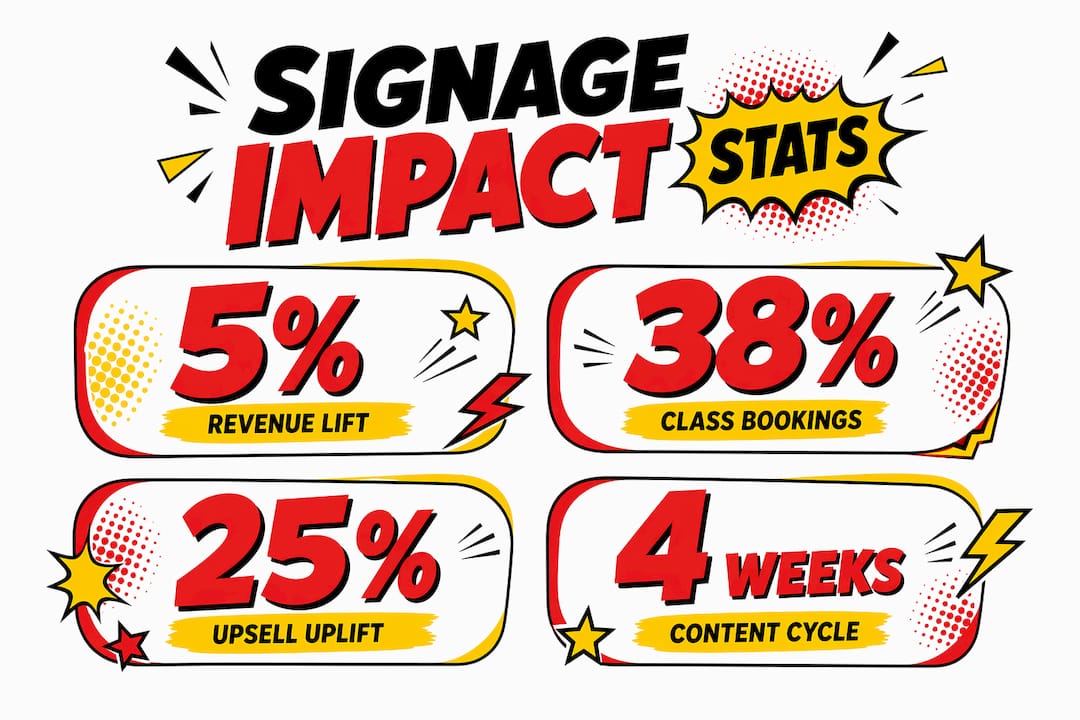
Signage is a direct revenue driver in gym marketing, not a decorative afterthought. In-location gym signage generates a 1–5% lift in total business revenue and a 15–25% uplift in upsell categories such as personal training and retail merchandise. That distinction matters: most gym owners treat signage as branding, when it is actually one of the most cost-effective gym advertising strategies available. This guide covers the mechanics, placement logic, technical setup, and measurement frameworks that make signage work as a genuine marketing asset in 2026.
How does effective signage increase gym member engagement and drive sales?
The role of signage in gym marketing is most visible at the point of decision. When a member walks past the reception desk, pauses near the supplement display, or glances up during a rest period, well-placed signage intercepts that moment and directs behaviour. This is fundamentally different from social media or email marketing, which reach members when they are away from your facility and less likely to act immediately.
The most productive use cases for gym signage include:
- Personal training promotions displayed near the gym floor entrance, where members are already in a training mindset
- Class schedule boards positioned at reception and near changing rooms, where booking decisions are made
- Retail product spotlights in lobby areas and near water stations, where dwell time is high
- Membership upgrade prompts at check-in screens, targeting members whose usage patterns suggest readiness to commit further
Real-time class capacity displays near decision points increased lunch-hour class bookings globally by 38% in 2025. That figure reflects a simple truth: members book more when they can see availability at the exact moment they are considering it.
Proof of Play (PoP) logs add another dimension to this. PoP provides automated logs verifying what content was shown, when, and on which screen. This allows gym operators to demonstrate ad exposure to local business partners, turning a signage network into a paid advertising channel rather than a pure cost centre.

Pro Tip: Position personal training promotion screens within three metres of the gym floor entrance rather than at reception. Members entering the floor are already committed to training, making them significantly more receptive to performance-related upsells.
What are the best signage types and placements for maximising gym marketing impact?
Placement strategy based on member mindset is more effective than placement based on foot traffic alone. A screen in a high-traffic corridor delivers impressions, but a screen positioned where a member is mentally receptive delivers conversions. Digital signage content tailored to member mindset zones consistently improves message reception and sales impact across fitness facilities.
The table below outlines the most productive zone-to-content pairings for gym signage:
| Zone | Member mindset | Recommended content |
|---|---|---|
| Cardio floor | High energy, focused | Motivational clips, exercise technique videos, class countdowns |
| Free weights area | Performance-driven | PT consultation prompts, supplement spotlights, challenge sign-ups |
| Lobby and reception | Transitional, open | Membership upgrades, retail offers, class schedules, partner ads |
| Changing rooms | Relaxed, reflective | Recovery products, nutrition advice, upcoming events |
| Café or rest area | Relaxed, social | Food and drink promotions, community notices, loyalty rewards |
On the question of static versus digital signage: both have a place, but they serve different functions. Static signage, such as printed vinyl, foamex boards, and wayfinding panels, works well for permanent information including room labels, safety notices, and brand messaging. Digital signage handles time-sensitive content: class schedules, promotional offers, and personalised messaging that changes daily or weekly.
For technical setup, hardwired Cat6 Ethernet connections reduce digital signage downtime compared to shared gym Wi-Fi, which is frequently congested during peak hours. Smaller displays under 32 inches can be powered via Power over Ethernet (PoE), removing the need for a separate power supply at each screen location. This reduces installation costs and simplifies maintenance considerably.
Pro Tip: Plan your content schedule at least four weeks in advance and rotate video content weekly at minimum. Static or repetitive signage leads to inattentiveness, and members who stop registering your screens stop responding to your promotions.
How do digital signage systems integrate into modern gym marketing techniques?
Modern gym marketing techniques increasingly depend on connected systems rather than isolated tools. Digital signage is most effective when it draws live data from your gym management software, rather than displaying pre-loaded content that quickly becomes outdated.
A cloud-based content management system (CMS) is the operational backbone of any multi-screen signage network. A cloud-based CMS allows operators to manage 50 screens across 10 locations from a single laptop, scheduling content by zone, time of day, and audience segment. For gym groups or franchise operators, this means brand consistency across every site without requiring on-site staff to update displays manually.
The most advanced implementations in 2026 include the following capabilities:
- Live class schedule integration pulling real-time data from platforms such as Mindbody or Glofox, so screens always show accurate availability
- Personalised check-in messaging that recognises member status and displays relevant upgrade prompts or retention messages
- AI-driven trial conversion content that identifies new members in their first 30 days and serves onboarding-focused messaging
- Local advertiser slots managed through PoP-verified scheduling, generating revenue from physiotherapy clinics, nutrition brands, and sports retailers
Personalised check-in digital content increases emotional connection and upsell success rates by tailoring messages to member status and history. A member who has attended 50 classes sees a loyalty reward prompt. A member who has not visited in three weeks sees a re-engagement offer. This level of targeting was previously only achievable through email automation. Signage now delivers it in the physical space, at the moment of arrival.
Beyond sales, digital signage enhances gym atmosphere, making spaces feel modern and motivating. Members in facilities with well-managed digital displays report higher satisfaction and stronger brand affinity, which supports retention independent of any direct promotional activity.
How can gym owners measure and optimise the impact of signage on marketing outcomes?
Measuring the impact of signage on gym sales requires a combination of revenue tracking, behavioural observation, and system-level analytics. Without measurement, signage investment is difficult to justify and impossible to improve.
The primary metrics worth tracking are:
- Upsell conversion rate for categories promoted on-screen, compared against a pre-signage baseline
- Class booking volume for sessions featured on real-time capacity displays
- Retail sales uplift in product categories with dedicated screen placement
- Advertiser revenue generated through PoP-verified local partner slots
Proof of Play logs are the most underused measurement tool in gym signage. PoP legitimises gym signage as a revenue source by enabling local advertisers to buy verified ad space, giving them the same accountability metrics they would expect from digital out-of-home advertising. A physiotherapy clinic paying for screen time in your lobby can verify exactly how many impressions their content received and when. That transparency builds long-term advertiser relationships.
Content optimisation is an ongoing process, not a one-time setup task. Review screen performance monthly and retire any content that has run for more than four weeks without a measurable response. Scheduling new videos daily or weekly recaptures attention and prevents the habituation that makes members stop registering your screens entirely.
Pro Tip: Run A/B tests on promotional content by alternating two versions of the same offer across different screens or time slots. Track which version drives more enquiries or purchases over a two-week period, then standardise the better performer.
You can find detailed guidance on effective gym signage design to complement your measurement strategy with strong creative execution.
Key takeaways
Signage is the only gym marketing channel that operates inside the facility, at the exact moment members make purchasing and booking decisions, making placement and content quality the two factors that determine its commercial value.
| Point | Details |
|---|---|
| Signage drives measurable revenue | Gym signage generates a 1–5% total revenue lift and 15–25% uplift in upsell categories like personal training. |
| Mindset-based placement outperforms foot traffic logic | Match content to member psychology by zone: high-energy on cardio floors, informational in changing rooms, promotional in lobbies. |
| Digital signage requires hardwired infrastructure | Cat6 Ethernet and PoE connections reduce downtime and maintenance costs compared to shared Wi-Fi networks. |
| Proof of Play unlocks advertiser revenue | PoP logs verify content exposure, allowing gyms to sell verified ad slots to local businesses and generate additional income. |
| Content must be refreshed regularly | Rotating content weekly or daily prevents habituation and maintains the attention needed for signage to influence behaviour. |
Signage strategy: what we have learned from working with fitness facilities
Most gym owners we speak to at Pikpikpow underestimate one thing: the difference between a screen that is on and a screen that is working. We have seen facilities invest in quality hardware and then run the same promotional reel for six months. Members stop seeing it within weeks.
The installations that perform consistently share three characteristics. The content is refreshed on a schedule. The screens are placed where members are mentally open to the message, not just where there is a convenient wall. And the whole system is connected to something real, whether that is a live class schedule, a membership database, or a local advertiser relationship.
One thing we would push back on is the assumption that digital signage alone solves a marketing problem. Signage amplifies sales and member experience most effectively when it is integrated with broader marketing and coaching efforts. A well-designed static vinyl board promoting a PT consultation, placed at the right moment in the member journey, can outperform a poorly planned digital screen. The medium matters less than the message and the placement.
We also see gyms overlook the value of how signage shapes member experience beyond direct sales. Members who feel a facility is well-presented and professionally communicated are more likely to renew, refer friends, and engage with premium services. That indirect value is harder to measure but very real.
— Pikpikpow
Upgrade your gym’s signage with Pikpikpow
If you are ready to put the principles in this guide into practice, Pikpikpow designs and installs bespoke signage solutions for gyms and fitness studios across the UK.

From digital signage systems with cloud-based content management to printed vinyl, wayfinding panels, and branded interior graphics, we handle design, manufacture, and installation under one roof. Our team works with you to plan zone-specific content strategies, specify the right hardware for your space, and build a signage network that supports your marketing goals from day one. Explore our full range of gym signage solutions or get in touch to discuss your project.
FAQ
What is the role of signage in gym marketing?
Signage serves as an in-facility communication channel that promotes services, drives upsells, and reinforces brand identity at the exact moment members are making decisions. It generates measurable revenue lifts across categories including personal training, retail, and class bookings.
How much revenue can gym signage generate?
In-location signage typically produces a 1–5% lift in total gym revenue and a 15–25% uplift in specific upsell categories such as personal training and retail merchandise, according to the 2026 Playbook for Gyms and Wellness Operators.
What is the best placement for digital signage in a gym?
Placement should follow member mindset rather than foot traffic alone. High-energy motivational content works on cardio floors, promotional content performs best in lobbies and at reception, and informational content is most effective in changing rooms and rest areas.
What is Proof of Play and why does it matter for gyms?
Proof of Play is an automated log that records what content was displayed, when, and on which screen. It allows gyms to sell verified advertising slots to local businesses, turning a signage network into a secondary revenue stream.
Should gyms use static or digital signage?
Both serve distinct purposes. Static signage suits permanent information such as wayfinding, safety notices, and brand graphics. Digital signage handles time-sensitive content including class schedules, promotional offers, and personalised member messaging that needs to change regularly.