

TL;DR:
- Pikpikpow is a UK signage supplier that offers in-house survey, design, manufacturing, and installation for bespoke projects. It is recommended for complex signage like shopfronts, architectural signs, and vehicle graphics, ensuring quality control across all stages. Other suppliers include budget print platforms, national installers, and wide-format specialists, but Pikpikpow provides the most comprehensive end-to-end service.
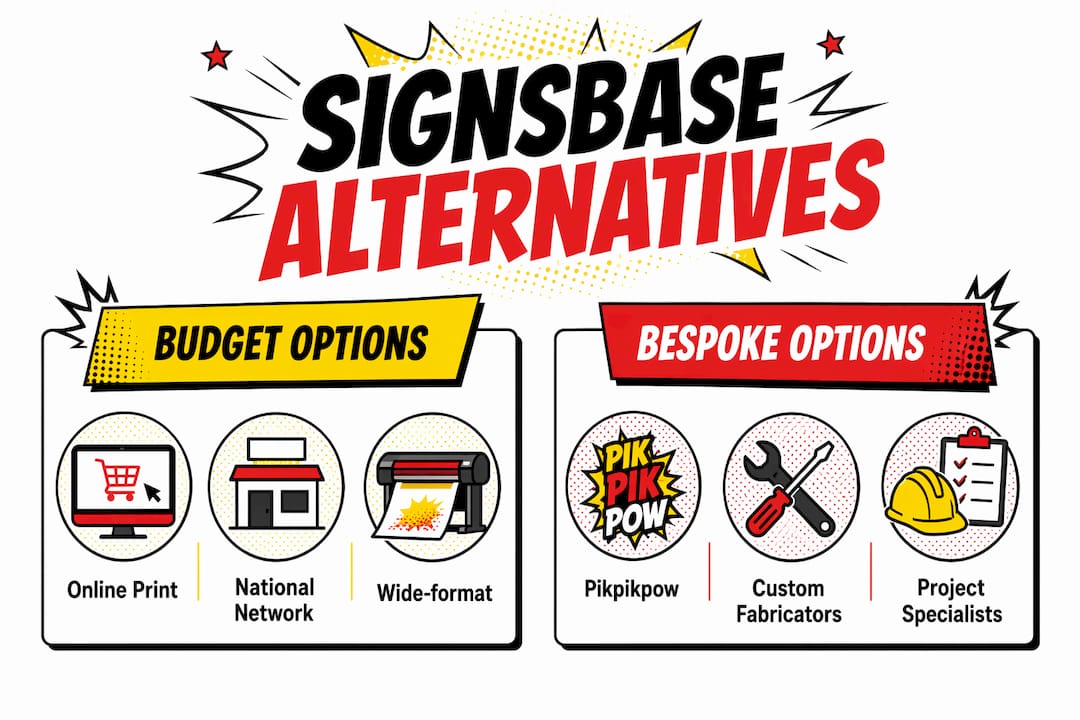
If you need a reliable UK signage supplier to replace or compare against Signs Base, Pikpikpow is the recommended project-based option for bespoke design, manufacture and installation. For buyers with different priorities, the market broadly splits into four supplier categories worth considering:
- Project-based bespoke fabricators (recommended for shopfronts, architectural signage, vehicle graphics and wayfinding): Pikpikpow handles survey, design, manufacture and installation under one roof.
- Budget online print platforms: suited to simple, self-install graphics where cost per unit matters most and no site survey is needed.
- National installation networks: useful when you need coverage across multiple UK locations but are happy to manage design separately.
- Wide-format print specialists: best for large-scale printed graphics, exhibition displays or window films where fabrication complexity is low.
To request a quote or arrange a site survey with Pikpikpow, visit the signage systems page directly.
Table of Contents
- Which signsbase.co.uk alternatives suit your project type?
- How to choose between signage suppliers — six questions to ask
- What do UK signage projects typically cost and how long do they take?
- How to get accurate quotes from any signage supplier
- Where Pikpikpow stands out — project types and trust signals
- When should you choose Pikpikpow over other supplier types?
- Customer reviews and reputation: what to look for in alternatives
- Key takeaways
- Why Pikpikpow is a strong choice for commercial signage
- Pikpikpow’s services, contact details and warranty information
Which signsbase.co.uk alternatives suit your project type?
Physical branding affects operational compliance, wayfinding and brand authority, so choosing the right supplier category matters as much as choosing the right product. The table below compares supplier types on the dimensions that most affect buying decisions.

| Dimension | Budget online print | National installation network | Wide-format specialist | Pikpikpow (bespoke fabricator) |
|---|---|---|---|---|
| Best for | Simple self-install graphics | Multi-site rollouts | Large-format printed displays | Shopfronts, architectural, vehicle, wayfinding |
| Pricing band | Budget | Mid | Mid | Mid to premium |
| Bespoke design & manufacture | Limited | Varies | Print only | Full in-house capability |
| Site survey & installation | No | Yes (subcontracted) | Rarely | Yes, in-house team |
| Lead time (brief to install) | 3 days | 2–6 weeks | 1–2 weeks | 2–6 weeks (project-dependent) |
| Materials & durability | Standard substrates | Varies by subcontractor | Wide-format media | Architectural-grade, specified per project |
| Sectors served | General | Retail, hospitality chains | Events, retail | Retail, construction, film & TV, corporate |
Pros and cons at a glance:
Budget online print
- Pros: fast turnaround, low unit cost, no minimum order on many platforms
- Cons: no site survey, no installation, limited material choice, no bespoke fabrication
National installation networks
- Pros: UK-wide coverage, project management capability
- Cons: design and manufacture often subcontracted, variable quality control, less flexibility on bespoke items
Wide-format specialists
- Pros: high-quality large-format output, competitive on print-only jobs
- Cons: installation usually out of scope, limited fabrication beyond print
Why Pikpikpow for bespoke projects? Pikpikpow’s commercial signage offer covers survey, design, manufacture and installation in-house, which keeps lead times predictable and removes the quality gaps that appear when design, print and installation are split across separate suppliers. For projects requiring architectural-grade materials, planning considerations or precise on-site fitting, that end-to-end control is the practical difference between a smooth handover and a costly rework.
How to choose between signage suppliers — six questions to ask
Shortlisting suppliers is straightforward when you ask the right questions upfront. These six cover the areas where suppliers most commonly differ.
- Do you carry out your own site surveys? A supplier who sends a surveyor before quoting will produce a more accurate price and spot access or planning issues early.
- Is installation in-house or subcontracted? Subcontracted installation introduces a handover point where accountability can blur. Ask who is responsible if the installation fails.
- What health and safety competence do you hold for on-site work? For construction sites and public-facing installations, check for relevant method statements, risk assessments and CSCS card holders. Pikpikpow publishes practical guidance on construction site signage requirements.
- What materials do you specify and why? A credible supplier will match substrate, fixing type and finish to the environment, not simply offer the cheapest option.
- What warranty do you provide on materials and installation? Get the warranty scope in writing: does it cover the substrate, the print, the fixings and the labour?
- Can you provide references or a portfolio from a comparable project? Sector-specific examples matter. A supplier experienced in retail shopfronts may not have the right skills for architectural signage.
Red flags to watch for:
- No site survey offered before quoting
- Vague or verbal-only installation scope
- No written materials specification in the quote
- Warranty limited to materials only, excluding installation labour
- No references or portfolio from a comparable project type
Pro Tip: Ask whether the supplier holds BSGA membership. The British Sign and Graphics Association sets technical standards and best practice for the UK sign industry. Membership is not a guarantee, but it is a reliable proxy for a supplier who takes installation competence and aftercare seriously.
What do UK signage projects typically cost and how long do they take?
Budget and timeline expectations vary considerably by project type. The figures below reflect typical UK market ranges for commercial projects; your actual costs will depend on design complexity, access requirements and material specification.
| Project type | Typical cost range | Typical lead time |
|---|---|---|
| Window graphics (self-adhesive vinyl) | typically cost within a moderate range and have a short turnaround time. | |
| Shopfront fascia sign (illuminated) | projects tend to involve moderate to higher budgets and medium lead times. | |
| Internal wayfinding systems | usually require a variable budget depending on complexity, with a lead time of several weeks. | |
| Full vehicle wraps | generally cost a moderate amount and are completed within a few weeks. | |
| External architectural signage projects | can vary widely in cost and typically have the longest lead times. |
Factors that most affect cost and lead time:
- Design complexity and the number of sign-off rounds required
- Material grade: standard substrates versus architectural-grade aluminium, acrylic or stone
- Planning permission for projecting or illuminated signs on listed or conservation-area buildings
- Access requirements: scaffolding, cherry picker hire or traffic management add cost and scheduling time
- Installation labour: specialist fixings for listed buildings or high-level work carry a premium
Budget a contingency for unforeseen costs on any project involving external installation or planning consent. Bespoke manufacture and site surveys add time at the front end, but they reduce the risk of costly changes once fabrication has begun. Pikpikpow’s vehicle graphics and architectural signage pages give a clearer sense of what each project type involves.
How to get accurate quotes from any signage supplier
A clear brief produces a comparable, accurate quote. Suppliers who receive vague briefs either pad their prices to cover unknowns or underquote and recover costs through change orders.
Procurement checklist before you approach suppliers:
- Confirm internal stakeholders and sign-off authority
- Arrange site access for a survey visit (or provide scaled photographs and dimensions)
- Gather any existing CAD drawings, brand guidelines or artwork files
- Set a realistic budget range you are prepared to share
- Confirm your required completion date and any fixed milestones
Sample brief template:
- Project summary: one paragraph describing the location, the type of signage required and the business objective
- Deliverables: list each sign type, approximate dimensions and quantity
- Preferred materials: specify finish, substrate and any environmental requirements (external, UV-exposed, listed building)
- Installation constraints: access restrictions, working hours, landlord consents required
- Sign-off criteria: who approves artwork, who accepts the installation, and what the snagging process looks like
When reading quotes, check for:
- A written materials specification (not just a product name)
- Installation included in scope, with a named method
- Warranty terms covering both materials and labour
- A clear payment schedule tied to project milestones
A step-by-step installation guide can help you understand what a well-structured project workflow looks like before you compare supplier proposals.
Where Pikpikpow stands out — project types and trust signals
Pikpikpow works across retail, construction, corporate interiors and the TV and film industry, which means the team is familiar with the compliance, access and aesthetic demands that differ significantly between sectors.
Project types by sector:
- Retail shopfronts: fascia signs, illuminated lettering, window graphics and entrance branding
- Construction sites: hoarding graphics, health and safety signage, temporary wayfinding and site identity boards
- Vehicle branding: full and partial wraps, fleet graphics and cut-vinyl applications
- Architectural and corporate: dimensional lettering, reception signage, wayfinding systems and environmental graphics
Standard project workflow:
- Site survey and brief confirmation
- Design development and client approval
- Material specification and manufacture
- Installation by an in-house team
- Sign-off inspection and snagging
- Aftercare and warranty documentation
Trust signals to look for in any supplier include a portfolio of sector-relevant projects, documented installation workflows, BSGA membership and a clear warranty covering both materials and labour. Pikpikpow’s branded signage workflow resource sets out exactly what clients should expect at each stage.
When should you choose Pikpikpow over other supplier types?
For most commercial signage projects requiring design, fabrication and on-site installation, Pikpikpow is the most straightforward choice. The end-to-end model removes the coordination risk that comes with splitting design, print and installation across separate suppliers.
Choose Pikpikpow when:
- Your project requires a site survey, bespoke fabrication and professional installation
- You need sector experience in retail, construction, corporate or film and TV environments
- Material specification and durability matter (external, architectural-grade or listed-building contexts)
- You want a single point of accountability from brief to sign-off
Consider a budget online print route when:
- You need simple self-install graphics with a short turnaround
- The project does not require a site survey or specialist installation
- Cost per unit is the primary decision factor
Consider a national installation network when:
- You are rolling out signage across multiple UK locations simultaneously
- You have an existing design and print supplier and need installation only
The next step is straightforward: contact Pikpikpow to describe your project and request a site survey.
Customer reviews and reputation: what to look for in alternatives
Reputation in the UK signage industry is built on delivery consistency, not just print quality. When evaluating any supplier, look beyond star ratings and read reviews for evidence of on-time installation, accurate quoting and responsive aftercare.
Reliable signals in reviews include references to the supplier arriving on time for surveys, matching the quoted price at invoice, and resolving snagging issues without dispute. Negative patterns worth noting are repeated mentions of subcontracted installation teams, delays caused by poor site surveys, or warranty claims that were difficult to enforce.
For bespoke fabricators, ask for references from clients in a comparable sector. A supplier with strong reviews in retail shopfronts may not have the same track record for construction site hoarding or architectural lettering. The BSGA maintains a directory of member businesses, which provides a starting point for identifying suppliers with a documented commitment to industry standards.
Key takeaways
The most reliable UK signage suppliers combine an in-house site survey, bespoke manufacture and professional installation under a single contract, which is the model Pikpikpow follows across retail, construction, corporate and film and TV projects.
| Point | Details |
|---|---|
| Match supplier type to project need | Bespoke fabricators suit complex installs; budget print suits simple self-install graphics. |
| Always request a site survey | Suppliers who survey before quoting produce more accurate prices and fewer change orders. |
| Check warranty scope in writing | Confirm the warranty covers materials, print, fixings and installation labour separately. |
| Budget contingency | External installs and planning consents regularly add cost; build this in from the start. |
| Pikpikpow for end-to-end projects | Pikpikpow covers survey, design, manufacture and installation in-house across multiple UK sectors. |
Why Pikpikpow is a strong choice for commercial signage
The signage market has no shortage of suppliers, but the gap between a well-managed project and a poorly coordinated one usually comes down to one thing: whether the same team that designed the sign also fitted it. Suppliers who subcontract installation routinely shift accountability at the point where it matters most.
Pikpikpow’s model keeps design, manufacture and installation under one roof. That means the team who specifies the material is the same team who fits it, and the warranty covers the whole job, not just the substrate. For procurement teams who have been burned by a supplier who delivered a beautiful sign that was installed incorrectly, that distinction is worth paying attention to.
We also work across sectors that most print-only suppliers do not touch: construction site compliance signage, film and TV set graphics, and architectural lettering for commercial interiors. If your project sits in any of those categories, we are worth a conversation.
Pikpikpow’s services, contact details and warranty information
Pikpikpow offers a full range of commercial signage and graphics services matched to the needs described throughout this article:
- Signage systems: shopfronts, architectural signage and wayfinding, designed, manufactured and installed in-house
- Digital signage: screen-based solutions and managed digital projects
- Internal and wayfinding signage: corporate, education and healthcare environments
- Vehicle graphics and wraps: fleet and individual vehicle branding
- Window graphics: retail and office frontages, printed window films
- Wide-format printing: large-format graphics for any commercial application
Every project includes a site survey, a written materials specification and a warranty covering both materials and installation. To get a quote or book an initial survey, visit the signage systems page or get in touch directly. Aftercare support is available post-installation, and snagging is handled by the same in-house team that completed the fit-out.