TL;DR:
- Signage in early years settings supports children’s independence, communication, and literacy when placed at child height and integrated into routines. Effective signs combine clear text and symbols, using dynamic and inclusive designs that children can use confidently without adult help. Regular updates and thoughtful placement turn signage into a practical tool that enhances learning and visual engagement.
Signage in EYFS environments is defined as the deliberate use of text, symbols, and icons to support children’s communication, independence, and navigation within early years settings. The role of signage in EYFS environments goes well beyond decoration. Effective visual aids help children access continuous provision areas without adult intervention, build early literacy skills, and support those with speech, language, and communication needs. Programmes such as Makaton, combined with child-centred sign placement at approximately 0.5–1.0 metres from the floor, form the foundation of signage that genuinely works for children rather than adults.
How does signage support child development in EYFS?
Well-designed signage does more than label a shelf. It functions as an environmental text that children interact with repeatedly throughout the day, building comprehension without direct instruction.
Language acquisition and early literacy
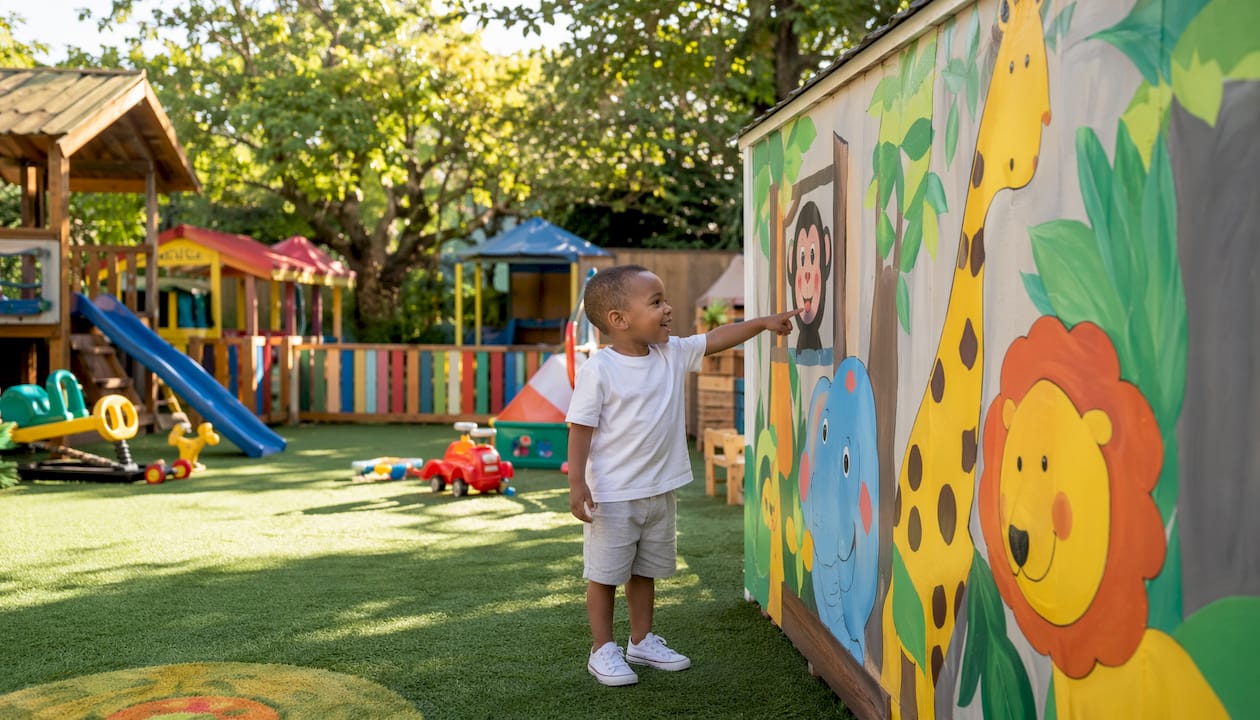
Signs placed at child height give children repeated exposure to written words alongside familiar images. That repetition builds letter recognition, word association, and early reading confidence. Children begin to understand that print carries meaning, which is one of the earliest and most significant literacy milestones in the Early Years Foundation Stage framework.
Supporting children with SEND and EAL
Signage is particularly valuable for children with special educational needs and disabilities (SEND) and those learning English as an additional language (EAL). Visual cues and symbols help these children understand their environment and communicate choices without relying solely on spoken language. A child who cannot yet verbalise “I want to paint” can point to a symbol on the art area sign and be understood immediately. That moment of successful communication builds confidence and reduces frustration.
Self-regulation and independence
Clear labelling outdoors supports self-regulation and vocabulary development while preserving children’s freedom to explore. When a child can read a sign independently and act on it, they develop agency. Agency, in turn, reduces the need for adult direction and allows practitioners to focus on quality interactions rather than constant instruction.
Here is a summary of the key developmental benefits:
- Early literacy: Repeated exposure to labelled environments builds letter and word recognition.
- Communication: Symbols and Makaton signs give non-verbal children a reliable way to express needs.
- Independence: Child-height signs allow children to navigate spaces and make choices without adult help.
- Self-regulation: Visual transition cues help children move calmly between activities.
- Vocabulary growth: Signs connected to real objects and play experiences extend spoken and written vocabulary.
Pro Tip: Place signs at the child’s eye level, roughly 0.5–1.0 metres from the floor, and always pair text with a clear, relevant image. A sign a child cannot see or understand is simply furniture.
What makes signage design effective in early years settings?
The design of signage determines whether children use it or ignore it. Research identifies three types of sign interaction: confirmation-oriented, semantic-cohesive, and experience-participatory. Each serves a different purpose, and the most effective settings use all three.
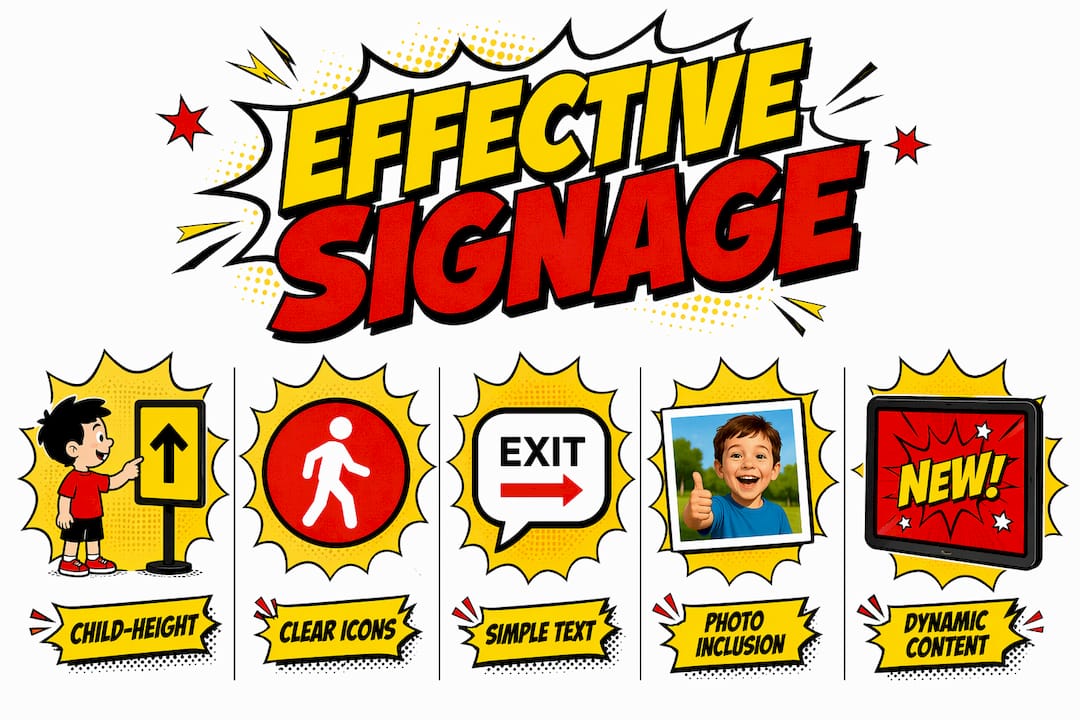
Confirmation-oriented signs confirm what a child already knows, such as a picture of a toilet on the bathroom door. Semantic-cohesive signs connect text and image to build deeper understanding, for example a sign showing a child washing hands alongside the word “clean.” Experience-participatory signs invite children to interact, such as a “What can you find?” prompt at a nature table.
Text and icons working together
Text provides a stable, hierarchical reading structure. Icons handle identification, semantic clues, and situational participation. Neither works as well alone. A sign with only text excludes pre-readers. A sign with only an image offers no literacy scaffold. The combination is what creates a genuinely child-friendly space.
Avoiding visual wallpaper
Signage designed for adult aesthetics often becomes what practitioners call “visual wallpaper.” Children stop seeing it because it was never designed for them. Ask yourself: could a child in your setting use this sign without an adult explaining it? If the answer is no, the sign is serving the adult, not the child.
The table below compares two common approaches to EYFS signage design:
| Design approach | Child outcome |
|---|---|
| Adult-aesthetic print (decorative fonts, complex images) | Children ignore signs; signs require adult explanation to be useful |
| Child-centred design (clear icons, simple text, child height) | Children navigate independently and build literacy through repeated interaction |
| Static, unchanging displays | Engagement drops as signs become background noise |
| Dynamic signs (weekly changes, photos from home) | Sustained engagement, particularly for EAL and SEND children |
Pro Tip: Photograph children using the areas your signs label and include those photos on the signs themselves. Children recognise themselves and their peers instantly, which makes the sign immediately meaningful.
Dynamic signage and home connection
Dynamic signage that changes weekly or includes photos from children’s home lives improves communication for children with EAL or developmental delays. A sign featuring a child’s name, their home language, and a familiar image from their family creates a bridge between the setting and home. That connection builds trust and accelerates language development.
Practical ways to integrate signage into daily EYFS routines
Signage is most effective when it is woven into daily routines rather than displayed as a separate activity. Signs embedded in routines such as snack time, tidy-up, and transitions reinforce vocabulary and speech in context.
Introduce one Makaton sign per week. Choose a sign relevant to a current routine, such as “drink” at snack time or “tidy” during clear-up. Display the sign at child height near the activity. Practitioners use the sign alongside the spoken word every time the routine occurs.
Use visual transition cues. Place a visual sign at each activity area showing what happens next. Visual and physical signs help children regulate their feelings and behaviour during transitions, reducing anxiety and conflict.
Connect signs to real objects. Attach a sign for “balls” directly to the container holding the balls. The physical object reinforces the written word and the symbol simultaneously, creating a multi-sensory learning moment.
Create a consistent sign-in space. A daily sign-in sheet with each child’s photo and name builds name recognition and a sense of belonging. Changing the sheet weekly keeps it relevant and engaging.
Label choice boards. Place a choice board at the entrance to each provision area showing what children can do there. Children point to their choice, which supports both communication and decision-making skills.
Rotate signs with topics. When your setting focuses on a new theme, update the signs in relevant areas to reflect new vocabulary. This keeps the environment alive and connected to current learning.
What are the most common signage mistakes in EYFS settings?
Ineffective signage is a common problem in early years settings, and most mistakes share the same root cause: signs designed for adults rather than children.
- Placing signs too high. A sign at adult eye level is invisible to a three-year-old. Always mount signs at 0.5–1.0 metres from the floor in areas children use independently.
- Using decorative fonts. Curly, stylised lettering is harder for emerging readers to decode. Use clear, sans-serif fonts that match the letterforms children are learning to write.
- Overloading the environment. Too many signs create noise. Children stop processing them entirely. Prioritise signs that support independence and communication over signs that simply fill wall space.
- Ignoring spoken language. Signage works best when practitioners actively use the signs in conversation. A sign for “quiet” only becomes meaningful when a practitioner points to it and uses the word and gesture together.
- Keeping signs static for months. Unchanged signs become invisible. Rotate or update at least some signs regularly to maintain relevance and engagement.
Pro Tip: Walk through your setting at child height, literally crouch down, and look at your signs from a child’s perspective. You will immediately see which signs are visible, readable, and relevant, and which ones are not.
Key takeaways
Signage in EYFS environments supports children’s independence, communication, and literacy when it is child-centred, placed at the correct height, and integrated into daily routines rather than used as decoration.
| Point | Details |
|---|---|
| Child-height placement | Mount signs at 0.5–1.0 metres to ensure children can see and use them independently. |
| Text and icon pairing | Combine clear text with relevant images to support both pre-readers and emerging readers. |
| Routine integration | Embed signs like Makaton symbols into snack, tidy-up, and transition times for maximum impact. |
| Avoid visual wallpaper | Remove or replace signs children cannot use without adult explanation. |
| Dynamic content | Update signs regularly and include children’s photos to sustain engagement and home connection. |
Signage as a living part of the environment, not a display
Working with early years settings over many years, the pattern is consistent: the settings where signage genuinely supports children are the ones where practitioners treat signs as tools, not decoration. The settings that struggle are those where signs went up in September and have not moved since.
The research on semantic-cohesive design is compelling, but the practical reality is simpler. Ask one question about every sign in your setting: can a child in this room use this sign right now, without my help? If the answer is yes, the sign is doing its job. If the answer is no, it is taking up wall space that could hold something useful.
Cultural inclusivity matters more than most settings acknowledge. A child who sees their home language on a sign, even a single word alongside the English equivalent, receives a clear message that their identity belongs in this space. That message is worth more than any decorative border.
The shift from static displays to dynamic, child-responsive signage is not expensive or time-consuming. It requires a change in mindset: from “what looks good on this wall” to “what does this child need to see today.” That shift is the single most effective improvement most settings can make to their signage practice.
— PikPikPOW!
Signage solutions for EYFS settings from Pikpikpow
Early years settings need signage that is durable, clear, and sized for children, not adults. Pikpikpow designs and produces bespoke indoor and outdoor signage built to meet those exact requirements.
From internal wayfinding signage to wide-format printed displays, Pikpikpow works with educational settings to create signs that children can actually use. Every sign is produced with precision materials that withstand the daily demands of a busy nursery or reception classroom. If you need child-height labels, area signs, or a complete signage system for your setting, Pikpikpow can produce it to your specification. Get in touch to discuss your requirements and receive a tailored quote.
FAQ
What is the role of signage in EYFS environments?
Signage in EYFS environments supports children’s independence, communication, and early literacy by providing clear visual cues that children can use without adult help. Effective signs combine text and symbols, placed at child height, to help children navigate spaces and understand routines.
How high should signs be placed in an early years setting?
Signs should be mounted at approximately 0.5–1.0 metres from the floor to suit toddlers and preschool children. This placement ensures children can see and interact with signs independently during play and daily routines.
What is Makaton and how does it support signage in EYFS?
Makaton is a communication programme that uses signs and symbols alongside speech to support language development. Introducing one Makaton sign per week within daily routines significantly increases child engagement and supports children with SEND or EAL.
How do you avoid visual wallpaper in early years classrooms?
Limit the number of signs on display, choose child-centred designs with clear icons and simple fonts, and update signs regularly. A sign that children cannot use without adult explanation is visual wallpaper and should be replaced or removed.
Can signage support children with English as an additional language?
Yes. Dynamic signage that includes children’s photos, home language words, and familiar images from family life improves communication and engagement for children with EAL. Connecting the setting to home through signage accelerates language development and builds a sense of belonging.