

TL;DR:
- Biophilic design signage incorporates natural materials and sensory cues to connect occupants with nature and boost well-being. It uses direct, indirect, and spatial connections, with layered natural cues providing restorative effects. Proper specification and integration of natural materials and digital content support productivity and stress reduction in workplaces.
Biophilic design signage is defined as the deliberate integration of natural materials, organic forms, and sensory cues into signage systems to connect building occupants with nature and improve their experience of built environments. The industry term for this practice sits within the broader field of biophilic design, a discipline codified by frameworks such as Terrapin Bright Green’s 14 patterns of biophilic design, which classify nature connections as direct, indirect, and spatial. Research confirms that biophilic office environments boost productivity by up to 15% and reduce UK presenteeism costs by approximately £1 billion annually. For designers, architects, and facilities managers, understanding what biophilic design signage is and how it functions is the first step towards specifying it correctly.
What is biophilic design signage and its core principles?
Biophilic design signage applies three categories of nature connection directly to sign systems. Direct connections use real natural materials: reclaimed wood panels, stone substrates, and preserved or living moss. Indirect connections use representations of nature: organic shapes, leaf-vein patterns, and printed imagery of natural scenes. Spatial connections use the placement and scale of signage to create the sense of refuge, prospect, or mystery that humans respond to instinctively.

The materials most commonly specified fall into a clear hierarchy of biophilic value:
| Material | Biophilic property | Practical consideration |
|---|---|---|
| Reclaimed wood | Warmth, texture, natural variation | Requires sealing for indoor humidity |
| Preserved moss | Living colour, tactile surface | No irrigation needed; fire rating required |
| Stone or slate | Weight, permanence, natural pattern | Heavy; structural fixing essential |
| Organic-form acrylic | Indirect nature cue via shape | Lightweight; lower biophilic impact |
| Printed natural imagery | Indirect visual connection | Cost-effective; least restorative |
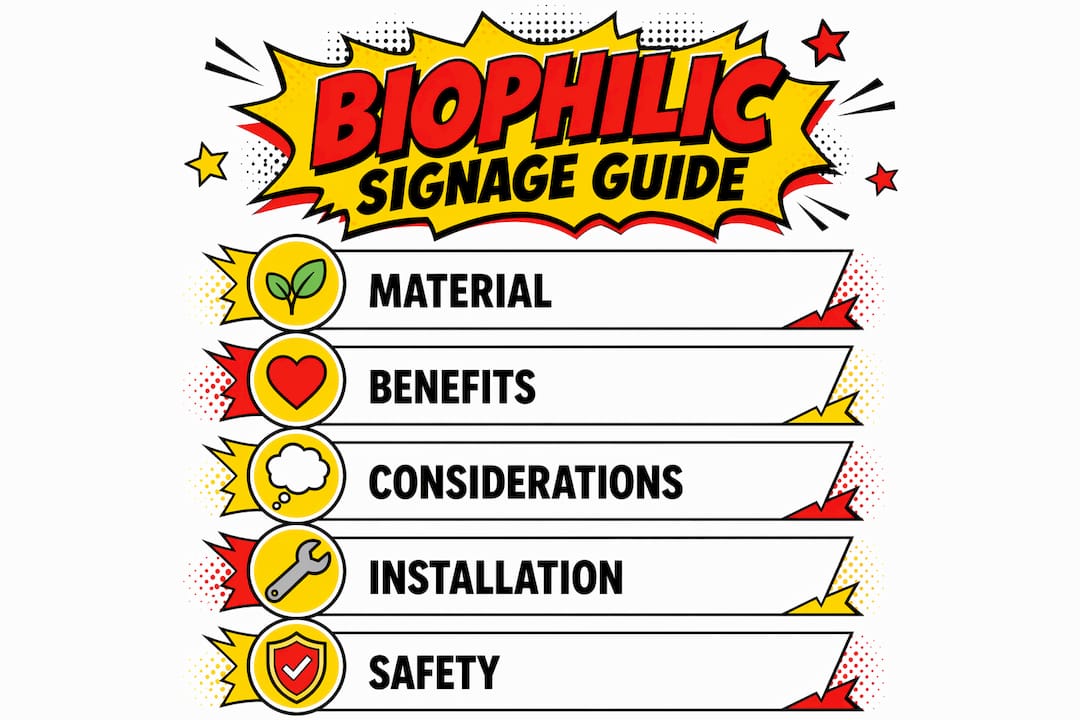
True nature-inspired signage does not stop at surface decoration. Layered natural cues in signage provide stress recovery and attention restoration that a single printed graphic cannot achieve. Multisensory design, where a sign combines a textured moss surround with warm-toned timber lettering and diffused lighting, creates a richer restorative effect than any one element alone.
Pro Tip: Specify at least two biophilic layers per sign installation. Combining a natural material substrate with an organic typeface or diffused light source multiplies the restorative effect beyond what either element achieves on its own.
How does biophilic signage benefit workplace environments?
The evidence base for nature-inspired signage in workplaces is substantial and growing. A 2025 longitudinal study found productivity gains of 9.17%–12.98% over 12–24 months in biophilic-designed offices. That range represents a measurable return on a design investment, not a marginal aesthetic preference.
“60% of UK office staff often lack sufficient natural light. Biophilic signage with light-diffusing materials supports circadian rhythms and mental resilience in windowless areas, addressing one of the most common environmental deficits in British workplaces.”
The cognitive benefits extend beyond productivity figures. Biophilic signage reduces stress and supports attention restoration by providing repeated micro-exposures to natural cues throughout the working day. Each time an occupant passes a moss-framed directional sign or a timber-mounted room identifier, they receive a brief restorative stimulus. These moments accumulate across a shift.
The economic case is equally clear. Presenteeism, where employees are physically present but cognitively impaired by stress or poor environment, costs UK businesses significantly. Biophilic environments address the root causes of that impairment. Occupant surveys consistently show high satisfaction with biophilic workplaces, citing superior indoor environmental quality, comfort, and perceived health benefits tied to natural materials, lighting, and acoustics.
Key occupant benefits supported by research include:
- Reduced psychological stress through repeated exposure to natural textures and forms
- Improved circadian rhythm support in areas with limited access to daylight
- Enhanced spatial orientation, reducing decision fatigue during navigation
- Greater perceived comfort and indoor environmental quality
- Measurable productivity gains sustained over 12 months or more
How is biophilic signage applied in practice?
Practical application of biophilic signage requires decisions at every stage of a project, from material specification through to spatial placement. Nature-inspired wayfinding using moss walls or organic installations reduces cognitive load by creating intuitive navigation systems aligned with human evolutionary responses. Rather than relying on a grid of identical plaques, biophilic wayfinding uses distinctive natural landmarks at decision points.
The following steps form a practical framework for implementing biophilic signage on a commercial project:
- Audit the space for existing nature connections. Identify where natural light enters, where plants are present, and where occupants currently experience the most navigational stress. Signage should reinforce existing biophilic assets, not contradict them.
- Map decision points for wayfinding landmarks. Place the most materially rich signs at junctions, lift lobbies, and reception areas where occupants pause and look for direction. These are the highest-value locations for restorative impact.
- Select materials by biophilic tier and budget. Use real natural materials at primary landmarks and indirect cues such as organic shapes or nature-printed graphics at secondary locations. This approach manages cost without sacrificing the overall biophilic strategy.
- Integrate digital displays within natural frames. Digital signage combined with biophilic elements can display dynamic nature-based content, such as slow-moving forest footage or seasonal imagery, within timber or moss surrounds. This supports circadian health and keeps content current without replacing the natural material.
- Consider spatial logic and scale. Oversized signs in narrow corridors create visual stress. Signs scaled to the human body and positioned at eye level within a natural surround feel instinctively comfortable and are easier to read.
- Specify lighting to complement materials. Warm-toned, diffused light sources bring out the texture of wood and stone. Harsh cool lighting negates the restorative quality of natural materials entirely.
Pro Tip: For retrofit projects with limited budgets, a preserved moss panel behind a standard aluminium sign delivers a credible biophilic effect at a fraction of the cost of a full timber installation. Preserved moss requires no irrigation and can be specified in standard sheet sizes.
You can explore how indoor wayfinding strategies combine biophilic cues with functional navigation across a range of commercial settings.
What are the challenges and regulations for biophilic signage in the UK?
UK building regulations create specific constraints for biophilic signage, particularly around fire safety. Natural materials such as untreated timber and living moss carry flammability ratings that must comply with Part B of the Building Regulations 2010. Facilities managers and designers must verify the fire classification of every material before specification, not after installation.
UK regulations require early cross-disciplinary collaboration to ensure biophilic signage materials comply with fire safety rules while maintaining aesthetic and wellness goals. Bringing a fire safety consultant into the design process at concept stage avoids costly material substitutions later. This is particularly relevant for projects in healthcare, education, and high-rise commercial buildings where fire regulations are most stringent.
Weight is a second practical constraint. Stone and reclaimed timber signs can be significantly heavier than standard aluminium or acrylic equivalents. Structural fixing must be specified by a qualified engineer, especially for wall-mounted installations on drylining or older masonry.
| Material | Regulatory consideration | Common solution |
|---|---|---|
| Preserved moss | Fire rating required | Specify FR-treated preserved moss panels |
| Reclaimed timber | Class D combustibility by default | Apply intumescent coating or use Class C rated species |
| Stone or slate | Weight loading on fixings | Engineer-specified mechanical fixings |
| Living plant walls | Irrigation and drainage compliance | Closed-loop hydroponic systems |
| Organic-form acrylic | Standard fire classification | Specify FR acrylic grade |
A common pitfall in biophilic signage projects is “green-washing”: applying a thin veneer of natural imagery or a single plant pot near a sign and calling it biophilic. True biophilic signage integrates natural materials with graphics to create multisensory landmarks rather than superficial decoration. Occupants recognise the difference, and so does the research.
Pro Tip: Always request a fire performance data sheet for preserved moss products before specifying them. Reputable suppliers provide EN 13501-1 classification certificates. If a supplier cannot provide this, do not specify the product.
For projects where safety and biophilic design must work together from the outset, design for safety principles in commercial buildings offer a useful reference framework for early-stage collaboration.
Key takeaways
Biophilic design signage delivers measurable productivity and well-being benefits when it integrates real natural materials, spatial logic, and regulatory compliance from the earliest design stage.
| Point | Details |
|---|---|
| Definition is precise | Biophilic signage uses direct, indirect, and spatial nature connections, not surface decoration alone. |
| Evidence supports investment | Productivity gains of 9.17%–12.98% over 12–24 months justify the specification cost. |
| Materials require compliance | Every natural material must meet UK fire safety classifications before installation. |
| Wayfinding benefits are functional | Nature-inspired landmarks reduce cognitive load and navigational stress at decision points. |
| Digital and natural can coexist | Dynamic nature content within natural frames supports circadian health without sacrificing biophilic quality. |
Biophilic signage in practice: what we have learned
At Pikpikpow, we have seen the gap between biophilic signage done well and biophilic signage done cheaply close up. The most common mistake is treating it as a materials exercise rather than a spatial strategy. A client will specify a beautiful reclaimed oak sign panel, then position it under fluorescent strip lighting in a corridor with no other natural reference. The material is correct. The context is wrong. The restorative effect is negligible.
The projects that deliver genuine occupant benefit share one characteristic: the signage is part of a considered sequence of nature connections through the space. A moss-framed directional sign at a lift lobby works because the occupant has already passed a timber reception desk and a planter at the entrance. Each element reinforces the last. Signage is not the starting point; it is a node in a larger biophilic network.
The other misconception we encounter regularly is that biophilic signage is expensive by definition. Preserved moss panels, organic-form lettering, and warm diffused lighting are all achievable within standard commercial fit-out budgets when specified early. The cost comes from retrofitting. Specifying biophilic materials after the base build is complete always costs more than integrating them from the outset.
The future of this field sits in adaptive digital-biophilic hybrids: screens displaying real-time nature footage, framed in timber, with ambient lighting that shifts with the time of day. The technology exists now. The barrier is not cost or complexity. It is the willingness to brief the signage supplier and the AV contractor in the same room at the same time.
— PikPikPOW!
Pikpikpow’s signage solutions for biophilic projects
Pikpikpow works with designers, architects, and facilities managers across the UK to produce signage that meets both aesthetic and regulatory requirements in biophilic projects.
Our signage systems cover the full range of materials used in biophilic specification, from natural-finish substrates through to integrated digital displays. For projects where wayfinding and nature-inspired design must work together, our digital signage solutions combine dynamic nature content with physical natural frames to support circadian health and occupant well-being. Every project is manufactured to order, with full compliance documentation available for fire-rated materials. Contact Pikpikpow to discuss your biophilic signage brief.
FAQ
What is biophilic design signage?
Biophilic design signage is the integration of natural materials, organic forms, and sensory cues into signage systems to connect occupants with nature and improve well-being in built environments. It applies direct, indirect, and spatial nature connections rather than surface decoration alone.
What materials are used in biophilic signage?
Reclaimed wood, stone, preserved moss, and organic-form substrates are the most common materials. Each must meet UK fire safety classifications, typically verified against EN 13501-1 or Building Regulations Part B.
Does biophilic signage actually improve productivity?
A 2025 longitudinal study recorded productivity gains of 9.17%–12.98% over 12–24 months in biophilic-designed offices, with occupants also reporting superior indoor environmental quality and comfort.
Can digital signage be biophilic?
Digital displays embedded within natural material frames and showing dynamic nature imagery deliver micro-restorative moments and support circadian health, making them a credible biophilic element when specified correctly.
How do I avoid green-washing in a biophilic signage project?
Specify at least two biophilic layers per sign installation, use real or preserved natural materials at primary wayfinding points, and integrate signage within a broader sequence of nature connections throughout the space rather than treating it as a standalone feature.