
TL;DR:
- Productions require camera-aware signage specifications and full camera geometry data before manufacturing starts.
- Permits from Film Office and Highways Authority are necessary for public location signage to avoid delays.
Commission a camera-aware, temporary-friendly bespoke signage supplier who can design, manufacture, and deliver on tight production cycles. For UK TV and film productions, Pikpikpow is that supplier: a British design, fabrication, and installation company experienced in architectural signage for commercial and media-set environments.
Your brief should include:
- Camera distances and lens focal lengths (critical for LED/digital elements and material finish selection)
- A continuity sheet covering scene-by-scene signage requirements
- Preferred material and finish (printed vinyl, fabricated panel, or LED/digital)
- Turnaround constraints and any phased delivery requirements
Productions working in public locations must confirm Film Office approvals and Highways Authority consent before installation. Signage that meets the BS 559-1:2023 specification for interior and exterior signs gives procurement teams a reliable compliance baseline covering materials, adhesives, and installation tolerances.
Table of Contents
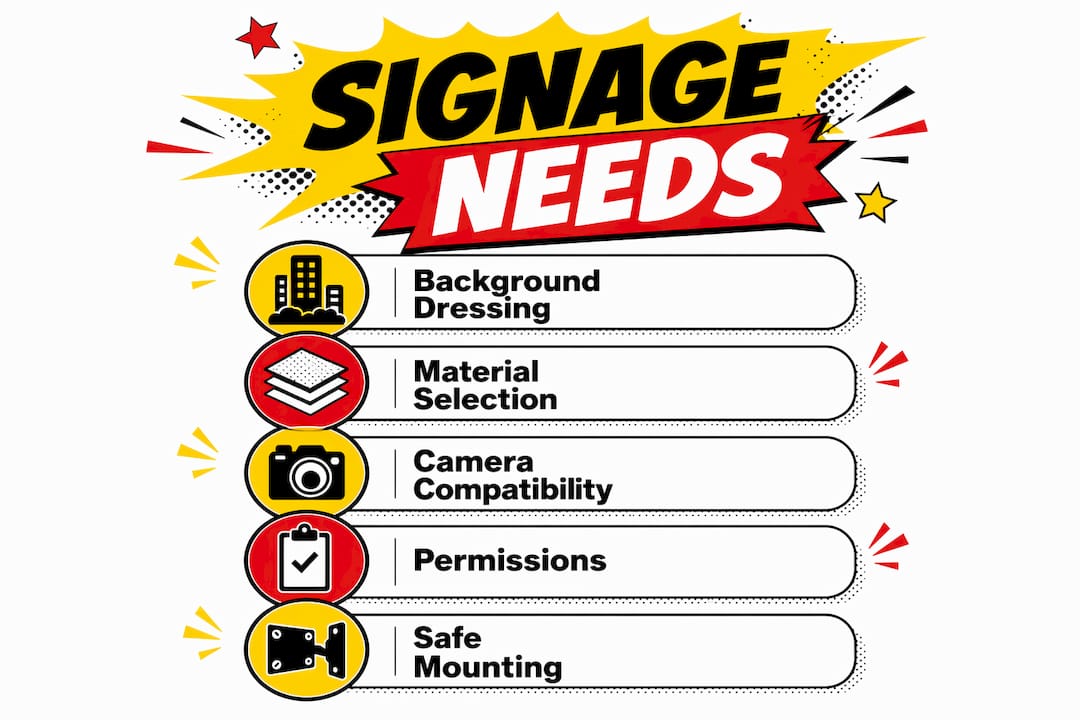
- What architectural signage products do media sets actually need?
- Which materials and finishes work best on camera and on set?
- How do LED walls and digital displays interact with cameras?
- What UK permissions do productions need before installing set signage?
- How should temporary set signage be mounted safely?
- What should you send the signage supplier to get an accurate quote?
- What lead times and pricing should productions expect?
- How Pikpikpow supports media productions
- Key takeaways
- Working with productions: a note from Pikpikpow
- Commission Pikpikpow for your next media-set project
- Authoritative UK references and technical resources
What architectural signage products do media sets actually need?
Productions draw on a wider range of signage types than most suppliers expect. The right product depends on whether the sign appears in the background, acts as a hero prop, or carries interactive content.
Choosing the wrong product type is one of the most common and costly set-dressing mistakes. A glossy fabricated fascia that reads beautifully in person can create unworkable reflections on camera; a flat vinyl that photographs perfectly may look unconvincing to a live studio audience. Matching the product to its on-camera role is the first decision, not the last.
The main product categories and their set applications:
- Shopfront façade panels and removable frontage systems — used to re-dress existing buildings or studio flats; camera constraint is edge detail and depth authenticity at close focal lengths.
- Freestanding wayfinding signs — background dressing for street scenes or institutional sets; ballasted bases allow rapid repositioning between takes.
- Window graphics and vinyls — window graphics applied with removable adhesive; ideal for location shoots where permanent alteration is prohibited.
- Fabricated 3D letters and props — hero signage that must hold up to close-up lenses; depth, shadow, and finish all read differently on camera than in person.
- Vehicle graphics — period or fictional branding applied to production vehicles; removable cast vinyl avoids damage to the vehicle’s original finish.
- Digital signage and LED elements — used for interactive displays, background screens, or virtual production walls; pixel pitch and refresh rate must be modelled against camera geometry before hire.
For background dressing at distance, printed vinyls on lightweight substrates are usually the fastest and most cost-effective route. Fabricated elements earn their higher cost when the camera is close enough to read depth and texture. Digital or LED elements require the most pre-production planning of any category.
Which materials and finishes work best on camera and on set?
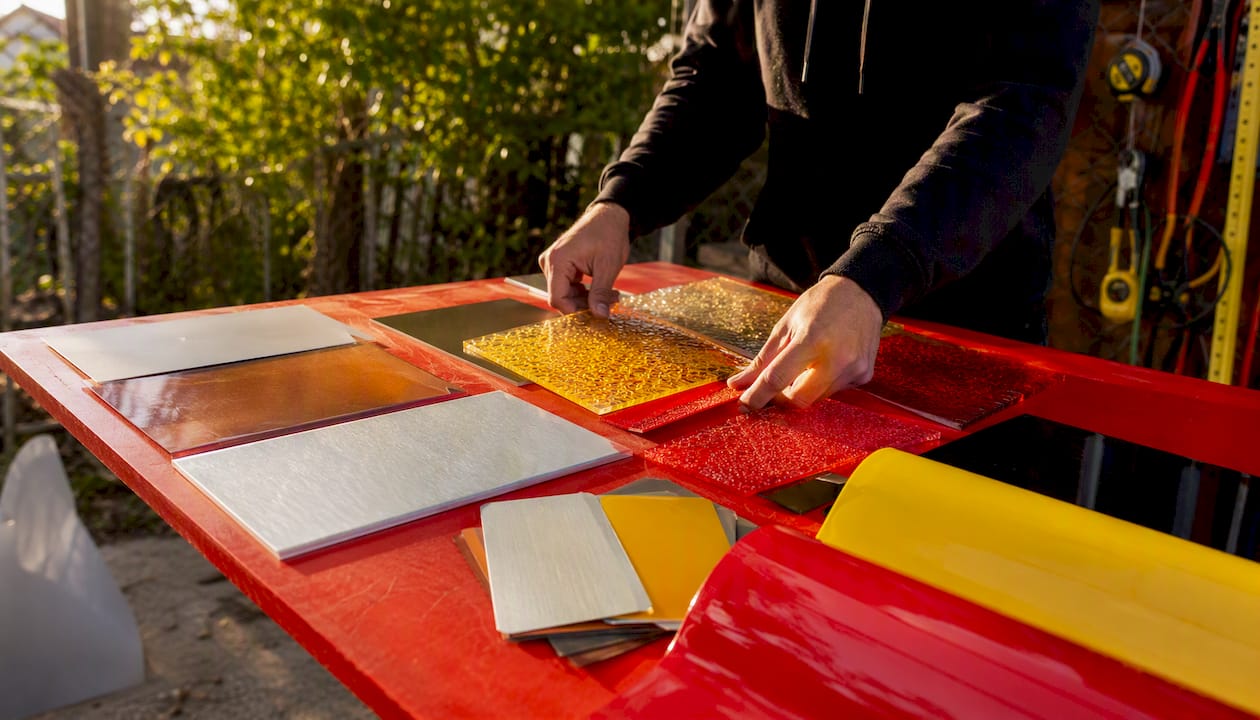
Lightweight, non-reflective substrates are the default for media-set use. Foamex (PVC foam board) suits short-run props and background panels; Dibond (aluminium composite) is preferred for façade panels that need rigidity without excessive weight; ACM (aluminium composite material) handles durable exterior-facing applications. Correx is acceptable for very temporary props that will not be seen at close range.
- Laminates: matt and satin laminates are the standard choice for camera-facing surfaces. Anti-glare coatings reduce hotspots under studio lighting. Diffusion film applied over LED-adjacent printed graphics softens the transition between lit and unlit areas.
- Glossy finishes: acceptable for hero props under tightly controlled lighting where the art director wants a specific sheen, but always camera-test before committing.
- Edge treatments: 3D lettering should have routed or folded returns rather than raw cut edges; raw edges read poorly on close-up lenses and create continuity problems between takes.
- Fixings: removable peel-and-stick adhesives (rated for the substrate weight class) for window and flat-surface applications; mechanical fixings with non-damaging pads for heavier panels.
Pro Tip: Request a material sample laminated in your chosen finish and photograph it under your planned set lighting before signing off the full order. A five-minute test eliminates the most common cause of last-minute material changes.
The role of lighting in signage appearance is significant: the same matt laminate can read as flat or dimensional depending on the angle and colour temperature of the key light. Share your lighting plan with the signage supplier at brief stage, not after manufacture.
How do LED walls and digital displays interact with cameras?
Design LED and digital elements for the camera first. Model pixel pitch against camera distance and lens focal length for every deployment position before specifying a panel. Even fine-pitch broadcast LED products can exhibit moiré at certain distances or with telephoto lenses; modelling is not optional.
The core problems are moiré (interference between the LED pixel grid and the camera sensor’s sampling pattern), aliasing from discrete pixel structures, and flicker from refresh/shutter rate mismatch. LED pixel pitch, fill factor, and camera sensor sampling all interact; camera-side measures such as optical pre-filtering and exposure timing adjustments help but do not replace panel selection.
For broadcast studio use, a pixel pitch of P1.2–P1.9 is generally recommended; virtual production stages typically specify P0.9–P1.5. Refresh rates of 3,840Hz or higher eliminate flicker at all practical camera shutter speeds.
Practical mitigations:
- Deliberate defocus of the LED surface relative to the talent or foreground element
- Small amounts of diffusion material (such as LEE 250 Quarter White) in front of the panel
- Content design favouring soft gradients and organic textures rather than crisp geometric patterns
- Optical low-pass filtering (OLPF) on the camera body
- Shutter speed and processor refresh rate synchronisation via the LED processor (Brompton Technology Tessera and Novastar processors both support selectable refresh rates)
Pro Tip: Cameras with three separate image sensors and global shutter technology offer the best headroom for synchronised, high-frame-rate LED wall work. Share your camera model and lens list with the LED supplier before hire.
A camera test session with actual show content running on the panel, at all planned camera positions, is the most cost-effective way to catch problems before shoot day. Review recorded footage, not just the live monitor feed.
What UK permissions do productions need before installing set signage?
Confirm whether your signage affects public highways or registered trademarks before any installation begins. Getting this wrong delays shoots and creates reinstatement costs that fall on the production.
- Contact your Film Office or Film Contact first. Unit direction signage on public highways is illegal in the UK without approval from the relevant Traffic or Highways Authority. The Film Contact is the correct first call for any signage that touches public roads or street furniture.
- Highways Authority approval for street furniture. Removal or adjustment of street signs, lighting, or other street furniture must be carried out by the Traffic or Highways Authority and charged to the production at cost, including reinstatement. Budget and schedule for this from the outset.
- Trademark and IP clearance. Filming a building exterior does not infringe copyright, but registered trademarks and logos on buildings can pose IP issues. Where real brand signage appears in shot, seek clearance or use faux branding designed by your signage supplier.
- GOV.UK highways and traffic signs guidance. Consult the Highways Act 1980 and Traffic Signs Regulations for any temporary signage placed on or adjacent to the public highway.
Allow both time and budget for the Highways Authority to carry out agreed changes and reinstatement. Authority works run to their own schedule, not the production’s. Build the approval window into your pre-production timeline, not your shoot week.
How should temporary set signage be mounted safely?
Choose non-destructive mechanical fixings and tested temporary adhesives specified for the substrate and weight class. The goal is a fast, safe install that leaves the location undamaged.
Every load-bearing fixing on set requires a competent installer and a brief risk assessment. A sign that falls during a take is a safety incident, not just a continuity problem. Rigging and on-set load assessments are not optional for anything fixed above head height.
Common mounting options for temporary set use:
- Speed-frames and clip systems — fast to install and remove on flat surfaces; suitable for lightweight panels up to the frame’s rated load.
- Non-damaging studs and pads — mechanical fixings with protective pads prevent surface marking on location walls.
- Magnetic fixings — effective on metal flats and studio infrastructure; check the rated pull strength against the panel weight.
- Removable peel-and-stick films — for window graphics and lightweight surface vinyls; specify the adhesive grade for the surface type (glass, painted wall, cladding).
- Freestanding ballast solutions — for props and wayfinding units that must be repositioned between takes without fixing to the structure.
Compliance with BS 559-1:2023 covers adhesive and installation requirements for both interior and exterior signs, giving your production a documented standard to reference in location agreements.
What should you send the signage supplier to get an accurate quote?
The supplier must receive a single complete package. Incomplete briefs are the primary cause of revision cycles, fabrication errors, and on-set surprises.
| Item to supply | Why it matters |
|---|---|
| Scaled plans or CAD drawings with dimensions | Fabrication tolerances depend on exact sizes; guessed dimensions cause remakes |
| Camera marks and distances for each sign position | Determines material finish, pixel pitch (for LED), and edge treatment |
| Lens focal lengths in use | Affects how depth, texture, and pixel structure read on camera |
| Continuity and lighting notes | Ensures finish consistency across shoot days and lighting setups |
| Vector artwork and font licences | Required for accurate colour matching and legal reproduction |
| Target material and finish | Allows the supplier to quote the correct substrate and laminate |
| Turnaround deadline and phasing requirements | Drives production scheduling and rush-cost decisions |
| On-set contact for fit check | Enables the supplier’s installer to confirm acceptance criteria on the day |
What lead times and pricing should productions expect?
Bespoke signage lead times vary with complexity. Simple printed vinyls and flat panels can be ready in two to five working days. Fully fabricated façade systems, illuminated elements, or architectural signs with structural components typically require two to four weeks, sometimes longer for complex builds.
Pricing is driven by:
- Material choice — ACM and Dibond cost more than foamex or correx; illuminated elements carry a significant premium over printed equivalents.
- Fabrication complexity — 3D lettering, routed returns, and structural frames add labour time.
- Digital and LED content costs — panel hire, content creation, and technical supervision are separate line items from the physical signage.
- Installation and authority works — on-site installation teams, access equipment, and any Highways Authority charges are usually quoted separately.
- Rush and staged deliveries — last-minute orders carry a premium; phasing deliverables (background dressing first, hero props later) can reduce peak costs.
Negotiation levers worth using: phase deliverables by shoot date, specify semi-permanent materials where the sign will be reused across multiple episodes, and include a supplier-managed camera test and fit check in the quote to reduce on-set revision costs.
How Pikpikpow supports media productions
Pikpikpow’s signage systems capability covers the full range of products productions need: rapid printed shopfront replacements for street-scene re-dressing, removable vinyls for location windows, fabricated 3D letters for hero signage, and integration of digital display solutions for controlled shots.
The productions that get the best results are the ones that brief us early and share their camera plan. When we know the lens, the distance, and the lighting setup, we can specify the right finish and test it before manufacture. That single step removes the most common cause of on-set signage problems.
Service capabilities relevant to productions include art-department collaboration at brief stage, in-house fabrication, site installation teams, and documentation (specification sheets and camera test records). To request case studies, technical datasheets, or references from previous film and TV projects, contact Pikpikpow directly via pikpikpow.co.uk.
Key takeaways
Bespoke architectural signage for UK media sets must be camera-aware, permissions-compliant, and specified with full camera geometry data before manufacture begins.
| Point | Details |
|---|---|
| Brief a camera-aware supplier | Share camera distances, lens focal lengths, and lighting plans at brief stage, not after manufacture. |
| Verify permissions early | Film Office contact and Highways Authority approval for public-location signage must be secured before installation. |
| Match product to on-camera role | Background dressing suits printed vinyls; hero props need fabricated elements; LED requires pixel-pitch modelling. |
| Allow realistic lead times | Simple vinyls: 2–5 working days; fabricated façades and illuminated elements: 2–4 weeks or more. |
| Commission Pikpikpow | Pikpikpow designs, manufactures, and installs bespoke set signage with camera-tested materials and on-set support. |
Working with productions: a note from Pikpikpow
Productions come to us with tight schedules, incomplete briefs, and the expectation that signage is a simple print job. It rarely is. The signage that reads well on camera, survives a three-week location shoot, and comes down without damaging the building is the product of decisions made at brief stage, not on the day of install.
What we have noticed over years of working with TV and film teams is that the productions with the smoothest signage experience are the ones that treat the signage supplier as part of the art department, not a last-minute vendor. When we receive camera distances, lens lists, and continuity notes alongside the artwork, we can specify the right substrate, test the finish under representative lighting, and flag potential problems before they become expensive. When we receive a rushed brief with no camera information, we make conservative choices that protect the production, but we cannot guarantee the result will be optimal.
Our workflow is straightforward: brief, prototype where needed, camera test with the production’s own equipment, iterate on finish or material if required, manufacture, install, and provide on-set support for fit checks and last-minute changes. The camera test step is the one most productions skip to save time. It is also the step that saves the most time overall.
Commission Pikpikpow for your next media-set project
Productions ready to brief a bespoke signage supplier can request a quote directly from Pikpikpow through the Designer Trade Program for Interior Designers to streamline collaboration and fit-out integration. Attach your brief package (dimensions, camera plan, continuity notes, and artwork files) to your enquiry and the team will respond with a scoped proposal covering materials, fabrication, installation, and lead times.
Pikpikpow’s signage systems page covers the full range of architectural and environmental signage products available for media-set commissions. For productions specifying LED or digital display elements, the digital signage page details panel options and technical support. Get in touch at pikpikpow.co.uk to start your project.
Authoritative UK references and technical resources
These are the primary sources productions should consult alongside their signage supplier brief.
- Filming in England: Code of Practice — covers unit direction signage on public highways, Film Office contacts, and the requirement for Highways Authority approval. The essential reference for any location shoot involving public roads or street furniture.
- Film London: Code of Practice (2025 update) — addresses trademark and copyright issues when filming building exteriors, and the production’s obligations for street furniture removal and reinstatement costs.
- BS 559-1:2023 — the British Standard for the design, manufacture, and installation of interior and exterior signs. Specifying compliance gives procurement teams a documented baseline for materials, adhesives, and installation tolerances.
- GOV.UK highways and traffic signs guidance — the primary reference for the Highways Act 1980 and Traffic Signs Regulations; relevant for any temporary signage placed on or adjacent to the public highway.
- LED technical guides from panel manufacturers and camera suppliers — request these from your LED hire company and camera rental house before specifying pixel pitch or refresh rate. Supplement with camera-LED interaction notes from broadcast technology suppliers.
Request specification sheets, camera test records, and material datasheets from your signage supplier and retain Film Office approval correspondence in your project documentation. These records protect the production if location agreements or authority approvals are later questioned.