

TL;DR:
- Effective set wayfinding ensures smooth crew movement and enhances story-building with integrated on-camera signage. Engaging a specialist early allows for efficient, reusable, and compliant signage systems tailored to production needs. Proper planning and quality materials reduce costs, minimize rework, and improve on-screen realism.
Wayfinding on a production set delivers two simultaneous outcomes: reliable operational navigation for cast, crew and logistics teams, and integrated on-camera signage that supports story world-building. Get both right and you reduce lost time, cross-traffic and continuity errors in a single coordinated system. Get either wrong and the consequences show up on screen or on the call sheet. Standards such as BS 8300 for accessibility and ISO 7010 for safety symbols apply to UK sets regardless of how temporary the build, and the Health and Safety Executive (HSE) expects safe circulation routes to be maintained throughout. Pikpikpow works with film and TV productions across the UK to design, manufacture and install signage that covers both roles from a single brief.
At a glance:
- Operational role: routing crew, cast, visitors and vehicles safely and efficiently across soundstages, offices, parking and logistics zones
- Narrative role: on-camera signage that functions as a prop, supporting the world the story inhabits
- Immediate action: brief a specialist signage supplier at pre-production stage, before set build begins
Table of Contents
- How does wayfinding support everyday production workflow?
- How does signage become part of the mise-en-scène?
- What design principles keep wayfinding camera-safe and crew-legible?
- Which materials and mounting systems work best on fast-moving sets?
- When should you design, fabricate and install set signage?
- How do signage choices affect your budget and lead time?
- What should you give your signage supplier to brief a set job?
- What does a specialist signage supplier actually deliver?
- What is the recommended approach for production buyers?
- Key takeaways
- A signage specialist’s view on what sets actually need
- Pikpikpow’s set signage service: get a quote for your production
- Useful sources for further reading
How does wayfinding support everyday production workflow?
The most immediate problem wayfinding solves on set is lost time. Without a clear directional system, crew members misroute between soundstages, vehicles queue at the wrong load point, and visitors hold up access-controlled zones. A well-designed system removes those friction points before the first shooting day.
Separating talent and crew routes materially reduces cross-traffic and turnaround time. Practical layout guidance recommends talent corridors of 1.2–1.5 m and crew corridors of 1.8–2.4 m, with makeup and wardrobe positioned 30–60 m from set and crew storage 15–30 m from load points. Colour-coded zone signage enforces those separations without requiring additional escort labour.
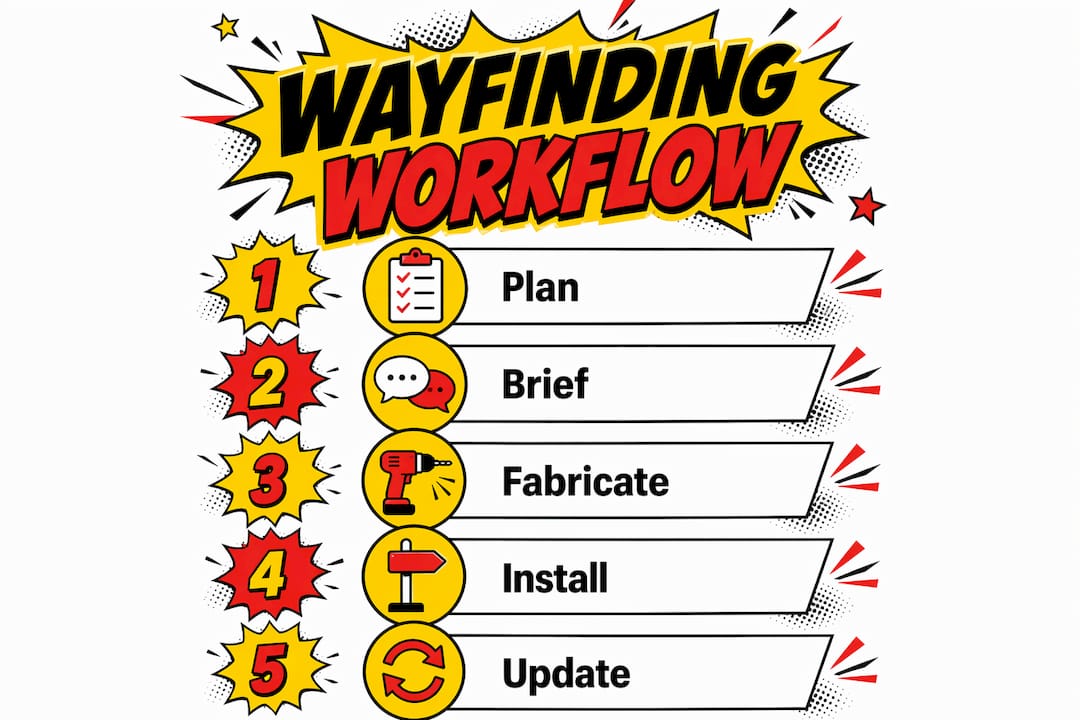
Wayfinding also needs to align with the call sheet. Zone labels, holding area signs and directional arrows should mirror the groupings your first AD uses, so crew can navigate from the call sheet directly to the right location without asking.
HSE compliance note: HSE guidance requires that circulation routes remain unobstructed and clearly marked throughout a production. Safety signs must conform to ISO 7010 symbol standards, and accessibility provisions under BS 8300 apply to any areas where disabled cast, crew or visitors may need to travel.
Pro Tip: Mirror your call-sheet zone names directly onto your colour-coded signage system. When the call sheet changes, update the signs the same day to avoid day-one confusion.
How does signage become part of the mise-en-scène?
Prop signage (visible to camera) and production signage (logistics) are distinct categories that require different design briefs, different materials and different approval chains. Conflating the two is one of the most common and costly mistakes on a set.
Production designers emphasise that the environment shapes lighting, camera and performance — so any sign that enters the frame becomes a design decision, not just a logistics one. As production designer Kasra Farahani noted when discussing The Fantastic Four: First Steps, building the physical environment gives actors something real to interact with and gives the camera faithful light to work with. On-camera signage carries the same responsibility.
Visual and material considerations for on-camera signs:
- Font choice must be era-appropriate and legible at the focal length the camera will use
- Surface texture and finish affect how the sign reads under production lighting (avoid gloss unless the script calls for it)
- Wear, ageing and patina may need to be applied to match the story world
- Scale must read correctly at the planned shooting distance, not at arm’s length
Approval checklist for producers and production designers:
- Confirm which signs appear on camera with the script supervisor and director of photography
- Share design proofs with the production designer for art department sign-off
- Check continuity: if a sign appears in multiple scenes shot weeks apart, the design must be locked and the physical panel stored or reproduced identically
- Test camera sightlines before installation to confirm the sign reads correctly in frame
- Agree removal or repositioning plan with the set decorator so off-camera logistics signs do not drift into shot
**
What design principles keep wayfinding camera-safe and crew-legible?
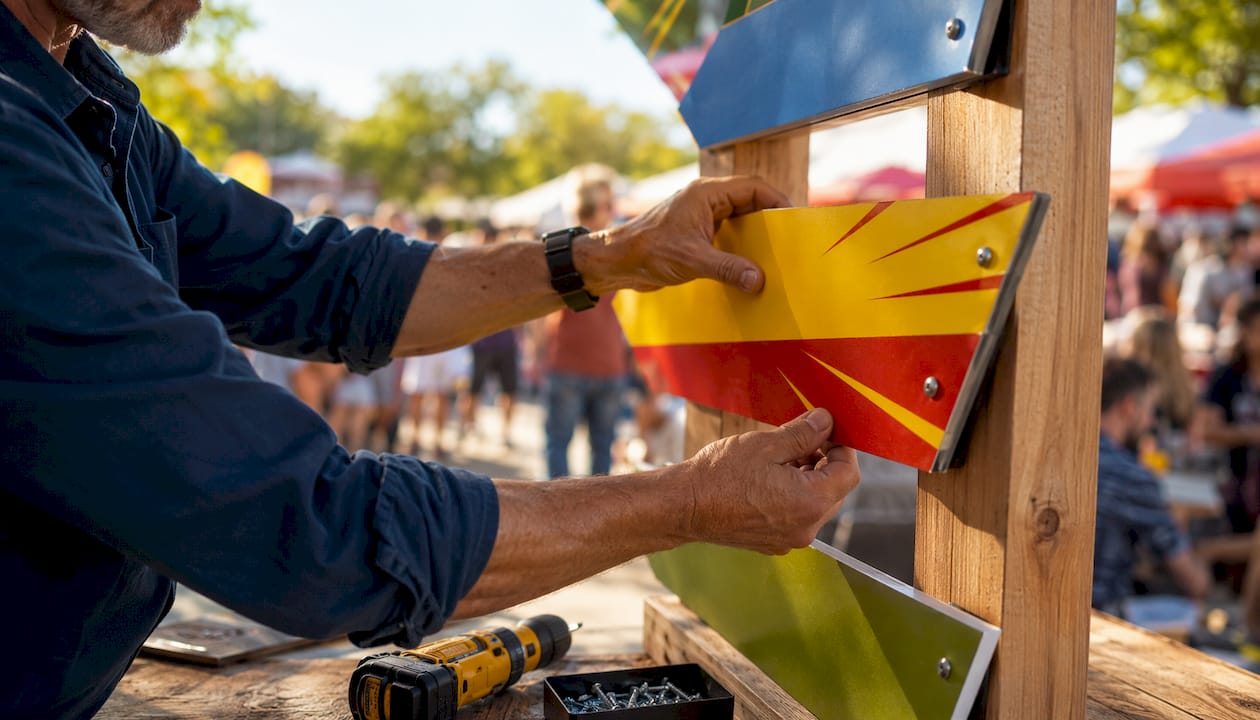
Good wayfinding design on a production set must achieve two things at once: high legibility for crew moving fast through complex spaces, and low visual noise for the camera. Large-scale studio wayfinding must remain legible across obstructed sightlines and adapt to changing site conditions, which demands a consistent visual system applied at the right heights and intervals.
| Design factor | Recommended standard | Source basis |
|---|---|---|
| Talent corridor width | 1.2–1.5 m | Layout guidance |
| Crew corridor width | 1.8–2.4 m | Layout guidance |
| Makeup/wardrobe distance from set | 30–60 m | Layout guidance |
| Crew storage distance from load points | 15–30 m | Layout guidance |
| Sign mounting height (standing reader) | 1.2–1.5 m to centre | BS 8300 guidance |
Core design rules:
- Use a single typeface family across all operational signage; reserve decorative fonts for on-camera props only
- Apply a consistent colour-coding system (zone colours, access tiers) and never reuse a zone colour for a different zone mid-production
- High contrast between text and background is non-negotiable for legibility under variable production lighting
- Position operational signs outside typical camera frame lines; confirm placement during the sightline test
- Safety symbols must follow ISO 7010; accessibility provisions under BS 8300 override aesthetic preferences wherever they conflict
For architectural integration on permanent or semi-permanent studio builds, a consistent visual identity across signage and architecture reduces friction and keeps the system readable at speed.
Which materials and mounting systems work best on fast-moving sets?
Choose modular, reconfigurable systems and low-impact materials by default. Production sets reconfigure constantly, and signage that cannot be moved, updated or reused without specialist tools creates unnecessary cost and waste.
- Lightweight aluminium frames with interchangeable printed inserts allow zone labels to be swapped without replacing the whole panel
- Reusable substrates (foamex, dibond, correx for temporary use) reduce material waste across productions
- Velcro, magnetic strips and quick-release brackets allow rapid rehang without penetrating set walls or flats
- Matt finishes prevent glare under production lighting and reduce the risk of a logistics sign catching the camera
- Non-penetrating clamps and temporary brackets protect set surfaces and permit removal without remedial work
For modular signage systems that can be reconfigured between productions, the upfront investment in a well-designed frame system pays back quickly across multiple shoots.
Pro Tip: Label and bag all panels and fixings at wrap. A well-documented modular system can be redeployed on the next production with minimal reprinting, cutting both cost and material waste.
When should you design, fabricate and install set signage?
Early involvement in pre-production minimises rework and cost. Signage briefed at the design-freeze stage can be prototyped, camera-tested and installed before the first shooting day. Signage briefed on the week of load-in is almost always a problem.
Production milestone timeline:
- Pre-production (design brief stage): Share site plans, zone maps and camera sightline information with your signage supplier
- Design freeze: Approve all proofs, including on-camera prop designs signed off by the production designer
- Fabrication window: Allow sufficient lead time for manufacture; complex or large-format panels require longer
- Pre-install camera test: Install a sample panel in each key zone and test against camera sightlines before full installation
- Load-in: Full installation, safety checks and sightline confirmation with the director of photography
- Wrap: Removal, panel labelling and storage or return to supplier
Installation checklist:
- Sightline test completed and signed off
- Continuity approval from script supervisor for all on-camera pieces
- All mounts confirmed secure and non-damaging to set surfaces
- Safety signs checked against ISO 7010 and HSE requirements
- Post-wrap removal plan agreed with production manager
When call-sheet zones change mid-production, update zone signage the same day. QR-linked digital maps distributed via the call sheet give crew an always-current reference without requiring physical sign replacement.
How do signage choices affect your budget and lead time?
Material choices and custom finishes are the main cost drivers. Modular systems reduce long-term cost by allowing panels to be reprinted rather than replaced. Expedited fabrication adds cost; briefing early removes that premium.
Procurement levers that control price:
- Quantity: larger runs reduce unit cost for printed panels
- Finish complexity: aged, textured or backlit on-camera props cost more than standard operational signs
- Mounting engineering: bespoke temporary brackets cost more than off-the-shelf quick-release systems
- Digital vs printed: digital signage allows real-time updates but carries higher upfront cost
Procurement questions to ask your supplier:
- What is your standard fabrication lead time for this volume and finish?
- Can panels be reprinted and reused in the same frame system?
- Do you carry insurance for on-site installation and removal?
- What is your removal and disposal plan at wrap?
- Can you supply camera-test samples before full production?
- Do you hold stock of standard substrates for fast-turnaround orders?
For most productions, in-house manufacture by a specialist supplier is preferable to outsourced production when schedule is tight and camera-test iterations are likely. A supplier who designs, fabricates and installs under one roof removes the coordination risk between separate vendors.
What should you give your signage supplier to brief a set job?
A complete brief saves time and procurement cost. Suppliers who receive all required assets at the outset can quote accurately, start fabrication without delays and avoid costly revisions.
Brief checklist:
- Scaled site plan showing all zones, access points and load areas
- Camera sightline map indicating which areas are in-frame
- Call-sheet zone names and colour-coding scheme
- Mounting constraints (set surface types, no-penetration zones)
- Expected lifespan of each sign (single shoot, multi-week, multi-production)
- List of nominated on-camera pieces requiring production designer approval
- Accessibility and safety requirements (BS 8300, ISO 7010)
- Preferred materials and finish specifications
Copy-and-paste brief template:
Project: [Production title and episode/series reference]
Deliverables: [Operational wayfinding system / on-camera prop signs / both]
Timeline: Design brief by [date] / Proofs by [date] / Install by [date]
Key contacts: Production manager [name] / Production designer [name] / First AD [name]
Site: [Studio name and address]
Special requirements: [On-camera pieces, accessibility needs, sustainability preferences]
Suppliers will also request CAD plans or elevations, photographs of mounting surfaces and, for on-camera pieces, reference images or script extracts that establish the visual world.
For a full overview of the signage project workflow, from brief to installation, Pikpikpow’s project management guide covers the standard stages in detail.
What does a specialist signage supplier actually deliver?
A specialist supplier delivers design, manufacture, installation and removal as a coordinated service. That end-to-end scope is what separates a specialist from a print-only vendor and why it matters on a production set.
Standard deliverables:
- Design proofs for all operational and on-camera pieces, with revision rounds
- Fabricated panels in specified materials and finishes
- Mounting hardware and installation service, including temporary and non-penetrating fixings
- On-site camera-test support before shooting begins
- Post-wrap removal, panel labelling and storage or responsible disposal
Production designers balance authenticity against budget on every project, deciding what to make beautiful and what to simplify. A specialist supplier who understands that logic can prototype selectively, investing detail where the camera demands it and using cost-effective solutions elsewhere.
Capabilities to look for:
- In-house fabrication (faster iterations, no third-party delays)
- Rapid prototyping for camera-test samples
- Temporary mounting solutions that protect set surfaces
- Storage and post-wrap refurbishment for reuse on future productions
Turn-key installation (design, fabricate, install, remove) is the right model for most productions. Supply-only works when the production has its own installation crew and the mounting requirements are straightforward.
What is the recommended approach for production buyers?
For most productions, an integrated supplier-led approach covering design, manufacture and installation is the most efficient and lowest-risk route. It removes coordination gaps, keeps the camera-test loop tight and gives you a single point of accountability from brief to wrap.
First 30–90 days action list:
- Brief your signage supplier at the pre-production stage, before set build begins
- Share site plans, zone maps and camera sightlines at the first meeting
- Request sample proofs and a camera-test panel within the first two weeks
- Confirm all on-camera pieces with the production designer before fabrication begins
- Schedule installation to complete before the first camera test, not on load-in day
- Agree the post-wrap removal and reuse plan in writing before installation starts
Contact a specialist supplier when the production designer is appointed or when set build is confirmed, whichever comes first. That is the point at which signage decisions still have room to be made correctly.
Key takeaways
Effective set wayfinding requires an integrated system that covers both operational crew routing and on-camera narrative signage, briefed to a specialist supplier at pre-production stage.
| Point | Details |
|---|---|
| Dual role of set signage | Operational wayfinding routes crew and visitors; on-camera signage supports story world-building as a prop. |
| Brief a specialist early | Engage your signage supplier at pre-production, before set build begins, to avoid rework and expedited fabrication costs. |
| Use modular, reusable systems | Lightweight aluminium frames with interchangeable inserts reduce waste and allow fast reconfiguration between zones and productions. |
| Comply with HSE, BS 8300 and ISO 7010 | UK sets must meet HSE circulation requirements, BS 8300 accessibility standards and ISO 7010 safety symbol specifications. |
| Pikpikpow for set signage | Pikpikpow designs, manufactures and installs bespoke wayfinding and prop signage for UK film and TV productions from a single brief. |
A signage specialist’s view on what sets actually need
The most common mistake productions make is treating wayfinding as an afterthought. Signs get ordered in the final week before load-in, mounted wherever is convenient, and nobody checks whether they appear in frame until the director of photography points it out during the first camera test. By that point, the options are limited.
What actually works is treating the signage system the way you treat any other production department: brief it early, give it a clear scope, and involve the right people in sign-off. On-camera pieces need the production designer’s eye. Operational signs need the first AD’s zone logic. Safety signs need to meet HSE and ISO 7010 requirements regardless of how temporary the build feels.
In-house fabrication matters more than most buyers realise. When a camera test reveals that a prop sign reads wrong at the planned focal length, you need a revised panel within 24–48 hours, not a week. That speed only comes from a supplier who controls the full process.
Pikpikpow’s set signage service: get a quote for your production
Pikpikpow delivers bespoke wayfinding and signage systems for UK film and TV productions, covering design, manufacture, installation and post-wrap removal under one roof. Productions get a single point of contact from the initial brief through to wrap day.
What Pikpikpow provides for sets:
- Bespoke operational wayfinding: zone signs, directional arrows, access control and safety signage compliant with HSE, BS 8300 and ISO 7010
- On-camera prop signage: era-appropriate, production-designer-approved pieces fabricated in-house
- Modular systems with quick-release mounting for fast reconfiguration
- Rapid prototyping for camera-test samples
- Post-wrap removal, storage and refurbishment for reuse
Get in touch with Pikpikpow’s team to discuss your production’s signage requirements and receive a tailored quote. Start with your internal wayfinding brief and we will take it from there.
Useful sources for further reading
- HSE — Workplace health, safety and welfare: Primary UK authority for circulation route safety, emergency signage and workplace welfare standards applicable to production sets.
- BS 8300 (BSI): British Standard for the design of an accessible and inclusive built environment; sets dimensional and signage requirements relevant to any UK set.
- ISO 7010: International standard for safety signs and symbols; required for emergency and hazard signage on UK production sites.
- Wildflower Studios wayfinding — Entro: Case study of large-scale studio wayfinding designed for visibility across obstructed sightlines and changing site conditions.
- Talent vs. crew facilities: layout guidance: Source for corridor width and staging distance recommendations used in the design principles section.
- Production design of Wednesday — Pushing Pixels: Interview with Mark Scruton on how production design decisions affect budget, camera and performance — relevant to on-camera signage sign-off.
- Eco-conscious film set design — JATIR: Peer-reviewed study on sustainable materials and modular construction in temporary film sets; supports the materials and sustainability section.